


Key takeaways
If you are an advisor to high-net-worth or ultra-high-net-worth clients – or you are seeking to attract them – it is increasingly important that you know how to help when a client intends to sell their business.
Among the top 10% of U.S. households by net worth, business ownership has grown to 48% as of the most recent survey of consumer finances.1 Within the top 1%, privately held businesses are on the balance sheets for 74% of households and tend to be the largest component of the family’s wealth.2
Baby Boomer and Gen X owners nearing their exit stage have the benefit of strong demand from professional buyers in the M&A market today. Within the next decade, 73% of owners over the age of 43 anticipate selling businesses with an aggregate value estimated at $14 trillion according to a report from the Exit Planning Institute.3
For clients who have dedicated their lives to building their business, selling is likely to be a deeply emotional, life-changing event that has massive implications for their wealth, family dynamics and legacy. These pivotal moments for your clients are opportunities for you to deepen relationships and deliver value as their trusted advisor.
Advisors have increasing opportunities to serve business owners
Business ownership within the top 10% of U.S. households by net worth
Source: Federal Reserve, Survey of Consumer Finances, 2022.
Selling a business introduces complex risks and tax considerations for the client. Helping them navigate the transformation of their assets while transferring wealth to loved ones and fulfilling philanthropic goals requires thoughtful planning that commonly begins three to five years in advance of the transaction. Your involvement from the beginning of the exit-planning process makes you a critical partner to your client in the sale of their business and your overall relationship.
Early preparation provides more options when making financial decisions relating to the sale of a business, which can lead to better outcomes. Check in with your business-owner clients periodically about their intentions for their exit. Having your finger on the pulse enables you to ask the right questions at the right time in four key areas.
Your relationship with your client makes you the ideal counselor when they begin contemplating the sale of their business.
75% of former owners profoundly regret selling their business one year later.4 Going from ‘always on’ to ‘always off’ can be an incredibly hard pivot for your client, so it’s worth asking more than once what they plan to do with their time after exiting the business.
Whether your client plans to retire or start another business, help them assess whether the proceeds of their sale combined with any other sources of income or wealth will be sufficient to fund their lifestyle. If not, work toward a feasible timeline for the sale and explore the client’s openness to revisiting their post-exit plan.
Sellers of a business typically receive cash, shares of the acquiring firm’s stock or a combination of the two. Ask your client how they expect the deal to be structured so you can proactively seek to manage risk and tax costs.
Your client is likely to receive the largest tax bill of their life for the year in which they sell their business. Consider these strategies for investing a cash infusion while helping to offset or defer capital gains.
Tax loss harvesting. Seek to offset the unavoidable capital gain by selling assets that have declined in value. You can start banking excess capital losses years in advance of an anticipated business sale. Timing a business sale early in the year also provides more time to harvest losses before year end.
Manually looking for individual opportunities to take capital losses can take a lot of time. A more efficient approach might be a direct indexing strategy, which is typically accessed by investing in a separately managed account (SMA) that holds individual stocks and systematically harvests losses with the goal of improving after-tax returns.
A tax-managed long/short SMA may enhance your opportunities to capture losses in both rising and falling markets while adhering to the client’s pre-tax investment thesis. This approach entails leveraging the client’s available holdings to increase exposure on the long side while also creating similar exposure on the short side.
Discuss with your tax advisor which approach works best for your situation.
Qualified Opportunity Zone investments. Starting in 2027, your clients will be able to take advantage of a provision under the One Big Beautiful Bill Act that offers incentives to taxpayers who invest in economically distressed areas, known as Qualified Opportunity Zones (QOZs). Realized capital gains that are invested in a qualified opportunity fund may be deferred for up to five years from the date of investment. If a client is contemplating a business sale before 2027, discuss the tradeoffs of postponing the transaction, or a portion of it, to take advantage of the upcoming QOZ provision.
Many clients who are paid with an acquiring company’s stock have a low conviction on the new holding. Selling the stock immediately may not be possible due to trading restrictions, or may be costly from a tax perspective. There are strategies that may help you deliver a range of desired outcomes and manage concentration risk for clients who are paid with stock.
Option overlays. Hedging against a decline in the acquirer’s stock, industry or sector is a common tactic to protect clients against losses in such highly important transactions. You can also use options to generate income, or to swap exposure from the acquirer’s stock into diversified equities without needing to sell shares or trigger a capital gain. An experienced options manager can help you choose the appropriate strategies and tailor them for your client’s existing portfolio and risk level.
Long/short exposure. Adding a short position in the same or similar exposure can mitigate downside risk without incurring capital gains tax. A long-short strategy may be calibrated to diversify a concentrated stock position either quickly or gradually, based on your client’s confidence in the stock, risk tolerance and willingness to use leverage.
Lending programs. For a client who receives stock but would have preferred cash, lending programs that don’t force stock sales or taxes are a creative way to engineer the client’s desired outcome.
Charitable remainder uni-trust (CRUT). Transferring stock into a CRUT can provide a charitable tax deduction, capital gains deferral, immediate risk diversification and a stream of income. Once transferred, the stock is liquidated and the proceeds are reinvested in a diversified set of assets. The sale does not incur taxes until the capital gains are ultimately distributed to the beneficiaries. During the term of the trust, regular payments are made to the donor (or other non-charitable beneficiaries). At the end of the trust term, assets remaining in the CRUT pass to one or more qualified charities.
There are various ways you can help a client who wants to share the fruits of their labor without taxes taking a big bite.
Gifting interests in the business to family members or to trusts in advance of a sale may provide significant transfer tax savings while allowing the transferor to retain control of the business. For example, gifting a noncontrolling interest in a closely held business may qualify for transfer tax discounts due to a lack of marketability or minority interest, reflecting the fact that a potential buyer may be willing to pay less for an interest that does not control management decisions and may not be readily sold. Gifts of closely held business interests made early in the lifecycle of the business may be at reduced valuations compared to gifts made closer to the time of the sale, providing additional tax savings.
If your client plans to make gifts or provide ongoing financial support to loved ones, be mindful of the limits for gift tax exemptions. In 2025, individuals can make tax-free annual exclusion gifts up to $19,000 per recipient, per year ($38,000 for married couples). Gifts that exceed the annual limit are applied to the giver’s lifetime gift tax exemption, which increased in 2025 to $13.99 million ($27.98 million for married couples).
A grantor retained annuity trust (GRAT) can provide potential gift and estate tax savings to wealthy clients with minimal administrative costs. Income and appreciation generated by the trust assets that exceed the Internal Revenue Code Section 7520 hurdle rate transfer to the trust’s beneficiaries free of gift and estate taxes.
For wealth transfers exceeding the estate and gift tax exclusion limit, consider a dynasty trust. When structured properly, a dynasty trust may eliminate transfer taxes from generation to generation in perpetuity. The funder of a dynasty trust can stipulate conditions under which beneficiaries may or may not receive distributions, which can be an appealing feature for clients who have concerns about large inheritances causing their children or future generations to lack motivation or feel entitled.
If your client is charitably inclined, help them make contributions in a tax-efficient manner.
While donating cash proceeds of business sale can provide a charitable tax deduction, donating stock may provide a tax deduction plus the elimination of capital gains tax. Note that donating an interest in a small business may require an appraisal and should be considered far in advance of a sale. Involve the client’s tax professional early in the planning process as there may be important tax issues and complexities to consider.
The passing of the One Big Beautiful Bill Act may influence your charitable giving strategies. Effective in 2026, individuals in the top tax bracket (37%) who itemize deductions on their tax return may deduct no more than $0.35 per $1.00 of cash donations. Clients who sell their business before the end of 2025 may prefer to accelerate their giving plans to benefit from the higher limit ($0.37) before the rule change takes effect. Also be aware that across tax brackets, an itemizing individual’s charitable contributions must exceed 0.5% of their adjusted gross income in order to claim a charitable deduction beginning in 2026.
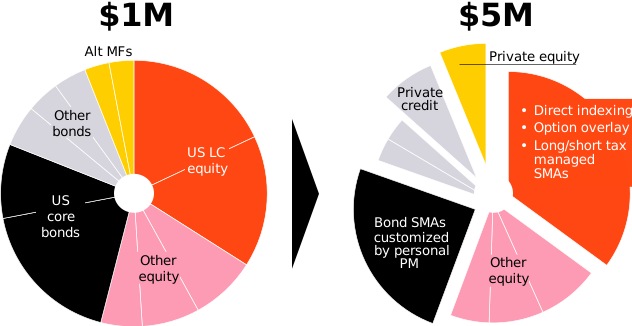
Selling a business may elevate a client’s wealth to a level where they now qualify for more sophisticated investment strategies and tax minimization becomes a more important objective.
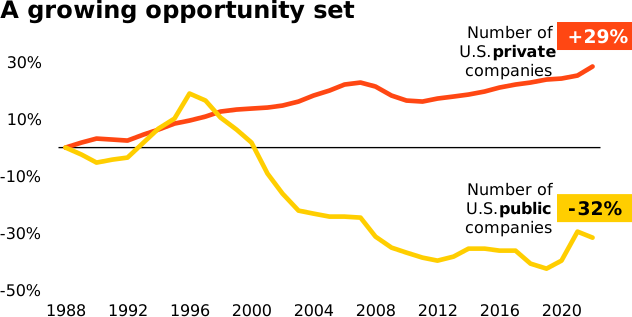
A significant increase in the size of a client’s investable assets does not necessarily mean their asset allocation should change. Rather, the focus should be on improving after-tax returns, which may be achieved through custom strategies such as direct indexing and tax-exempt SMAs, or by adding alternative investments, including private market assets. Before implementing changes in a client’s taxable portfolio, weigh the tradeoffs of different strategies to assess whether the potential benefits to the client justify the additional costs.
Managing the financial impact of a client’s business sale demonstrates the breadth of your capabilities and builds your brand as a subject matter expert. BlackRock can help you plan and execute investment strategies to achieve your client’s financial goals more tax efficiently. Ask your BlackRock representative for more information.