Give yourself the gift of lower taxes
There are two ways to reduce your tax costs through securities donations. Note that publicly traded stock is typically easy to value, transfer, and widely accepted by nonprofits compared to more complex or illiquid assets.
Reset the cost basis of your star performers. Maximize your savings on capital gains taxes by donating your strongest performing stocks. The cash you would have donated can instead be used to replenish your portfolio by purchasing the same security (or a similar exposure). Because the stock has appreciated since your original purchase, your new cost basis will be higher, reducing your future taxable gain.
Revive tax loss-harvesting accounts. Active tax management that involves systematic tax-loss harvesting while retaining positions that, if sold, would produce sizable taxable gains can lead to situations where a portfolio has very highly appreciated, low cost basis tax lots. Donating these lots and replenishing the shares at a higher cost basis creates the potential to harvest additional tax losses to offset gains in future years.
Rebalance for a cause. When your portfolio has drifted from its target allocation, it’s time for rebalancing, which is a great time to think about your favorite charities. As you trim outsized exposures, consider donating your lower cost-basis long-term holdings as this will reduce the tax impact of rebalancing.
Know your limits
As a charitable investor, you may consider maximizing the benefit of your charitable contributions as a part of your annual tax planning. This requires an understanding of the charitable deduction limits for the current year, keeping in mind that tax laws change from time to time.
Deduction limits vary depending on whether you itemize deductions on your federal tax return, what type of charitable entity4 you donate to, and whether you donate cash or some other type of asset.5 For simplicity, assume a client plans to itemize deductions and plans to make contributions to public charities in the forms of cash and appreciated securities that have been held more than one year.
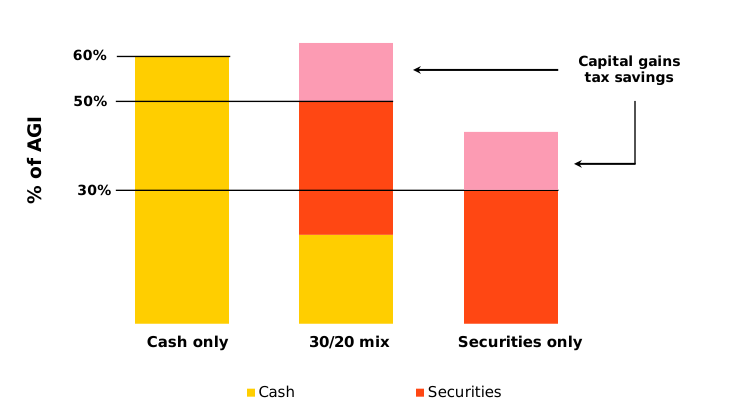
If you make all of your donations in cash, the maximum amount that you may deduct against your taxable income is 60% of your adjusted gross income (AGI). If you donate securities instead of cash, you may deduct up to 30% of your AGI. Pretty simple so far, right?
Now, what if you want to donate a combination of both cash and securities? For this scenario, the rule maintains the limit for cash donations at 60% of AGI but limits the deduction for securities donations to the lesser of 30% of AGI or 50% of AGI minus the amount of cash that is deducted. If you work through the math, you will conclude that when you donate a combination of cash and securities, the maximum amount you can deduct is 50% of AGI. If the securities you donate have appreciated significantly, not having to pay taxes on the appreciation can increase your tax savings above the savings derived from donating only cash up to the 60% of AGI limitation.
Strategize to maximize your tax benefit
The greater the portion of charitable contributions that are comprised of eligible, appreciated securities versus cash, the greater the tax benefit might be. Therefore, if you plan to make donations to public charities totaling up to 30% of your AGI this year, consider making those donations entirely in the form of securities. If you plan to donate between 30% and 50% of your AGI, consider donating 30% of AGI in the form of securities and the remainder in cash.
Achieve more tax savings by donating securities