

Equity

Jul 03, 2026|ByLisa Goldberg
This article has additional related content:
Key takeaways:
- A long/short loss-harvesting strategy can diversify an appreciated concentrated position, a single stock whose market price exceeds its purchase price, without incurring capital gains tax.
- The speed of diversification depends on the strategy’s leverage as well market conditions and the active returns of the stocks.
- The strategy can be customized to incorporate an investor’s belief in the upside potential of the stock, risk tolerance and willingness to use leverage.
History demonstrates the perils of holding a concentrated position. Nevertheless, there is roughly $1trillion in concentrated stock held by US investors, leaving them exposed to downside risk.1 While conviction can explain this phenomenon in part, the specter of realized capital gains may be an impediment to diversification for a taxable investor.
Recent innovation allows tax-neutral diversification2 of a concentrated position without incurring capital gains, using a long/short loss-harvesting strategy. Investors enhance the concentrated position by purchasing additional securities with borrowed funds and create a short position by selling borrowed securities.3 The new securities and short positions comprise long and short extensions of the concentrated position, and they are constructed to minimize tracking error to a broad market index.

For illustrative purposes only. A long/short diversification strategy completes a fully invested concentrated position with long and short extensions of equal weight by minimizing tracking error to a diversified benchmark in a SMA. Financing costs are calculated by taking the difference between the borrowing rate on the long extension and the lending rate on the short extension, scaled by the exposure.
Loss harvesting strategies are option like. They seek to generate value when the market price of an asset breaches the original purchase price, which serves as a reference point. Losses may be abundant at the start of a long/short diversification strategy since market prices match purchase prices in both the long and short extensions. Harvested losses can be used to tax-neutrally liquidate the concentrated position, and the proceeds are reinvested in the strategy, resulting in new securities with market prices equal to their purchase prices.
Some investors may prefer to diversify their portfolios rapidly, while others may choose a more gradual approach. The speed of diversification is influenced by the rate at which losses are harvested, which depends on the degree of leverage. Higher leverage increases market exposure, thereby enhancing loss-harvesting capacity.
We conducted an empirical study involving back-testing of hypothetical concentrated portfolios to examine the speed of diversification for the LS130 strategy, where the dollar value of the long and short extensions is 30% of equity, and the LS200 strategy, where the long and short extensions are 100% of equity. The study involved running these strategies over 380 10-year scenarios with different stocks and historical time periods, and it provided a broad view of their diversification speeds. For the more rapidly diversifying LS200 strategy, the concentration of any single stock was reduced to 5% of portfolio weight by year 5 in 346 out of the 380 scenarios analyzed.

Speed of diversification: In a study based on 380 back-tests (using hypothetical accounts) of long/short diversification strategies on different stocks over different 10-year horizons between December 31,1995 and ending December 31, 2023 we calculated the percentage of historical scenarios on which the active weight of the concentrated position was reduced to 20% (left panel) and 5% (right panel). Higher leverage led to a more reliable reduction in active weight. For illustrative purposes only.
Speed of diversification also depends on market conditions as well as the concentrated position’s active return. Plotting the 380 10-year hypothetical back-tested scenarios on a common set of axes indicates a wider range of diversification speeds for LS130 than for LS200. For many stocks and in many historical periods, LS200 diversified more rapidly and more consistently than LS130. In contrast, LS130 provided more exposure to the upside potential of the stock for longer periods.
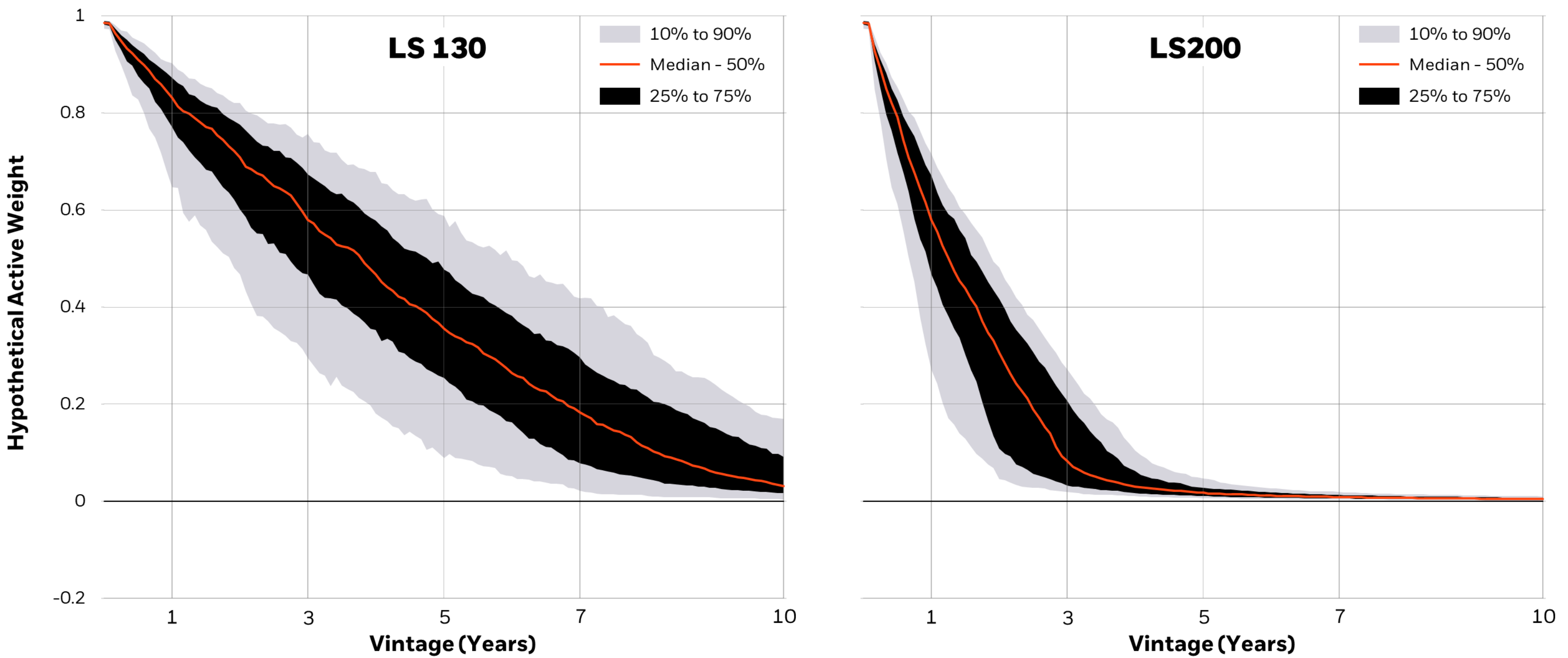
For illustrative purposes only. Consistency of diversification: We temporally aligned 380 back-tests (on hypothetical accounts) of long/short diversification strategies on different stocks over different 10-year horizons between December 31,1995 and ending December 31, 2023. Higher leverage led to more rapid and more reliable reduction in active weight.
Long/short diversification strategies that use loss harvesting may tax-neutrally convert a concentrated position into a diversified portfolio. These strategies can be calibrated to diversify either quickly or gradually, based on an investor's confidence in the stock, risk tolerance, and willingness to use leverage. To learn more about our research on tax-aware diversification with long/short strategies, read our full research paper.
FAQ
-
A tax-managed long/short strategy can be thought of as an extension to a traditional long-only portfolio. Similar to direct indexing, a long/short strategy systematically harvests losses to generate tax alpha. By combining long and short positions, the strategy aims to enhance the use cases of long-only tax-managed SMAs by providing additional loss-harvesting opportunities in both up and down markets.
-
Long-only investing seeks returns by buying securities expected to increase in value. Long/short strategies expand on this approach by also shorting securities expected to decline. This allows portfolio managers to pursue returns from both rising and falling securities while potentially improving diversification and reducing reliance on overall market direction.
-
The pace of diversification depends on several factors, including the amount of leverage used, market conditions, and the performance of the concentrated stock. Higher leverage generally creates more loss-harvesting opportunities, which can accelerate diversification.
-
Yes. Long/short diversification strategies can be tailored based on an investor's confidence in the concentrated stock position, desired diversification timeline, risk tolerance, and willingness to use leverage.
-
Not necessarily. These strategies involve leverage, short selling, and margin-related risks. Investors should consider their objectives, risk tolerance, and tax circumstances before implementing a long/short diversification approach.

Lisa R. Goldberg
Managing Director, Head of Research at Aperio Direct Indexing
Related resources
More articles loaded. Use Shift+Tab keys to browse.
Total articles:


Investments
Insights
Retirement
Tools
Resources
About Us


1. Source: BlackRock estimates as of 2024
2. Diversification does not guarantee profit or protect against investment loss.
3. See “Important notes” for risks associated with short selling and trading on margin.
Important Notes:
Aperio Group, LLC, provides this material for informational purposes only and for the sole use of the recipient. The information contained herein was carefully compiled from both internal data and external data, but we do not guarantee its accuracy. The information is provided with the understanding that we are not engaged in rendering legal, accounting, or tax services. We recommend that all investors seek out the services of competent professionals in these areas. The strategies and/or investments referenced may not be suitable for all investors, because the appropriateness of a particular investment or strategy will depend on an investor’s individual circumstances and objectives. None of the examples should be considered advice tailored to the needs of any specific investor or a recommendation to buy or sell any securities. The fees and expenses Aperio charges may be higher than the fees and expenses of other investment advisors and may offset profits. Additional information about the firm, and our fees and expenses, is included in our Form ADV.
Investing involves risk, including possible loss of principal. Asset allocation and diversification may not protect against market risk, loss of principal or volatility of returns. There is no guarantee that any investment strategy discussed herein will work under all market conditions. Many factors affect performance, including changes in market conditions and interest rates, as well as other economic, political, or financial developments.
You should not assume that investment decisions we make in the future will be profitable or will equal the investment performance of the past. With respect to the description of any investment strategies, simulations, or investment recommendations, we cannot provide any assurances that they will perform as expected and as described in our materials. Past performance is not indicative of future results.
Any tax information provided herein is for illustrative purposes only and does not constitute the provision of tax advice by Aperio. Due to the complexity of tax law, not every single taxpayer will face the situations described herein exactly as calculated or stated, i.e., the examples and calculations are intended to be representative of some, but not all, taxpayers. Since each investor’s situation may be different in terms of income tax, estate tax, and asset allocation, there may be situations in which the calculations would not apply. Please discuss any individual situation with tax and investment advisors first before proceeding. For those clients using tax advantaged indexing, taxpayers paying lower tax rates than those assumed, or without taxable income, would earn smaller tax benefits from tax-advantaged indexing (or even none at all) compared to those described.
An investor must have gains to offset losses to benefit from tax-loss harvesting. It may not be possible to realize losses in any particular account in any particular year. Tracking an index may limit the extent to which all unrealized losses can be realized.
Short Sales
In a short sale, a portfolio sells securities it does not own. To accomplish this, the portfolio borrows the securities at a fee from the custodian (the lender). The position is “closed” by “returning” the security (buying a replacement security on the lender’s behalf). This “return” obligation to replace the borrowed securities does not typically have a specified “maturity” date and the lender generally may require replacement of the securities whenever it chooses. A short sale theoretically involves the risk of unlimited loss: The price at which a portfolio must buy “replacement” securities could increase without limit. A portfolio may experience losses on short positions that are not offset by gains on long positions.
Possibility of Margin Calls or Liquidations
Borrowings are usually from securities brokers and dealers and are typically secured by a portfolio’s securities and other assets. Under certain circumstances, such a broker or dealer may demand an increase in the collateral that secures a portfolio’s obligations, and if a portfolio is unable to provide additional collateral, the broker or dealer could close either long and/or short positions held in a portfolio’s account to satisfy a portfolio’s obligations. Closing positions in that manner could have extremely adverse consequences, including initiating closing transactions at disadvantageous times and prices and the acceleration of tax consequences.
Back-tested Hypothetical Data
This article contains hypothetical information, including back-testing and other statistical analysis generated by Aperio. The hypothetical data used in this document do not reflect actual investments or trades. Back-tested information is provided for informational and discussion purposes only and should not be considered a recommendation to buy or sell any securities, or as investment advice. It is provided solely for discussion and illustrative purposes to provide a general example of the potential implementation of the strategy. The assumptions and projections displayed are estimates, hypothetical in nature, and meant to serve solely as a guideline. They should not be considered an indication of actual performance or time to diversify.
Aperio used its After-Tax Back-Testing Analysis Tool (ATBAT) to build the hypothetical portfolios discussed herein. ATBAT uses historical returns to perform taxable optimizations and calculate tax alpha as well as other after-tax portfolio metrics. The ATBAT system, as with all back-testing systems, is inherently limited in its ability to reflect actual results regarding performance and other quantitative information that may have been, or will be, achieved by any given portfolio.
With respect to measuring potential equity risk in the process of portfolio analysis, Aperio also uses and relies upon MSCI Barra risk models. You should note that such use and reliance of the MSCI Barra models in the optimization and equity risk analysis presents model risk, which is defined as the potential for adverse consequences from decisions based on incorrect or misused model outputs and reports. Model risk can lead to financial loss.
The mathematical calculation and quantification exercise underlying any model generally involves application of theory, choice of sample design and numerical routines, selection of inputs and estimation, and implementation in information systems. Errors can occur at any point from design through implementation. In addition, shortcuts, simplifications, or approximations used to manage complicated problems could compromise the integrity and reliability of outputs from those calculations. Finally, the quality of model outputs depends on the quality of input data and assumptions, and errors in inputs or incorrect assumptions will lead to inaccurate outputs. The model may be used incorrectly or inappropriately. Even a fundamentally sound model producing accurate outputs consistent with the design objective of the model may exhibit high model risk if it is misapplied or misused. Models by their nature are simplifications of reality, and real-world events may prove those simplifications inappropriate.
There is no guarantee that any client results actually achieved will align with the modeled results demonstrated or output by the back-testing systems. Back-testing may have fundamental errors and may produce inaccurate outputs when viewed against its design objective and intended business uses. The mathematical calculation and quantification exercise underlying the models embedded in Aperio’s back-testing systems, for example, generally involves the application of theory, choice of sample design and numerical routines, selection of inputs and estimation, and implementation in information systems. Errors may have occurred and can occur at any point from design through implementation. In addition, shortcuts, simplifications, or approximations used to manage complicated problems could compromise the integrity and reliability of outputs from those calculations. Finally, the quality of the outputs from back-testing depends on the quality of input data and assumptions, and errors in inputs or incorrect assumptions, will lead to inaccurate outputs. Even assuming that the back-testing systems are a fundamentally sound tool, producing accurate outputs consistent with its design objective may still exhibit high risk if it is misapplied or misused. Such modeling tools, by their nature, are simplifications of reality, and real-world events may prove those simplifications inappropriate.
©2026 BlackRock, Inc. or its affiliates. All rights reserved. BLACKROCK and APERIO are trademarks of BlackRock, Inc. or its affiliates. Other trademarks are property of their respective owners.
MKTG0926-H-5778739-EXP0927