


Tax

3 investment strategy shifts that can impact taxes for wealthy clients

Jogger alongside arrows on pavement

Key takeaways

  • As your clients’ wealth grows, an increasing portion of their assets will be held in taxable accounts, necessitating a stronger focus on tax management.
  • Wealthier clients may qualify to invest in more sophisticated strategies but that doesn’t always mean they should.
  • Before you shift strategies in a client’s taxable portfolio, carefully weigh the tradeoffs to ensure the potential benefits are worth the additional cost.

Taxes matter more as your clients’ wealth grows

The increasing wealth of your clients is a sign of your success as an advisor. It also means you will need to adapt the way you plan and invest as an increasing portion of your clients’ assets are held in taxable accounts. For advisors who serve high-net-worth clients , tax management is as important as wealth preservation.

If you want to stand out from competitors and earn more referrals from your high-net-worth clients, you’ll need to pull multiple levers to help manage taxes in their portfolios. The good news is that at higher levels of wealth, clients have access to unique investment strategies, giving you more levers to pull. Evolve your clients’ portfolios to seek improved tax efficiency while maintaining the same or similar asset allocation.

Tax minimization is a leading investment objective for wealthy clients
% of high-net-worth practices identifying objectives as very important for their clients 

Bar chart of most important investment objectives

Source: Cerulli, “U.S. High-Net-Worth and Ultra-High-Net-Worth Markets 2024.”

Weigh the tradeoffs before shifting investment strategies in a taxable portfolio

As a client’s growing wealth enables them to satisfy the higher investment minimums associated with more sophisticated strategies, you will have more options for accessing the underlying exposures held in their portfolio. But just because a client qualifies to invest in an exclusive strategy doesn’t necessarily mean they should.

Some strategies use investment vehicles with higher fees and more tax friction. Before you implement a strategy shift, evaluate whether the potential benefits are likely to justify any additional cost. Assess the potential impact of these three strategy decisions in the context of a client’s whole portfolio and personal circumstances:

1. Stock ETFs or direct indexing strategies?

Direct indexing strategies , which investors can access through separately managed accounts (SMAs), aim to closely replicate a benchmark through the direct ownership of individual stocks. The goal is to outperform the benchmark on an after-tax basis through an automated process for harvesting capital losses that can offset gains elsewhere in the client’s portfolio. Additionally, SMAs offer investors the ability to customize holdings and align them to their values, as well as greater flexibility for managing liquidity as compared to ETFs.

However, direct indexing strategies tend to have higher fees than ETFs. A key factor for justifying the added cost is whether the client is expected to have sufficient taxable gains to offset . It is important to account for whether the gains would be taxed as long-term or short-term capital gains. Clients nearing the sale of an asset, like a business or concentrated stock, could particularly benefit from accumulating tax losses in advance. The client’s tax rate, time horizon and whether they will eventually sell, donate or pass the strategy through an estate are also relevant factors in determining whether direct indexing is right for your client.

2. Municipal bond funds or tax-exempt SMAs?

For municipal bond exposure , the fund-versus-SMA decision comes down to cost, control and customization. Unlike mutual funds or ETFs, investors in SMAs directly own the underlying bonds, providing full visibility of their individual positions, greater fee transparency and the ability to customize holdings to align with their unique tax circumstances and yield needs. Residents of high income tax states with minimal bond issuance may have an easier time accessing local bonds by investing in an SMA versus mutual funds or ETFs.

SMAs generally have lower costs than actively managed mutual funds, however, clients who want access to hedging and high yield bonds might be better off with a mutual fund for their municipal bond exposure.

3. Do alternative investments make sense for my client?

Exposure to illiquid / less liquid alternative investments may improve portfolio outcomes by offering amplified or differentiated return opportunities, but they also introduce trade-offs and risk considerations around cash flows, liquidity and taxes.

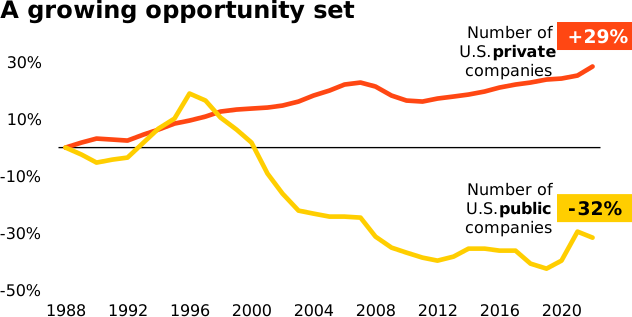
For wealthy families who are not concerned about cash flows and can comfortably forgo access to a portion of their assets for long periods of time or perhaps indefinitely, alternatives and private market investments in particular can provide higher return potential in exchange for the investor’s commitment to a long holding period. The longer the time horizon of the investment, the greater the potential illiquidity premium.

While most alternative investments are not built with tax efficiency as a primary goal, some strategies can make sense for a taxable investor depending on the client’s individual tax circumstances and overall allocation. Before you invest in an alternative strategy, weigh the potential benefits of the excess yield, return or diversification against the estimated tax cost to the client. Additionally, consider whether the client may be able to offset the investment’s taxable capital gains or other income with predictable capital losses from a direct indexing strategy or tax deductions such as margin interest (investment interest expense).1

If you conclude that an otherwise desirable investment would be too costly in a client’s taxable account, consider what other asset locations are available to the client. A qualified, charitable, trust or insurance structure may be able to hold the investment more tax efficiently.

Increase your focus on taxable and illiquid assets for wealthier clients
Breakdown of RIA industry assets under management by client wealth segment

Visual representation of how assets are distributed across account types by level of investor net worth

Source: Cerulli, “U.S. RIA Marketplace 2022” and BlackRock estimates.

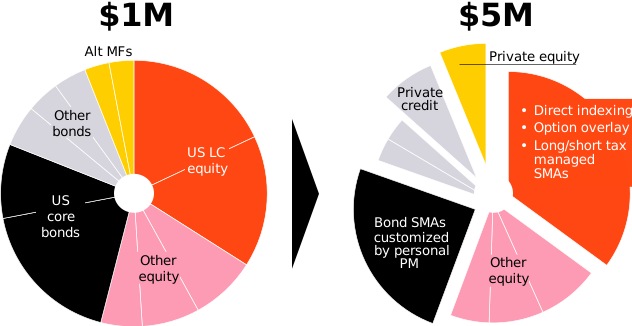
Evolve your investment process for increasing levels of wealth

Advisors who specialize in after-tax allocation strategies for high-net-worth clients often have a defined and repeatable investment process for each tier of wealth. Using model portfolios to increase efficiency when managing smaller or qualified accounts frees up time to research and execute sophisticated strategies in your larger accounts, and having clearly defined investment processes will help your team deliver a consistent client experience. 

If you are building portfolios “in 2D,” segmenting by taxability and risk tolerance alone, let the BlackRock Portfolio Design Services team help you evolve to a “3D” process that also accounts for client net worth with a focus on after-tax returns. Ask your BlackRock Market Leader for more information and explore our online portfolio design tools and resources.

Cullen Roberts, CEPA®, CIMA®
Director, Advisor Engagement
Cullen Roberts, CEPA®, CIMA® is Director of Advisor Engagement for BlackRock's US Wealth Advisory Business (USWA). USWA delivers BlackRock's full suite of resources including portfolio design research, investment process guidance, financial advisor technology, and practice management consulting.