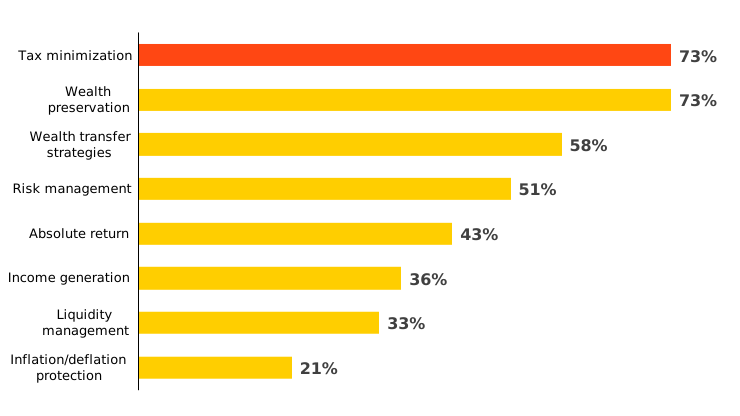
Use after-tax allocation strategies to stand out from competitors
While asset location is the first line of defense in the pursuit of tax efficiency, its impact is limited for high-net-worth and, especially, ultra-high-net-worth clients who hold most of their assets in taxable accounts. It is within these taxable accounts that after-tax allocation strategies help reduce tax costs and help you stand out among your competition.
Many advisors invest using risk and pre-tax return as the key, if not only, factors in their allocation decisions. Adding taxes to the equation means that all returns need to be analyzed on an after-tax basis. However, projecting the impact of taxes on future portfolio returns can be challenging, especially given the complexity of tax law, its variation over time and the wide range of its effect across different asset classes. Investing on an after-tax basis requires more time, effort and expertise, but the cost of ignoring taxes can be significant for your clients and, likewise, for your business.
Tax considerations change the asset allocation
Certain asset classes look very different on a pre-tax versus after-tax basis. Bonds provide a familiar example: A comparison of tax-equivalent yield determines whether a client should hold an allocation to taxable bonds or tax-exempt municipals. If you have applied this method in your client portfolios, you have already taken a step into the after-tax investing world.
A similar comparison of pre-tax and after-tax returns can be applied across all asset classes and the differences can be particularly notable in some, such as private equity and private credit. In taxable accounts, a private equity fund can offer the potential for attractive returns on an after-tax basis as they often do not trigger gains or other income for many years, and even then, such income is frequently taxed at the lower long-term capital gains rate. In contrast, private credit as well as some public high yield taxable debt tends to generate income on an ongoing basis that is taxed at the highest rate, which may make those assets compare less favorably on an after-tax basis than pre-tax.
In public markets, the various available equity strategies also look different through an after-tax lens. If you want to increase your focus on after-tax investing, your stock allocation can be a good place to start.
Apply an after-tax mindset in your stock allocation
Within stocks, evaluate the tradeoffs between traditional actively managed mutual funds, index exchange-traded funds (ETFs), actively managed ETFs and direct indexing separately managed accounts (SMAs). The right mix of these investment vehicles and mandates considers the correlations and volatility of the investments and the extent to which other exposures in the portfolio may offset their risks.
- Actively managed mutual funds can offer attractive potential returns but also tend to be the least tax-efficient equity vehicle. Over the past five years on average, 76% of active U.S. equity mutual funds distributed capital gains at amounts averaging a sizable 7.5% of their net asset values.1 Accordingly, active equity mutual funds are ideally held in a tax exempt account; however, they may still be attractive in a taxable account if you pick a fund manager who can potentially generate a level of return that exceeds the tax costs by an amount that justifies the investment risk.
- Index ETFs could be considered when equity assets are held in a taxable account. Efficiently managed equity index ETFs have historically distributed little to no capital gains to their shareholders, creating little to no ongoing tax liability.
- Active ETFs provide the potential for outperformance with the features of an ETF wrapper. They can be a good choice for taxable accounts when you are seeking to outperform the market, deliver a specific outcome or gain exposure to a hard-to-index market. The in-kind creation and redemption process used by some active equity ETFs serves to limit the number of taxable events that occur within the fund, which can make them more tax efficient than their mutual fund peers.
- Direct indexing SMAs seek to provide exposure to a benchmark through the direct ownership of individual stocks while seeking to outperform on an after-tax basis by tax loss harvesting (i.e., generating tax losses that can offset the investor’s taxable gains). Holding a direct indexing SMA in a taxable account can have a positive impact on a client’s overall after-tax returns when there are realized gains elsewhere in the portfolio.
Consider the whole portfolio for optimal after-tax returns
You can take measures to reduce tax costs within your bonds and your stocks, but seeking optimal after-tax returns requires consideration of the whole portfolio within the context of the client’s complete tax situation. An effective after-tax allocation accounts for the interdependencies of all possible asset classes with consideration of their correlations, risk, expected returns and tax implications for the particular client. For a deep dive into the mechanics of after-tax allocation, read ‘What Would Yale Do if it Were Taxable?’
Constructing personalized portfolios optimized for after-tax returns takes a significant amount of time. Advisors who opt for the do-it-yourself approach typically focus their efforts on top-tier clients while their smaller client accounts are either served using models, delegated to a junior advisor or outsourced to a third-party investment manager.
Alternatively, you can save time by using customizable tax-aware models. This approach allows you to transition existing portfolios into models easily and tax efficiently, automate rebalances and tax loss harvesting in your portfolios, and generate performance reports you can share with your clients. Automating tax management in your portfolios lightens the lift for you significantly, so you can dedicate more time to solving your best clients’ biggest problems outside of the portfolio.
Show clients how you reduce their tax costs
Your clients won’t value what they don’t know about. Talk about taxes with your high-net-worth clients. Show them how their portfolio is designed with the goal of maximizing after-tax returns and how much you are saving them in taxes.
BlackRock can help you grow your expertise on after-tax investing and attract high-net-worth clients to your business. Explore our online resources and tools to learn more.