






CONTACT US
Talk to a BlackRock specialist
Meet with a BlackRock specialist to learn more about alternatives and private markets.
EXPLORE MORE ALTERNATIVES
Hi, I’m Jaime Magyera, Head of BlackRock’s US Wealth and Retirement businesses.
Today, investors are navigating a more complex market and portfolio construction landscape than ever before.
And the message is clear — financial advisors are looking for more when it comes to alternatives and private markets.
More transparency.
Easier access.
Better analytics.
And a more integrated, whole-portfolio approach — where private markets work seamlessly alongside public markets.
At BlackRock, our business is built to evolve with those needs.
We operate at scale across both public and private markets — and we continue to innovate, helping advisors access alternatives in ways that align to the needs of their clients.
That’s why we created Inside Alternatives.
A one-stop destination designed to help advisors build confidence implementing and scaling alternatives in their practices — with foundational primers, portfolio implementation guidance, and timely insights all in one place.
And with our tools and analytics built for advisors, you can better assess the expanding opportunity in alternatives and private markets.
So please take a look around. Explore what’s new.
And come back for insights as the landscape continues to evolve — or connect with a BlackRock specialist to learn more.
Inside Alternatives is built to help you deepen your knowledge of alternatives, from private markets to liquid alternatives, and highlight their potential roles in diversification, resilience and long-term returns.

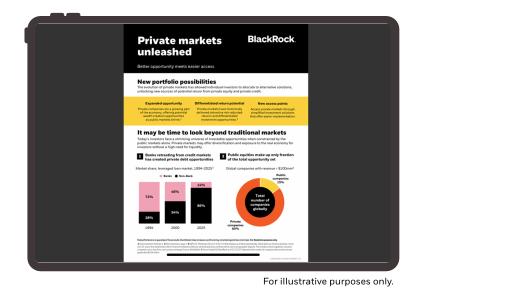
Private markets are becoming an increasingly important part of how modern portfolios are built, offering access to investments beyond traditional public stocks and bonds.
Understand how private markets work, what sets them apart and some key considerations for incorporating into client portfolios.

Private equity provides investors the ability to have an ownership stake in companies beyond public markets, spanning early-stage innovation to established businesses.
Learn how private equity works, risks to consider and how investors can access these investment strategies.

Private credit enables investors to lend directly to companies outside of public markets, offering potentially differentiated sources of returns.
See how private credit works, the range of strategies available to investors and why interest in private credit continues to grow.

Private real estate gives investors access to tangible assets across sectors and markets, with return potential driven by income, asset appreciation and diversification benefits.
Discover how private real estate investing works, including common risks and the range of strategies available.

Liquid alternatives bring sophisticated strategies into more accessible, daily liquid formats offering investors new ways to seek returns and diversification beyond traditional long-only stock and bond exposures.
See how liquid alternatives work, the techniques they employ and how they aim to diversify portfolios and improve risk-adjusted returns.

Private credit has become a core alternative investment for many investors seeking income.
Explore how direct lending works, where it fits within private credit, and its potential income, diversification and portfolio benefits for investors.

Paid-In-Kind (PIK) interest is interest that is not paid in cash when it accrues but, rather, is added to the outstanding principal balance of a loan or bond.
Learn how PIK interest works, why companies use it and how good and bad PIK can affect private credit borrowers and investors.

Asset-based finance (ABF) encompasses a range of investment opportunities, often backed by assets used by businesses and individuals on a daily basis.
Explore how private asset-based finance may help diversify client portfolios, mitigate risk and target specific risk and return goals.
This course explores key concepts, opportunities, and risks of investing in private markets, all while helping you earn continued education credits.
Alternative investments sit outside the traditional asset classes (stocks, bonds and cash) most often used to construct portfolios. Once the domain of institutional investors only, simpler structures, lower investment minimums and greater transparency have democratized access to investments such as private equity, real estate, infrastructure and credit. Alternative investments also include more liquid strategies known “liquid alternatives.”
Advisors and individual investors increasingly see alternatives as a potential way to enhance returns and diversify portfolios. The potential benefits come with risks, as alternatives are often more complex than their public markets counterparts.
The term “liquid alternatives” or “liquid alts” refers to alternative investment strategies that are packaged in pooled investment vehicles such as mutual funds or exchange-traded funds that are highly liquid, easily traded and traditionally regulated. They are broadly available to advisors and individual investors. Liquid alts employ strategies such as long/short, market neutral, global macro or derivatives to seek less correlated returns. They are not hedge funds or private markets investments.
Private markets are a type of alternative investment distinguished by the fact that they are not listed and traded on public exchanges. Like alternatives broadly, private markets were once harder to access but can now be implemented in portfolios through registered investment vehicles with private underlying assets. Private markets are a growing part of the economy, and investors of all sizes are increasingly recognizing that they can offer a potential source of wealth creation that compliments the public sphere.
Private equity involves investing directly in companies that are not listed on public exchanges. Private equity managers (general partners or lead sponsors) use investor capital to help private companies grow and enhance profitability.
Private credit refers to lending conducted outside traditional bank lending channels or public debt markets. Private loans are typically originated between a corporate borrower and a small group or single lender. The loans are negotiated directly by companies that do not have access to or have chosen not to seek credit from public corporate bond and loan markets (often medium-sized "middle market" companies).
Real assets are tangible assets (or rights to them) that have intrinsic value in the economy. Examples include real estate (e.g., commercial, residential, industrial); infrastructure (e.g., roads, bridges, utilities); and natural resources (e.g., energy, materials, metals). Real assets are gaining interest from investors as a way to potentially enhance portfolio diversification.
As access expands, investors are seeking out alternatives due to their potential diversification and return benefits. However, some key considerations like liquidity, complexity, and transparency remain important for those including alternatives in portfolios.
Meet with a BlackRock specialist to learn more about alternatives and private markets.
Please consider the investment objectives, risks, charges and expenses of the funds carefully before investing. The prospectuses and, if available, the summary prospectuses contain this and other information about the funds and are available, along with information on other BlackRock funds, by calling 800-882-0052 or at www.blackrock.com/funds The prospectuses and, if available, the summary prospectuses should be read carefully before investing.
Investing involves risk, including possible loss of principal.
This material is strictly for illustrative, educational, or informational purposes and is subject to change. There can be no assurance that an investment strategy based will be successful. This information should not be relied upon as research, investment advice, or a recommendation regarding any products, strategies, or any securities in particular.
Incorporating alternative investments into a portfolio presents the opportunity for significant losses including in some cases, losses which exceed the principal amount invested. Also, some alternative investments have experienced periods of extreme volatility and in general, are not suitable for all investors. Asset allocation and diversification strategies do not ensure profit or protect against loss in declining markets.
Infrastructure Securities
Investment in securities and instruments of infrastructure companies can be affected by the general performance of the stock market and the infrastructure sector. In particular, adverse economic or regulatory occurrences including high interest costs in connection with capital construction programs, high leverage, changes in and/or costs associated with environmental and other regulations, the effects of economic slowdown, surplus capacity, increased competition from other providers of services, uncertainties concerning the availability of fuel at reasonable prices, the effects of energy conservation policies and other factors can affect the value of infrastructure securities. Investing in infrastructure securities is not equivalent to investing directly in infrastructure and the performance of these securities may be more heavily dependent on the general performance of stock markets.
Past performance is no guarantee of future results. It is not possible to invest in an unmanaged index.
Investing involves risks, including possible loss of principal.
©2026 BlackRock, Inc. or its affiliates. All Rights Reserved. BLACKROCK is a trademark of BlackRock, Inc. or its affiliates. All other trademarks are those of their respective owners.
Prepared by BlackRock Investment, LLC, Member FINRA.
USWA0926-H-5954539-EXP0927
