

Multi-Asset

Quick read:
- US stocks remain one of the most durable sources of long-term capital appreciation, but rising index concentration creates portfolio construction challenges and can make it challenging to deliver diversifying alpha confined within the universe of domestic equities.
- GMIX combines US large-cap equity beta with a derivatives-based, global macro alpha strategy to provide investors with a single ticker that simultaneously seeks to maintain US equity participation while adding a diversifying source of potential active returns that spans a wider investment universe.
The S&P 500 has been a powerful engine of wealth creation. The US is home to many of the world's most innovative and profitable companies, and the unique combination of deep capital markets, resilient corporate earnings, and exposure to innovative secular trends rightly makes US equities a core exposure in most portfolios.
Within this market, however, rising concentration creates both alpha generation and portfolio construction challenges. The largest US companies now account for a historically large share of the S&P 500 Index, a standard measure of the US large cap equity market.1 For advisors looking to build diversified portfolios for their clients, there is a growing concern that the underlying diversification within an index that contains 500 large cap US corporations is diminishing. For active US equity investors, elevated index concentration narrows the alpha opportunity set since it raises the stakes on getting decisions right or wrong on a relatively small number of stocks.
The question is therefore this: How can an investor maintain exposure to an important source of long-term capital appreciation and simultaneously unlock that capital allocation to remain actively invested in a potentially durable source of alpha that hasn’t experienced a narrowing of its opportunity set? In our view, this question can be answered with a portfolio construction approach that decomposes two decisions that are often bundled together: (1) where investors want to source their index beta exposure and (2) the universe of assets over which they take active positions to source their alpha. We explore these considerations and present a potential solution in the sections below.
Rising S&P 500 concentration matters for equity investors
More concentrated US equity indices are evidenced by popular acronyms like FAANG and MAG7 that reduce the entirety of an index of hundreds of listed corporations into just a few key constituents.2 Though these terms are overly reductive, they do acknowledge a reality where an increasingly small number of companies dominate the overall returns of an increasingly less diversified stock market. The chart below shows one way of measuring this increased concentration. Using a BlackRock Aladdin risk model, the analysis estimates how broadly risk is spread across the companies in the index. A higher score indicates greater breadth, while a lower score indicates greater concentration. By this measure, the breadth of the S&P 500 has declined considerably over the past decade.
The effective breadth of the S&P 500 has declined meaningfully
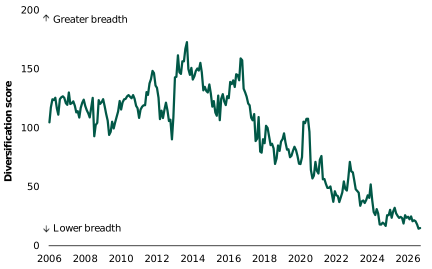
Source: BlackRock, with data from Bloomberg, as of September 30, 2026. The diversification score is a model-based measure designed to estimate how broadly risk is distributed across the index. The score uses a beta-adjusted, risk-based inverse Herfindahl methodology to approximate the number of independent sources of risk within the index. A higher score indicates greater diversification of risk exposures, while a lower score indicates greater concentration. The score is not a measure of the number of securities held by the index.
Despite rising index concentration, earnings of the overall S&P 500 have continued to outpace non-US equities in recent years.3 The economic, regulatory, and technological backdrop of the last decade has clearly favored scale operators within and across industries, benefiting large public firms.4 So while the outsized market capitalizations of these select corporations may feel uncomfortable relative to history, the forward-looking return implications of a historically concentrated equity index are ambiguous.
For active stock pickers however, the challenge of this diminished index breadth of US benchmarks is unambiguous. The fundamental law of active management clearly links diminished portfolio breadth with lower expected alpha; having fewer active dimensions to get right or wrong makes it harder to be an active manager.5
To us, this combination of ambiguous implications for the beta and challenges for constrained alpha elevates the attractiveness of an innovative portfolio construction approach known as portable alpha.
What is portable alpha and how does it work?
Portable alpha is a capability that has long been used by institutional investors and, in recent years, has started to become accessible to wealth investors.6 This portfolio construction approach separates the universe of the benchmark, or beta, of the portfolio and manages it distinctly from the universe of the active positions that generate potential active returns, or alpha, in the portfolio. Simply put, an investor can combine a market exposure they want (such as US large cap equities) and then pair that beta with an independent alpha-seeking strategy which is typically implemented with capital-efficient derivatives. The key word is independent: the alpha does not need to come from finding a different combination of stocks within the S&P 500, for example, but instead it can come from an entirely different investment universe and distinct opportunity set.
Many asset allocators are familiar with the portfolio construction benefits of diversifying liquid alternative strategies. These strategies seek to deliver diversifying alpha returns above a cash benchmark that are lowly correlated with stocks and bonds. In contrast, a portable alpha allocation can be thought of as an amplifying portfolio allocation insofar as it seeks to deliver an alpha return stream on top of an equity beta benchmark. The graphic below shows how a common macro alpha engine can potentially deliver returns above either a cash or equity starting point to deliver these different portfolio outcomes.
Portable alpha combines market exposure with a separate strategy that seeks to generate returns independent of that market exposure
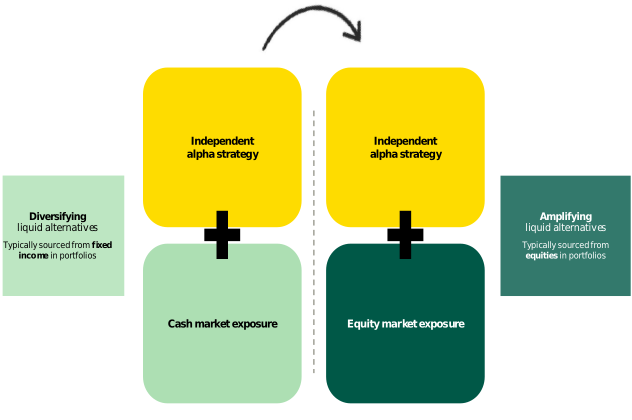
Source: BlackRock. For illustrative purposes only. Box sizes do not represent actual, expected, targeted, or projected returns. Neither alpha nor beta are guaranteed and may be negative. The addition of an alpha strategy may increase losses as well as gains.
Why global macro?
Global macro is particularly well-suited as a portable alpha “engine” for two reasons: (1) its opportunity set is very different from the US equity market, and (2) its exposures are typically accessed with capital-efficient derivatives. Since global macro strategies take long and short positions across asset classes and countries, their returns do not depend on the direction of the S&P 500 nor the individual constituents of the index. Instead, opportunities come from dispersion across country equities, bonds and currencies.
In an environment where economic and policy paths are increasingly diverging, the breadth of the opportunity set available to macro investors can maintain many more independent sources of potential excess return. These divergences can create relative-value opportunities across stocks, bonds, and currencies that we can access with low transaction cost and liquid derivatives instruments.
The visual below shows some of the potential portfolio construction benefits that derive from combining a lowly correlated macro alpha stream with a US equity beta. While portfolio returns are additive as shown in the visual above, overall portfolio volatility is less than the sum of its beta and alpha strategies.
Combining lowly correlated sources of returns potentially mitigates total portfolio volatility
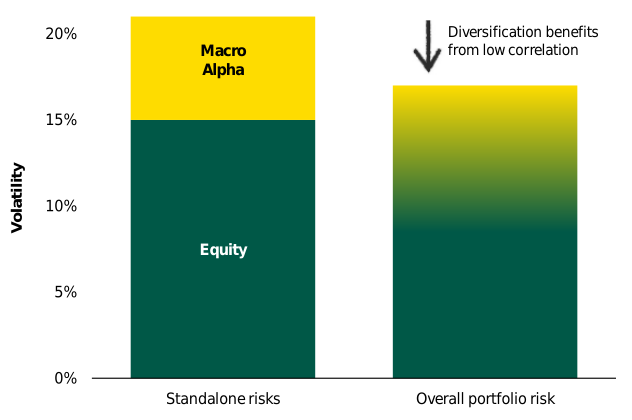
Source: BlackRock. For illustrative purposes only. Results are hypothetical and do not represent actual portfolio performance. Assumes a 15% volatility equity beta paired with a 6% volatility macro alpha strategy that has a 0.1 correlation. Macro alpha strategy volatility assumption is based on the average volatility of Morningstar Macro Trading category over the trailing 10-year period. Equity volatility assumption is based on the historical annualized volatility of the S&P 500 Index over the trailing 10-ayear period. For a two-asset portfolio, combined risk = √(A2 + B2 + 2 × ρ × A × B).
Bringing portable alpha to the active ETF wrapper
The iShares Macro AlphaBeta Active ETF (GMIX) brings this all together in a single active ETF, combining exposure to US large-cap equities with a global macro tactical asset allocation strategy. The macro component builds on the investment approach used in the BlackRock Tactical Opportunities Fund, which has historically delivered lowly correlated, diversifying alpha.
The launch of GMIX also reflects BlackRock’s continued innovation across active ETFs and liquid alternatives, combining established investment capabilities with the scale of iShares. The active ETF wrapper adds transparency, intraday liquidity and potential tax efficiencies, providing additional flexibility in how these exposures are implemented and managed in portfolios.
By pairing US large cap equity exposure with a diversifying global macro alpha capability in a single active ETF, GMIX offers a differentiated way to seek more from a core equity allocation. We anticipate this combination will be a powerful tool for financial advisors and portfolio constructors.
1. As of November 2026, the top 10 stocks in the S&P 500 comprise roughly 40% of the market capitalization-weighted index
2. FAANG referred to Facebook, Amazon, Apple, Nvidia, and Google and has been supplanted by MAG7 to both accommodate the name changes of Facebook (Meta) and Google (Alphabet) while also adding the newly important Tesla and Microsoft. We eagerly await the next sell-side moniker that will no doubt try to incorporate SpaceX and (possibly) Anthropic.
3. Over 2020-2025, S&P 500 earnings grew approximately 68% cumulatively, compared with 34% for non-US equities, as measured by MSCI ACWI ex USA. Past performance does not guarantee future results. Source: Factset as of November 2026.
4. Over the decade ending 2025, US large cap equities significantly outperformed smaller companies, with the S&P 500 returning approximately 298% cumulatively vs. 150% for the Russell 2000. Past performance does not guarantee future results. Source: Bloomberg as of November 2026.
5. Active Portfolio Management: A Quantitative Approach for Producing Superior Returns and Controlling Risk, Richard Grinold and Ronald Kahn, McGraw Hill (1999).
6. In October 2025, Morningstar introduced a new category for funds combining traditional market exposure with a separate investment strategy, citing the growing number of such strategies. Originally called “Multi-Asset Leveraged,” the category was renamed “Multi-Asset Overlay” in April 2026.

Tom Becker
Senior portfolio manager, Global Tactical Asset Allocation team
More articles loaded. Use Shift+Tab keys to browse.
Total articles:
Investments
Insights
Retirement
Tools
Resources
About Us


Carefully consider the Funds' investment objectives, risk factors, and charges and expenses before investing. This and other information can be found in the Funds' prospectuses or, if available, the summary prospectuses, which may be obtained by visiting the iShares Fund and BlackRock Fund prospectus pages. Read the prospectus carefully before investing.
Investing involves a high degree of risk, including possible loss of principal.
The Fund is actively managed and does not seek to replicate the performance of a specified index, may have higher portfolio turnover, and may charge higher fees than index funds due to increased trading and research expenses. There is no guarantee the fund will meet its investment objective.
Fixed income risks include interest-rate and credit risk. Typically, when interest rates rise, there is a corresponding decline in the value of debt securities. Credit risk refers to the possibility that the debt issuer will not be able to make principal and interest payments. Non-investment-grade debt securities (high-yield/junk bonds) may be subject to greater market fluctuations, risk of default or loss of income and principal than higher-rated securities.
Asset-backed securities are subject to credit, interest rate, call, extension, valuation and liquidity risk and are subject to the risk of default on the underlying asset or mortgage, particularly during periods of economic downturn. Small movements in interest rates may quickly and significantly reduce the value of certain ABS. There may be less information on the financial condition of municipal issuers than for public corporations. The market for municipal bonds may be less liquid than for taxable bonds. Some investors may be subject to federal or state income taxes or the Alternative Minimum Tax (AMT). Capital gains distributions, if any, are taxable. Securities with floating or variable interest rates may decline in value if their coupon rates do not keep pace with comparable market interest rates. The Fund’s income may decline when interest rates fall because most of the debt instruments held by the Fund will have floating or variable rates. Mortgage-backed securities ("MBS") and commercial mortgage-backed securities ("CMBS") are subject to prepayment and extension risk and therefore react differently to changes in interest rates than other bonds. Small movements in interest rates may quickly and significantly reduce the value of certain mortgage-backed securities. Collateralized Debt Obligations ("CDOs") carry additional risks including, but not limited to: (i) the possibility that distributions from collateral securities will not be adequate to make interest or other payments; (ii) the risk that the collateral may default or decline in value or be downgraded, if rated by a nationally recognized statistical rating organization; (iii) the Fund may invest in tranches of CDOs that are subordinate to other tranches; (iv) the lack of a readily available secondary market for CDOs.
An investment in the Fund is not insured or guaranteed by the Federal Deposit Insurance Corporation or any other government agency and its return and yield will fluctuate with market conditions.
International investing involves risks, including risks related to foreign currency, limited liquidity, less government regulation and the possibility of substantial volatility due to adverse political, economic or other developments. These risks often are heightened for investments in emerging/developing markets or in concentrations of single countries.
Commodities' prices may be highly volatile. Prices may be affected by various economic, financial, social and political factors, which may be unpredictable and may have a significant impact on the prices of precious metals. Commodity futures exposure is achieved through investments in, but not limited to, commodity-linked notes, swap agreements, commodity options, futures and options on futures. Investing in commodity-linked derivatives and commodity-related companies may increase volatility. Price movements are outside of the fund’s control and may be influenced by weather and climate conditions, livestock disease, war, terrorism, political conflicts and economic events, interest rates, currency and exchange rates, government regulation and taxation.
The Fund's use of derivatives may reduce the Fund's returns and/or increase volatility and subject the Fund to counterparty risk, which is the risk that the other party in the transaction will not fulfill its contractual obligation. The Fund could suffer losses related to its derivative positions because of a possible lack of liquidity in the secondary market and as a result of unanticipated market movements, which losses are potentially unlimited. There can be no assurance that the Fund's hedging transactions will be effective.
The Fund gains certain commodity exposure through a wholly owned Cayman Islands subsidiary and is indirectly exposed to the risks of the subsidiary’s investments. The subsidiary is not registered under the Investment Company Act of 1940 and is not subject to all of its investor protections. Changes in applicable USUS or Cayman Islands law could adversely affect the Fund or the subsidiary. Changes in applicable tax law or guidance regarding the Fund’s use of its Cayman subsidiary could require changes to the Fund’s operations, reduce its ability to obtain commodity exposure or result in adverse tax consequences for shareholders. Changes in applicable tax law or guidance regarding the Fund’s use of its Cayman subsidiary could require changes to the Fund’s operations, reduce its ability to obtain commodity exposure or result in adverse tax consequences for shareholders.
Diversification and asset allocation may not protect against market risk or loss of principal. Transactions in shares of ETFs may result in brokerage commissions and will generate tax consequences. All regulated investment companies are obliged to distribute portfolio gains to shareholders. The information provided is not intended to be tax advice. Investors should be urged to consult their tax professionals or financial advisors for more information regarding their specific tax situations.
This material is not intended to be relied upon as a forecast, research or investment advice, and is not a recommendation, offer or solicitation to buy or sell any securities or to adopt any investment strategy. The opinions expressed are as of the date indicated and may change as subsequent conditions vary. The information and opinions contained in this material are derived from proprietary and non-proprietary sources deemed by BlackRock to be reliable, are not necessarily all-inclusive and are not guaranteed as to accuracy. As such, no warranty of accuracy or reliability is given and no responsibility arising in any other way for errors and omissions (including responsibility to any person by reason of negligence) is accepted by BlackRock, its officers, employees or agents. This material may contain “forward-looking” information that is not purely historical in nature. Such information may include, among other things, projections and forecasts. There is no guarantee that any of these views will come to pass. Reliance upon information in this material is at the sole discretion of the viewer.
The Funds are distributed by BlackRock Investments, LLC (together with its affiliates, “BlackRock”).
©2026 BlackRock, Inc. or its affiliates. All Rights Reserved. BLACKROCK and iSHARES are trademarks of BlackRock, Inc. or its affiliates. All other trademarks are those of their respective owners.
MASS1126-MH-6101883-EXP1127