
Private Market
Jul 15, 2026|ByJonathan Diorio
Welcome to Unlocking private markets with BlackRock’s Jon Diorio, Head of Alternatives for U.S. Wealth, where we offer a close look at trends in private markets and provide insights for clients.

Three things to know about changing demographics — and how they’re reshaping the investment landscape
Key takeaways:
- Markets and economies are constantly evolving, and demographic change may be one of the most important long-term forces shaping the investment landscape today. Aging populations, longer life expectancies, migration trends and changing household dynamics are influencing everything from healthcare infrastructure to housing demand and private debt markets.
- At the same time, many investors continue searching for ways to diversify portfolios, generate income, and navigate an environment marked by elevated volatility and uncertainty. Increasingly, investors are exploring private markets for differentiated sources of return and exposure to long-term secular trends.
- One area we believe deserves greater attention is seniors housing — a segment sitting at the intersection of real estate, healthcare, infrastructure, and private credit.
1. The U.S. population is aging rapidly — and the implications may be significant
A major demographic transformation is already underway in the United States. Today, more than 61 million Americans are age 65 or older, and by 2030 every Baby Boomer will be over the age of 65. Perhaps more importantly for investors, the 80+ population is expected to grow substantially over the next decade. Projections estimate the cohort could increase from roughly 14 million people in 2025 to nearly 23 million by 2035 — representing approximately 55% growth.1
This matters because demographic shifts can create durable, long-term demand trends that may persist across economic cycles. Similar to how digitization fueled growth in data centers and logistics transformed industrial real estate, aging demographics may shape opportunities across healthcare, housing, and private infrastructure. For example, an aging population has led to expected increases in government spending in Medicaid and Medicare, seeking to anticipate the demand for seniors housing. (see Exhibit below) Some have coined this shift in demographics the “Silver Tsunami.”2
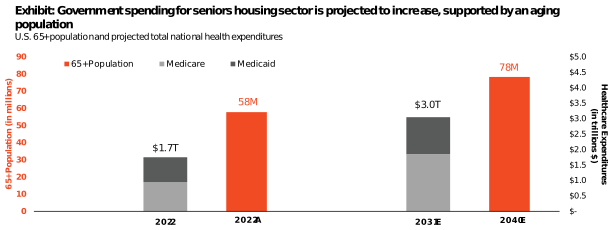
Source: Population data: Administration for Community Living, U.S. Department of Health and Human Services, May 2024 (actual data for 2022 and estimated data for 2040) Expenditures data: Centers for Medicare & Medicaid Services, 2022 (actual data for 2022 and estimated data for 2031). For illustrative purposes only. There is no guarantee that any forecasts made will come to pass.
2. A housing crunch for seniors? Demand for seniors housing may outpace new supply
While demand for seniors housing is expected to grow meaningfully, supply growth has remained constrained. Construction starts in seniors housing are currently near historic lows, and estimates suggest the U.S. may add only approximately 191,000 senior housing units by 2030 — well below the estimated 560,000 units needed to meet projected demand.3
Occupancy levels are already elevated, with seniors housing occupancy near 89% nationally.4 Several factors have contributed to the supply imbalance:
- Rising construction costs
- Longer development timelines
- Labor shortages
- Regulatory complexity
At the same time, demand for seniors housing continues to increase as Americans live longer and healthcare needs evolve. In a recent whitepaper, MONTICELLOAM LLC, a specialized senior housing lending platform, states that just 10% of the country's housing units are ready to accommodate older adults, presenting opportunities for investors to fill the gap.5
3. As the population ages, the demand for income and diversification increases as well
The aging population is also influencing another structural trend, which we refer to at BlackRock as the ‘Income Imperative’; where retired investors want capital preservation and stability with the ability to generate attractive cash flow from investments.
Increasingly, investors have started looking to private markets for new and differentiated sources of return, income, and overall diversification. According to our latest Advisor Trends Survey, 56% of advisors now use private markets in client portfolios, up from 49% in 2023, with adoption expected to reach 69% by 2027.6
At BlackRock, we are looking at real estate debt and asset-based finance (ABF) with the following characteristics to provide both income and diversified exposures:
- Needs-based demand
- Income-producing collateral
- Historically resilient trends (occupancy rates, recovery rates, etc.)
Unlike many traditional fixed income instruments, private real estate debt and other asset-based structures are typically negotiated directly with borrowers. Loans are often backed by operating properties and supported by recurring cash flows separate from the credit of the owner or business creating structural protection and leading to higher recovery rates.
Additionally, we like sectors tied to megatrends, like aging demographics or infrastructure needs driven by the AI boom. With 70% of Class A industrial stock built before 2000, an aging asset footprint is driving significant investment opportunity in industrial real estate.7 Sectors supported by these structural tailwinds we believe tend to be differentiated from more economically sensitive categories because demand is often tied less to consumer discretion and more to demographic needs or secular shifts. We view this as an opportunity to finance the needs of our everyday lives.
Over the last several years, many investors have become increasingly concentrated in traditional public market exposures — particularly large-cap U.S. equities. As Larry Fink recently discussed in his Chairman’s Letter, the future portfolio framework may evolve beyond the traditional 60/40 model toward a broader mix of public and private assets.
Private assets will play an important role in providing investors with more access to opportunities to diversify their portfolios. That said, private markets investments involve risks including illiquidity, operational complexity, and manager selection considerations. Explore our resources on private markets, real estate debt, and other alternative investment opportunities in our Inside Alternatives hub.
Additional resources
- The fourth edition of unlocking private markets with Jon Diorio
- 2026 Private Markets Outlook
- Explore the new Inside Alternatives
Questions?
To learn more, reach our team at 609-282-0050 or altshelp@blackrock.com
Jon Diorio
BlackRock’s Head of Alternatives for U.S. Wealth
Investments
Insights
Retirement
Tools
Resources
About Us


1. Source: U.S. Census Bureau as of June 2025 and NIC MAP as of May 2026 “The Impending Age Wave Navigating the
Urgent Need for Senior Housing”
2. Source: Investopedia as of April, 2026.
3. Source: NIC MAP as of May 2026 “Senior
Housing Industry’s Next Challenge: A Demand Surge Without the Supply to Match”
4. Source: Cushman and Wakefield, as of
February 2026. “U.S. SENIOR LIVING & CARE INVESTOR SURVEY AND TRENDS REPORT”
5. The MONTICELLOAM whitepaper was published on October, 2025.
6. Source: BlackRock, as of 1/31/26. The 2026 BlackRock Advisor Trends Survey reflects the perspectives of 1,023 advisors across the U.S. wealth management industry. The study was fielded by Escalent, an independent research firm, between August 22 and September 7, 2025. There is no guarantee that any forecasts made will come to pass.
7. Source: CBRE Industrial Research, Q1 2024. “Class A industrial stock” refers to industrial buildings, such as high-quality warehouses, logistics centers, distribution facilities, and similar properties.
IMPORTANT INFORMATION
This material is provided for informational purposes only and is not intended to be relied upon as a forecast, research or investment advice, and is not a recommendation, offer or solicitation to buy or sell any securities or to adopt any investment strategy. The opinions expressed are subject to change. References to specific securities, asset classes and financial markets are for illustrative purposes only and are not intended to be and should not be interpreted as recommendations. Reliance upon information in this material is at the sole risk and discretion of the reader. The material was prepared without regard to specific objectives, financial situation or needs of any investor.
THE INFORMATION CONTAINED HEREIN MAY BE PROPRIETARY IN NATURE AND HAS BEEN PROVIDED TO YOU ON A CONFIDENTIAL BASIS, AND MAY NOT BE REPRODUCED, COPIED OR DISTRIBUTED WITHOUT THE PRIOR CONSENT OF BLACKROCK, INC. (“BLACKROCK”). These materials are not an advertisement and are not intended for public use or dissemination.
This communication is not an offer and should not be deemed to be a contractual commitment or undertaking between the intended recipient of this communication and BlackRock but an indication of what services may be offered subject to a legally binding contract between the parties and therefore no reliance should be placed on this document or its content.
This material is not intended to be relied upon as a forecast, research or investment advice, and is not a recommendation, offer or solicitation to buy or sell any securities or to adopt any investment strategy. Any reference herein to any security and/or a particular issuer shall not constitute a recommendation to buy or sell, offer to buy, offer to sell, or a solicitation of an offer to buy or sell any such securities issued by such issuer.
Investing involves risks, including possible loss of principal.
Incorporating alternative investments into a portfolio presents the opportunity for significant losses including in some cases, losses which exceed the principal amount invested. Also, some alternative investments have experienced periods of extreme volatility and in general, are not suitable for all investors. Asset allocation and diversification strategies do not ensure profit or protect against loss in declining markets.
©2026 BlackRock, Inc. or its affiliates. All Rights Reserved. BLACKROCK, ALADDIN and eFRONT are trademarks of BlackRock, Inc. or its affiliates. All other trademarks are those of their respective owners.
USWA0726-5728165-EXP0727