
Multi-Asset

Quick read:
- Macroeconomic forces are driving divergent outcomes across and within international markets.
- Greater market dispersion creates opportunities for selective, active investing across equities and fixed income.
- BlackRock’s active investment solutions seek to identify opportunities amid this dispersion.
American investors can have good reason to feel comfortable at home. US markets are robust, liquid, and home to many of the world’s most profitable companies. That familiarity is reflected in portfolios. BlackRock’s analysis of advisor models continues to show a clear US home preference: the average moderate portfolio holds 76% of its equity allocation in US stocks while nearly 80% of fixed income is allocated to the US.1
But just as traveling abroad creates new experiences and broadens your perspective, expanding the universe beyond just the US broadens your investment opportunity set. Different countries’ equity and fixed income markets are shaped by different paths for growth, inflation, and policy – creating meaningful differences in returns. For investors, that can make potential sources of return and diversification that a US-centric portfolio may miss, especially when cross-country return dispersion is high.
In our view this suggests jointly including international exposures and applying an active lens when deciding which and how those exposures are built. Our approach looks to invest inside of broad regional segments to identify the countries, companies, and bond markets where fundamentals and prices are most misaligned, while also employing a disciplined risk management approach.
Going global with equities
Country-level equity returns rely on earnings strength, policy regimes, and global market linkages, which can vary immensely. In recent decades, US equities have been an exemplar compared to peers, yet there are distinct tailwinds in other countries that are unavailable to those who just invest at home. The BlackRock Target Allocation model portfolio team includes international stocks in our equity benchmarks, and such exposures provide an opportunity for fine-tuning investments to potentially deliver additional return via active vehicles.
Equity market returns have varied widely across countries
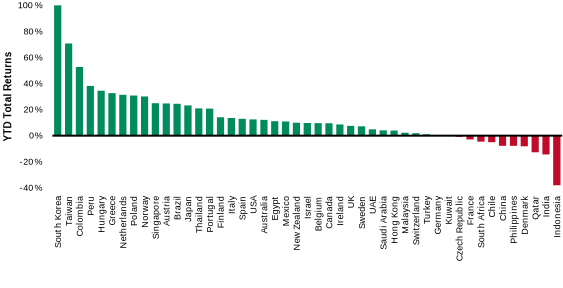
Source: BlackRock with data from Bloomberg, as of 30 September 2026. Past performance does not guarantee or indicate future results.
2026 has demonstrated how unexpected shocks can shake global equity markets. Record-breaking AI buildout capital investments, for example, have had uneven effects across regions and countries. The AI supply chain is heavily concentrated in specific countries, with the US, Japan, South Korea, and Taiwan standing out as notable beneficiaries. While many investors have stuck with just US equities to create exposure to the AI trend, going global has offered a diversifying way into the same theme. Beyond AI, many identifiable trends can inform granular country selection strategy, and portfolios may benefit from higher selectivity. We think it is an attractive time to employ a more selective approach to international equities, aiming to capitalize on these opportunities.
Going global with bonds
The case for going global with bonds is like the case for equities: a global, active approach in bonds allows investors to capture a broader range of opportunities and allocate toward the most attractive markets.
We see particular value in this as growing US Treasury issuance has led popular benchmarks such as the Bloomberg US Aggregate Bond Index, which is issuance weighted, to become increasingly exposed to US government debt.2 That concentration leaves investors more exposed to elevated US inflation, expansionary US fiscal policy, and uncertainty around monetary policy. Allocating globally can increase portfolio diversification and reduce reliance on that single set of risks. Hedging currency exposure of foreign bonds back to USD can also reduce risk and create additional potential for yield uplift when US cash rates are high relative to other markets, which has, on average, been the case.
As shown in the charts below, a diversified, actively managed global government bond strategy has delivered strong performance with lower volatility relative to the Bloomberg US Aggregate Bond Index and the Bloomberg Global Treasury USD-Hedged Index. From a multi-asset portfolio builder’s perspective, the lower reliance of such a strategy on spreads as a source of return is particularly attractive as it makes the strategy less correlated to equities, and therefore a more effective portfolio diversifier. The BlackRock Target Allocation models and some of the world's largest institutional investors have been evolving their fixed income allocations in this direction. For example, Norway's $2.2bn sovereign wealth fund recently recommended restructuring its bond benchmark to explicitly seek exposures to across both government and non-government allocations.3
An active, globally diversified USD-hedged government bond strategy has delivered greater return and less risk than US-only indexes
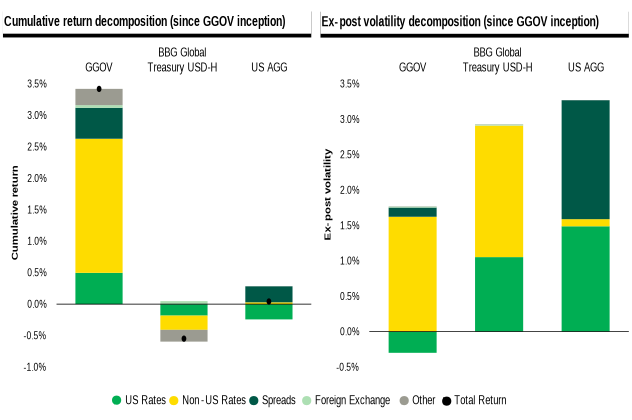
Index performance is for illustrative purposes only. Indexes are unmanaged and one cannot invest directly in an index. Past performance does not guarantee or indicate future results.
Source: BlackRock, as of 30 September 2026. Return and volatility decomposition are shown cumulatively since GGOV inception. The fund’s inception date is 25 June 2025. GGOV represents iShares Global Government Bond USD Hedged Active ETF, BBG Global Treasury USD-H represents the Bloomberg Global Treasury USD Hedged Index, US Agg represents Bloomberg US Aggregate.
Bringing it all together
A growing set of forces are driving dispersion across global markets, creating opportunities for investors willing to look beyond domestic borders to broaden potential sources of return and help portfolios adapt to changing market conditions.
BlackRock is seeking to help investors capture these opportunities across stocks and bonds through actively managed strategies:
- iShares International Country Rotation ETF (CORO) combines regional and country-level insights to identify opportunities across international equity markets. Drawing on more than 10 years of research from BlackRock's Target Allocation team, the strategy incorporates macroeconomic, sentiment and fundamental insights. CORO aims to first weight broad regions by their relative strength, then make more granular active selections on a single country level within each region.
- iShares Global Government Bond USD-Hedged Active ETF (GGOV) actively navigates exposure to government bonds in ~40 countries. Managed by BlackRock's Global Tactical Asset Allocation (GTAA) team, which has more than 15 years of experience seeking alpha for clients through a global macro approach,4 the strategy combines systematic and discretionary insights to pursue diversified sources of return, with the potential to reduce reliance on traditional fixed income risk factors.
1. Source: BlackRock, Aladdin. “Advisor models” data is as of 31 August 2026, based on the 17,546 (fixed income) and 22,052 (equity) collected by BlackRock in the 3 months ending 31 August 2026. Advisor models collected by BlackRock are grouped into 5 risk cohorts for analysis, based on total equity allocation. The portfolios analyzed represent a subset of the industry, and not its entirety. As such, there may be certain biases present in the data that reflect the advisors who choose to work with BlackRock to analyze their portfolios.
2. Source: Bloomberg as of August 2026. US Treasuries now represent roughly 46% of the Bloomberg US Aggregate Bond Index, up from about 36% a decade ago, as growing government debt issuance has increased the benchmark’s exposure to Treasury risk.
3. Source: Norges Bank, “The Government Pension Fund Global – analyses and assessments of the investment strategy for bonds”, 1 September 2026.
4. GTAA seeks to generate alpha through a data-driven macroeconomic research process, with performance measured at the end of each calendar year. Alpha measures risk-adjusted performance relative to a benchmark index, taking into account the volatility (price risk) of an investment. Positive alpha indicates that an investment has outperformed its benchmark on a risk-adjusted basis.

Michael Gates
Head of Model Portfolios Solutions, Americas, Multi-Asset Strategies and Solutions team

Tom Becker
Senior portfolio manager, Global Tactical Asset Allocation team
More articles loaded. Use Shift+Tab keys to browse.
Total articles:
Investments
Insights
Retirement
Tools
Resources
About Us


Carefully consider the Funds' investment objectives, risk factors, and charges and expenses before investing. This and other information can be found in the Funds' prospectuses or, if available, the summary prospectuses, which may be obtained by visiting the iShares Fund and BlackRock Fund prospectus pages. Read the prospectus carefully before investing.
Investing involves a high degree of risk, including possible loss of principal.
This material is not intended to be relied upon as a forecast, research or investment advice, and is not a recommendation, offer or solicitation to buy or sell any securities or to adopt any investment strategy. The opinions expressed are as of the date indicated and may change as subsequent conditions vary. The information and opinions contained in this material are derived from proprietary and non-proprietary sources deemed by BlackRock to be reliable, are not necessarily all-inclusive and are not guaranteed as to accuracy. As such, no warranty of accuracy or reliability is given and no responsibility arising in any other way for errors and omissions (including responsibility to any person by reason of negligence) is accepted by BlackRock, its officers, employees or agents. This material may contain “forward-looking” information that is not purely historical in nature. Such information may include, among other things, projections and forecasts. There is no guarantee that any of these views will come to pass. Reliance upon information in this material is at the sole discretion of the viewer.
The Fund is actively managed and does not seek to replicate the performance of a specified index, may have higher portfolio turnover, and may charge higher fees than index funds due to increased trading and research expenses. There is no guarantee the fund will meet its investment objective.
Fixed income risks include interest-rate and credit risk. Typically, when interest rates rise, there is a corresponding decline in the value of debt securities. Credit risk refers to the possibility that the debt issuer will not be able to make principal and interest payments.
International investing involves risks, including risks related to foreign currency, limited liquidity, less government regulation and the possibility of substantial volatility due to adverse political, economic or other developments. These risks often are heightened for investments in emerging/developing markets or in concentrations of single countries.
There is no guarantee that interest rate risk will be reduced or eliminated within the Fund.
The Fund's use of derivatives may reduce the Fund's returns and/or increase volatility and subject the Fund to counterparty risk, which is the risk that the other party in the transaction will not fulfill its contractual obligation. The Fund could suffer losses related to its derivative positions because of a possible lack of liquidity in the secondary market and as a result of unanticipated market movements, which losses are potentially unlimited. There can be no assurance that the Fund's hedging transactions will be effective.
Diversification and asset allocation may not protect against market risk or loss of principal.
Investing involves risk, including possible loss of principal.
There is no guarantee that the classification system used to determine the rotation model or strategy will achieve its intended results. The fund may engage in active and frequent trading of its portfolio securities which may result in higher transaction costs to the fund. The fund is actively managed and does not seek to replicate the performance of a specified index.
The Funds are distributed by BlackRock Investments, LLC (together with its affiliates, “BlackRock”).
©2026 BlackRock, Inc. or its affiliates. All Rights Reserved. BLACKROCK and iSHARES are trademarks of BlackRock, Inc. or its affiliates. All other trademarks are those of their respective owners.
MASS1126-MH-6024583-EXP1127