

Multi-Asset

Key takeaways
- Active ETFs can be utilized in model portfolios to reposition faster and offer potentially greater capital and tax efficiency.
- Our team utilizes active ETFs to sharpen our portfolio exposures after making broad asset allocation decisions.
For decades investing has been an active exercise, even as shifts toward low-cost, index-based investments have strengthened. Today, investors are once again evaluating active vehicles to seek enhanced risk-adjusted returns. The Model Portfolio Solutions team at BlackRock sees certain active exposures, select active ETFs, as additive, but today as a finishing touch rather than foundational building block in portfolio construction.
Primary considerations for building a portfolio are determining the investment objective and setting an appropriate risk budget. It’s critical for investors to get these basics right from the outset, often together with their advisor. Given the portfolio objective and risk budget, we begin portfolio construction using core exposures to reflect our benchmark, then incorporating long term tilts, and stacking increasingly fine-tuned tactical positions to gain exposure to attractive market segments.
The process of setting a high benchmark, assembling index building blocks, and layering on compelling factors and sectors based on our team’s signal set has generated solid results since we incepted our model family in 2014.
Recent launches of active ETFs offer new opportunities to make more precise bets, becoming part of the “last mile” in our journey to delivering active returns. We consider these to be the last stretch to amplify outcomes: specialized themes managed by specialist teams; active funds with additive access; rotational strategies; alternatives (alts); and an active core. Sources of alpha beyond our strategic tilts and tactical positions help us tighten our aperture, filling in portfolio gaps and offering distinctly new opportunities.
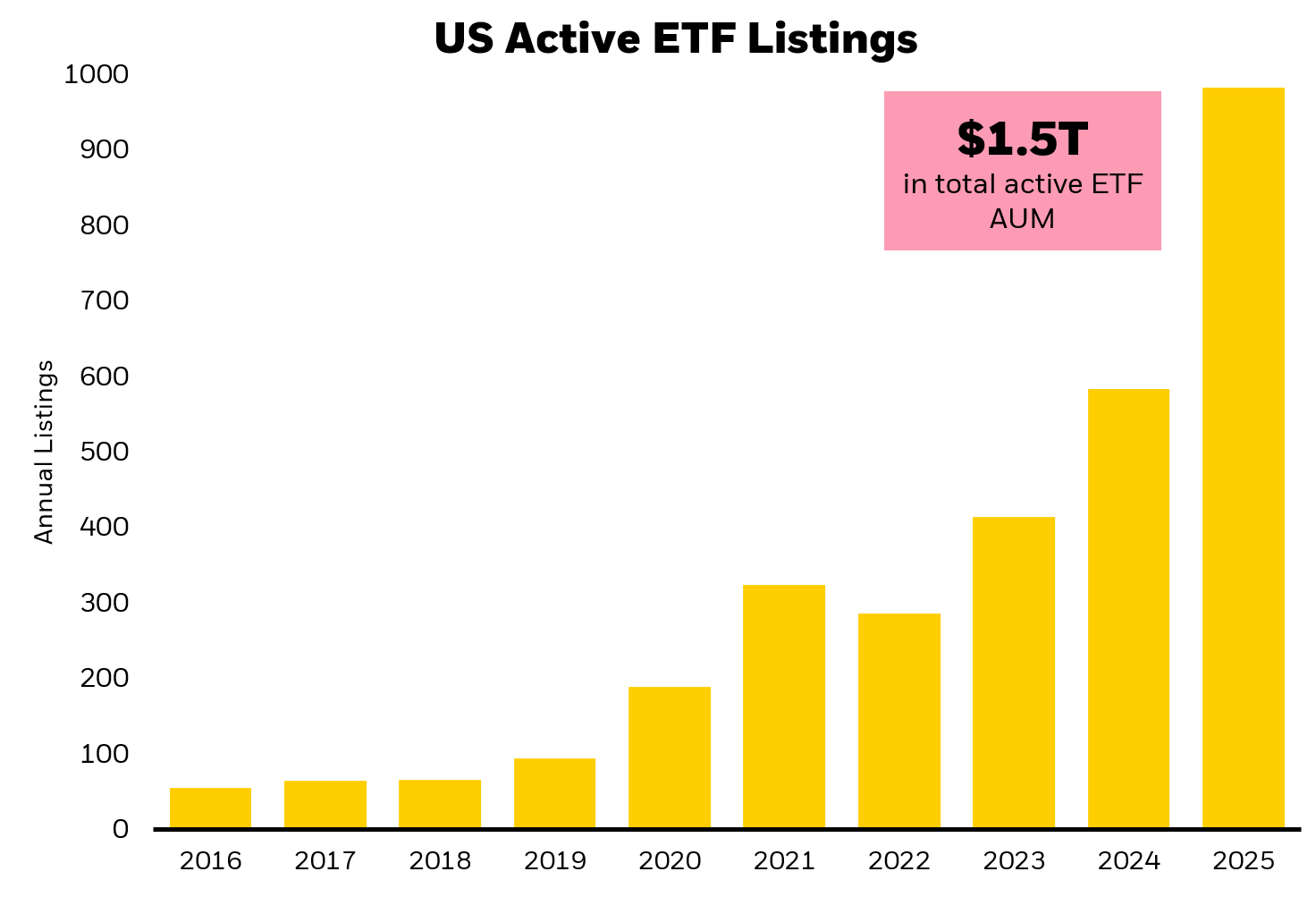
Source: BlackRock Global Business Intelligence as of January 30, 2025. Total active ETF AUM only including US listed active ETFs, rounded up to the nearest decimal.
The road so far
We believe (and academic literature shows) that the vast majority of investment returns come from asset allocation rather than security selection1. We focus our energy on the goal of getting the right asset allocation; active manager security selection is a complementary rather than primary return driver. Many portfolio builders choose implicitly to build bottom-up: a common practice we have seen in portfolios we customize has been to set aside favorite active managers to establish a portfolio’s foundational building blocks before beginning risk-taking elsewhere.
Our addition of active exposures represents a later development in our history – we began building model portfolios before the modern era of active ETFs. Getting the strategic tilts right seeks to set clients up for success even before tactical positions are layered in. Our strategic tilts are by definition funded from the core standard performance benchmark.
Most of our history has been assembling a harmony of index exposures to further tune our initial strategic tilts. Introducing more instruments over time was a natural evolution: adding new factors and indices as they became available and fitting. In recent years, novel strategies in active ETFs have enabled our team to more finely tune our portfolios.
Our team has recently been making targeted additions of active ETFs to the portfolio to go beyond index capabilities. First, active fixed income ETFs that offer unique access to less integrated markets outside of conventional indices. Heightened access was complemented by rotational strategies, which use systematic investing to navigate shifting market conditions. There have also been thematic additions, pursuing high conviction trends using company-specific active selection. When considering the core, we screen to identify the rare manager whose risk-adjusted return can’t be entirely explained by basic market and factor tilts.
Conclusion
In all of these cases, active ETFs are able to reposition faster and with potentially greater capital and tax efficiency than we would achieve otherwise. As model portfolio managers, we could not replicate this task without substantially increasing the number of portfolio holdings and the cadence of trading. ETFs are a powerful tool for constructing portfolios. The transparent, low-cost, tax-efficient vehicle is ideal for use as a core component of a more holistic investment allocation. The expansive and growing menu of ETFs has enhanced our ability to exploit attractive opportunities and act on investment theses. Even so, the current array of ETFs is not exhaustive, and as more funds become available, we will continue refining our active exposure framework. Last mile allocations embolden the investment palette, helping us deliver better risk-adjusted returns in our model portfolios.
Subscribe for the latest market insights and trends
Please try again


Michael Gates, CFA
Head of Model Portfolio Solutions in the Americas for Multi-Asset Strategies & Solutions

George Anderson
Market Strategist
Investments
Insights
Retirement
Tools
Resources
About Us


1. Brinson, Hood and Beebower, 1986. Asset allocation does not guarantee investment success or protect from investment loss.
This information should not be relied upon as investment advice, research, or a recommendation by BlackRock regarding (i) the funds, (ii) the use or suitability of the model portfolios or (iii) any security in particular. Only an investor and their financial professional know enough about their circumstances to make an investment decision.
The third-party branded or BlackRock model portfolios that are provided by BlackRock exclusively to applicable platform users (collectively “custom model portfolios”) are offered through third parties which are not affiliated with BlackRock. Custom model portfolios are subject to contractual instructions provided to BlackRock by the respective third-party firms. BlackRock does not endorse any custom model portfolios.
Carefully consider the investment objectives, risk factors, charges and expenses of funds within the model portfolios before investing. This and other information can be found in the funds’ prospectuses or, if available, the summary prospectuses which may be obtained by visiting each fund company's website or calling their toll-free number. For BlackRock and iShares Funds, please visit www.blackrock.com or www.iShares.com. Read the prospectuses carefully before investing.
Investing involves risks, including possible loss of principal.
The model portfolios are made available to financial professionals by BlackRock Fund Advisors (“BFA”) or BlackRock Investment Management, LLC (“BIM”), which are registered investment advisers, or by BlackRock Investments, LLC (“BRIL”), which is the distributor of the BlackRock and iShares funds within the model portfolios. BFA, BIM and BRIL (collectively, “BlackRock”) are affiliates.
The model portfolios are provided for illustrative and educational purposes only. The model portfolios do not constitute research, are not personalized investment advice or an investment recommendation from BlackRock to any client of a third party financial professional, and are intended for use only by a third party financial professional, with other information, as a resource to help build a portfolio or as an input in the development of investment advice for its own clients. Such financial professionals are responsible for making their own independent judgment as to how to use the model portfolios. BlackRock does not have investment discretion over, or place trade orders for, any portfolios or accounts derived from the model portfolios. BlackRock is not responsible for determining the appropriateness or suitability of the model portfolios, or any of the securities included therein, for any client of a financial professional. Information concerning the model portfolios – including holdings, performance, and other characteristics – may vary materially from any portfolios or accounts derived from the model portfolios. There is no guarantee that any investment strategy or model portfolio will be successful or achieve any particular level of results. The model portfolios themselves are not funds.
The model portfolios include investments in shares of funds. Clients will indirectly bear fund expenses in respect of portfolio assets allocated to funds, in addition to any fees payable associated with any applicable advisory or wrap program. BlackRock intends to allocate all or a significant percentage of the model portfolios to funds for which it and/or its affiliates serve as investment manager and/or are compensated for services provided to the funds ("BlackRock Affiliated Funds"). BlackRock has an incentive to (a) select BlackRock Affiliated Funds and (b) select BlackRock Affiliated Funds with higher fees over BlackRock Affiliated Funds with lower fees. The fees that BlackRock and its affiliates receive from investments in the BlackRock Affiliated Funds constitute BlackRock’s compensation with respect to the model portfolios. This may result in model portfolios that achieve a level of performance less favorable to the model portfolios, or reflect higher fees, than otherwise would be the case if BlackRock did not allocate to BlackRock Affiliated Funds.
This material does not constitute any specific legal, tax or accounting advice. Please consult with qualified professionals for this type of advice.
Fixed income risks include interest-rate and credit risk. Typically, when interest rates rise, there is a corresponding decline in bond values. Credit risk refers to the possibility that the bond issuer will not be able to make principal and interest payments. Non-investment-grade debt securities (high-yield/junk bonds) may be subject to greater market fluctuations, risk of default or loss of income and principal than higher-rated securities. Mortgage-backed securities ("MBS") and commercial mortgage-backed securities ("CMBS”) are subject to prepayment and extension risk and therefore react differently to changes in interest rates than other bonds. Small movements in interest rates may quickly and significantly reduce the value of certain mortgage-backed securities. There may be less information on the financial condition of municipal issuers than for public corporations. The market for municipal bonds may be less liquid than for taxable bonds. Some investors may be subject to federal or state income taxes or the Alternative Minimum Tax (AMT). Capital gains distributions, if any, are taxable. An investment in a treasury Fund is not insured or guaranteed by the Federal Deposit Insurance Corporation or any other government agency and its return and yield will fluctuate with market conditions.
International investing involves risks, including risks related to foreign currency, limited liquidity, less government regulation and the possibility of substantial volatility due to adverse political, economic or other developments. These risks often are heightened for investments in emerging/developing markets and in concentrations of single countries. Funds that concentrate investments in specific industries, sectors, markets or asset classes may underperform or be more volatile than other industries, sectors, markets or asset classes and the general securities market.
There can be no assurance that performance will be enhanced or risk will be reduced for funds that seek to provide exposure to certain quantitative investment characteristics (""factors""). Exposure to such investment factors may detract from performance in some market environments, perhaps for extended periods. In such circumstances, a fund may seek to maintain exposure to the targeted investment factors and not adjust to target different factors, which could result in losses.
Alternative investments present the opportunity for significant losses and some alternative investments have experienced periods of extreme volatility. Alternative investments may be less liquid than investments in traditional securities.
Commodities’ prices may be highly volatile. Prices may be affected by various economic, financial, social and political factors, which may be unpredictable and may have a significant impact on the prices of precious metals.
Actively managed funds do not seek to replicate the performance of a specified index. Actively managed funds may have higher portfolio turnover than index funds.
Prepared by BlackRock Investments, LLC, member FINRA.
©2026 BlackRock, Inc. or its affiliates. All Rights Reserved. BLACKROCK and iSHARES are trademarks of BlackRock, Inc. or its affiliates. All other trademarks are those of their respective owners.
MASS0326-5339265-EXP0327