

Multi-Asset

Key takeaways:
- Cash is losing its edge: With central banks cutting rates, money-market yields are falling, creating a potentially important moment for retirees to shift toward more durable sources of income.
- Resilient economy remains supportive of taking measured risk: Strong U.S. growth and loose financial conditions could underpin the case for quality equities and diversified multi-asset income exposure in 2026.
- Income over price appreciation: With bond returns likely driven by income rather than further meaningful rate moves or spread compression, well-diversified portfolios could help support more reliable retirement cash flow.
After another year of shifting policy, falling short-term yields, and record cash balances, many retirees could be entering 2026 at an important inflection point. Central banks have already begun cutting rates, eroding the income available from money market funds and conservative bonds. There is around $9.1 trillion in money market funds (“MMFs”) worldwide, but cash isn’t paying what it used to – and we believe it could fall even further.1 In our view, this may create an opportunity. We see the era of easy income fading; as a result diversified income portfolios may offer appealing yields and the potential for greater durability. Our Multi-Asset Income Model Portfolios and funds are designed to help advisors build that consistency through diversified, risk-aware exposures.
Cash yields have fallen meaningfully since the Fed began cutting interest rates in September 2024.
Hypothetical annual income received from a $1,000,000 investment
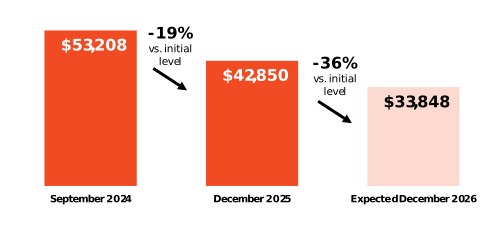
Cash income estimates are illustrative and based on historical SOFR rates and forward pricing of market implied rate cuts to a $1,000,000 balance. September 2024 and December 2025 cash income estimates reflect total annual income received based on average daily SOFR yields for the trailing 12-month periods as of September 1, 2024 and December 11, 2025, respectively. Expected December 2026 cash income estimate based on the average monthly forward 90-day contracts for the 1-year period ending December 31, 2026. Actual yields, fund expenses, and investor outcomes may differ. Sources: Bloomberg, Federal Reserve Economic Data (FRED). Source: BlackRock, FactSet. S&P 500 index weights. Data as of December 31st 2010 and as of October 31st, 2025. Box colors correspond to company GICS sector mapping to distinguish. Past performance does not guarantee future results. Index performance is for illustrative purposes only. Index Performance does not reflect any management fees or expenses. Indexes are unmanaged and one cannot invest directly in an index.
Against this backdrop of falling short-term rates, let’s dig into where the BlackRock Multi-Asset Income team is sourcing durable, risk-aware income. In our view the U.S. economy remains resilient, policy support (both monetary and fiscal) is strong, and yields are still among the most attractive in a decade. Yet confidence among retirees has not followed suit: only 27% feel sure their savings will last through retirement compared to 43% 3 years ago, while two-thirds worry about running out of money.2 This tension between market strength and personal uncertainty, in many ways defines the investing landscape for 2026. The task now is not to predict every policy move or market swing, but to structure portfolios around stability, yield, and adaptability.
“For retirees, the ultimate measure of success is the confidence in income and how the portfolio pays, rather than how the market performs.” Justin Christofel, Head of Income Investing for BlackRock’s Multi-Asset Strategies & Solutions (MASS) Group
Our Multi-Asset Income 2026 outlook explores three themes that will shape that journey for retirees:
1. Staying constructive amidst continued U.S. economic expansion
2. Stock market concentration: why diversification still matters
3. Positioning for income over price appreciation
1. Staying constructive amidst continued U.S. economic expansion
We believe the U.S. economy may continue to show above-trend growth into 2026, supported by fiscal expansion, easy financial conditions, and strong private-sector investment. It is our expectation that the One Big Beautiful Bill, targeted policy incentives, and ongoing public and private investment could reinforce economic momentum, while AI-related capital expenditure lifts productivity.
Financial conditions have loosened meaningfully over the past two years to levels that have rarely been this supportive of growth. The Global Financial Conditions Index summarizes how easy or restrictive financial conditions are by blending interest-rate, credit, equity market, and currency indicators into a single measure. As shown in the chart below, these easier financial conditions are broad-based, with all seven components of the Index contributing. For the Federal Reserve, this argues for a measured policy stance rather than aggressive rate cuts.
Financial conditions are loose, rivaling post-crisis levels. The Global Financial Conditions Index has fallen in 2025.
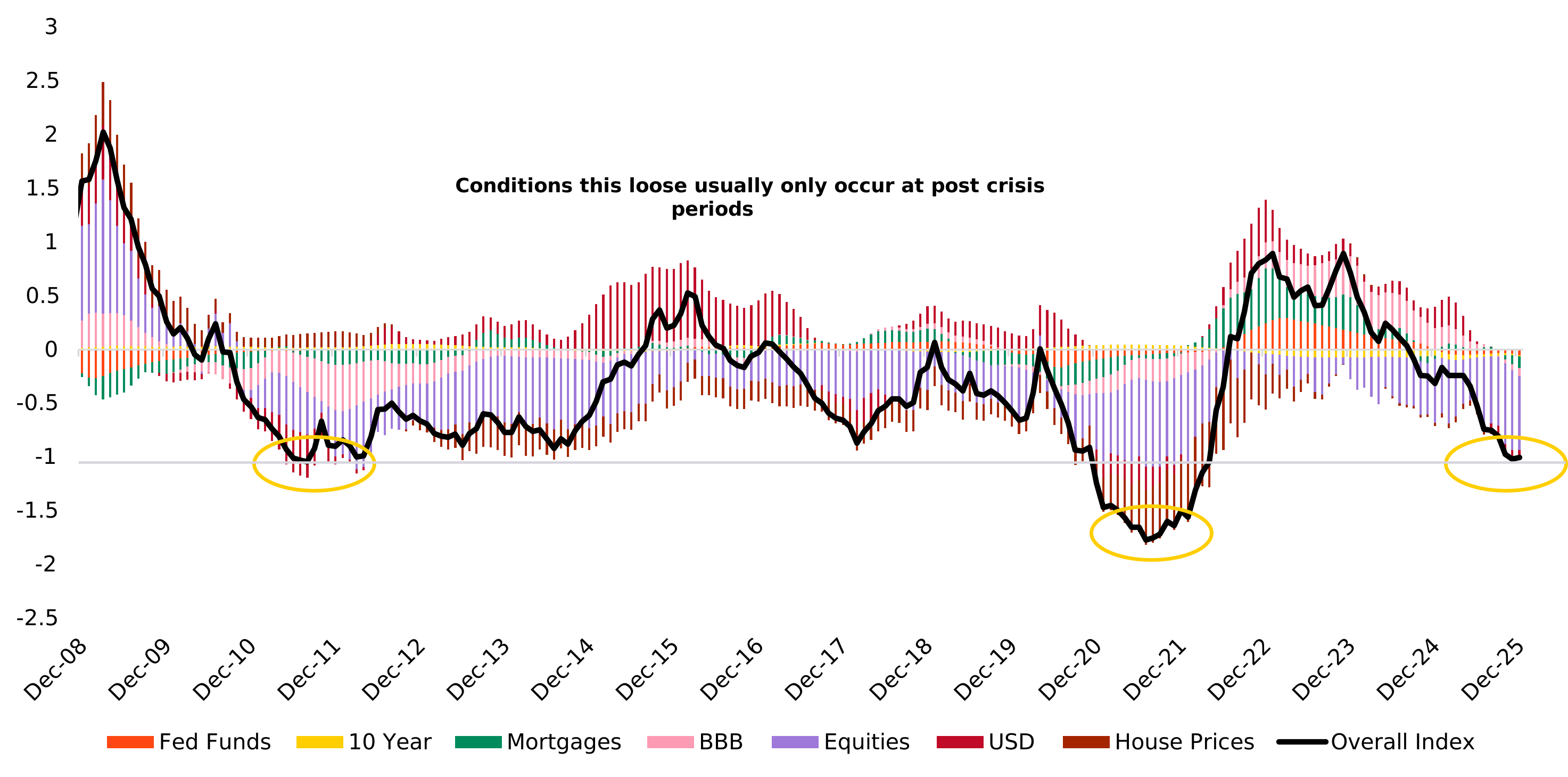
Source: BlackRock Investment Institute, using data from the Federal Reserve, Bloomberg, Bank of America Merrill Lynch, ICE, J.P. Morgan, MSCI, and national housing price indices. December 5th 2025. Past performance does not guarantee future results.
Given this backdrop, we remain long equities with an emphasis on quality and cash-flow-oriented exposures. Within fixed income, we are keeping duration short and continue to lean into high-quality spread assets such as securitized credit, CLOs, and investment-grade corporates, where we believe carry remains attractive relative to the risk taken. We are selectively reducing high yield exposure, where spreads are tight, and reallocating toward areas that offer better compensation per unit of risk. In our view, volatility may present opportunities to enhance income, depending on investor objectives and risk tolerance. We express this view by allocating to covered call exposures that help convert equity volatility into income.
2. Stock market concentration: why diversification still matters
One of the defining features of this cycle has been the extraordinary concentration of equity returns. The “Magnificent Seven” and other AI-linked leaders have dominated global performance, masking a broader market that remains uneven and increasingly sensitive to policy shifts, funding costs, and capex dynamics. U.S. equity markets were once more balanced across individual stocks and sectors, but today AI-driven technology names dominate the index.
Market concentration of the top 10 companies in the S&P 500 and average dividend yields are moving in opposite directions

Source: BlackRock, FactSet. S&P 500 index weights. Data as of December 31st 2010 and as of October 31st, 2025. Box colors correspond to company GICS sector mapping to distinguish index composition change by sector. Any companies mentioned do not necessarily represent current or future holdings of any BlackRock products. For actual Fund holdings, please visit www.ishares.com. Past performance does not guarantee future results. Index performance is for illustrative purposes only. Index Performance does not reflect any management fees or expenses. Indexes are unmanaged and one cannot invest directly in an index.
As shown in the chart above, in 2010, the ten largest S&P 500 companies represented 19% of the index and offered an average dividend yield of nearly 3%. By 2025, the top 10 accounted for roughly 40% of total market value - double the historical average and more concentrated than the peak of the TMT bubble (the technology, media, and telecommunications bubble) in 2000 - while the average dividend yield has fallen to just 0.44%.3 This shift highlights a market that delivers more growth potential but far less income and diversification.
Historically, periods of concentrated leadership and heavy capex investment have been followed by phases of higher volatility and mean reversion.4 We believe 2026 may fit that pattern - not as a downturn, but as a transition to a more volatile, less one-directional market. In this environment, our yield centric portfolio construction may help smooth the income stream rather than chase the highest total return.
We believe dividend-growth and quality-income equities remain well supported by fundamentals, and we continue to hold meaningful allocations to these segments across our portfolios. This includes exposure to U.S. large-cap dividend payers with strong balance sheets and stable free-cash-flow generation, as well as systematic strategies that tilt toward profitability, yield, and quality factors. These positions can offer the potential for steady distributions while helping cushion portfolios during periods of heightened rate or policy uncertainty.
We also maintain targeted allocations to healthcare, global infrastructure, and select emerging market (“EM”) equities. Healthcare can offer defensive earnings and attractive dividend growth potential while infrastructure can provide stable, inflation-linked cash flows. Meanwhile, emerging markets can provide differentiated sources of income and attractive relative valuations. Together these exposures diversify the equity income stream and reduce reliance on the narrow group of mega-cap technology names that have dominated index performance.
Ultimately, we think well-balanced income portfolios can strengthen the stability of the income retirees depend on and help mitigate short-term market swings.
3. Positioning for income over price appreciation
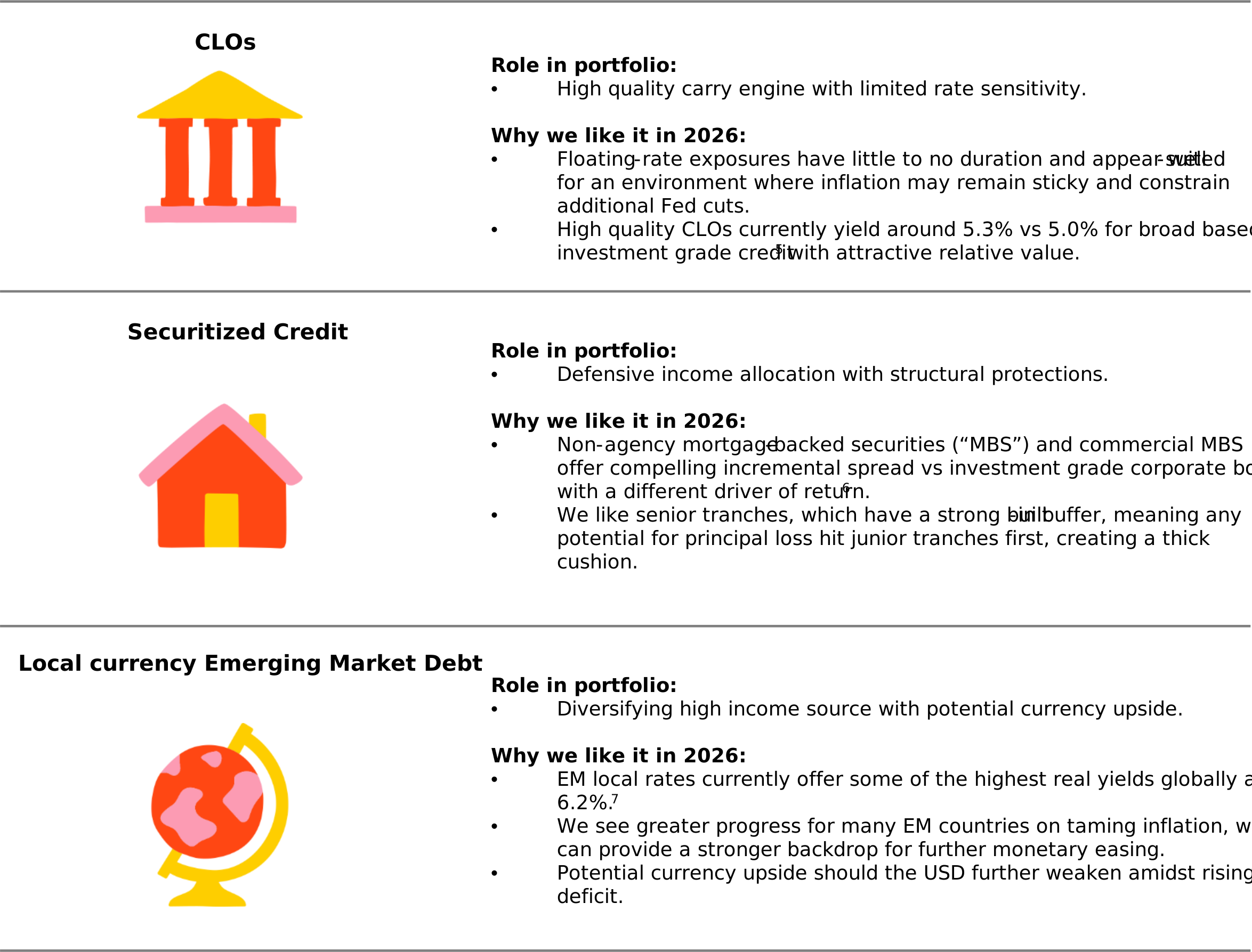
Spreads across most credit asset classes remain quite tight, but well supported by a resilient economy, healthy corporate balance sheets, and relatively low defaults. Thus, we believe 2026 is shaping up to be another year where returns may be driven primarily by income, or carry, rather than price appreciation. Our focus remains on working hard to build portfolios that capture reliable yield while maintaining quality, flexibility, and diversification. We favor sectors that balance attractive carry with lower interest rate sensitivity.
Three areas stand out for income investors today:
Source: Bloomberg December 8th, 2025. This material represents an assessment of the market environment as of the date indicated; is subject to change; and is not intended to be a forecast of future events or a guarantee of future results. This information should not be relied upon by the reader as research or investment advice regarding the funds or any issuer or security in particular. Past performance does not guarantee future results. Index performance is for illustrative purposes only. Index Performance does not reflect any management fees or expenses. Indexes are unmanaged and one cannot invest directly in an index.
Conclusion: turning market strength into retirement resilience
As 2026 begins, the market offers both opportunity and complexity. Growth remains strong, yields are compelling, and innovation continues to reshape productivity. Yet for retirees, the true measure of success is not necessarily about beating the market but about supporting income needs through market cycles. For advisors, the message to clients is simple: confidence in retirement comes from preparation, not prediction. As attractive returns from cash and short-duration assets become less accessible and as diversification plays an important role in achieving stability, BlackRock’s Multi-Asset Income Model Portfolios and funds seek to add value by being thoughtfully dynamic, rotating within and across sectors and regions to pursue a more consistent income profile through market fluctuations. This is central to the Multi-Asset Income approach, which seeks to turn volatility from a source of stress into a source of opportunity for retirees.
The performance quoted represents past performance and does not guarantee future results. Investment returns and principal values may fluctuate so that an investor’s shares, when redeemed, may be worth more or less than their original cost. Current performance may be lower or higher than the performance data quoted. Refer to www.blackrock.com or www.ishares.com to obtain performance data current to the most recent month-end.

Justin Christofel
Global head of Income Investing, Multi-Asset Strategies & Solutions
Justin Christofel, CFA, CAIA, Managing Director, is global head of Income Investing for BlackRock’s Multi-Asset Strategies & Solutions group. He is a portfolio manager for a number of income strategies including the Multi-Asset Income Fund, Dynamic High Income Fund, Managed Income Fund, and Multi-Asset Income model portfolios.

Louis Arranz,
Portfolio manager, Multi-Asset Strategies and Solutions (MASS) Income team
Louis Arranz, CFA, CAIA, FRM, Director, is a portfolio manager and researcher for BlackRock’s Multi-Asset Strategies & Solutions (MASS) Income team. He is a portfolio manager for a number of income strategies including the Multi-Asset Income Fund, Dynamic High Income Fund, Managed Income Fund, and Multi-Asset Income model portfolios.
Investments
Insights
Retirement
Tools
Resources
About Us


1. SEC “Money Market Fund Statistics”; Federal Reserve Economic Data (FRED) December 8th, 2025
2. Blackrock.com/readonretirement
3. Bloomberg, December, 2025
4. Historical analysis of the largest 500 U.S. stocks (1964–2024, data from Compustat)
5. JP Morgan CLOIE AAA Index yield, Bloomberg, December 8th, 2025
6. Barclays Non-Agency CMBS Index, BBG US Corporate Index, December 8th, 2025
7. J.P. Morgan GBI-EM Global Core Index (GBIEMCOR), Bloomberg, December 8th, 2025
Carefully consider the Funds' investment objectives, risk factors, and charges and expenses before investing. This and other information can be found in the Funds' prospectuses or, if available, the summary prospectuses which may be obtained by visiting www.iShares.com or www.blackrock.com. Read the prospectus carefully before investing.
Investing involves risks, including possible loss of principal.
The strategies discussed are strictly for illustrative and educational purposes and are not a recommendation, offer or solicitation to buy or sell any securities or to adopt any investment strategy. There is no guarantee that any strategies discussed will be effective. The information presented does not take into consideration commissions, tax implications, or other transactions costs, which may significantly affect the economic consequences of a given strategy or investment decision.
The BlackRock model portfolios are provided for illustrative and educational purposes only. The BlackRock model portfolios do not constitute research, are not personalized investment advice or an investment recommendation from BlackRock to any client of a third party financial professional and are intended for use only by a third party financial professional, with other information, as a resource to help build a portfolio or as an input in the development of investment advice for its own clients. The BlackRock model portfolios themselves are not funds.
BlackRock intends to allocate all or a significant percentage of the BlackRock model portfolios to funds for which it and/or its affiliates serve as investment manager and/or are compensated for services provided to the funds ("BlackRock Affiliated Funds"). Clients will indirectly bear fund expenses relating to assets allocated to funds, including BlackRock Affiliated Funds. BlackRock has an incentive to (a) select BlackRock Affiliated Funds and (b) select BlackRock Affiliated Funds with higher fees over BlackRock Affiliated Funds with lower fees.
International investing involves risks, including risks related to foreign currency, limited liquidity, less government regulation and the possibility of substantial volatility due to adverse political, economic or other developments. These risks often are heightened for investments in emerging/developing markets or in concentrations of single countries.
Diversification and asset allocation may not protect against market risk or loss of principal. Fixed income risks include interest-rate and credit risk. Typically, when interest rates rise, there is a corresponding decline in bond values. Credit risk refers to the possibility that the bond issuer will not be able to make principal and interest payments.
Securities with floating or variable interest rates may decline in value if their coupon rates do not keep pace with comparable market interest rates. The Fund’s income may decline when interest rates fall because most of the debt instruments held by the Fund will have floating or variable rates. An investment in fixed income funds is not equivalent to and involves risks not associated with an investment in cash.
Mortgage-backed securities ("MBS") and commercial mortgage-backed securities ("CMBS") are subject to prepayment and extension risk and therefore react differently to changes in interest rates than other bonds. Small movements in interest rates may quickly and significantly reduce the value of certain mortgage-backed securities.
This information should not be relied upon as research, investment advice, or a recommendation regarding any products, strategies, or any security in particular. This material is strictly for illustrative, educational, or informational purposes and is subject to change.
The BlackRock and iShares Funds are distributed by BlackRock Investments, LLC (together with its affiliates, "BlackRock").
The iShares Funds are not sponsored, endorsed, issued, sold or promoted by Bloomberg, BlackRock Index Services, LLC, Cboe Global Indices, LLC, Cohen & Steers, European Public Real Estate Association (“EPRA® ”), FTSE International Limited (“FTSE”), ICE Data Indices, LLC, NSE Indices Ltd, JPMorgan, JPX Group, London Stock Exchange Group (“LSEG”), MSCI Inc., Markit Indices Limited, Morningstar, Inc., Nasdaq, Inc., National Association of Real Estate Investment Trusts (“NAREIT”), Nikkei, Inc., Russell, S&P Dow Jones Indices LLC or STOXX Ltd. None of these companies make any representation regarding the advisability of investing in the Funds. With the exception of BlackRock Index Services, LLC, who is an affiliate, BlackRock Investments, LLC is not affiliated with the companies listed above.
Neither FTSE, LSEG, nor NAREIT makes any warranty regarding the FTSE Nareit Equity REITS Index, FTSE Nareit All Residential Capped Index or FTSE Nareit All Mortgage Capped Index. Neither FTSE, EPRA, LSEG, nor NAREIT makes any warranty regarding the FTSE EPRA Nareit Developed ex-U.S. Index, FTSE EPRA Nareit Developed Green Target Index or FTSE EPRA Nareit Global REITs Index. “FTSE®” is a trademark of London Stock Exchange Group companies and is used by FTSE under license.
The Funds are distributed by BlackRock Investments, LLC (together with its affiliates, "BlackRock").
©2026 BlackRock, Inc. or its affiliates. All Rights Reserved. iSHARES and BLACKROCK are trademarks of BlackRock, Inc. or its affiliates. All other trademarks are those of their respective owners.
MASS0226-5227826-EXP0227
MKTG0126-5161139-EXP0127