
Multi-Asset

Quick read:
- Advisors are searching for ways to add resilient income while capturing long-term growth.
- Utilities and infrastructure, which have been considered as mature, defensive sectors, are being reshaped by AI-driven electricity demand and a global wave of investment.
- Our Multi-Asset Income (MAI) team’s exposures to these sectors aim to provide ballast in portfolios while also tapping into structural growth opportunities that we believe can extend well beyond today’s market cycle.
Advisors are increasingly focused on these two questions:
- How can I add resilient income to client portfolios?
- How can I capture the long-term growth potential of artificial intelligence (AI)?
Our Multi-Asset Income (MAI) model portfolios seek to deliver on both. This year, we have increased exposure to U.S. utilities and global infrastructure equities - sectors often characterized as “defensive,” but we believe they are now evolving into fruitful income and growth opportunities.
Utilities to benefit from AI
What has led to this evolution? Utilities have been experiencing broad-based momentum as investors increasingly view the sector as a key beneficiary of structural shifts in electricity demand - particularly the surge driven by AI adoption and the expansion of data centers, which are projected to consume huge amounts of power. U.S. technology giants are expected to spend nearly $450 billion per year by 2027 on data center power demand, up from an estimated $300 billion at the end of 2024.1 We believe utilities may be the direct beneficiaries of this demand growth. As shown in the chart below, analysts now forecast sector earnings to climb over 73% on average over the next three years, compared to the average of the previous five years.
Utility sector annual earnings per share (EPS) growth, forecast
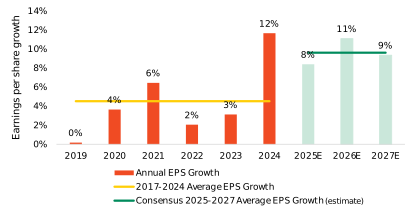
Source: Bloomberg as of 8/27/2025. Utilities represented by aggregate of all utility companies in S&P 500 Utilities Index. Past performance does not guarantee future results. Forward looking estimates may not come to pass.
For investors, we feel this is worth paying attention to. In our opinion, utilities and infrastructure are no longer just mature, defensive sectors offering income, or slow growing “bond proxies.” Instead, we believe they are becoming essential in powering the next stage of global growth and have the potential to provide both income and long-term growth opportunity in portfolios.
Infrastructure: a broader growth story
Utilities are just one part of a bigger infrastructure investing revival. After years of underinvestment, governments and companies around the world are spending heavily on the “backbone” assets that help keep economies running and creating AI infrastructure opportunities.2
Energy infrastructure has been seeing growth, especially in natural gas pipelines and export facilities, as global demand for U.S. liquefied natural gas increases.3 Transportation networks are also in focus. In North America, major railroads are exploring mergers that could reshape trade routes. In Europe, transportation companies have benefited from government spending plans and have offered attractive valuations.3
From a global perspective, we believe valuations remain appealing as shown in the chart below. Global infrastructure earnings are expected to grow at 8% annually for the next three years.4 However, despite strong earnings momentum, many infrastructure companies have been trading at discounts compared with the broader stock market. We feel this gap between fundamentals and return creates an opportunity for investors.
Infrastructure valuations at relative lows versus equities

The figures shown relate to past performance. Past performance is not a reliable indicator of current or future results. Index performance returns do not reflect any management fees, transaction costs or expenses. Indices are unmanaged and one cannot invest directly in an index. Source: FTSE, Factset as of 5/31/2025. Infrastructure = FTSE Dev. Core Infrastructure 50/50 Index - Equities = MSCI World Index. 1yr forward EV/EBITDA. Expensive/Cheap = +/- 1 standard deviation from mean spread. MSCI World is a market capitalization weighted average. EV, or Enterprise Value, is a measure of a company’s total value calculated as sum of market capitalization and total debt minus cash. EBITDA is earnings before interest, taxes, depreciation, and amortization. Standard deviation indicates how much individual data points differ from the mean of the data set. Forward looking estimates may not come to pass.
Multi-Asset Income Portfolios: Utilities and infrastructure as engines of income and growth
In the Multi-Asset Income model portfolios, we expressed our preference for utilities and infrastructure earlier this year. In April, we favored U.S. utilities as a portfolio ballast while also providing direct exposure to rising power demand from AI. In June we leaned into global infrastructure to seek opportunities across utilities, transportation, energy, and other essential assets - all in a yield-focused way that aligns with the models’ income objectives.
For advisors and clients, we believe the takeaway is clear: utilities and infrastructure are no longer just a “boring” corner of the market. They are deeply integrated in the AI revolution and, in our view, allocating to these sectors may provide resilience today and growth potential for tomorrow.
Investing involves risks, including possible loss of principal. Past performance is no guarantee of future results. Index performance is shown for illustrative purposes only. It is not possible to invest directly in an index.
Performance data quoted represents past performance and is no guarantee of future results. Investment returns and principal values may fluctuate so that an investor’s shares, when redeemed, may be worth more or less than their original cost. All returns assume reinvestment of dividends and capital gains. Current performance may be lower or higher than that shown. Refer to blackrock.com for most recent month-end performance.

Justin Christofel
Global head of Income Investing, Multi-Asset Strategies & Solutions
Justin Christofel, CFA, CAIA, Managing Director, is global head of Income Investing for BlackRock’s Multi-Asset Strategies & Solutions group. He is a portfolio manager for a number of income strategies including the Multi-Asset Income Fund, Dynamic High Income Fund, Managed Income Fund, and Multi-Asset Income model portfolios.

Stella Wang
Researcher in Income Investing, Multi-Asset Strategies & Solutions
Stella Wang, Vice President, is a researcher for BlackRock’s Multi-Asset Strategies & Solutions Income team.
Investments
Insights
Retirement
Tools
Resources
About Us


1 Source: Goldman Sachs “AI to drive 165% increase in data center power demand by 2030”.
2 Source: McKinsey, “The infrastructure moment”.
3 Source: U.S. Energy Information Administration 9/6/2025.
4 Source: Bloomberg 8/31/2025. Global Infrastructure represented by FTSE Core Infrastructure 50/50 Index. Past performance is not a reliable indicator of current or future results. Forward looking estimates may not come to pass.
Carefully consider the Funds' investment objectives, risk factors, and charges and expenses before investing. This and other information can be found in the Funds' prospectuses or, if available, the summary prospectuses which may be obtained by visiting www.iShares.com or www.blackrock.com. Read the prospectus carefully before investing.
Investing involves risk, including possible loss of principal. Asset allocation and diversification may not protect against market risk, loss of principal or volatility of returns.
This information should not be relied upon as investment advice, research, or a recommendation by BlackRock regarding (i) the funds, (ii) the use or suitability of the model portfolios or (iii) any security in particular. Only an investor and their financial professional know enough about their circumstances to make an investment decision.
The model portfolios are made available to financial professionals by BlackRock Fund Advisors (“BFA”) or BlackRock Investment Management, LLC (“BIM”), which are registered investment advisers, or by BlackRock Investments, LLC (“BRIL”), which is the distributor of the BlackRock and iShares funds within the model portfolios. BFA, BIM and BRIL (collectively, “BlackRock”) are affiliates.
The BlackRock model portfolios, third-party branded model portfolios, or BlackRock model portfolios that are provided by BlackRock exclusively to applicable platform users (collectively “model portfolios”) are provided for illustrative and educational purposes only.
The model portfolios do not constitute research, are not personalized investment advice or an investment recommendation from BlackRock to any client of a third party financial professional, and are intended for use only by a third party financial professional, with other information, as a resource to help build a portfolio or as an input in the development of investment advice for its own clients. The model portfolios themselves are not funds.
BlackRock intends to allocate all or a significant percentage of the BlackRock model portfolios to funds for which it and/or its affiliates serve as investment manager and/or are compensated for services provided to the funds ("BlackRock Affiliated Funds"). Clients will indirectly bear fund expenses relating to assets allocated to funds, including BlackRock Affiliated Funds. BlackRock has an incentive to (a) select BlackRock Affiliated Funds and (b) select BlackRock Affiliated Funds with higher fees over BlackRock Affiliated Funds with lower fees.
Funds that concentrate investments in specific industries, sectors, markets or asset classes may underperform or be more volatile than other industries, sectors, markets or asset classes and than the general securities market. There is no guarantee that any investment will pay dividends.
This material is not intended to be relied upon as a forecast, research or investment advice, and is not a recommendation, offer or solicitation to buy or sell any securities or to adopt any investment strategy. The opinions expressed are as of the date indicated and may change as subsequent conditions vary. The information and opinions contained in this material are derived from proprietary and nonproprietary sources deemed by BlackRock to be reliable, are not necessarily all-inclusive and are not guaranteed as to accuracy. As such, no warranty of accuracy or reliability is given and no responsibility arising in any other way for errors and omissions (including responsibility to any person by reason of negligence) is accepted by BlackRock, its officers, employees or agents. This material may contain “forward-looking” information that is not purely historical in nature. Such information may include, among other things, projections and forecasts. There is no guarantee that any of these views will come to pass. Reliance upon information in this material is at the sole discretion of the viewer.
Fixed income risks include interest-rate and credit risk. Typically, when interest rates rise, there is a corresponding decline in bond values. Credit risk refers to the possibility that the bond issuer will not be able to make principal and interest payments. Non-investment-grade debt securities (high-yield/junk bonds) may be subject to greater market fluctuations, risk of default or loss of income and principal than higher-rated securities.
AI technology relies on large data sets, which can lead to inaccuracies. Companies in AI face competition, rapid obsolescence, and depend on demand from various industries. Regulatory scrutiny could limit AI development, with data collection facing closer examination and potential fines. Country-specific regulations could also impact AI and big data companies.
Prepared by BlackRock Investments, LLC, member FINRA.
©2026 BlackRock, Inc. or its affiliates. All rights reserved. BLACKROCK is a trademark of BlackRock, Inc. or its affiliates. All other trademarks are those of their respective owners.
MASS0226-5209385-EXP0926
iCRMH1025U/S-4824563