

Market Insights

In a world where traditional sources of return can be challenged by changing market regimes, the Tactical Opportunities Fund was designed to provide investors with a flexible and diversified source of alpha. As we mark its 10-year anniversary, the strategy continues to draw on the Global Tactical Asset Allocation (GTAA) team's macro expertise to identify opportunities across markets and generate results for clients.

00:00:00.080 — 00:00:21.560 · Speaker 1
Hi everyone. I'm Meghan Colarusso, senior product strategist on the global Tactical Asset Allocation team. And I have with me today. Tom Becker, a senior portfolio manager on the team. This month is very exciting. We're marking the ten year anniversary of the Tactical opportunities strategy. Take us back to 2016, when the fund first launched, what were some of the thoughts and way that you were thinking?
00:00:21.600 — 00:00:54.840 · Speaker 2
Sure. So we had been building momentum in our institutional business, delivering macro to large clients around the world. We wanted to build scale into our business. We thought a great way to do that was with a daily co-mingled liquid offering, where we could have just our macro insights all in one product.
The other is we could offer that product to a wider range of global clients. So it could be institutional clients, it could be wealth clients. And so now, ten years on, it's been really great to see the diversity of clients that we've been able to to manage the strategy on behalf of.
00:00:54.840 — 00:01:00.240 · Speaker 1
And over that decade, what has changed in markets?
00:01:00.610 — 00:01:59.950 · Speaker 2
So I guess in the ten years I sort of think about it as a first half, second half, the first half was this period of very low policy rates. QE, um, low dispersion kind of beta was was grinding higher in stocks and bonds. That's a tricky environment for us just because we capitalize on dispersion and we build off of a cash benchmark that yields the prevailing cash rate.
Then you have the pandemic, which sort of changed a lot of things in the global economy, but materially changed the global macro investment landscape. A couple important things where inflation has been high and above target since then, that has meant that policy rates have been higher. We've been building on a higher starting cash yield, but more importantly, we've had dispersion back in markets.
So central banks have gotten out of the QE game has been more the norm, and we've been able to capitalize on different economies, different countries, different policymakers, shifting stocks and bonds in very different directions.
00:01:59.950 — 00:02:17.230 · Speaker 1
So more dispersion across countries gives you more opportunities to capitalize with those longs and shorts. And then you're building on top of a higher cash rate. Yep. As you think ahead to the next decade, or maybe even just the next few years, what gives you confidence about the future of the strategy or what gets you really excited?
00:02:17.310 — 00:02:57.550 · Speaker 2
I mean, investment process is really important. So we continue to evolve the way that we find insights. Uh, what excites me about markets and investing is the sources of inefficiency are always changing. So the last five years have been about fiscal. The five years before that was about monetary. Who knows what the next five years holds?
I think that's the exciting thing, is to do the research, understand how the world is interacting with asset markets and try to deliver that consistent return stream for clients. So I'd like to thank clients on behalf of the team. It's been a real honor and privilege to have you entrust us with your capital, and we look forward to continuing on the journey together.
Thanks very much.
This material is provided for educational purposes only and is not intended to constitute investment advice or an investment recommendation within the meaning of federal, state or local law. You are solely responsible for evaluating and acting upon the education and information contained in this material. BlackRock will not be liable for direct or incidental loss resulting from applying any of the information obtained from these materials or from any other source mentioned. BlackRock does not render any legal, tax or accounting advice and the education and information contained in this material should not be construed as such. Please consult with a qualified professional for these types of advice.
This information should not be relied upon as research, investment advice, or a recommendation regarding any products, strategies, or any security in particular. This material is strictly for illustrative, educational, or informational purposes and is subject to change.
The Tactical Opportunities Fund is actively managed and its characteristics will vary.
BlackRock offers investments across a comprehensive range of asset classes and exposures, addressing investor needs with respect to growth, income, and capital preservation.
Bond values fluctuate in price so the value of your investment can go down depending on market conditions.
International investing involves special risks including, but not limited to currency fluctuations, illiquidity and volatility. These risks may be heightened for investments in emerging markets.
Fixed income risks include interest-rate and credit risk. Typically, when interest rates rise, there is a corresponding decline in bond values. Credit risk refers to the possibility that the bond issuer will not be able to make principal and interest payments.
Asset allocation strategies do not assure profit and do not protect against loss.
The fund may use derivatives to hedge its investments or to seek to enhance returns. Derivatives entail risks relating to liquidity, leverage and credit that may reduce returns and increase volatility.
Investing in small- and mid-cap companies may entail greater risk than large-cap companies, due to shorter operating histories, less seasoned management or lower trading volumes.
Please ask your clients to consider the investment objective, risk, charge and expense of the funds carefully before investing. The prospectus and, if available, the summary prospectus contain this and other information about the fund and are available, along with information on other BlackRock funds, by calling 800-882-0052 or at www.blackrock.com. The prospectus and, if available, the summary prospectus should be read carefully before investing.
Prepared by BlackRock Investments, LLC, member FINRA
©2026 BlackRock, Inc. or its affiliates. All Rights Reserved. BLACKROCK is a trademark of BlackRock or its affiliates. All other trademarks are those of their respective owners.
RO CODE
What was the genesis of the Tactical Opportunities strategy in 2016?
The GTAA team assembled in 2008 to deliver alpha through top-down, asset allocation to large institutions via separate accounts. A belief of the team – both then and now – is that markets are mostly efficient, but that a combination of behavioral biases and structural barriers can create inefficiencies that create investment opportunities. To capture those opportunities, we’ve sought to continuously improve our measurement of macro fundamentals (growth, inflation and policy) while remaining vigilant about what’s priced in markets (equities, bonds, and currencies) to generate durable alpha for clients on a tactical, 1-2 quarter investment horizon.
In 2016, the team launched the Tactical Opportunities Fund as its first commingled “cash+” offering. It was designed to bring together the superset of the team’s active macro insights – both systematic and discretionary – to deliver alpha above a cash benchmark. A standalone fund allowed us to create scale in our institutional, separate account business and also opened access to a broader range of investors. Ten years later, the Tactical Opportunities franchise has grown to $8 billion in assets globally and plays an important role in the portfolios of wealth and institutional clients.
The Tactical Opportunities Fund has delivered uncorrelated alpha over cash since inception
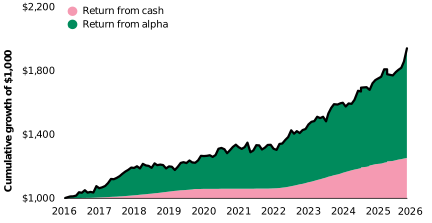
Source: BlackRock as of 1 June 2026. Tactical Opportunities Fund inception date is 1 July 2016. The figures shown relate to past performance. Past performance is not a reliable indicator of current or future results and should not be the sole factor of consideration when selecting a product or strategy. The performance quoted represents past performance and does not guarantee future results. Investment return and principal value of an investment will fluctuate so that an investor's shares, when sold or redeemed, may be worth more or less than the original cost. Current performance may be lower or higher than the performance quoted. Click here to view fund performance as of the most recent calendar quarter.
How has the macro investment backdrop evolved over the last decade?
We launched the Tactical Opportunities strategy in the macro doldrums. 2016 was squarely in the middle of a decade of fiscal austerity, monetary overreach, and corporate underinvestment. Against this volatility-suppressed backdrop, we needed to fight for every 5-10bp shift in central bank expectations, navigate stock & bond markets that were historically correlated across countries, and manage with a cash benchmark yielding close to zero. Markets during our first five years of running the fund were characterized by:
- Central bank-induced volatility suppression – persistent undershoots in consumer price inflation emboldened monetary activism that resulted in ballooning central bank balance sheets and persistently negative stock-bond correlations.1
- Broad-based asset price appreciation with low asset price dispersion – rising global integration and benign geopolitics generated a relatively flat securities market line, which meant that portfolio returns were relatively independent of asset allocation decisions.
- Low cash rates – low cash yields mechanically lowered the benchmark returns for liquid alternatives, but they also raised the opportunity cost for investors to be patient during overvalued moments in directional stock and bond markets.
The pandemic was a generational global event that shook loose the stagnant investment backdrop of the 2010s and blew wind back into macro investment sails. The last five years have exemplified this resurrected macro investment opportunity set:
- Fiscal and industrial policy have triggered multi-year cycles of economic divergence across countries while also creating bouts of government bond supply jitters.
- Entrenched, above-target inflation has led to higher policy rates, balance sheet normalization, and greater uncertainty over the reaction function of central banks.
- Geopolitical fragmentation and supply chain rewiring have generated asset price dispersion as countries jostle for AI supremacy, resurrect defense spending, and corporations monetize ballooning fiscal deficits.
A normalization of cross-country dispersion has resuscitated the macro opportunity set
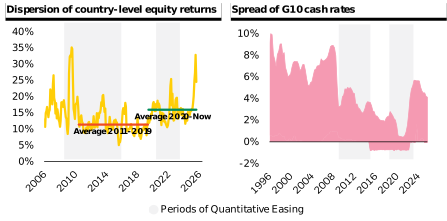
Source: BlackRock with data from Bloomberg, Morningstar as of 31 March 2026. Equity dispersion based on root mean squared error of rolling 12-month returns for 27 individual country equity markets within MSCI ACWI. Those countries include Australia, Brazil, Canada, Chile, China, France, Germany, Hong Kong, Indonesia, India, Italy, Japan, South Korea, Mexico, Malaysia, Netherlands, Poland, South Africa, Singapore, Spain, Sweden, Switzerland, Taiwan, Thailand, Turkey, United Kingdom, and United States. Policy rate dispersion represented by spread of cash rates across G10 countries. G10 countries include Belgium, Canada, France, Germany, Italy, Japan, Netherlands, Sweden, Switzerland, United Kingdom, and United States. The figures shown relate to past performance. Past performance is not a reliable indicator of current or future results and should not be the sole factor of consideration when selecting a product or strategy.
Throughout this decade of two halves, our philosophy has remained consistent: continuously innovate and evolve to identify alpha investment opportunities at the intersection of the macro environment and what’s priced in markets.
Why do markets become inefficient, and why do macro mispricings persist?
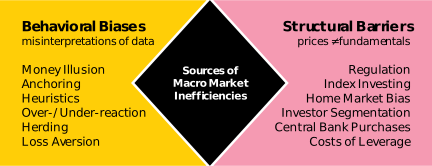
The graphic below organizes some of the catalysts that we see driving macro mispricings along with some of the barriers that allow them to persist over an investible horizon.
Catalysts for investible mispricings across asset classes and across countries
Source: BlackRock, as of 30 June 2026.
Market prices are set by humans and, as the extensive behavioral finance literature documents, humans are prone to biases.2 Over the years, we’ve often observed market participants, policymakers, and brokers anchoring, misinterpreting, and underreacting to developments in macro fundamentals. Some examples include local and global data innovations being conflated; nominal and real data being mixed up; and narratives across asset classes, countries, and policy regimes getting stale. These behavioral biases create gaps between what macro fundamentals imply and market prices; so long as humans set supply and demand across financial markets we expect our biases to remain a source of mispricings.
Structural and institutional barriers further explain why market mispricing can persist, particularly across countries. We list some of the hurdles to speedy market efficiency on the right above. Financial markets are highly regulated and subject to numerous, country-specific rules that often prevent capital from flowing frictionlessly across borders. There are also many financial market participants that are not profit-oriented, notably central banks and indexers, and their flows can temporarily determine prices independent of macro developments. A more geopolitically fragmented world is likely to increase these capital market frictions, and more heterogenous policy and regulation could mean that asset prices take even longer to equilibrate across regions.
What data do you use, and how has it evolved?
We will use any and all available data that might help us to better understand the state of economy or market pricing. We use traditional and non-traditional data sources, structured and unstructured data, and conversations with colleagues throughout the firm to try to identify insights that can lead to investment opportunities. We are always innovating our approaches, and as the tools (including machine learning and large language models) have evolved so too have our capabilities and investment use cases.
The visual below shows one measure of how this continuous innovation has made its way into portfolios. As the market environment has evolved the sources of mispricing have shifted and we’ve sought out new insights and signals to capture those new sources of alpha. For example, in the aftermath of the pandemic we have been particularly focused on fiscal policy research in response to the growing market relevance of government spending, industrial policy, and bond supply. Going forward, our insights will continue to evolve alongside the shifts in market structure, data availability, and analytical tools.
Research and signal innovation helps to maintain our edge as markets evolve
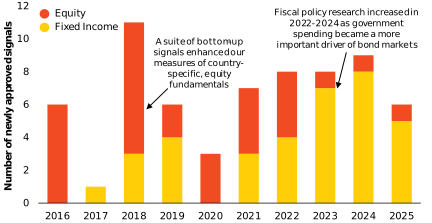
Source: BlackRock as of 31 December 2025.
What’s the role of the strategy in client portfolios?
At launch, we intended for Tactical Opportunities to serve as a source of differentiated alpha in an accessible, daily liquid structure. Delivered results have been consistent with that objective. The majority of alpha has come from cross-country, relative value exposures while the beta to traditional stocks and bonds has remained consistently low. That combination has allowed the fund to act as a source of both growth and ballast within a multi-asset portfolio – a role that has become even more relevant in today’s environment.
The expanded client base of Tactical Opportunities over the last decade demonstrates the value that global investors see in this type of diversifying macro strategy within their portfolios. Our continuous interactions with clients help to keep us sharp in an ever-shifting macro environment and we are grateful for the trust you’ve placed in our investment process. As we mark this ten-year anniversary, we’d like to thank clients for their partnership as we seek to continue delivering differentiated macro alpha with disciplined risk management.
1. Quantitative Easing (QE), negative interest rates (NIRP), yield curve control (YCC), spread asset purchases (LSAPs), and flexible average inflation policy (FAIT) are some of the most notable acronyms that pervaded global monetary policy setting.
2. Kahneman and Tversky (1974) “Judgement under Uncertainty: Heuristics and Biases,” Science 185, is the anchor text for the behavioral economics field.
The Morningstar Rating™ for funds, or “star rating”, is calculated for managed products (including mutual funds, variable annuity and variable life sub-accounts, exchange-traded funds, closed-end funds, and separate accounts) with at least a three-year history. Exchange-traded funds and open-ended mutual funds are considered a single population for comparative purposes. It is calculated based on a Morningstar Risk-Adjusted Return measure that accounts for variation in a managed product’s monthly excess performance, placing more emphasis on downward variations and rewarding consistent performance. The top 10 of products in each product category receive 5 stars, the next 22.5 receive 4 stars, the next 35 receive 3 stars, the next 22.5 receive 2 stars, and the bottom 10 receive 1 star. The Overall Morningstar Rating for a managed product is derived from a weighted average of the performance figures associated with its three-, five-, and 10-year (if applicable) Morningstar Rating metrics. The weights are: 100 three-year rating for 36-59 months of total returns, 60 five-year rating/40 three-year rating for 60-119 months of total returns, and 50 10-year rating/30 five-year rating/20 three-year rating for 120 or more months of total returns. While the 10-year overall star rating formula seems to give the most weight to the 10-year period, the most recent three-year period actually has the greatest impact because it is included in all three rating periods. Past performance does not guarantee future results.
To obtain more information on the funds, including the Morningstar time period ratings and standardized average annual total returns as of the most recent calendar quarter and current month-end, please click on the fund product profile page above.

Tom Becker
Senior portfolio manager, Global Tactical Asset Allocation team
Filter by:
- All
- ARTICLE
- Practice Management
- Tools
Investments
Insights
Retirement
Tools
Resources
About Us

This material is provided for educational purposes only and is not intended to constitute investment advice or an investment recommendation within the meaning of federal, state or local law. You are solely responsible for evaluating and acting upon the education and information contained in this material. BlackRock will not be liable for direct or incidental loss resulting from applying any of the information obtained from these materials or from any other source mentioned. BlackRock does not render any legal, tax or accounting advice and the education and information contained in this material should not be construed as such. Please consult with a qualified professional for these types of advice.
This information should not be relied upon as research, investment advice, or a recommendation regarding any products, strategies, or any security in particular. This material is strictly for illustrative, educational, or informational purposes and is subject to change.
The Tactical Opportunities Fund is actively managed and its characteristics will vary.
BlackRock offers investments across a comprehensive range of asset classes and exposures, addressing investor needs with respect to growth, income, and capital preservation.
Bond values fluctuate in price so the value of your investment can go down depending on market conditions.
International investing involves special risks including, but not limited to currency fluctuations, illiquidity and volatility. These risks may be heightened for investments in emerging markets.
Fixed income risks include interest-rate and credit risk. Typically, when interest rates rise, there is a corresponding decline in bond values. Credit risk refers to the possibility that the bond issuer will not be able to make principal and interest payments.
Asset allocation strategies do not assure profit and do not protect against loss.
The fund may use derivatives to hedge its investments or to seek to enhance returns. Derivatives entail risks relating to liquidity, leverage and credit that may reduce returns and increase volatility.
Investing in small- and mid-cap companies may entail greater risk than large-cap companies, due to shorter operating histories, less seasoned management or lower trading volumes.
Please ask your clients to consider the investment objective, risk, charge and expense of the funds carefully before investing. The prospectus and, if available, the summary prospectus contain this and other information about the fund and are available, along with information on other BlackRock funds, by calling 800-882-0052 or at www.blackrock.com. The prospectus and, if available, the summary prospectus should be read carefully before investing.
Prepared by BlackRock Investments, LLC, member FINRA
©2026 BlackRock, Inc. All Rights Reserved. BLACKROCK is a trademark of BlackRock, Inc., or its subsidiaries in the United States and elsewhere. All other trademarks are those of their respective owners.
MASS0726-5703567-EXP0727