

Market Insights

Draghi Report on national security

Peace is the first and foremost objective of Europe. But physical security threats are rising and we must prepare. The EU is collectively the world’s second largest military spender, but it is not reflected in the strength of our defense industrial capacity.
Quick read:
- We view the Iranian conflict as a catalyst for Europe to enact portions of the Draghi Report to address the region’s security, energy, and technology deficiencies.
- We see European government bond markets underpricing the size of the potential inflation shock and associated fiscal policy response. In portfolios like the BlackRock Tactical Opportunities Fund and iShares Global Government Bond USD Hedged Active ETF (GGOV), we have increased duration shorts across the Eurozone.
- Elevated inflation, geopolitical risks, and structurally higher fiscal spending put a premium on portfolio diversification. In our view, the current environment suits the diversifying alpha strategies that can be generated by a top-down macro investment approach.
The Iranian conflict looks set to catalyze an expansion of deficit-financed European spending to manage an acute supply shock. Governments have strong incentives to increase spending on critical energy infrastructure, military rearmament, and consumer subsidies to offset the inflation shock. Some of these fiscal shifts align with the recommendations of the 2024 Draghi Report, which we anticipate could gain additional political traction in the wake of the Strait of Hormuz closure.1 Rising government bond supply along with accelerating inflation is motivating a growing European bond short across portfolios.
Broker chatter on European fiscal expansion
Our suite of fiscal insights has seen upside risks for Eurozone government spending since the 2025 German election catalyzed that country’s fiscal pivot. Among these signals is one that uses natural language processing to measure the ratio of expansionary to contractionary fiscal chatter across broker reports. The plot below shows how the relative proportion of expansionary descriptions of European government spending has increased meaningfully compared with reports about the US. We interpret this as a sign that Europe is shifting toward a more pro-spending stance in the global cross-section and that recent developments have added to upside fiscal risks.
European fiscal discussions shifting toward more spending
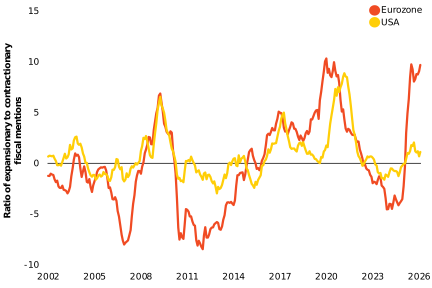
Source: BlackRock GTAA with data from broker reports, March 2026.
Draghi Report on regional security
The EU’s defense sector is critical to ensure Europe’s strategic autonomy in facing increasing external security threats, as well as driving innovation through spillovers across the entire economy.
European military spending picking up speed
Military spending was already rising in Europe before the onset of the Iranian conflict. European defense stocks, anticipating the increase in revenue from national security spending, have steadily outperformed global equities for the past two years.2 The plot on the left below – from the Draghi Report – shows that the revenue of the largest European defense manufacturers is low compared to their US peers. We view this lower starting point as an opportunity for Europe to catch-up in a fractured geopolitical world.
The chart on the right shows that the increase in German defense spending has only just gotten started. German legislative approvals from the Bundestag lead tender offers to defense manufacturers and associated debt issuance. In other words, the late 2025 jump in approvals has not yet begun to flow into the economy nor to impact government bond auction sizes. As firms are allocated these defense contracts their spending will translate into more bond issuance, more growth, and more inflation – all causes for concern for global bond investors.3
European defense firms are smaller than US counterparts but spending ramping quickly
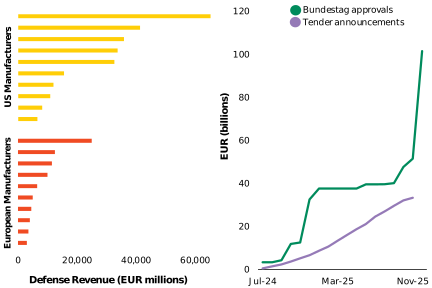
Source: (Left) Draghi Report and Elaboration of Defense News Top 100, as of 2023. European manufacturers include non-EU manufacturers. (Right) BlackRock, German Finance Ministry, as of January 2026.
Draghi Report on the scale of spending
To digitize and decarbonize the economy and increase our defense capacity, the investment share in Europe will have to rise by around 5 percentage points of GDP to levels last seen in the 1960s and 70s. This is unprecedented: for comparison, the additional investments provided by the Marshall Plan between 1948-51 amounted to around 1-2% of GDP annually.
European debt markets underprice issuance risks
Despite the outsized spending magnitudes described in the Draghi Report, European government bond markets are not priced for anything like a domestically financed Marshall Plan. Instead, current levels of bond yields remain anchored closer to the secular stagnation pricing of the last decade. Long-dated Eurozone bond yields reflect the well known growth and inflation challenges of the region and therefore underprice the rising possibility of a meaningful fiscal expansion. The chart below shows this by comparing the 5-year, 5-year forward yields for German, US, and UK government bonds. German forward nominal yields currently trade at more than 1.5% below their developed market peers; a wedge that is historically large. A meaningful fiscal expansion in Europe would align deficit to GDP percentages with the US and UK, which would likely catalyze Eurozone forward yields to reconnect with their developed market peers.
Forward bond yields in Europe have not yet even repriced back to pre-QE levels
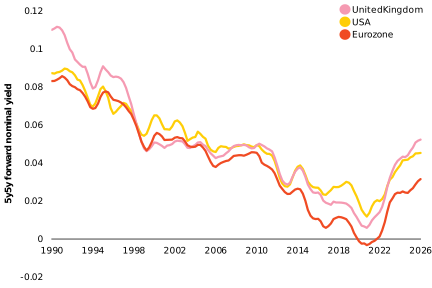
Source: BlackRock with data from Aladdin, March 2026.
So, what does it mean for portfolios?
We view the Iranian conflict as a meaningful event for the future of European policy. Long-dated Eurozone yields appear to underprice the upside risks to bond issuance as governments increase spending on the back of the Iranian crisis. Shorter-dated Eurozone yields potentially underappreciate the hawkishness of the ECB reaction function to rising inflation in the presence of historically tight labor markets and a fiscal boost. These fiscal and inflation insights inform short positions across European government bond markets in the BlackRock Tactical Opportunities Fund and iShares Global Government Bond USD-Hedged Active ETF (GGOV).
The conflict also has implications for portfolio builders seeking additional sources of diversification for their clients. Persistently above-target inflation tends to elevate stock-bond correlations and collapse the diversification within traditional balanced portfolios. This challenge was front and center this March as simultaneous declines in stocks and bonds resulted in the worst monthly return for a classic 60/40 portfolio since June 2022. The Middle Eastern hostilities are increasing regional dispersion, which creates an improved opportunity set for global macro strategies as portfolio diversifiers. A rethink of portfolio construction with an eye for high-quality, active, macro alternatives can also be especially valuable in times like these.
1. We refer to the 2024 Draghi Report which is technically entitled “The future of European competitiveness: Report by Mario Draghi.”
2. Bloomberg as 31 March 2026. European defense stocks represented by Bloomberg Europe Defense Select Index.
3. A recent Atlantic Monthly article “Building Tanks While the Ukrainians Master Drones,” by Simon Shuster poses an interesting question of the future security efficaciousness of the authorized German defense spending.
The Morningstar Rating™ for funds, or “star rating”, is calculated for managed products (including mutual funds, variable annuity and variable life sub-accounts, exchange-traded funds, closed-end funds, and separate accounts) with at least a three-year history. Exchange-traded funds and open-ended mutual funds are considered a single population for comparative purposes. It is calculated based on a Morningstar Risk-Adjusted Return measure that accounts for variation in a managed product’s monthly excess performance, placing more emphasis on downward variations and rewarding consistent performance. The top 10 of products in each product category receive 5 stars, the next 22.5 receive 4 stars, the next 35 receive 3 stars, the next 22.5 receive 2 stars, and the bottom 10 receive 1 star. The Overall Morningstar Rating for a managed product is derived from a weighted average of the performance figures associated with its three-, five-, and 10-year (if applicable) Morningstar Rating metrics. The weights are: 100 three-year rating for 36-59 months of total returns, 60 five-year rating/40 three-year rating for 60-119 months of total returns, and 50 10-year rating/30 five-year rating/20 three-year rating for 120 or more months of total returns. While the 10-year overall star rating formula seems to give the most weight to the 10-year period, the most recent three-year period actually has the greatest impact because it is included in all three rating periods. Past performance does not guarantee future results.
To obtain more information on the funds, including the Morningstar time period ratings and standardized average annual total returns as of the most recent calendar quarter and current month-end, please click on the fund product profile page above.

Tom Becker
Senior portfolio manager, Global Tactical Asset Allocation team
Filter by:
- All
- ARTICLE
- Practice Management
- Tools
Investments
Insights
Retirement
Tools
Resources
About Us


This material is provided for educational purposes only and is not intended to constitute investment advice or an investment recommendation within the meaning of federal, state or local law. You are solely responsible for evaluating and acting upon the education and information contained in this material. BlackRock will not be liable for direct or incidental loss resulting from applying any of the information obtained from these materials or from any other source mentioned. BlackRock does not render any legal, tax or accounting advice and the education and information contained in this material should not be construed as such. Please consult with a qualified professional for these types of advice.
This information should not be relied upon as research, investment advice, or a recommendation regarding any products, strategies, or any security in particular. This material is strictly for illustrative, educational, or informational purposes and is subject to change.
The Tactical Opportunities Fund and GGOV are actively managed and its characteristics will vary.
BlackRock offers investments across a comprehensive range of asset classes and exposures, addressing investor needs with respect to growth, income, and capital preservation.
Bond values fluctuate in price so the value of your investment can go down depending on market conditions.
International investing involves special risks including, but not limited to currency fluctuations, illiquidity and volatility. These risks may be heightened for investments in emerging markets.
Fixed income risks include interest-rate and credit risk. Typically, when interest rates rise, there is a corresponding decline in bond values. Credit risk refers to the possibility that the bond issuer will not be able to make principal and interest payments.
Asset allocation strategies do not assure profit and do not protect against loss.
The funds may use derivatives to hedge its investments or to seek to enhance returns. Derivatives entail risks relating to liquidity, leverage and credit that may reduce returns and increase volatility.
Investing in small- and mid-cap companies may entail greater risk than large-cap companies, due to shorter operating histories, less seasoned management or lower trading volumes.
Please ask your clients to consider the investment objective, risk, charge and expense of the funds carefully before investing. The prospectus and, if available, the summary prospectus contain this and other information about the fund and are available, along with information on other BlackRock funds, by calling 800-882-0052 or at www.blackrock.com. The prospectus and, if available, the summary prospectus should be read carefully before investing.
Prepared by BlackRock Investments, LLC, member FINRA
©2026 BlackRock, Inc. or its affiliates. All rights reserved. BLACKROCK and iSHARES are trademarks of BlackRock, Inc. or its affiliates. All other trademarks are those of their respective owners.
MASS0426-5368226-EXP0427