


The new year brings a market characterized by above-trend growth, easing policy, and accelerating productivity. We believe this backdrop favors risk taking, but weakness in the labor market, rich valuations, and an uncertain forward path for interest rates remain risks, arguing for greater selectivity.
Artificial Intelligence (AI) remains the dominant theme for investors, as it catalyzes a capital-intensive expansion, boosting productivity and sustaining earnings strength. With over $500 billion spent on data centers in 2025 alone, and another $5 trillion to $8 trillion in overall AI infrastructure spending expected through 2030, capital expenditures underpin not only corporate profit expectations, but indeed macroeconomic growth forecasts.1 We continue to believe this buildout is only in its early stages and will continue to drive growth in the quarters and years to come.
Still, the prevalence of the AI theme within investor portfolios introduces risks of higher concentration and correlations. Powered in large part by AI-related returns, U.S. equity indices have advanced to new all-time highs and have become even more concentrated: the 10 largest companies in the S&P 500 now constitute over 40% of the index market cap.2 We believe demand for tailored and targeted diversification will be a key focus for investors in 2026, and a key motivator of fund flows in the year ahead.
Easing policy rates should prove a boon to risk assets, but present new challenges for investors seeking reliable income sources. The reliable carry harvested from short-duration instruments appears set to diminish, making income generation a portfolio-level priority for many investors rather than a single–asset-class decision. This shift is amplified by the volume of capital still idling on the sidelines — nearly $9.1 trillion in money market funds that may need to be reallocated to achieve long-term income objectives.3
Overall, investors are moving into 2026 with a higher-than-average optimism about markets (Figure 1). Nearly 50% of respondents in our latest client survey characterized themselves as bullish or very bullish, and those who did were most likely to take risk in U.S. equities (48%) and emerging markets (24%).4 Investors identifying as bearish were more likely to look to developed markets abroad (24%) or consider Alts (24%).
Figure 1: Investors are feeling mostly bullish
Source: BlackRock webinar on Dec. 10, 2025, share of 2,004 unique respondents shown in response to the question “What is your current risk sentiment (1-5)?”
Bonds resumed more of their traditional role as “ballast” in a portfolio in 2025, though the relationship between stocks and bonds remains less stable than in prior decades. Even so, the improved hedge effectiveness was likely a motivating factor in greater allocations. Fixed income ETFs saw another record year in 2025, with total flows of over $407 billion; active ETFs captured a record 37% of fixed income inflows.5 We expect these trends to continue as investors increasingly seek active management to navigate a more complex market environment driven by the tug of war between yields across fixed income remaining attractive but spreads across many asset classes persisting at historical tight levels.6
The “belly” of the curve remains our highest conviction fixed income preference. Equity-bond correlations have recently become less positive for longer stretches of time in intermediate parts of the curve than in much longer durations (Figure 2). While not a perfectly reliable hedge, this part of the curve has historically helped provide resiliency when growth slows.
Figure 2: After an unusual 5 years, equity-bond correlations in the belly of the curve have been slightly negative
Morningstar data, as of Dec. 11, 2025. The 2, 5, 10 and 30 are the tenors of Treasuries. 2-year, 5-year, etc. The correlation shown here is the rolling 20-week correlation with the S&P 500 index and the Bloomberg US Generic Govt 2 Year, 5 Year, 10 Year, and 30 Year calculation. Correlation is a statistical measure of how two variables move in relation to each other, ranging from -1 (perfectly negative correlation) to 0 (perfectly uncorrelated) to 1 (perfectly correlated).
Longer duration bonds performed well in H2 2025 after term premia reached their highest level since 2014 and fiscal concerns receded.7 The Fed’s reserve management purchases, alongside continued reinvestment of maturing agency mortgage-backed securities into Treasuries, also partially allay supply concerns.8 However, long duration bonds have been a less reliable diversifier and risks remain. Inflation remains above target and the fiscal stimulus enacted in 2025 alongside accelerating growth suggests inflation may be slow to fall.9 Still, we believe longer-duration bonds can play a role in investor portfolios, particularly as a hedge if economic conditions deteriorate materially – especially if a slowing of AI-related investment spending were to drive that scenario.
Within corporate credit, carry and income are likely to drive returns, as spreads begin 2026 at tight levels and supply rises. With U.S. Investment Grade spreads near historical tights, investors may find more attractive valuations and diversification benefits in U.S. High Yield Credit, Agency Mortgage Backed Securities (MBS), and securitized products.10 High yield fundamentals have remained solid, but index spreads are below 300 basis points – something that has occurred only 5% of the time since January 2000.11 This means there may be little cushion for unexpected defaults. With the return to a normal credit cycle after a long period of financial repression, we anticipate more idiosyncratic dislocations within the high yield universe. Active management and systematic approaches can help identify relative opportunities within crowded credit markets.
Emerging markets remain a compelling source of income with constructive fundamentals and clean technical positioning even after a strong 2025. We expect a weaker U.S. dollar, lower developed-market rates, easier global financial conditions, improving sovereign balance sheets and prudent fiscal policies to support hard and local currency EM debt. Further, we expect manageable new supply and modest inflows to contribute to a gradual tightening in spreads. In our view, EM debt could provide an attractive and less crowded alternative to domestic spread products. Over the past year, EM debt, as well as structured and securitized U.S. dollar products, have enjoyed a higher risk-adjusted yield than U.S. corporate credit (Figure 3).
Figure 3: Risk-adjusted returns for U.S. dollar fixed income
Source: Bloomberg, Dec. 19, 2025. The 1-year Sharpe ratio is the excess return divided by the standard deviation of returns over 1 year. The time frame for the 1 yr Sharpe ratio shown above is December 19, 2024 to December 19, 2025. Categories represented by the following indexes: U.S Treasuries represented by ICE BofA US Treasury Index, U.S. IG Credit represented by ICE BofA US Investment Grade Index, U.S. MBS represented by ICE BofA US Mortgage Backed Securities Index, U.S HY Credit represented by Bloomberg U.S. High Yield Very Liquid Index, EM Debt represented by J.P. Morgan EMBI Global Core Index, and CLO represented by J.P. Morgan CLOIE AAA Index. Index performance is for illustrative purposes only. Index performance does not reflect any management fees or expenses. Indexes are unmanaged and one cannot invest directly in an index. Past performance does not guarantee future results.
In rates, after a dismal 2022–early 2025, duration has some better hedge effectiveness going forward as we are now in more ‘normal times’ with a new ‘industrial backbone’—making some interest rate risk now reasonable for a portfolio today, even further out the yield curve.
We remain highly convicted on AI in U.S. equities, but we’re also finding more to like in select non-AI pockets as fundamentals improve. Earnings growth across the S&P 500 strengthened meaningfully in 2025 – presenting broad opportunities for investors across the spectrum of U.S. equities. We are grounded in two views:
1 – AI: still in early years of the data center buildout
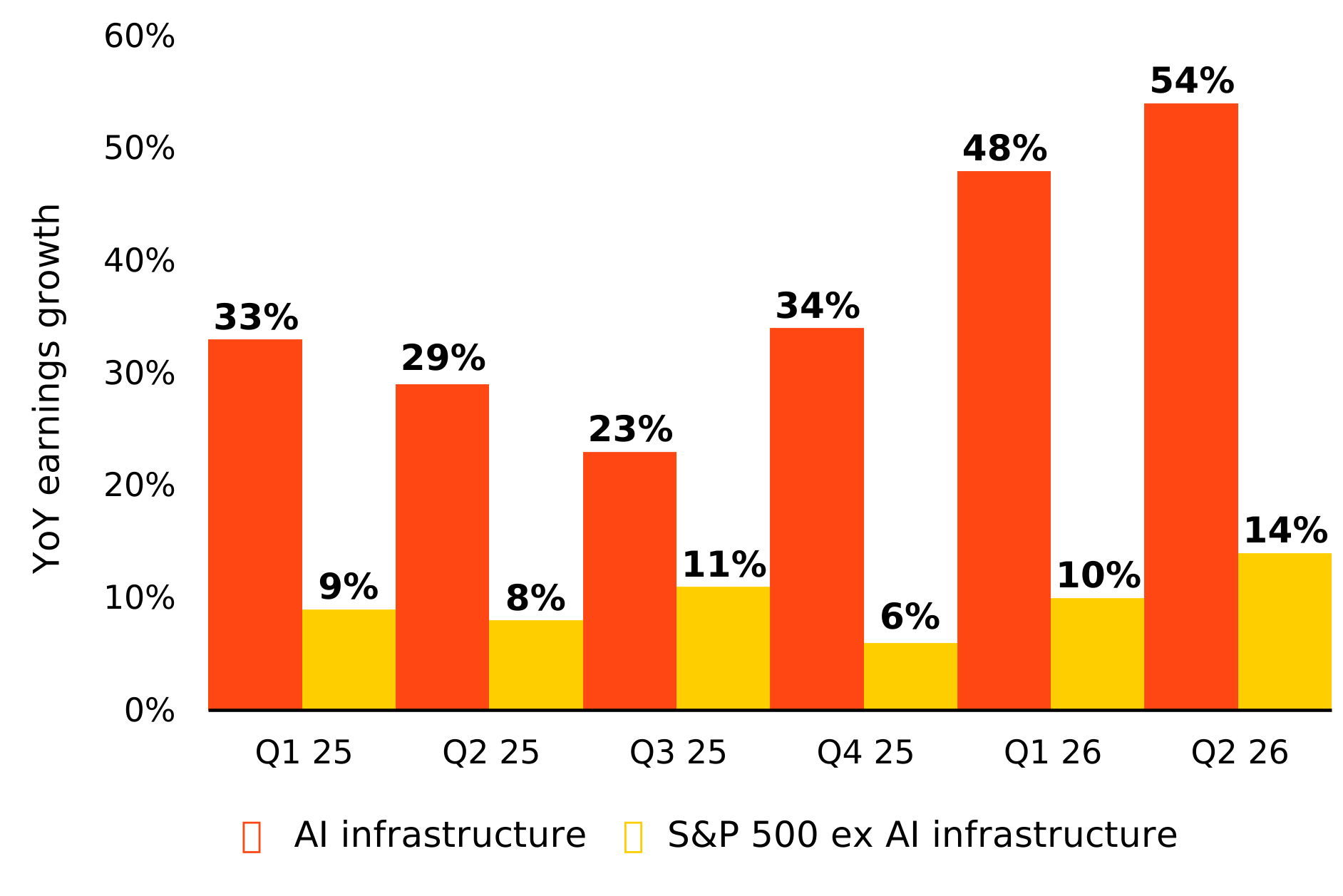
AI remains our top equity investment theme, as we believe the market continues to underappreciate the opportunity of the AI data center buildout. Overall, we believe AI-related names have the potential to lead again this year. AI stocks grew earnings markedly faster than their non-AI counterparts since the AI chatbot ChatGPT was released: the 46 stocks in the S&P index that we identify as AI stocks grew their aggregate net income by 30% per year from 2023-2025, versus just 3% for the non-AI cohort.12 We believe the above-average earnings growth can carry its momentum into 2026 as the AI infrastructure buildout is still in its early stages.
Figure 4: Even with strong returns in 2025, AI stocks got cheaper
BlackRock, Bloomberg. AI and non-AI companies comprised by a custom basket by GPS Investment strategy. AI companies comprised of 46 companies within the S&P 500. Non-AI companies are S&P 500 ex AI basket companies. Past performance does not guarantee future results. As of Dec. 30, 2025.
Index performance does not reflect any management fees or expenses. Indexes are unmanaged and one cannot invest directly in an index. Past performance does not guarantee future results.
Even with strong fundamentals, AI related stocks saw wide swings in stock performance and high dispersion. Of the 46 AI stocks, 44 had a drawdown of at least 20% in 2025. Yet, 18 managed to post a total return of over 20% for the year. But at the same time, 12 AI stocks in the S&P 500 had negative performance in 2025. We expect volatility and dispersion to remain a persistent feature in 2026, as winners and losers within the AI theme continue to emerge.13
Based on recent data, we expect over $700 billion to be spent on AI infrastructure in 2026 as hyperscalers, sovereign entities, enterprises, neoclouds, and AI labs build increasingly large AI data centers that can manufacture “AI tokens,” or units of data used for AI models to generate intelligence.14 The scale and complexity of the intelligence being generated is expanding exponentially as agentic AI and systems that process multiple types of data become more capable. So far, most people that have used AI have interacted with text-to-text chatbots, which utilize little computing power when compared with other uses of AI, such as image/video generation, agentic systems, and robotics. These more complex use cases (such as self-driving taxis) are in their infancy but expanding fast.15 In our view, 2026 will bring more technological progress, with new capabilities and productivity gains unlocked by larger AI models trained on today’s most advanced chips.
2 – Beyond AI: Improving fundamentals stretch across U.S. equities
The second half of 2025 delivered evidence of broadening out, in both returns and earnings growth. All 11 sectors of the S&P 500 posted annual gains – a rarity in recent years.16 The top five weights in the S&P 500 contributed 29% of the index’s 11% gain in the latter half of the year.17 Since 2020, the top five names have been responsible for 45% of annual returns.18
Earnings growth outside of the AI theme strengthened meaningfully in Q3. Ten of the 11 sectors beat Q3 preseason forecasts, and the median S&P 500 stock delivered its strongest earnings per share growth in four years. Using the S&P 500 excluding technology and Communication Services as a proxy, year-over-year earnings per share growth accelerated to 12% in Q3 from just 3% in Q2.19 While that level still trails tech and Communication Services growth (24%), the rate of change underpins a positive inflection in fundamentals beyond AI, in our view. Importantly, market performance rarely mirrors the level of earnings growth – returns are often more sensitive to changes in expectations. Consider last year: the S&P 500’s median weekly return was positive in weeks with net upgrades to forward earnings per share forecasts, and negative in weeks with net downgrades.20
Figure 5: Gap closes between growth and value
BlackRock, Bloomberg, Refinitiv. S&P Growth represented by S&P 500 Growth Index, S&P Value represented by S&P 500 Value Index. As of Dec. 9, 2025. Asterisks represent forecasts (as of Dec. 9, 2025). Forward looking estimates may not come to pass. Past performance does not guarantee future results.
This backdrop supports our broader U.S. equity market outlook: we remain most highly convicted on AI, but turn more constructive elsewhere, too.
We believe the earnings of many AI-leveraged companies today justify their higher prices, and in fact, it is earnings growth (not multiple expansion) that has been driving their returns.
The backdrop for global investing is shifting after a strong run for international markets in 2025. While a softer U.S. dollar may still support international exposures, the return boost from outright depreciation is unlikely to be as powerful as it was in 2025, in our view. This environment places greater emphasis on selectivity. Giving up U.S. exposure could be costly, so we believe investors are focused on international markets with credible earnings growth, improving macro fundamentals, and diversification benefits relative to portfolios that have become heavily concentrated in U.S. growth and AI-centric equities. We see two opportunity sets for international equities in the year ahead.
1 - Diversify within the AI trade
We believe Asian emerging markets may offer a key source of earnings growth and AI differentiation. Emerging markets (EMs) have entered a cyclical upswing in activity, now accounting for about 41% of global nominal GDP, supported by easing financial conditions and recovering exports.22 We see the strongest opportunities in Asian emerging markets, which offer direct exposure to the global AI buildout and the highest earnings growth expectations alongside attractive fundamentals.
Figure 6: Select EM earnings growth boosted by AI-associated industries
LSEG Refinitiv, as of Dec. 8, 2025. EM industries categorized by IBES, developed markets represented by MSCI EAFE Index, Emerging markets represented by MSCI Emerging Markets Index. AI-associated industries selected if major constituents either develop AI tools and systems or leverages AI to transform its operations, services, and efficiency. Forward looking estimates may not come to pass.
EMs in Asia complement U.S. mega-cap leaders with earlier-stage, capacity-driven beneficiaries. U.S. leadership is anchored in model development, chip design, cloud platforms, and enterprise software. Asia’s leadership is tied to semiconductor manufacturing, energy infrastructure and cost-efficient model deployment. The data highlight this distinction:
Figure 7: Top 3 industries per market by weight
Bloomberg, as of Dec. 8, 2025. Regions represented by respective MSCI index, industry groups represented by S&P GICS industries.
2 - Diversify outside the AI trade
While growth in developed markets (DM) has lagged EMs, many DM equity markets carry higher weights to value-oriented sectors, offering potential diversification from AI-led concentration. The policy backdrop supports selectivity: we do not expect fiscal or monetary easing to lift all DM sectors equally. Dividend-paying equities can also serve as potential diversifiers in an AI-led equity sell-off. Their tilts toward value and lower earnings volatility can help counterbalance long-duration AI exposures. International dividend payers, in particular, can offer income stability and sector diversification at a time when recent U.S. equity returns have largely been tied to a relatively narrow group of AI beneficiaries.
Recent polling shows that our clients are increasingly looking internationally for portfolio diversification (38%), alongside traditional asset classes like alternatives and private markets.28
International outperformance was an underappreciated story of 2025. Of course, strong performance doesn’t guarantee what comes next, but we see many reasons why international equities could thrive again in 2026.
We anticipate the most pressing problems facing investors in 2026 will be how to seek portfolio income and targeted diversification. Income may become more of an issue for investors because the Fed has cut rates, while diversification takes on new urgency because of the increasing role that the AI theme plays in portfolios. Here we outline approaches to consider for these two key challenges.
Investors face a structurally different income regime in 2026 as markets transition toward an environment where two policy rate cuts are expected.29
Elevated yields in money market funds and other cash-like instruments are likely to fade as the rate environment normalizes, weakening the income buffer against ongoing portfolio challenges such as persistent inflation. With an unprecedented amount of capital still concentrated in cash, income generation is increasingly becoming a portfolio-level priority.
At the same time, we believe the opportunity set for yield is expanding due to the combination of a resilient U.S. economy and strong AI-driven financing demand. Options income strategies can help investors with a differentiated source of return by seeking to capture volatility risk premium through covered call writing, generating income while maintaining some exposure to the equity market’s long-term growth potential.
Investors today have access to a broad “income toolkit” across public and private markets (Figure 8).
Figure 8: Income toolkit
Source: Bloomberg, BlackRock, view as of Dec. 9, 2025 from the BlackRock Investment and Portfolio Solutions team. Views are subject to change. Correlation claims based on monthly data from January 2015 to December 2025, using S&P 500 Index to represent public equity market, Bloomberg US Aggregate Bond Index to represent public core fixed income exposures, Preqin Private Credit North America Index (Index track funds focused on lending and credit strategies across U.S. and Canadian markets) to represent private credit and private infrastructure.
Most importantly, sourcing income holistically can enable not only a meaningful pickup in portfolio yield potential, but also a more balanced risk profile. This is an especially important consideration as investors navigate elevated U.S. equity concentration and increasingly AI-driven market dynamics.
The greatest efficiency gains have historically come from combining public and private income sources. Our blended model portfolio starts from a standard 60/40 allocation and reallocates 20% from public equities and 20% from fixed income into a blended public and private income allocation. This approach has historically delivered similar returns with meaningfully lower risk when compared to a pure public market portfolio (in yellow), while also achieving higher returns at comparable risk levels to a private only income solution (in orange). Our finding is that blending public and private income engines has historically improved portfolio efficiency.
Figure 9: Multi-source income has driven portfolio efficiency
Source: Morningstar, Preqin, MPI. Analysis period: 01/01/2010 – 06/30/2025. Risk represented by standard deviation. Public income sources representative of a 50% stocks, 30% bonds, 10% dividend, 10% High Yield. Private income sources represented by 50% stocks, 30% bonds, 20% private credit, 10% infrastructure. High Yield: iBoxx USD Liquid High Yield Index TR Index. Dividend: Morningstar Dividend Yield Focus Index. 60/40 Benchmark: 60% S&P 500 Index / 40% Bloomberg US Aggregate Bond Index. Preqin Private Credit North America Index: Index track funds focused on lending and credit strategies across U.S. and Canadian markets. Preqin Infrastructure North America Index: Index track funds focused on infrastructure strategy across U.S. and Canadian markets. Preqin Index return data are de-smoothed by BlackRock for private markets using the Getmansky-Lo-Makarov (GLM) model. Index performance is for illustrative purposes only. Index performance does not reflect any management fees or expenses. Indexes are unmanaged and one cannot invest directly in an index. Past performance does not guarantee future results.
Many investors are considering the role of AI in their portfolios, whether they’ve intentionally allocated to the theme or not.30 A handful of mega-cap technology and AI-adjacent companies are responsible for an outsized portion of the S&P 500’s performance in recent years, and these firms now represent 38% of companies in the index.31 That shift has left many investors, even those without explicit AI allocations, more exposed to the same underlying growth and innovation drivers than they may realize.
Figure 10: Correlation of major asset classes to U.S. technology
Source: BlackRock, Bloomberg, Morningstar, LBMA, as of Dec. 8, 2025. Data is from January 2015 to August 2025,S&P 500 Information Technology (TR USD) to represent US tech, S&P 500 (TR USD), Bloomberg U.S. Aggregate Bond (TR USD), Bloomberg Bitcoin spot price to represent Bitcoin, LBMA Gold Price PM (USD) to represent gold, Equity Market Neutral, Macro Trading, and Multi-strategy fund categories are represented by HFRI Equity market neutral Index, HFRI Multistrategy Index, and HFRI Macro Trading Index, 60% S&P500/ 40% Bloomberg U.S. Aggregate hypothetical portfolio.
This concentration challenge is reinforced by a structural shift in how traditional hedges behave. For decades, long-duration government bonds reliably offset equity drawdowns, offering a dependable source of diversification.32 But that relationship has become less stable. Post-pandemic inflation uncertainty, larger supply-side and fiscal pressures, and heightened rate volatility have undermined the ability of duration to effectively hedge equity risk. While stock–bond correlations have improved in recent months, they remain far from the deeply negative levels that once anchored portfolio diversification. This means the traditional hedging relationship has not fully returned, leaving portfolios that appear diversified on paper potentially more exposed in practice.
To address concentration risk and the reduced hedge effectiveness of traditional assets, investors can build a “diversified diversifier” allocation. This is an intentional set of exposures that broaden return drivers and improve resilience across a wider range of macro regimes. This framework spans two complementary categories:
Targeted volatility alpha diversifiers: Hedge fund strategies
Alternative investment solutions such as hedge fund strategies offer diversified sources of return potential with targeted volatility ranges and low correlation to traditional markets.
These strategies aim to deliver risk-adjusted returns independent of the AI-led equity cycle or the interest-rate dynamics that influence duration. By reducing portfolio beta, stabilizing drawdowns, and improving Sharpe ratios, hedge fund exposures can help rebuild the diversification that traditional hedges once supplied.
High-volatility beta diversifiers: Bitcoin and gold
Higher-volatility beta assets like Bitcoin and gold can also serve as powerful complements to a traditional portfolio. When analyzing assets with low correlations to stocks and bonds, a small allocation even to high volatility assets can reduce overall portfolio volatility. However, above certain sizing thresholds, these assets may switch from portfolio diversifiers to portfolio amplifiers given their higher implied and realized risk.
Figure 11: Each diversifier brings its different risk-return benefits
Source: Morningstar, MPI, Bloomberg, MSCI, LBMA and BlackRock. Data from September 2020 to August 2025 using monthly frequency, and Data is shown for S&P 500 Index, Bloomberg U.S. Aggregate Bond, Bloomberg Bitcoin spot price, Bloomberg Gold Spot, Hedge Fund represented by HFRI North America Hedge Fund index. Risk is calculated using standard deviation of returns. As of December 8, 2025. Index returns are for illustrative purposes only and do not represent actual fund performance. Index performance does not reflect management fees, transaction costs or expenses. Indexes are unmanaged and one cannot invest directly in an index. Past performance does not guarantee future results
The iShares Trusts are not investment companies registered under the Investment Company Act of 1940, and therefore are not subject to the same regulatory requirements as mutual funds or ETFs registered under the Investment Company Act of 1940. Investments in these products are speculative and involve a high degree of risk.
In 2025, global stocks delivered strong returns despite periodic pullbacks, underscoring the value of staying invested in a diversified portfolio. Bonds once again acted as stabilizers, with Fed rate cuts boosting fixed income performance relative to cash. Looking ahead to 2026, many investors remain constructive on equities, while seeking balance through bonds, alternatives, and option-based strategies.


Investment vehicle
Asset class
What it seeks to provide
Portfolio benefits
Dividend Equities
Equity
Defensive sector exposures and inflation-aware cash flows
Balance growth-led AI exposures
Active Premium Income
Derivatives
Enhanced income via option premiums while staying in core exposures
Decrease potential trade-off between income and growth trade with an actively managed equity allocation
Index Buy-Write
Derivatives
Seeks to generate yield pick-up from option premiums
May act as a potential hedge when rates are volatile
Public Credit
Fixed Income
Attractive all-in yields even with tighter spreads, reliable carry
Diversified sector exposure
Private Infrastructure
Alternatives
Long-dated, inflation-linked cash flows supported by secular mega forces such as AI deployment and energy transition
Low correlation to public markets
Private Credit
Alternatives
Often a source of stable cash flow as banks retreat from middle-market lending
Low correlation to core fixed income exposures