

Multi-Asset

Quick read:
- The last three quarters of 2025 were characterized by a relatively boring, low-volatility rally. We view the current market equilibrium as somewhat fragile. Flows and pricing insights point to signs of market complacency, and we enter 2026 with limited directional equity exposures, short positions in long-dated government bonds, and short the US dollar.
- Divergences of corporate earnings trajectories, central bank balance sheet operations, and national fiscal policies have increased cross-country dispersion. As we start 2026, this creates a rich opportunity set for a high-breadth, macro investment approach.
Taylor Swift’s release of Life of a Showgirl might rank as one of the more interesting events of the last 150 days of market trading. After a tumultuous first 63 trading days that included DeepSeek, German Fiscal Emergence, and “Liberation Day”, markets then went on to spend three quarters climbing higher in a relatively boring, low-volatility rally. Global risk assets currently embrace a Goldilocks mindset toward One Big Beautiful Bill Act (OBBBA) tax cuts, European rearmament, US dollar weakness, Federal Reserve dovishness, and artificial intelligence (AI) capex. But below the surface, macro risk continues to be a meaningful driver of regional stock and bond returns that offers a rich opportunity set for those able to capitalize on economic divergences and price dislocations.1
As we look forward to the upcoming year, we believe that unbalanced positioning and high prices create a fragile market equilibrium. The broad risk rally of the last two years has crowded-in many investors and our flow and pricing insights show signs of complacency. The recent AI-enthralled market narrative rhymes with the US exceptionalism euphoria that characterized markets in late 2024; correspondingly, we hold minimal directional positions and maintain a relatively contrarian portfolio focused on the more attractive risk-return opportunities available in relative-value, cross-country positions.
Three market insights that inform our current tactical positioning include:
Balance sheet confusion
In the month of December 2025, the Federal Reserve (Fed) managed to both end its second Quantitative Tightening program (QT2) and also quickly initiate a new set of asset purchases. QT2 accomplished little in terms of tightening overall financial conditions in the US and the Fed’s ownership share of outstanding government duration actually increased throughout 2025.2 The chart below shows this counterintuitive loosening of US financial conditions juxtaposed against the material balance sheet tightening delivered by European central banks. Our interpretation is that the European Central Bank and Bank of England have successfully unwound the delivered quantitative loosening from their pandemic-related asset purchases whereas the Fed and Bank of Japan have de facto delayed a balance sheet normalization.
European central bank balance sheets tightened throughout 2025 whereas the Fed added to its duration holdings share and loosened net financial conditions
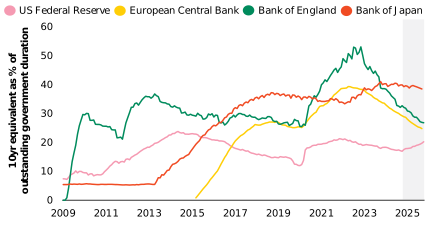
Source: BlackRock with data from the Federal Reserve, European Central Bank, Bank of Japan, Bank of England, as well as data from the Treasuries of Finance Ministries of the US, Japan, Germany, France, Italy, the EU and the UK.
The rising politicization of central bank balance sheets combined with a diffuse range of stated goals and objectives makes us think that asset holdings, sales, and potential purchases are likely to remain important for markets in 2026.3 The Q3 collapse in US commercial bank reserves that triggered the end of QT2 has set of complex drivers that are likely to remain persistent headaches for the Fed. A more accommodative balance sheet policy combined with more hawkish actions and speeches by non-US central bankers have motivated a shift in our bond shorts into European, Australian, and Canadian sovereign markets. We position directionally short duration with sticky, target inflation and hawkish monetary policy outside the US. US Treasury Secretary Scott Bessent describing the current “balance sheet function, which I can tell you no one understands,” makes us optimistic that dispersion in competing monetary transmission channels can remain a source of durable alpha.
Exponential margin growth?
Equity markets in 2025 benefitted from margin expansion and profitability growth aided by looser fiscal policy across major developed markets. OBBBA raised margins in the US, Europe was buoyed by the hopes of a German fiscal regime change, and Prime Minister Takaichi’s LDP victory in Japan priced the possibility of Abenomics 2.0. However, these improvements in margins and profits have been unevenly distributed across firms. The plot below compares results for S&P 500 companies vs. a broader economy-wide set of companies, represented by the National Income and Product Accounts (NIPA). We note the degree to which the larger, listed, S&P 500 companies have been disproportionate beneficiaries.4
S&P 500 profit growth accelerated in 2025 and margin growth for large, listed US firms has diverged from economy-wide profit margins
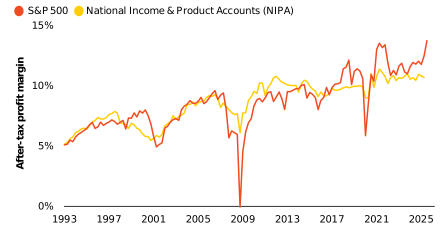
Source: BlackRock with data from Bureau of Economic Analysis (BEA) and Standard and Poor’s (S&P). Margins calculated as operating profits divided by sales.
Equity market forecasters and valuations have extrapolated some of 2025’s margin boosts into forward-looking estimates of S&P 500 profits, but the more muted trajectory of economy-wide metrics gives us pause. Equity indices are historically concentrated and our positioning signals indicate that market sentiment has become relatively one-sided in terms of its view on the cost-benefit of artificial intelligence deployment (AI) to future equity returns. The finance literature is replete with historical episodes of capex overinvestment, and we enter 2026 neutral directional stocks and with reduced exposure to US equities in the cross-section.5
Country selection is back!
Our investment process is built on identifying dislocations between macro fundamentals and market prices. A prerequisite for our ability to deliver uncorrelated alpha is heterogeneous macro fundamentals (like the aforementioned divergences in central bank policies, fiscal spending, and corporate earnings) that translate into asset price dispersion across countries. Today, that environment is clearly in place. As the charts below show, country-level equity returns and policy rates have broken out of the more synchronized, rate-suppressed environment that defined the 2010s and now look more like the early 2000s. In short: the backdrop for country selection has returned, and that creates a rich opportunity set for a high-breadth macro investment approach.
Country-level return dispersion across equities and cash policy rates has normalized
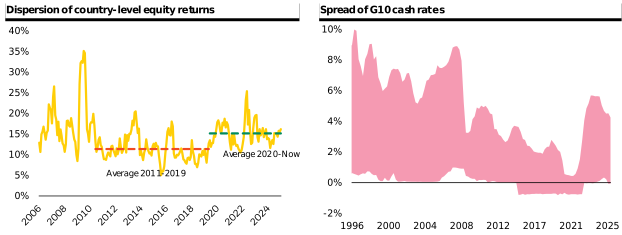
Source: BlackRock with data from Bloomberg, Morningstar as of 30 September 2025. Equity dispersion based on root mean squared error of rolling 12-month returns for 27 individual country equity markets within MSCI ACWI with futures contracts. Policy rate dispersion represented by spread of cash rates across G10 countries. The figures shown relate to past performance. Past performance is not a reliable indicator of current or future results and should not be the sole factor of consideration when selecting a product or strategy.
So what does it all mean for portfolios?
We enter 2026 with the Tactical Opportunities Fund positioned to capitalize on a high breadth set of relative value opportunities across countries. In government bond markets, the portfolio is long US Treasuries and Korean government bonds versus UK Gilts, Australian, and Canadian government bonds. Across equity markets, we favor under-owned countries like France and the UK against shorts in more crowded markets like Germany and high-flying emerging markets like Brazil and India.
From the perspective of advisors constructing diversified portfolios for their clients, the Tactical Opportunities Fund has served as a way to actively navigate and capture opportunities beyond the US – particularly as the average client portfolio remains tilted towards increasingly concentrated domestic equities. Against a backdrop of elevated uncertainty and unreliable stock-bond correlations, we also continue to see advisors seek out new sources of return and diversification in client portfolios, and the fund remains well positioned to help deliver those outcomes in 2026 and beyond.
Good luck and Happy New Year!
The Morningstar Rating™ for funds, or “star rating”, is calculated for managed products (including mutual funds, variable annuity and variable life sub-accounts, exchange-traded funds, closed-end funds, and separate accounts) with at least a three-year history. Exchange-traded funds and open-ended mutual funds are considered a single population for comparative purposes. It is calculated based on a Morningstar Risk-Adjusted Return measure that accounts for variation in a managed product’s monthly excess performance, placing more emphasis on downward variations and rewarding consistent performance. The top 10 of products in each product category receive 5 stars, the next 22.5 receive 4 stars, the next 35 receive 3 stars, the next 22.5 receive 2 stars, and the bottom 10 receive 1 star. The Overall Morningstar Rating for a managed product is derived from a weighted average of the performance figures associated with its three-, five-, and 10-year (if applicable) Morningstar Rating metrics. The weights are: 100 three-year rating for 36-59 months of total returns, 60 five-year rating/40 three-year rating for 60-119 months of total returns, and 50 10-year rating/30 five-year rating/20 three-year rating for 120 or more months of total returns. While the 10-year overall star rating formula seems to give the most weight to the 10-year period, the most recent three-year period actually has the greatest impact because it is included in all three rating periods. Past performance does not guarantee future results.
To obtain more information on the funds, including the Morningstar time period ratings and standardized average annual total returns as of the most recent calendar quarter and current month-end, please click on the fund product profile page above.

Tom Becker
Senior portfolio manager, Global Tactical Asset Allocation (GTAA) team
Investments
Insights
Retirement
Tools
Resources
About Us


1. Some of the notable divergences that we capitalized on included short German Bunds versus UK Gilts in Q1, long S&P 500 versus European equities in the summer, long US Treasuries versus UK, Canada, and Australia in Q4.
2. The Fed’s QT2 has morphed into a de facto Operation Twist as balance sheet operations withdraw a rising share of Treasury duration from markets - this has resulted from the intersection of the Treasury’s T-Bill heavy issuance and the composition of maturing SOMA holdings that have been reinvested out the curve.
3. We note the vastly different objectives and characterizations of balance sheet policy articulated by the Fed’s Lori Logan and the ECB’s Isabel Schnable in their recent speeches. Schnable’s characterization of “balance sheet normalization having a long way to go” and her focus on the loosening impact of remaining asset holdings contrasts with the Logan’s emphasis on “a safe and efficient liquidity environment” and her focus on liabilities side of the ledger to justify the end of QT2.
4. The US government shutdown delayed the release of the NIPA data for Q3, but the most recent revisions through Q2 point to a worrisome pre-OBBBA downdraft in the profit trajectory of non-listed and smaller US corporates. Smaller and non-listed US firms have disproportionately borne the higher input costs from tariffs, high electricity costs, and insurance premia.
5. Malmendier and Tate (2005) “CEO Overconfidence and Corporate Investment,” Journal of Finance Vol 60 pp2661-2700, summarize an aspect of this phenomenon succinctly “Overconfident CEOs systematically overestimate the return to their investment projects. If they have sufficient internal funds for investment and are not disciplined by the capital market or corporate governance mechanisms, they overinvest relative to the first–best.”
This material is provided for educational purposes only and is not intended to constitute investment advice or an investment recommendation within the meaning of federal, state or local law. You are solely responsible for evaluating and acting upon the education and information contained in this material. BlackRock will not be liable for direct or incidental loss resulting from applying any of the information obtained from these materials or from any other source mentioned. BlackRock does not render any legal, tax or accounting advice and the education and information contained in this material should not be construed as such. Please consult with a qualified professional for these types of advice.
This information should not be relied upon as research, investment advice, or a recommendation regarding any products, strategies, or any security in particular. This material is strictly for illustrative, educational, or informational purposes and is subject to change.
The Tactical Opportunities Fund is actively managed and its characteristics will vary.
BlackRock offers investments across a comprehensive range of asset classes and exposures, addressing investor needs with respect to growth, income, and capital preservation.
The fund is actively managed and its characteristics will vary.
Bond values fluctuate in price so the value of your investment can go down depending on market conditions.
International investing involves special risks including, but not limited to currency fluctuations, illiquidity and volatility. These risks may be heightened for investments in emerging markets.
Fixed income risks include interest-rate and credit risk. Typically, when interest rates rise, there is a corresponding decline in bond values. Credit risk refers to the possibility that the bond issuer will not be able to make principal and interest payments.
Asset allocation strategies do not assure profit and do not protect against loss.
The fund may use derivatives to hedge its investments or to seek to enhance returns. Derivatives entail risks relating to liquidity, leverage and credit that may reduce returns and increase volatility.
Investing in small- and mid-cap companies may entail greater risk than large-cap companies, due to shorter operating histories, less seasoned management or lower trading volumes.
Please ask your clients to consider the investment objective, risk, charge and expense of the funds carefully before investing. The prospectus and, if available, the summary prospectus contain this and other information about the fund and are available, along with information on other BlackRock funds, by calling 800-882-0052 or at www.blackrock.com. The prospectus and, if available, the summary prospectus should be read carefully before investing.
Prepared by BlackRock Investments, LLC, member FINRA.
©2026 BlackRock, Inc. or its affiliates. All rights reserved. BLACKROCK is a trademark of BlackRock, Inc. or its affiliates. All other trademarks are those of their respective owners.
MASS0326-5279494-EXP0327
MASS0126-5144868-EXP0127