

Fixed Income

Quick Read
- Global government bonds that are US$-hedged have historically delivered higher returns and lower volatility compared to similar US-only bond indices. They also offer more attractive equity diversification compared to bond indices that contain corporate credit.
- US investors have historically held low allocations to global government bonds and have therefore missed out on a diversifying source of returns (and yield pick-up) that may be particularly valuable in this era of rising risks for the US Treasury market.
US$-hedged global government bonds deliver portfolio benefits
Portfolio constructors typically look to bonds to deliver three things: yield/return, capital preservation, and equity diversification. As shown in the charts below, US$-hedged global government bonds are compelling across each of these dimensions relative to typical US-only and non-hedged index allocations.
Headline-1,Paragraph-2
Headline-2,Paragraph-3
Headline-3,Paragraph-4
Yield uplift of FX hedge
Hedging foreign exchange risk in a global government bond allocation can create a yield uplift for foreign bonds in low policy rate countries. It also allows a global government bond portfolio to maintain a similar risk profile with domestic fixed income by removing exchange rate volatility.
Hedged foreign yields have historically been higher than the yields of US-only bond indices
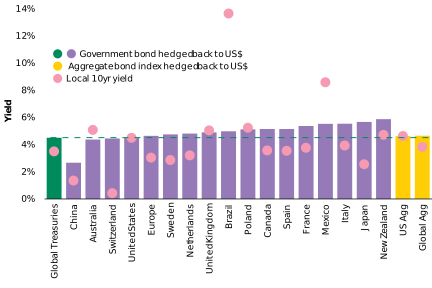
Source: BlackRock with data from Aladdin as of April 30, 2026. Hedged yields are computed as the annualized difference between the foreign yield and the 3-month FX forward points. Emerging market yields showing 5-year yields are Brazil, China, Mexico and Poland. Index performance is for illustrative purposes only. Index performance returns do not reflect any management fees or expenses. Indexes are unmanaged and one cannot invest directly in an index. Past performance does not guarantee or indicate future results.
Better returns with lower risk
Diversifying bond allocations globally have improved portfolio results with higher total returns and lower overall portfolio volatility.
US$-hedged global government bonds have delivered higher risk-adjusted returns
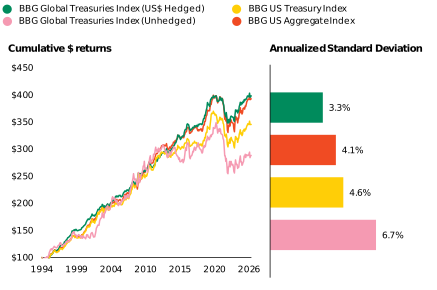
Source: BlackRock with data from Morningstar as of May 31, 2026. Annualized standard deviation is represented from 1994 to 2026. Index performance is for illustrative purposes only. Index performance returns do not reflect any management fees or expenses. Indexes are unmanaged and one cannot invest directly in an index. Past performance does not guarantee or indicate future results.
Improved equity diversification
US$-hedged global government bonds have been more diversifying to equities compared to non-hedged bond indices and those with corporate credit exposure.
Hedged government bond indices historically have been more diversifying to equities
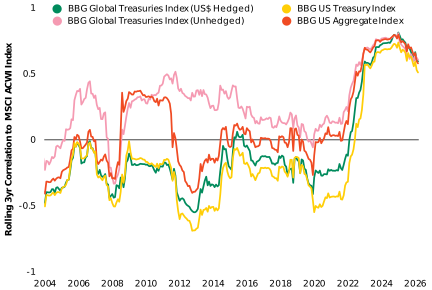
Source: BlackRock with data from Morningstar as of May 31, 2026. Index performance is for illustrative purposes only. Indexes are unmanaged and one cannot invest directly in an index. Past performance does not guarantee or indicate future results.
In our view, an allocation to US$-hedged global government bonds is a strong complement to the fixed income portfolio of the typical US asset allocator. A global government bond index provides exposure to a diverse set of sovereign issuers and their associated macro fundamentals of growth, inflation and policy. Hedging the foreign exchange risk lowers portfolio volatility and provides a yield uplift when US$ cash rates are high, relative to foreign markets. Additionally, these benefits of a hedged global government bond index come without corporate credit risk and the higher equity correlation associated with fixed income allocations that contain corporate bonds.
Along with the strategic advantages of a global government bond allocation, we also see tactical reasons to pursue greater diversification within fixed income exposures – in particular, elevated US inflation, profligate US fiscal policy and a Federal Reserve that continues to sell long-dated US Treasuries in its QT program.
The Morningstar Rating™ for funds, or “star rating”, is calculated for managed products (including mutual funds, variable annuity and variable life sub-accounts, exchange-traded funds, closed-end funds, and separate accounts) with at least a three-year history. Exchange-traded funds and open-ended mutual funds are considered a single population for comparative purposes. It is calculated based on a Morningstar Risk-Adjusted Return measure that accounts for variation in a managed product’s monthly excess performance, placing more emphasis on downward variations and rewarding consistent performance. The top 10 of products in each product category receive 5 stars, the next 22.5 receive 4 stars, the next 35 receive 3 stars, the next 22.5 receive 2 stars, and the bottom 10 receive 1 star. The Overall Morningstar Rating for a managed product is derived from a weighted average of the performance figures associated with its three-, five-, and 10-year (if applicable) Morningstar Rating metrics. The weights are: 100 three-year rating for 36-59 months of total returns, 60 five-year rating/40 three-year rating for 60-119 months of total returns, and 50 10-year rating/30 five-year rating/20 three-year rating for 120 or more months of total returns. While the 10-year overall star rating formula seems to give the most weight to the 10-year period, the most recent three-year period actually has the greatest impact because it is included in all three rating periods. Past performance does not guarantee future results.
To obtain more information on the funds, including the Morningstar time period ratings and standardized average annual total returns as of the most recent calendar quarter and current month-end, please click on the fund product profile page above.
Subscribe for the latest market insights and trends
Get the latest on markets from BlackRock thought leaders including our models strategist, delivered weekly.
Please try again


Tom Becker
Portfolio Manager, Global Tactical Asset Allocation Team

Amy Zhao
Portfolio Manager, Global Tactical Asset Allocation Team

Simon Wan
Portfolio Manager, Global Tactical Asset Allocation Team
Filter by:
- All
- ARTICLE
- Practice Management
- Tools
Investments
Insights
Retirement
Tools
Resources
About Us


Carefully consider the investment objectives, risks, charges and expenses of the funds carefully before investing. The prospectuses and summary prospectuses contain this and other information about the funds and are available, along with information on other BlackRock funds, by calling 800-882-0052 or at blackrock.com. The prospectus and, if available, the summary prospectus should be read carefully before investing.
Important risks: These funds are actively managed and their characteristics will vary. Stock and bond values fluctuate in price so the value of your investment can go down depending on market conditions. International investing involves special risks including, but not limited to political risks, currency fluctuations, illiquidity and volatility. These risks may be heightened for investments in emerging markets. Fixed income risks include interest-rate and credit risk. Typically, when interest rates rise, there is a corresponding decline in bond values. Asset allocation strategies do not assure profit and do not protect against loss. These funds may use derivatives to hedge its investments or to seek to enhance returns. Derivatives entail risks relating to liquidity, leverage and credit that may reduce returns and increase volatility.
The opinions expressed are those of Tom Becker and Simon Wan and are subject to change. There is no guarantee that the forecasts made will come to pass. This material does not constitute investment advice and is not intended as an endorsement of any specific investment. Investment involves risk. Information and opinions are derived from proprietary and non-proprietary sources.
This information should not be relied upon as research, investment advice, or a recommendation regarding any products, strategies, or any security in particular. This material is strictly for illustrative, educational, or informational purposes and is subject to change.
Prepared by BlackRock Investments, LLC, member FINRA.
©2026 BlackRock, Inc. or its affiliates. All Rights Reserved. BLACKROCK and iSHARES are trademarks of BlackRock, Inc. or its affiliates. All other trademarks are those of their respective owners.
MASS0726-5715027-EXP0727