INSIDE THE PRACTICE

4 ways to save time and serve more high-net-worth clients

Alarm clock against a blue background

Key takeaways

  • If you want to grow your business by serving more high-net-worth clients, you will need to free up time and resources to meet their complex needs and high expectations.
  • Segmenting your service model and leaning on experts can help you consistently deliver the right level of service and personalization to each client.
  • Streamlining portfolio construction and using AI to accelerate workflows can save time for important client conversations and HNW planning decisions.

Advisor capacity is essential for HNW client growth

Focusing on wealthier clients can be a powerful growth strategy, but it can also strain your bandwidth. High-net-worth and ultra-high-net-worth clients have more complex needs and higher service expectations, requiring greater coordination across investments, tax considerations, estate planning and family dynamics. The question is not whether you can deliver that level of service but how you will find the time to do it consistently.

Advisors who successfully serve wealthy clients at scale have created capacity by adhering to a segmented client service model, leaning on experts, streamlining their investment process and accelerating workflows with artificial intelligence. Together, these four strategies can free your team to focus on what your HNW and UHNW clients value most while pursuing larger prospects and strengthening loyalty with the wealthy clients you already serve.

1. Provide the right services to the right clients

HNW and UHNW clients expect advanced planning services and innovative solutions to their complex problems. While you may be well equipped to deliver on those expectations, offering the same level of service to every client can dilute the experience for your most valued clients and create an unprofitable burden on you and your team. 

Being intentional about the services you provide to each client is a more effective approach. Implement a segmented client service model, or revisit your current model, to align your time and resources with the value and needs of each client relationship.

Start by identifying your ‘ideal client.’ An ideal client’s needs are closely aligned with your value proposition. They are profitable and a good source for referrals that can help your business grow. The clients who fit this profile represent the top tier of your service model, where you offer your full range of services. 

Organize the remainder of your clients into wealth segments and determine which services you will offer to each segment and how often. To guide these decisions, within each segment, focus on the services that are both valued by the clients and profitable for your team to provide to them. As you evaluate your offering, consider whether any lower-value services can be discontinued, standardized or delivered less frequently. The resulting segmented framework should provide the appropriate level of service for each client’s needs and make the most efficient use of your time.

Your segmented client service model is only as effective as the team structure and discipline you put behind it. Assign senior advisors to the largest and most complex relationships, then give associate and junior advisors ownership of middle and lower tiers with defined escalation points for specialized or sensitive client needs. When roles and service levels are clear across segments, your team can deliver a consistent client experience.

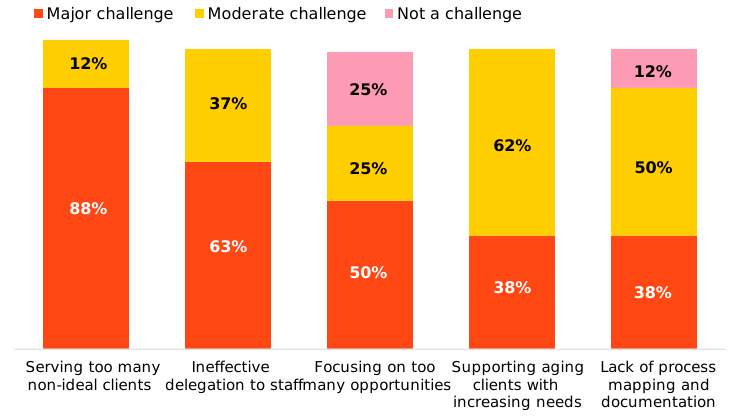
Whether you are establishing a segmented client service model for the first time or revisiting an existing one, you may discover during the process that some of your clients are no longer a good fit for your business. Serving too many non-ideal clients is the most common hinderance to advisor productivity today. Removing services from a client relationship or transitioning a relationship to another advisor can be uncomfortable, but protecting your time allows you to deliver more value to the clients you wish to attract and serve.

Serving too many non-ideal clients weighs on advisor productivity
% of advisors citing as a productivity challenge


Chart showing how serving too many non-ideal clients weighs on advisor productivity

Source: Cerulli, “U.S. Advisor Metrics, 2025.”

Segment your clients to boost growth

Our step-by-step guide provides specific guidance to help you define your ideal client, create a segmentation framework, align your services to client needs, and communicate service changes to clients.
People icon

2. Lean on experts to deliver specialized HNW planning

Serving wealthy clients requires specialized expertise, but coordinating estate plans, managing tax costs, planning for liquidity events and other personalized services can quickly devour your time. Consider sharing the workload with specialists on your team, trusted professionals in your network or third-party experts.

Use your team’s expertise strategically. As shown in the chart above, the second largest obstacle to advisor productivity is ineffective delegation. Review your team’s capabilities and identify who can effectively deliver specialized services. If you plan to expand your team, seek the expertise that is most valued by your ideal clients. Alternatively, hiring a junior advisor to serve lower-tier clients or deliver basic services can free up time for senior advisors to provide more specialized services.

Create leverage through your professional network. Rather than trying to deliver every service yourself, build relationships with attorneys, accountants, business valuation professionals, insurance specialists and other experts who can support specific client needs. This approach can benefit everyone involved: your clients receive specialized advice, your network partners gain business opportunities, and you increase your service capacity without having to build up every capability in-house.

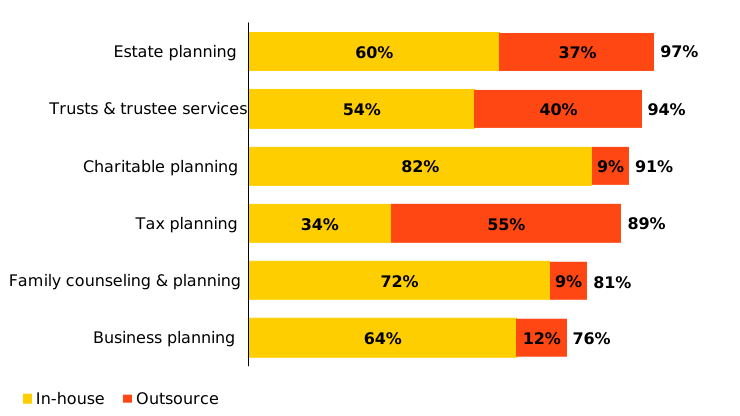
Outsource selectively. Third-party providers can be an effective solution, particularly for services that require dedicated infrastructure, technology or deeper levels of expertise. Outsourcing does not mean giving up ownership or accountability; clients still look to you to ensure the service is delivered well. With your proper due diligence, clear expectations and ongoing oversight, the right third-party relationships can help you serve clients more efficiently while preserving client trust.

Advisors often outsource HNW services
% of practices offering services in-house and by outsourcing

Chart showing that advisors often outsource HNW services

Source: Cerulli, “U.S. High-Net-Worth and Ultra-High-Net-Worth Markets, 2025.”

3. Streamline your investment process

HNW and UHNW clients often require sophisticated investment solutions, including strategies to manage concentrated stock risk, access to private markets, and tax-saving strategies such as direct indexing and option overlays. Building personalized portfolios takes a significant amount of time, but if you enjoy it, don’t give it up completely. You can streamline your investment process while retaining control where you want to apply your own judgement.

Consider transitioning smaller accounts to model portfolios available through your home office or a third-party investment manager. Then lighten the load in your larger, more complex accounts by engaging an experienced investment management partner who can provide extensive research capabilities and advanced technology. In a custom model relationship, you decide which parts of your investment process you want to do yourself and which parts you want to outsource.

Advisors use model portfolios for clients of all sizes to shift more of their time toward relationship-building and providing personalized planning services. 79% of advisors who use models say it enables them to spend more time with HNW clients, and 55% of their HNW clients are invested in models.1

If you are unsure how you want to allocate your time between managing portfolios and interacting with clients, review your investment and business results over the past four quarters and answer these questions:

  • How many of the past four quarters did your portfolios outperform their benchmarks?
  • How much did your revenue increase as a direct result of that outperformance?
  • How many hours did it take you to generate the outperformance?
  • What was the hourly cost (salary and resources) of generating the outperformance?
  • Compare the revenue benefit to the cost. Was the outperformance worth the effort?

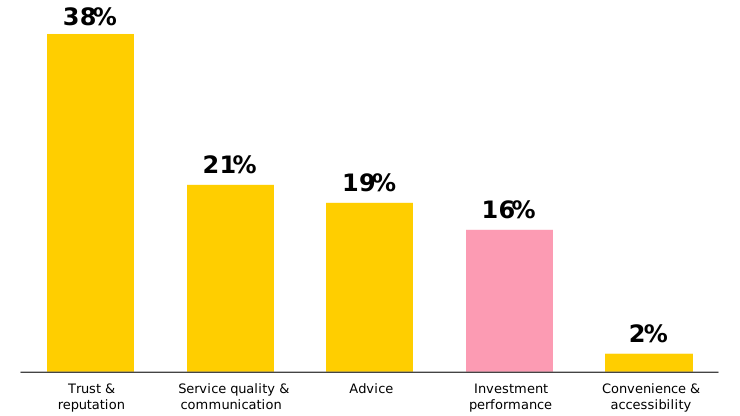
As you contemplate that last question, think about the bigger picture: What is most important to your ideal clients? Cerulli data shows that HNW and UHNW clients care more about your trustworthiness, service quality and advice – all of which require your time and attention.  Even still, partnering with a portfolio construction expert with a strong record of investment results can position you to continue seeking outperformance while spending more time with clients. When evaluating potential partners, also consider whether the level of customization, scalability across client segments, technology resources and engagement style is the right fit to help your business grow.

Investment performance is not a leading driver of client satisfaction
% of clients citing as a reason they are satisfied with their advisor

Chart showing that investment performance is not a leading driver of client satisfaction

Source: Cerulli, “U.S. High-Net-Worth and Ultra-High-Net-Worth Markets 2024.”

Choose how you want to use models

Seek outperformance your way: Use our industry-leading portfolios as a foundation, customize them for more complex needs, or build portfolios with BlackRock’s support.
red key icon

BUY: Portfolios designed for you

Access ready-to-use model portfolios across client objectives, maintained and managed by BlackRock.
Arrows branching in multiple directions

CUSTOMIZE: Portfolios designed with you

Customize model portfolios to reflect your investment views, client preferences and practice needs.
Crossed tools

BUILD: Portfolios designed by you

Build your own portfolios leveraging the strength of BlackRock’s institutional investment process and risk analytics.

4. Accelerate advisor workflows with AI

You can reclaim time by accelerating routine, repeatable work with tools and platforms powered by artificial intelligence. Start by identifying the tasks that consistently weigh on your team’s time, like preparing for client meetings, taking notes, writing emails, updating the CRM and onboarding clients.

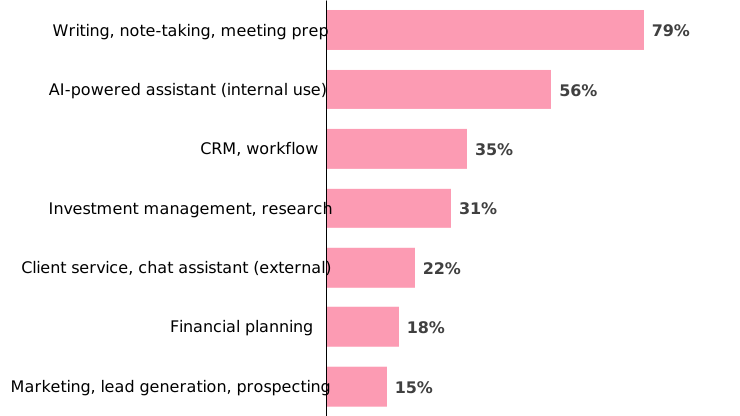
68% of advisors are using AI to some extent in their practice today, most commonly to streamline administrative work relating to client meetings.2 AI tools help advisors prepare for meetings by generating customized agendas, client briefs and summaries of prior client conversations. They can also be used to take meeting notes, draft meeting recaps and client emails, and create lists of follow-up items. While your oversight is still necessary, leveraging AI-powered technology can meaningfully reduce the time you spend preparing for, documenting and following up on client meetings.

Advisors favor AI tools that automate administrative work
% of AI-enabled advisors by use case

Chart showing that advisors favor AI tools that automate administrative work

Source: Fidelity Wealth Management Pulse Survey, 2025: “The current state of AI in wealth management.”

Other than client meetings, AI can make various laborious tasks faster and easier. Tools that summarize lengthy documents, extract key details and flag missing or conflicting information can streamline the way a team creates and manages client files, estate documents, tax materials and other planning inputs. Using AI for tasks that do not require your full expertise allows you to devote more time to the complex work and client relationships where your judgment matters most.

While there are numerous ways that AI can accelerate the growth and scale of an advisory practice, guardrails are critical. Ensure that sensitive data is protected, verify your inputs and review the outputs before using them in regulated workflows or client communications. When deciding whether to use AI for a particular task, consider whether it can save time without compromising your good judgment, compliance obligations, data security or your personal voice.

Capacity is a strategic advantage for moving upmarket

Capacity is no longer just an operational issue. For advisors pursuing growth with HNW and UHNW clients, it’s a strategic advantage. Advisors best positioned to move upmarket will be those making intentional choices about whom they serve and what they offer, while leveraging experts, model portfolios and AI technology to make their business more efficient. Protecting your time for complex planning conversations, family relationships and moments that shape client trust allows you to create a more scalable and referrable experience for the wealthy clients you want to serve.

BlackRock can help you unlock capacity to serve wealthier clients. Ask your BlackRock representative for more information and explore our online resources.

Jim Renitsky, CIMA®
Director, Head of BlackRock Business Consulting
Jim Renitsky, CIMA®, Director, is the head of BlackRock Business Consulting (BBC) within USWA Wealth Distribution. He helps advisors drive business growth through strategic planning, data-driven insights, peer study groups, and programs focused on enhancing the client experience.
Cullen Roberts, CEPA®, CIMA®
Director, Advisor Engagement
Cullen Roberts, CEPA®, CIMA® is Director of Advisor Engagement for BlackRock's US Wealth Advisory Business (USWA). USWA delivers BlackRock's full suite of resources including portfolio design research, investment process guidance, financial advisor technology, and practice management consulting.
  • INSIDE THE PRACTICE

    3 ways AI accelerates advisor growth and scale

    Learn how advisors use AI to streamline operations, enhance high-net-worth services and attract ideal clients with scalable, data-driven growth strategies.

  • Practice Management

    Attract and serve high-net-worth clients at scale

    High net worth investors present a significant opportunity for financial advisors. Learn how your practice can attract and retain high net worth clients.

  • Model Portfolio

    Whole Portfolio Solutions

    Explore BlackRock model portfolio solutions for advisors, including ready-made models, custom portfolios and guidance for building your own portfolios.

Frequently asked questions

  • Advisors can save time and create capacity by segmenting their client service model, leaning on internal and external experts, streamlining their investment process and using AI to accelerate routine workflows. These strategies can free up time for the complex planning and relationship-building that HNW and UHNW clients often require.

  • A segmented client service model helps advisors align their time and resources with the needs and value of each client relationship. Advisors can define appropriate services and service levels for each segment while reserving their most comprehensive offering for ideal clients.

  • Advisors can draw on specialists within their team, build relationships with attorneys, accountants and other professionals, or selectively outsource services that require specialized expertise, infrastructure or technology. This can expand capacity while allowing the advisor to maintain oversight of the client relationship.

  • Model portfolios can reduce the time required to build and manage individual portfolios, allowing advisors to devote more time to client relationships and personalized planning. Advisors can also use custom models or an investment management partner for more complex accounts while retaining control over the parts of portfolio construction they value most.

  • AI-powered tools can accelerate routine tasks such as preparing for client meetings, taking notes, drafting follow-up communications, updating CRM systems and onboarding clients. AI can also help summarize documents, extract key information and flag missing or conflicting information in planning materials.