

Tax

Key takeaways
- Business sales and other liquidity events often create significant opportunities for advisors to help clients invest their wealth and manage capital gains tax liabilities.
- Tax-managed investment strategies may allow clients to build diversified long-term investment portfolios while potentially reducing capital gains taxes.
- Preparing for a business sale well before the transaction closes can expand planning opportunities and help clients preserve more of the wealth they worked hard to create.
Liquidity events present opportunities for advisors
For many business owners, selling a successful company is the largest liquidity event of their lives. It may also generate the largest capital gains tax liability they will ever face. This creates powerful opportunities for advisors to demonstrate their strategic value.
The planning decisions business owners make before and after their sale can have a lasting impact on the wealth they have likely worked many years to create and now wish to preserve. Preparing far in advance of a sale is key to improving potential outcomes.
The story of Ethan, a hypothetical client, is an example of how you may be able to help business owners by offering investment strategies that seek to grow their wealth while potentially offsetting some of the capital gains from the sale of their business.
Early planning for a business sale can affect client outcomes
32-year-old Ethan Walker had built a successful California-based consulting firm and expected to sell it for approximately $10 million within the next 12 to 18 months in an all-cash transaction. His stock didn’t qualify for the Qualified Small Business Stock (QSBS) exclusion, and because his cost basis was effectively zero, nearly every dollar of the proceeds would be subject to capital gains tax. Ethan intended to explore new entrepreneurial opportunities after the sale.
Ethan met with his advisor, who helped him define his goal for the business sale: maximize after-tax sales proceeds while building a diversified portfolio designed to preserve and grow wealth over the long term.
His advisor explained that early planning often presents more valuable opportunities and guided Ethan through discussions about the timing of the sale, how to invest the proceeds, and how those choices might affect his portfolio and tax obligations. In consultation with Ethan’s tax advisor, they identified three planning actions that helped Ethan approach his business sale strategically.
1. Consider closing the sale early in the year
Ethan’s advisor explained that, if circumstances allow, closing the deal early in a calendar year would provide more time during which his portfolio might generate losses that may offset capital gains in the year of the sale. Instead of viewing the closing date as the finish line, Ethan now viewed it as the starting point of his long-term wealth strategy.
2. Put sale proceeds to work with taxes in mind
After years of concentrating his wealth in a privately owned business, Ethan would suddenly hold millions of dollars in cash that would need to support his long-term financial needs.
His advisor discussed investing a significant portion of the proceeds in a tax-managed 200/100 long/short strategy. Unlike a traditional long-only equity portfolio, the strategy seeks to provide meaningful market exposure through both long and short positions while harvesting available capital losses throughout the year in a tax-aware manner. Those losses may help offset capital gains from the business sale, subject to individual circumstances.
Recall that Ethan’s goal was two-fold: to maximize the after-tax proceeds from the business sale and build long-term wealth. Putting his sale proceeds to work in a separately managed account (SMA) that invests in a 200/100 long/short equity strategy allows him to seek both.
3. Align allocation sizes with desired outcomes
Ethan asked his advisor how much of the sale proceeds he should invest in the strategy. The answer, he said, depends on Ethan’s priorities. The advisor presented two hypothetical scenarios to illustrate how Ethan’s potential outcomes may differ depending on the portion of sale proceeds he chooses to invest in the strategy. Each scenario accounted for Ethan’s personal tax circumstances.
In the first hypothetical scenario, investing all the sale proceeds in the tax-aware 200/100 long/short equity strategy reduced Ethan’s net realized capital gain on the business sale from $10 million to approximately $5.2 million, which, in turn, reduced his capital gains tax from approximately $3.71 million to $1.93 million. Therefore, investing 100% of the sale proceeds in the strategy created a potential tax savings of roughly $1.78 million. In this scenario, Ethan would need to draw from other assets to fund allocations to other asset classes and to pay capital gains taxes.
However, Ethan does not expect to have other assets to draw from. He will be using some of the sale proceeds to fund a balanced portfolio that can support future business opportunities and pay capital gains taxes owed on the sale. His advisor illustrated a second hypothetical scenario where only 60% of the sale proceeds were invested in the 200/100 long/short strategy, which decreased Ethan’s net realized capital gains to $7.12 million, resulting in a capital gains tax of approximately $2.64 million. While he did not maximize the potential tax benefit of the strategy, he still saved approximately $1.07 million in capital gains tax while maintaining the liquidity he needs.
Hypothetical outcomes of a $10 million sale depending on client priorities
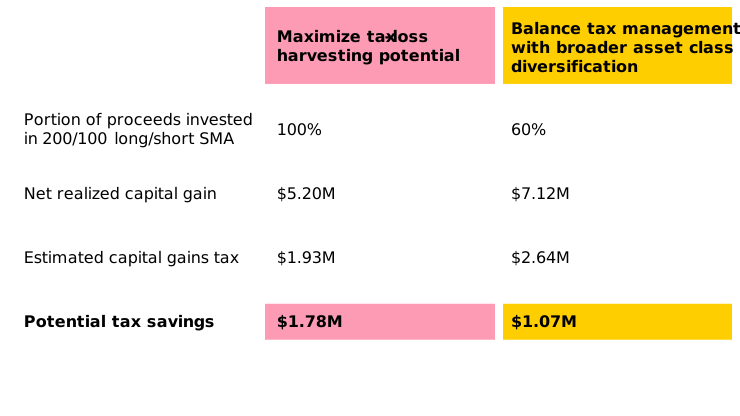
For illustrative purposes only. Assumes a hypothetical taxpayer who does not hold positions in their portfolio outside of their tax-managed 200/100 long/short SMA that may create potential issues under constructive sale, wash sale, or straddle rules, etc. Results will vary. Assumes top federal and CA long-term capital gains rate of 37.1% (23.8% + 13.3%). See Important Notes for risks associated with short selling and trading on margin.
These examples are for illustrative purposes only. Actual results will vary based on market conditions, investment performance, applicable tax laws and each client's individual circumstances.
While there isn't a single "right" allocation, in general the more proceeds invested in the tax-aware 200/100 long/short strategy, the greater the opportunity to harvest losses that may help offset gains from the sale of a business. Some clients may choose to invest a relatively modest portion of their sale proceeds in this type of product to balance the possible tax benefits with other investment goals, while others may allocate substantially more to maximize the possible benefits of tax loss harvesting. An appropriate allocation depends on the client's individual circumstances, objectives, risk tolerance and liquidity needs.
Deepen your relationships with business owners
When the transaction closed, Ethan wasn't simply walking away with the proceeds from a business sale. He was moving into the next chapter of his life with a thoughtful plan to preserve and grow his wealth, and a deeper appreciation for the advisor who helped him prepare long before the deal was finalized.
BlackRock can help you prepare high-net-worth and ultra-high-net-worth clients for liquidity events through tax-aware investment strategies, portfolio construction insights and practice management resources. Contact your BlackRock representative or explore our free online resources.

Lincoln Fleming, CPA/PFS, CFP, MAcc
Senior After-tax Wealth Strategist
Lincoln Fleming, CPA/PFS, CFP, MAcc is a Director and After-tax Wealth Strategist within SMA Solutions at Blackrock, where he helps clients focus on the intersection of income taxes, investing, charitable giving and estate planning.
FAQs
-
Planning well before closing may create additional opportunities to coordinate tax management, investment strategy and long-term wealth planning before taxable gains are realized.
-
Depending on the client's circumstances, tax-managed strategies may help clients maintain market exposure while harvesting available capital losses that may offset capital gains. Clients should consult a professional tax advisor.
-
Business owners expecting to sell privately held companies, founders approaching succession events and entrepreneurs anticipating significant liquidity, among others, may benefit from proactive planning before a transaction closes.
Investments
Insights
Retirement
Tools
Resources
About Us


Investing involves risks, including possible loss of principal.
Long/short strategies involve additional risks, including short sales, leverage, borrowing costs and the potential for unlimited losses on short positions. Tax-loss harvesting cannot guarantee a profit or eliminate the possibility of loss and may not be beneficial for every investor. Investors should consult their tax, legal and financial professionals before implementing any strategy. Information derived from BlackRock's hypothetical liquidity-event illustration.
Wash sale restrictions prevent investors from realizing a loss on a sale and buying a “substantially identical” security 30 days before and after the sale of the security. While “substantially identical” remains undefined some tax practitioners suggest that investors ought to consider the degree to which the funds’ holdings may overlap and the degree of difference in prospective returns. The information and examples provided are not intended to be a complete analysis of every material fact respecting tax strategy and are presented for educational and illustrative purposes only. Tax consequences will vary by individual taxpayer and individuals must carefully evaluate their tax position before engaging in any tax strategy. BlackRock does not provide tax advice. We urge you to consult with your client and a tax professional regarding the potential consequences of this rule.
Mentioned products may include investments that are less tax-efficient than others and may have complex tax consequences when aggregated with other positions across an investor’s entire portfolio, in particular because of the wash sale rules, constructive sale rules, and the straddle rules, among others.
Prospective investors are urged to consider the impacts of any of these strategies with their investment and tax advisors.
This article is for informational purposes only and should not be construed as tax, legal or investment advice. The hypothetical client example is for illustrative purposes only and does not represent any actual investor or actual investment results. The strategies discussed may not be appropriate for all investors.
This information should not be relied upon as research, investment advice, or a recommendation regarding any products, strategies, or any security in particular. This material is strictly for illustrative, educational, or informational purposes and is subject to change.
This material is provided for educational purposes only and does not constitute investment advice. The information contained herein is based on current tax laws, which may change in the future, possibly with retroactive effect. BlackRock cannot be held responsible for any direct or incidental loss resulting from applying any of the information provided in this publication or from any other source mentioned.
The information provided in this material does not constitute any specific legal, tax or accounting advice. Please consult with qualified professionals for this type of advice.
BlackRock does not provide tax advice. Clients are urged to consult with a tax professional regarding the potential tax consequences of the matters discussed herein.
The information and opinions contained in this material are derived from proprietary and nonproprietary sources deemed by BlackRock to be reliable, are not necessarily all-inclusive and are not guaranteed as to accuracy.
The Aperio strategies discussed are made available by Aperio Group, LLC, a wholly owned subsidiary of BlackRock, Inc., which is a registered investment adviser.
Prepared by BlackRock Investments, LLC, member FINRA.
©2026 BlackRock, Inc. or its affiliates. All Rights Reserved. BLACKROCK and APERIO are trademarks of BlackRock, Inc. or its affiliates. All other trademarks are those of their respective owners.
MKTG0926-MH-5803421-EXP0927