

Separately Managed Account

Mar 05, 2026|ByDaniel M. Greenberg, CFA Lisa Goldberg
The Bottom Line:
- Offsetting capital gains from a near-term liquidity event may require abundant capital losses, which in some cases can be supplied by a long/short tax-managed portfolio.
- Once the investor's near-term goal has been achieved, it may be prudent and cost effective to delever the long/short portfolio.
- Like charting a rocket’s re-entry, engineering a deleverage plan for a portfolio is analytical, nuanced and consequential.
Adding leverage to a long-only portfolio is like strapping on a rocket. It may substantially enhance the portfolio’s capacity to realize capital losses. When they are used to offset capital gains elsewhere in an investor’s portfolio, these capital losses may lead to an increase in the investor’s after-tax returns.
The need for abundant losses may be punctual: think about the sale of a business or the rapid derisking of an equity-heavy portfolio. Once the acute need for capital losses has been satisfied, reducing leverage or eliminating it entirely may make sense for an investor who wants to lower financing costs, control risk or bequeath the portfolio---short positions not eligible for a basis step up, and gains realized from short-term positions are always taxed at the short-term rate.
Re-entry is the hard part
Safely bringing a rocket back from space requires accuracy; an error in speed or direction during reentry could cause the rocket to burn up or ricochet back into orbit. In the same way, reducing leverage in an investment portfolio must be thoughtfully planned to balance capital gains taxes with borrowing expenses and risks.
Imagine a hypothetical investor holding a 200/100 portfolio that has $30 mm in gross exposure, $20 mm long and $10 mm short. Their long positions are established with $10 million of investor funds or securities extended with $10 million of borrowed funds. Short positions are obtained by borrowing securities and selling them, with funds from the short sale deposited in an interest-paying account.

Figure A: For illustrative purposes only. A 200 /100 portfolio is constructed by adding long and short extensions to a long-only portfolio, with each extension matching the value of the original portfolio. As a percentage of the investment, financing costs are the product of the spread between the borrowing rate on funds to finance the long extension and the lending rate on funds obtained from the short sale. The hypothetical borrowing and lending rates are for illustrative purposes only.
The investor sold their business a month ago, using a portion of the losses from their long/short portfolio to offset the capital gains from the sale. With a diminished need for capital losses, they decide to reduce leverage to 130/30 to lower risk and fees. The new level of leverage is calibrated to generate losses adequate to offset a moderate, steady stream of gains from hedge fund holdings.
The reduction means selling $7 mm in long positions and repaying the borrowed funds used to buy them, while covering $7 mm in short positions by buying back the borrowed securities with funds set aside from their sale and returning the securities to the lender. Either action may trigger a tax liability.
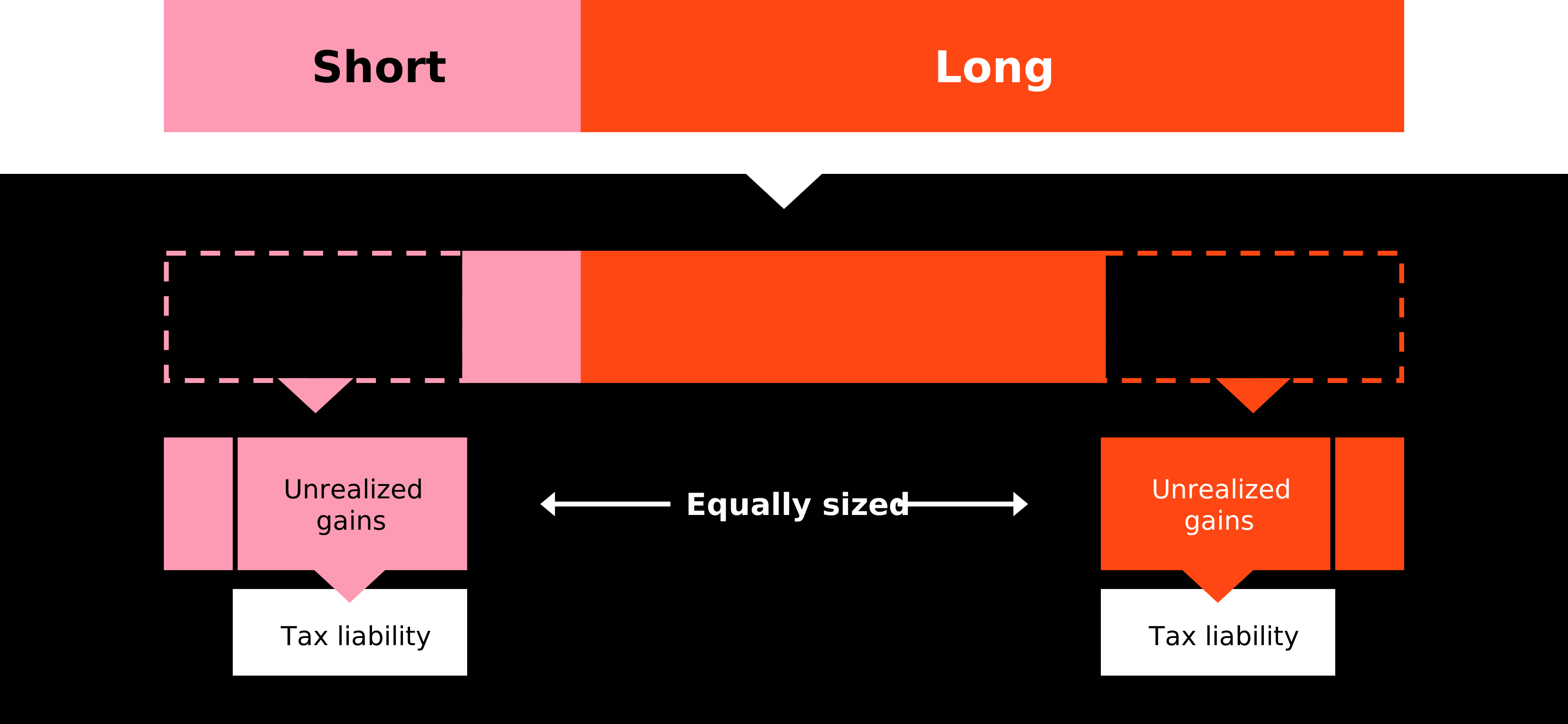
Figure B: Delevering a 200/100 portfolio to 130/30 involves liquidating long positions and covering shorts. Either action may trigger a tax liability.
Suppose there are $4 mm in long-term gains embedded in the long positions that are targeted for sale and $3 mm in short-term gains embedded in positions slated to be covered. As of tax year 2026, the highest federal rates of 23.8% and 40.8% for short- and long-term capital gains, instant delevering to 130/30 could lead to a tax bill exceeding $2.2 million. State taxes could drive that number higher. However, gradual unwinding may allow for further loss generation, potentially reducing the tax bill by offsetting capital gains from the delevering process.
Like a rocket’s journey to outer space and back, the trajectory of a levered, tax-managed portfolio is rugged and changeable, demanding careful planning and course corrections along the way. A change of fortune may prompt an investor to add leverage to Direct Indexing account to generate more losses. Just as easily, an investor may want to delever after carrying forward a treasure trove of capital losses amassed in a market downturn. To learn more about how BlackRock helps investors manage the full life cycle of a levered, tax-managed investment, see visit Aperio Tax-Managed Solutions page.
Investments
Insights
Retirement
Tools
Resources
About Us


Important Notes:
Aperio Group, LLC, provides this material for informational purposes only and for the sole use of the recipient. The information contained herein was carefully compiled from both internal and external data, but we do not guarantee its accuracy. The information is provided with the understanding that we are not engaged in rendering legal, accounting, or tax services. We recommend that all investors seek out the services of competent professionals in these areas. The strategies and/or investments referenced may not be suitable for all investors, because the appropriateness of a particular investment or strategy will depend on an investor’s individual circumstances and objectives. None of the examples should be considered advice tailored to the needs of any specific investor or a recommendation to buy or sell any securities.
Investing involves risk, including possible loss of principal. Asset allocation and diversification may not protect against market risk, loss of principal or volatility of returns. There is no guarantee that any investment strategy discussed herein will work under all market conditions. Many factors affect performance, including changes in market conditions and interest rates, as well as other economic, political, or financial developments.
You should not assume that investment decisions we make in the future will be profitable or will equal the investment performance of the past. With respect to the description of any investment strategies, simulations, or investment recommendations, we cannot provide any assurances that they will perform as expected and as described in our materials. Past performance is not indicative of future results.
Any tax information provided herein is for illustrative purposes only and does not constitute the provision of tax advice by Aperio. Due to the complexity of tax law, not every single taxpayer will face the situations described herein exactly as calculated or stated, i.e., the examples and calculations are intended to be representative of some, but not all, taxpayers. Since each investor’s situation may be different in terms of income tax, estate tax, and asset allocation, there may be situations in which the calculations would not apply. Please discuss any individual situation with tax and investment advisors first before proceeding. For those clients using tax advantaged indexing, taxpayers paying lower tax rates than those assumed, or without taxable income, would earn smaller tax benefits from tax-advantaged indexing (or even none at all) compared to those described.
An investor must have gains to offset losses to benefit from tax-loss harvesting. It may not be possible to realize losses in any particular account in any particular year. Tracking an index may limit the extent to which all unrealized losses can be realized.
Short Sales
In a short sale, a portfolio sells securities it does not own. To accomplish this, the portfolio borrows the securities at a fee from the custodian (the lender). The position is “closed” by “returning” the security (buying a replacement security on the lender’s behalf). This “return” obligation to replace the borrowed securities does not typically have a specified “maturity” date and the lender generally may require replacement of the securities whenever it chooses. A short sale theoretically involves the risk of unlimited loss: The price at which a portfolio must buy “replacement” securities could increase without limit. A portfolio may experience losses on short positions that are not offset by gains on long positions.
Possibility of Margin Calls or Liquidations
Borrowings are usually from securities brokers and dealers and are typically secured by a portfolio’s securities and other assets. Under certain circumstances, such a broker or dealer may demand an increase in the collateral that secures a portfolio’s obligations, and if a portfolio is unable to provide additional collateral, the broker or dealer could close either long and/or short positions held in a portfolio’s account to satisfy a portfolio’s obligations. Closing positions in that manner could have extremely adverse consequences, including initiating closing transactions at disadvantageous times and prices and the acceleration of tax consequences.
©2026 BlackRock, Inc., or its affiliates. All rights reserved. BLACKROCK and APERIO are trademarks of BlackRock, Inc., or its affiliates. Other trademarks are the property of their respective owners.
MKTG0326-5237526-EXP0327