Key takeaways
Client expectations are increasing. Wealth is transferring to the next generation. In this environment, advisors need to modernize their practice to drive higher productivity, deeper personalization and stronger client relationships. Generative artificial intelligence (AI) arrived right on time.
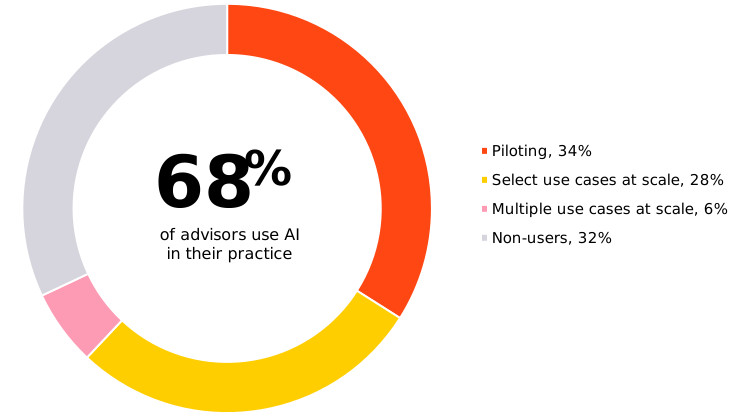
Advisors are adopting AI in various ways: 68% of wealth management firms are using it in some capacity today. Half of these firms are in the piloting stage, some have incorporated AI at scale for select use cases, and a small number have scaled their use of AI across multiple business functions.
Most advisors are using artificial intelligence in their practice
% of advisors
Source: Fidelity Wealth Management Pulse Survey, 2025: “The current state of AI in wealth management.”
Given our work with advisors across the industry, the BlackRock Business Consulting team has a unique view into advisors’ experiences and beliefs about AI. Most advisors believe AI can help them work faster and smarter, yet some fear it will replace them or it will be too difficult to learn. But AI is not taking the role of advisors. Rather it is reshaping it in a way that positions advisors to accelerate business growth.
While investors often use AI to seek financial information, only 26% say they would allow AI to manage their investments.1 Moreover, your value to clients is much bigger than the investments you manage for them. You help them define their financial goals, plan their future, stay on track through volatility and navigate complex decisions.
AI creates advantages for advisors by automating time-consuming tasks, identifying risks and opportunities early, and enhancing the quality and convenience of client services. It is a fascinatingly powerful technology that can support you and your clients in many ways, but it cannot replicate the human connection clients need to feel confident about their future.
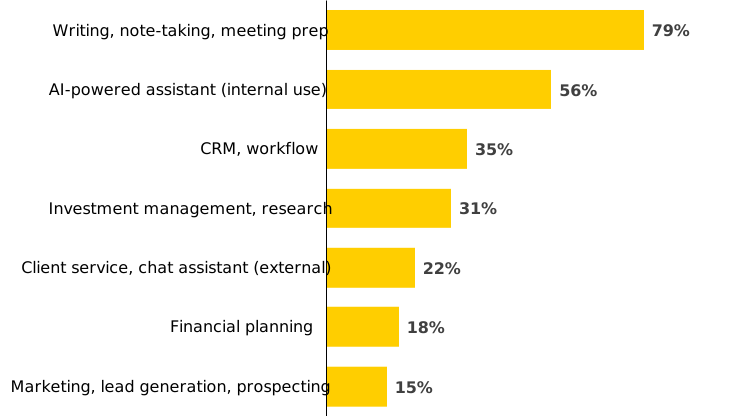
Most advisors currently use AI for administrative tasks, but there is potential to benefit in bigger ways. Advisors who fall behind in adopting AI will be disadvantaged in terms of scale, personalization and client expectations.
Advisors favor AI tools that automate administrative tasks
% of AI-enabled advisors by use case
Source: Fidelity Wealth Management Pulse Survey, 2025: “The current state of AI in wealth management.”
We see three paths to growth that advisors can accelerate by harnessing the power of AI: 1) improving operational efficiency to create capacity for serving more clients, 2) enhancing high-net-worth services such as estate planning, and 3) attracting ideal clients with a scaled, data-driven client acquisition strategy.
Four out of ten advisors who have adopted AI technology say it makes their business more efficient and saves them a significant amount of time.2 Common applications include virtual assistants like Copilot or ChatGPT that include agents designed for specific recurring tasks. Many advisors use client onboarding agents to automatically review new client documentation, upload important client data to their client relationship management (CRM) system, perform compliance checks and schedule meetings.
External-facing assistants, or client service chatbots, are increasingly ‘popping up’ on advisors’ websites, social media profiles and messaging apps, reducing the advisor’s involvement in simple, high-volume client interactions.
Increasingly, advisors are unlocking additional efficiency gains with AI solutions purpose-built for wealth management business functions, such as meeting automation platforms. Advisors have traditionally spent an average of 10% of their time on activities related to client meetings,3 making this a natural target for automation to lighten the load.
AI-powered meeting automation platforms (e.g., Jump, Zocks) include tools that draft agendas and pre-meeting briefs using client information from all available sources such as financial planning documents, notes of prior meetings and recent client communications. Note-taking tools allow advisors to be more present and attentive when they meet with clients. After meetings, AI tools update the CRM, compile ‘to-do’ lists, assign tasks, disseminate information to team members and draft follow-up client emails.
Having an AI-enabled process around meeting preparation, note-taking and post-meeting administrative work allows advisors to focus on the more important, human-to-human part of their client relationships.

“Shifting the effort from gathering information to offering high-value interpretation allows advisors to deepen trust with clients, deliver real value and drive lasting growth for their clients and their firm.”
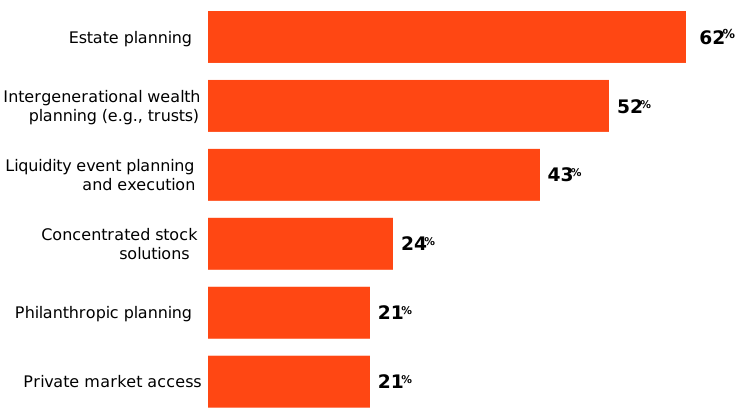
Offering personalized advanced planning services can help you attract more high-net-worth clients, but it can also challenge your bandwidth. AI enablement can be a game changer for your high-net-worth capabilities, and estate planning is a great place to start. Most advisors provide estate planning services to their high-net-worth clients and 62% say it is one of the most time-intensive services they provide.
Estate planning is the most offered and most time-consuming service
% of advisors citing as among the most time-intensive services they provide
Source: BlackRock 2026 Advisor Trends Survey.4
Advisors save a significant amount of time and deepen their value to clients by using AI-powered estate and tax planning platforms (e.g., FP Alpha, Vanilla) to automate and enhance their processes:
“As artificial intelligence becomes increasingly embedded in wealth management, complex services can become less cumbersome. Advisors can redefine estate planning as an ongoing dynamic process instead of a static set of documents.”
The benefit to advisors is greater efficiency and the ability to provide estate and tax planning services to more clients. The benefit to clients is a deeper level of service: Advisors who provide AI-enabled tax and estate planning services spend less time managing documents and more time evaluating strategic questions, like ‘Should we consider restructuring this trust before the next liquidity event?’ or ‘What governance conversations need to happen before decision-making shifts to the next generation?’
Additionally, AI tools continually monitor estate plans and alert advisors when a change in tax laws or client circumstances may have an impact. Early awareness can help advisors coordinate the necessary expertise and lead families through complex decisions more effectively.
“As tax policy uncertainty persists and family structures grow more complex, advisors need planning systems that enable ongoing awareness rather than periodic reviews.”
Purchasing leads and cultivating prospects through referrals and networking can take a lot of your time and money, and serving non-ideal clients can hinder profitability and growth. In an increasingly competitive landscape, advisors have begun leveraging artificial intelligence to grow their business more intentionally and with less drain on their resources.
AI-powered marketing tools and platforms designed specifically for the wealth management industry can help advisors target the right prospects, identify high quality leads, expedite conversion and drive ongoing client engagement at scale. AI automates the core functions of an end-to-end marketing strategy:
“Advisors now have access to tools that work 24/7 – researching clients and prospects, crafting personalized content and monitoring the pipeline – so they can focus on what actually matters: building relationships.”
“AI doesn’t replace advisors; it enables their teams to be quicker to market, personalize at scale, and convert opaque opportunities into real AUM growth.”
"By shifting from buying shared leads to building programmatic, AI-powered marketing systems, firms can lower client acquisition costs while simultaneously increasing enterprise valuation."
Advisors are increasingly embedding artificial intelligence into their client acquisition processes. End-to-end marketing automation platforms can help advisors build a bigger pipeline of clients without a bigger workload, which can be a competitive advantage for a growing practice.
If you use AI-driven technology, or you plan to, be mindful of the potential vulnerabilities and maintain close oversight to protect your clients and your business.
Only 48% of financial services firms have formal AI governance committees for setting policies and assessing risks relating to the use of AI tools, and only 28% have a process for testing or validating AI outputs.5 Client financial outcomes and trust are on the line, regulatory scrutiny is increasing, and the combination of AI’s speed and scale means that errors can be catastrophic. Establish rigorous procedures and train your staff to best manage risks and keep data secure.
Artificial intelligence can empower you to be more tactical in streamlining processes, allocating resources and focusing on the best growth opportunities. Yet even with powerful new technology at your disposal, the growth of your business still hinges on the strategic decisions you make about your business, clients and value proposition.
The BlackRock Business Consulting team can help you evolve your practice and reallocate your time where it matters most: serving your clients and growing your firm with intention, while staying human at the center and future‑ready at the edges. Contact your BlackRock representative for more information.