

Equity

Jul 09, 2025|ByPriya Panse, CFA
Key Points:
- In today's uncertain market environment, investors are increasingly turning to quality investing as a strategy to navigate uncertainty and pursue more stable returns.
- Quality investing extends outside the traditional definition of recurring profitability. Investors can also focus on investments that target favorable characteristics such as low leverage and stability in earnings across various markets spanning equities and fixed income.
- Investors can access a wide variety of investment options that incorporate quality. Portfolio implementers looking to incorporate quality but also seek nimbleness in their portfolio can consider coupling systematic and actively managed quality exposures, and we see this happening in practice today.
Why is Quality Important Today?
In today’s market environment—characterized by elevated volatility and a higher interest rate regime—quality has become increasingly important. Investors are placing greater value on companies with strong current profitability, as opposed to those with uncertain future earnings. Additionally, companies burdened with heavy debt can be more vulnerable to financial distress, making lower leverage a desirable trait.
A recent BlackRock's analysis of over 20,000 advisor portfolios revealed that the average portfolio has a higher-than-benchmark exposure to leverage and a lower-than-benchmark exposure to profitability—largely due to small-cap positioning, which tends to be both unprofitable and leveraged1. Quality factor ETFs seek to offset this imbalance.
Quality factor ETFs such as the iShares MSCI USA Quality Factor ETF (QUAL) aim to target high-quality companies that tend to exhibit certain characteristics:
- Higher profitability: Companies with stronger current profitability often have a wider financial moat to withstand uncertainty.
- Lower debt: High interest rates and potential volatility can make heavily indebted companies more susceptible to financial distress.
- Stable current earnings: Investors may prefer established companies exhibiting current stable, recurring earnings over less profitable growth companies with less-certain future earnings potential.
Companies with these characteristics may prove to be more resilient amidst today’s challenging market conditions.
Case Study: Can quality be found internationally?
While QUAL provides investors with exposure to U.S. quality, investors seeking quality exposure beyond the U.S. can turn to the iShares MSCI International Quality Factor ETF (IQLT). IQLT targets high-quality companies in developed markets outside the U.S. When thinking about quality investing overseas, historically, international companies have had lower profitability than their U.S. counterparts. IQLT provides "US-like" quality exposure as measured by return on equity (ROE) profitability as shown below.

*Source: BlackRock, FactSet as of 4/18/2025. Indexes are unmanaged and one cannot invest directly in an index. Past performance does not guarantee future results. Performance data represents past performance and does not guarantee future results. Investment return and principal value will fluctuate with market conditions and may be lower or higher when you sell your shares. Current performance may differ from the performance shown. For most recent month-end performance and standardized performance, click here
Furthermore, investors may find IQLT interesting as it has exhibited a better up/down capture ratio, than its Morningstar Category, Foreign Large Blend, as shown below.
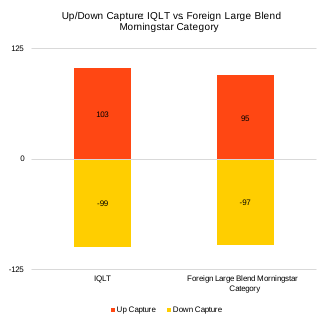
Source: Morningstar Direct as of 4/30/2025. Data spans from IQLT’s inception on 1/13/2015 to 4/30/2025
From an investor flows perspective, YTD in 2025, IQLT has gathered net inflows of over $2.8 billion2 indicating demand for quality strategies in international markets. Notably, investors can also turn to the iShares MSCI Global Quality Factor ETF (AQLT) and the iShares MSCI Emerging Markets Quality Factor ETF (EQLT) for global and emerging markets quality exposures respectively, speaking to the variety of ways in which the iShares suite can help bring quality investing to investors.

How can portfolio builders incorporate Quality?
Portfolios can gain exposure to quality in a variety of ways. For example, a portfolio could own QUAL and the iShares U.S. Equity Factor Rotation Active ETF (DYNF), alongside one another as complementary exposures. QUAL provides systematic exposure to resilient characteristics like profitability to help target stability across all types of markets. On the other hand, DYNF, which also provides exposure to quality, seeks to outperform the U.S. equity market by actively selecting stocks with additional factor characteristics that the PM’s believe are likely to excel in the near term, such as value, small size, low volatility and momentum. Relative to QUAL, DYNF seeks to capture more alpha3opportunities in a market environment experiencing a greater level of dispersion through frequent tactical adjustments by an active manager. Notably, DYNF recently boosted its exposure to quality given its economic model has pointed towards a slowdown in the economic regime.
Where else can investors find quality:
There are other ways investors can access quality. For instance, investors looking for a growth exposure may consider the iShares MSCI USA Quality GARP ETF, (GARP). This strategy seeks a growth screen as its main objective but also incorporates quality to tilt the portfolio towards resilience, and value to avoid overpriced stocks. A concern amongst growth investors is that such stocks may be priced at a premium due to the market’s high expectation of future growth. Tilting towards quality and value in a growth portfolio seeks address this concern by capturing more reasonably priced more resilient growth opportunities.
Quality can be found in other asset classes too, like fixed income. The iShares High Yield Systematic Bond ETF (HYDB) incorporates quality by screening out certain bonds with the highest probability of default (which is a measure of credit quality). For more information on HYDB please visit link.
Conclusion
BlackRock views quality as a compelling investment characteristic in today's market environment and offers a variety of exposures through which investors can access quality. High interest rates, inflation, and macroeconomic uncertainty make quality companies with strong recurring profitability and low leverage potentially more attractive. By focusing on quality today, investors can seek to navigate market uncertainty and pursue more stable returns.
Authors

Priya Panse, CFA
Lead Strategist, Factor and Alternative ETFs

Eric Legunn, CFA
Strategist, Factor and Alternative ETFs
Access exclusive tools and insights
Explore My Hub, your personalized dashboard for portfolio took, market insights and practice resources.
Investments
Insights
Retirement
Tools
Resources
About Us


1. This analysis uses Leverage and Profitability numbers derived from the following benchmark mix: 75% S&P 1500 Total Market Index (TOT SNP1500) and 25% MSCI ACWI ex-US Index (ACWX MS_ACWXUS). These figures reflect the advisor model data collected by BlackRock over the prior 12 months from 22,270 models of which 20,265 had an equity sleeve. The models are grouped into risk profile cohorts determined by equity weighting. Figures describe the average across all portfolios in the cohort for the metric in question. BlackRock’s proprietary risk model data is supplemented by asset allocation and fund characteristic data from Morningstar. The portfolios analyzed represent a subset of the industry, and not its entirety. As such, there may be certain biases present in the data that reflect the advisors who choose to work with BlackRock to analyze their portfolios. All data is as of April 30, 2025 unless otherwise specified.
2. Source: Morningstar Direct as of 4/28/2025
3. Alpha is a measure of performance on a risk-adjusted basis. Alpha takes the volatility (price risk) of a mutual fund and compares its risk-adjusted performance to a benchmark index. The excess return of the fund relative to the return of the benchmark index is a fund's alpha.
Carefully consider the Funds' investment objectives, risk factors, and charges and expenses before investing. This and other information can be found in the Funds' prospectuses or, if available, the summary prospectuses which may be obtained by visiting www.iShares.com or www.blackrock.com. Read the prospectus carefully before investing.
This material is not intended to be relied upon as a forecast, research or investment advice, and is not a recommendation, offer or solicitation to buy or sell any securities or to adopt any investment strategy. The opinions expressed are as of the date indicated and may change as subsequent conditions vary. The information and opinions contained in this material are derived from proprietary and nonproprietary sources deemed by BlackRock to be reliable, are not necessarily all-inclusive and are not guaranteed as to accuracy. As such, no warranty of accuracy or reliability is given and no responsibility arising in any other way for errors and omissions (including responsibility to any person by reason of negligence) is accepted by BlackRock, its officers, employees or agents. This material may contain “forward-looking” information that is not purely historical in nature. Such information may include, among other things, projections and forecasts. There is no guarantee that any of these views will come to pass. Reliance upon information in this material is at the sole discretion of the viewer.
Fixed income risks include interest-rate and credit risk. Typically, when interest rates rise, there is a corresponding decline in the value of debt securities. Credit risk refers to the possibility that the debt issuer will not be able to make principal and interest payments.
Non-investment-grade debt securities (high-yield/junk bonds) may be subject to greater market fluctuations, risk of default or loss of income and principal than higher-rated securities.
International investing involves risks, including risks related to foreign currency, limited liquidity, less government regulation and the possibility of substantial volatility due to adverse political, economic or other developments. These risks often are heightened for investments in emerging/ developing markets or in concentrations of single countries.
Funds that concentrate investments in specific industries, sectors, markets or asset classes may underperform or be more volatile than other industries, sectors, markets or asset classes and the general securities market.
There can be no assurance that performance will be enhanced or risk will be reduced for funds that seek to provide exposure to certain quantitative investment characteristics (""factors""). Exposure to such investment factors may detract from performance in some market environments, perhaps for extended periods. In such circumstances, a fund may seek to maintain exposure to the targeted investment factors and not adjust to target different factors, which could result in losses.
A fund's use of derivatives may reduce a fund's returns and/or increase volatility and subject the fund to counterparty risk, which is the risk that the other party in the transaction will not fulfill its contractual obligation. A fund could suffer losses related to its derivative positions because of a possible lack of liquidity in the secondary market and as a result of unanticipated market movements, which losses are potentially unlimited. There can be no assurance that any fund's hedging transactions will be effective.
Diversification and asset allocation may not protect against market risk or loss of principal. There is no guarantee that the classification system used to determine a rotation model or strategy will achieve its intended results. Fund’s may engage in active and frequent trading of its portfolio securities which may result in higher transaction costs to the fund. Actively managed funds do not seek to replicate the performance of a specified index, may have higher portfolio turnover, and may charge higher fees than index funds due to increased trading and research expenses.
The iShares Funds are not sponsored, endorsed, issued, sold or promoted by MSCI Inc., nor does this company make any representation regarding the advisability of investing in the Funds. BlackRock is not affiliated with MSCI Inc.
The Funds are distributed by BlackRock Investments, LLC (together with its affiliates, “BlackRock”).
©2026 BlackRock, Inc. or its affiliates. All Rights Reserved. BLACKROCK and iSHARES are trademarks of BlackRock, Inc. or its affiliates. All other trademarks are those of their respective owners.
iCRMH0725U/S-4562939