Multi-Asset

Fed rate cuts and potential portfolio implications

Multiple yarns forming an arrow
Sep 19, 2025|ByCarolyn Barnette

The Federal Reserve just cut interest rates for the first time since December 2024, and the implications for portfolios could be significant. Advisors and investors alike are asking: How should I position for falling interest rates?

Here’s what we’re watching, and where we see opportunity.

Key Takeaways:

  • The Fed has forecast additional cuts by the end of the year, suggesting a target of 3.6% by the end of 2025 and 3.4% by the end of 2026.
  • Cash yields falling: Investors may want to reduce high cash allocations to offset potential income loss.
  • This cycle may be different: A benign economic outlook favors the “belly” of the curve over long bonds, and may support selective credit positioning.

The Federal Reserve is cutting rates again

The Federal Reserve just cut interest rates by 0.25% at its September meeting, bringing the target Federal Funds Rate to a range of 4-4.25%. It also indicated in its Summary of Economic Projections that it may continue cutting rates in 2026 and 2027, albeit at a slower pace: its projections indicate a 3.4% rate by the end of 2026 and 3.1% by the end of 2027.1

What the Fed’s next move could mean for your portfolio

Those preparing portfolios for falling rates should consider three portfolio moves:

  1. Step out of cash into bonds with higher earnings potential
  2. Look to alternatives for additional diversification
  3. Maintain equity overweight, with a preference for U.S. large caps

Falling cash yields: why it’s time to move

The average advisor’s cash and short-term bond allocation has grown from 17% of the fixed income sleeve in January to 21% in June, as per the Advisor Outlook.2

With cash yields set to fall – potentially in a big way – it may be time to move in the opposite direction. We have already seen cash underperform most asset classes this year, and that trend could continue as falling rates reduce cash returns.

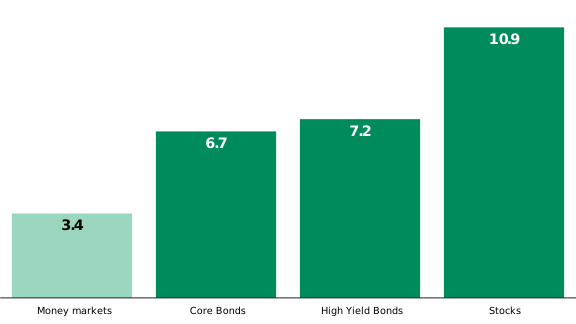
Stocks and bonds have outperformed cash

Cumulative returns 12/31/24-9/16/25

Core bonds, High yield bonds, and Stocks have all outperformed cash YTD.

Source: Bloomberg as of 9/16/25. Money markets refers to the Goldman Sachs USD GS 3-Month Money Market Index, Core Bonds refers to the Bloomberg Aggregate Bond Index, High Yield Bonds refers to the Bloomberg US High Yield Corporate Index, and Stocks refers to the S&P 500. Past performance does not guarantee or indicate future results. Index performance is for illustrative purposes only. Index performance does not reflect any management fees, transaction costs or expenses. Indexes are unmanaged and one cannot invest directly in an index.

Outlook on duration: why long bonds may underdeliver this cycle

Many of our multi-asset investors have neutralized their underweights to duration this year as they’ve looked ahead to potential rate cuts. However, they are tactically underweight the longest-dated bonds, preferring instead bonds with less than 10 years until maturity.

While long-dated bonds have delivered outsized returns in certain falling rate environments, we believe that this time might be different. There are two reasons that long-dated bonds may not provide as much return potential this time around:

1. We’re not expecting a recession. Long-dated bonds have historically delivered top-tier performance when recession concerns push rates down meaningfully. However, in more benign economic conditions, they haven’t done as well. Our base case is for economic growth to slow but remain positive, which could limit the magnitude of cuts. And historically, in calendar years with less than 1.5% in Federal Fund Rate (FFR) cuts, long-dated treasuries have underperformed meaningfully.

Core and high yield bonds have historically outperformed long treasuries in shallow-cut cycles, reinforcing our preference for credit and intermediate duration
1Y avg forward returns following annual Fed rate cuts of different magnitudes


In calendar years with less than 150bps of rate cuts, core and high yield bonds have outperformed long term treasuries.

Source: Bloomberg as of 8/15/25. “Ultrashort treasuries” refers to the Bloomberg Short Treasury 1-3 Months TR Index, “Agg Bond” refers to the Bloomberg US Aggregate Bond Index, “High Yield” refers to the ICE BofA US High Yield Index, and “20+ Yr Treasuries” refers to the Bloomberg US Treasury 20+ Yr TR Index. Past performance does not guarantee or indicate future results. Index performance is for illustrative purposes only. Index performance does not reflect any management fees, transaction costs or expenses. Indexes are unmanaged and one cannot invest directly in an index.

2. Investor demand for long-dated Treasuries has fallen. A weakening USD has made treasuries less attractive for foreign investors, who currently own 33% of treasuries.3 Additionally, concerns around the U.S. debt load may increase the term premium demanded by investors to hold long-dated bonds. Both of these factors could put upward pressure on long-dated bond yields, which would limit performance potential.

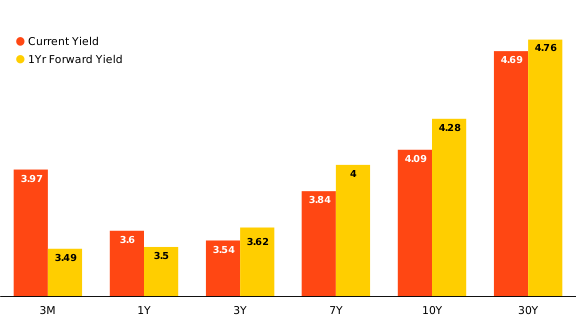
Futures markets are suggesting that, while shorter-dated yields are projected to fall in the coming months, long end rates could move higher as investors demand more term premium for owning longer-dated bonds.

Shorter-dated treasury yields projected to fall, but longer-term yields could still rise
Current and 1Y forward yields (estimated based on futures contracts)

1 year forward futures contracts project that short-term treasury yields will fall, and long-term yields are projected to rise.

Source: Bloomberg as of 9/17/25. Forward-looking yields may not come to pass.

One way to access specific bond tenors is by building out bond ladders with iShares iBonds ETFs: these allow investors to target specific maturities and potentially pursue today’s high yields for longer.

Credit investing in a falling rate environment

Credit spreads remain tight — 0.7% for investment grade and 2.7% for high yield4 — but absolute yields are still compelling. With growth intact, credit may offer more income potential than extending duration in treasuries, and the additional yield premium can offer a cushion against potential price losses on bonds.

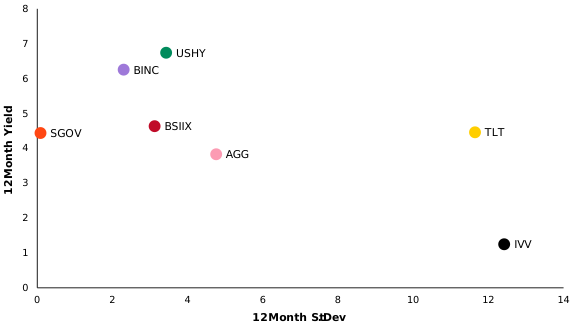
Credit has offered a bigger yield pickup, with a lower volatility profile
12M yields and standard deviations, as of August 2025

Leaning into selective credit exposure has offered a bigger pickup in yield, with lower volatility.

Source: Morningstar as of 8/31/25. Standard deviation measures how dispersed returns are around the average. A higher standard deviation indicates that returns are spread out over a larger range of values and thus, more volatile. The performance quoted represents past performance and does not guarantee future results. Investment return and principal value of an investment will fluctuate so that an investor’s shares, when sold or redeemed, may be worth more or less than the original cost. Current performance may be lower or higher than the performance quoted. Performance data current to the most recent month end may be obtained by visiting www.iShares.com or www.blackrock.com. For standardized performance and the 30-day SEC yield go to each product page. For standardized performance and the 30-day SEC yield go to each product page: SGOV, BINC, USHY, BSIIX, AGG, TLT and IVV.

Tight spreads make it even more prudent to approach high yield issuers through careful due diligence, suggesting an active approach to bond selection.

Risk-aware income strategies such as the iShares Flexible Income Active ETF (BINC) and BlackRock Strategic Income Opportunities Fund (BSIIX) can actively take advantage of the higher yields available in spread assets, seeking opportunity through curve positioning and credit evaluation.

Diversifying your diversifiers: seeking higher returns via alternative strategies

The past few years have shown how valuable diversifying beyond traditional bonds can be for investors. Strategies such as the BlackRock Global Equity Market Neutral Fund (BDMIX) and BlackRock Tactical Opportunities Fund (PBAIX) have delivered positive returns with low correlations to equities in four distinct rate policy regimes we’ve seen since the Fed began hiking rates in 2022 (hiking, holding, cutting, and holding again).

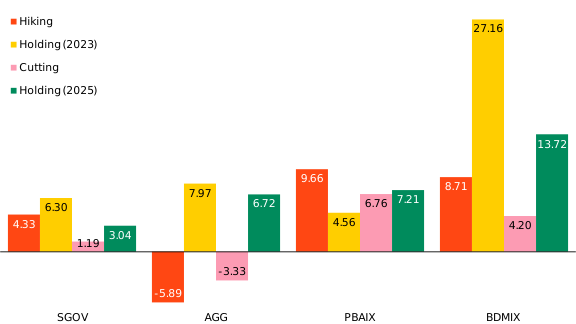
Alternative funds have delivered outsized returns through different rate policy regimes

Total return, 3/17/22-9/16/25

In periods of rate hikes, cuts, and holds, alternative funds have delivered outsized returns.

Source: Bloomberg as of 9/16/25. “Hiking” refers to 3/17/22-7/26/23, “Holding (2023)” refers to 7/26/23-9/18/24, “Cutting” refers to 9/18/24-12/18/24, and “Holding (2025) refers to 12/18/24-9/16/25). The performance quoted represents past performance and does not guarantee future results. Investment return and principal value of an investment will fluctuate so that an investor’s shares, when sold or redeemed, may be worth more or less than the original cost. Current performance may be lower or higher than the performance quoted. Performance data current to the most recent month end may be obtained by visiting www.iShares.com or www.blackrock.com. For standardized performance go to each product page: SGOV, AGG, PBAIX and BDMIX

The benefit of idiosyncratic diversification is that you don’t need to bet on what’s next for interest rates ... and additional diversification rarely hurts.

Given their low correlation and steady performance across rate regimes, now may be the time to increase alternative allocations.

Equity strategies when the Fed is cutting rates

In non-recessionary rate cut environments, equities have historically performed well. Many of our multi-asset investment teams (ie our Target Allocation, Global Allocation, and Multi-Asset Income teams) remain overweight equities, with a preference for large caps over small caps: while small caps have historically been more sensitive to interest rates, our view is that slowing economic growth and shrinking profit margins could outweigh the benefits of falling rates. In fact, the Target Allocation team increased its overweight to equities as part of their September rebalance.

Large caps outperformed during previous rate cuts
Average return by market cap, one year from first rate cut

Large caps have outperformed when compared to small caps following one year after an initial rate cut.

Source: BlackRock Fundamental Equities with data from Refinitiv as of August 2024. Chart shows average return of the S&P 500 (large caps) and Russell 2000 (small caps) indexes in the 12 months following prior rate cuts, covering six cycles since 1984. Past performance is not indicative of current or future results. Indexes are unmanaged. It is not possible to invest directly in an index.

Advisor playbook: how to position portfolios for Fed rate cuts

With more rate cuts likely to be on the way and growth still intact, now may be a good time to reassess portfolios.

Three key actions to consider:

  1. Shift out of cash into targeted bonds with higher yield potential. We see opportunity in the short-to-intermediate space, and like the extra yield on select credit exposure.
  2. Add diversification with alternatives to help manage volatility and potentially drive higher returns in uncertain rate environments.
  3. Maintain quality equity exposure, favoring large caps over small caps.

The opportunity set is shifting quickly, and the investors who act early may be best positioned to benefit.

Stay ahead with the monthly Advisor Outlook, where we share timely insights and portfolio strategies as the rate-cut cycle unfolds.

To obtain more information on the fund(s) including the Morningstar time period ratings please click on the fund tile.

The Morningstar RatingTM for funds, or "star rating", is calculated for managed products (including mutual funds, variable annuity and variable life subaccounts, exchange-traded funds, closed-end funds, and separate accounts) with at least a three-year history. Exchange-traded funds and open-ended mutual funds are considered a single population for comparative purposes. It is calculated based on a Morningstar Risk-Adjusted Return measure (excluding any applicable sales charges) that accounts for variation in a managed product's monthly excess performance, placing more emphasis on downward variations and rewarding consistent performance. The top 10% of products in each product category receive 5 stars, the next 22.5% receive 4 stars, the next 35% receive 3 stars, the next 22.5% receive 2 stars, and the bottom 10% receive 1 star. The Overall Morningstar Rating for a managed product is derived from a weighted average of the performance figures associated with its three-, five-, and 10-year 60-119 months of total returns, and 50% 10-year rating/30% five-year rating/20% three-year rating for 120 or more months of total returns. While the 10-year overall star rating formula seems to give the most weight to the 10-year period, the most recent three-year period actually has the greatest impact because it is included in all three rating periods.

Carolyn Barnette
Head of Market and Portfolio Insights for BlackRock's U.S. Wealth Advisory business
  • Multi-Asset

    2026 Income Outlook: If easy income is over, what’s next?

    Jan 07, 2026|ByJustin Christofel, CFALouis Arranz, CFA

    With cash yields set to fall in 2026 amid persistent volatility, see how diversified, risk-aware income strategies help build durable retirement confidence.

  • Portfolio

    Investment Directions

    Jan 06, 2026|ByGargi Pal ChaudhuriKristy Akullian, CFA

    Explore 2026’s new regime of improving growth, easing policy and AI-driven productivity, and how investors can adapt portfolios to shifting market dynamics.

  • Market Insights

    The Odds Are Changing: 2026 Is a Market for Investors, Not Gamblers

    Jan 02, 2026|ByRick Rieder

    Rick Rieder explains why 2026 favors investors over gamblers, as fading inflation, softening labor and AI driven dispersion reshape income and equity opportunities.