

Market Insights

2025 delivered no shortage of shocks, but ultimately growth proved resilient, inflation continued to cool, and public markets posted strong returns. The positive forces that drove strong returns in 2025 remain with us into the new year, the key difference is the starting point. With valuations higher and risk premia tighter, markets can still do well, but investors should respect the potential for gravity to assert itself.
Gravity is what happens when tight premiums meet shocks: higher financing costs, less room for valuation error, and a renewed premium on real cash generation. Returns can still be positive, but dispersion tends to rise, the market separates what’s executing from what’s only being rewarded by sentiment.
Two forces shaped 2025. First, a policy shock: on April 2, reciprocal tariffs pushed the U.S. effective tariff rate out of an eight-decade dormancy, triggering a rare cross-asset drawdown: equities, spread assets, rates, and the U.S. dollar all falling together.
But what followed was equally important. The inflationary impact was more contained than initially feared, growth stayed robust, and markets more than recovered.
The second force was the acceleration in artificial intelligence, as the dominant driver of both economic output and market leadership. Together, a resilient growth backdrop and faster productivity growth set up a 2026 environment that still looks constructive overall, but more two sided given richer valuations and less room for error.
Inflation is fading; labor is fraying
The good news is that inflation increasingly looks contained, at least in the way that matters for monetary policy.
The four categories in CPI that are most elevated relative to 2015-2019 run rate contributions are all goods categories that were impacted by tariffs, this is outside the scope of monetary policy influence. Core services inflation has moderated toward its longer-term run-rate, and the remaining pressure points are increasingly concentrated in places where interest rates have little effect. Healthcare, insurance, and education are categories driven more by structural costs, regulation, and market structure than by rates.
Shelter is roughly 44% of core CPI, and higher rates can be somewhat counterproductive to cooling inflation in this category. In a supply-constrained housing market, higher rates work against affordability by slowing the supply response needed to bring rents down. That notwithstanding, the volatility of month-over-month core CPI has moved back toward a range that looks much more like the 1990–2020 era of stability. Market pricing of five-year inflation break evens is around 2.4%, a level that is almost exactly aligned with a target of 2.0% Core PCE.
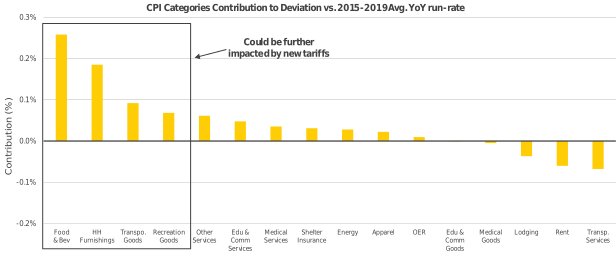
Bureau of Labor Statistics, as of 12/31/2025
But while inflation is cooling, labor is tangibly weakening, and in ways that matter.
A number of under-the-hood measures of slack have been drifting higher, including the marginally attached and those not in the labor force but wanting a job. More striking, excluding healthcare, the U.S. economy has shed over two hundred thousand jobs over the last eight months, despite still looking surprisingly resilient by headline growth measures.
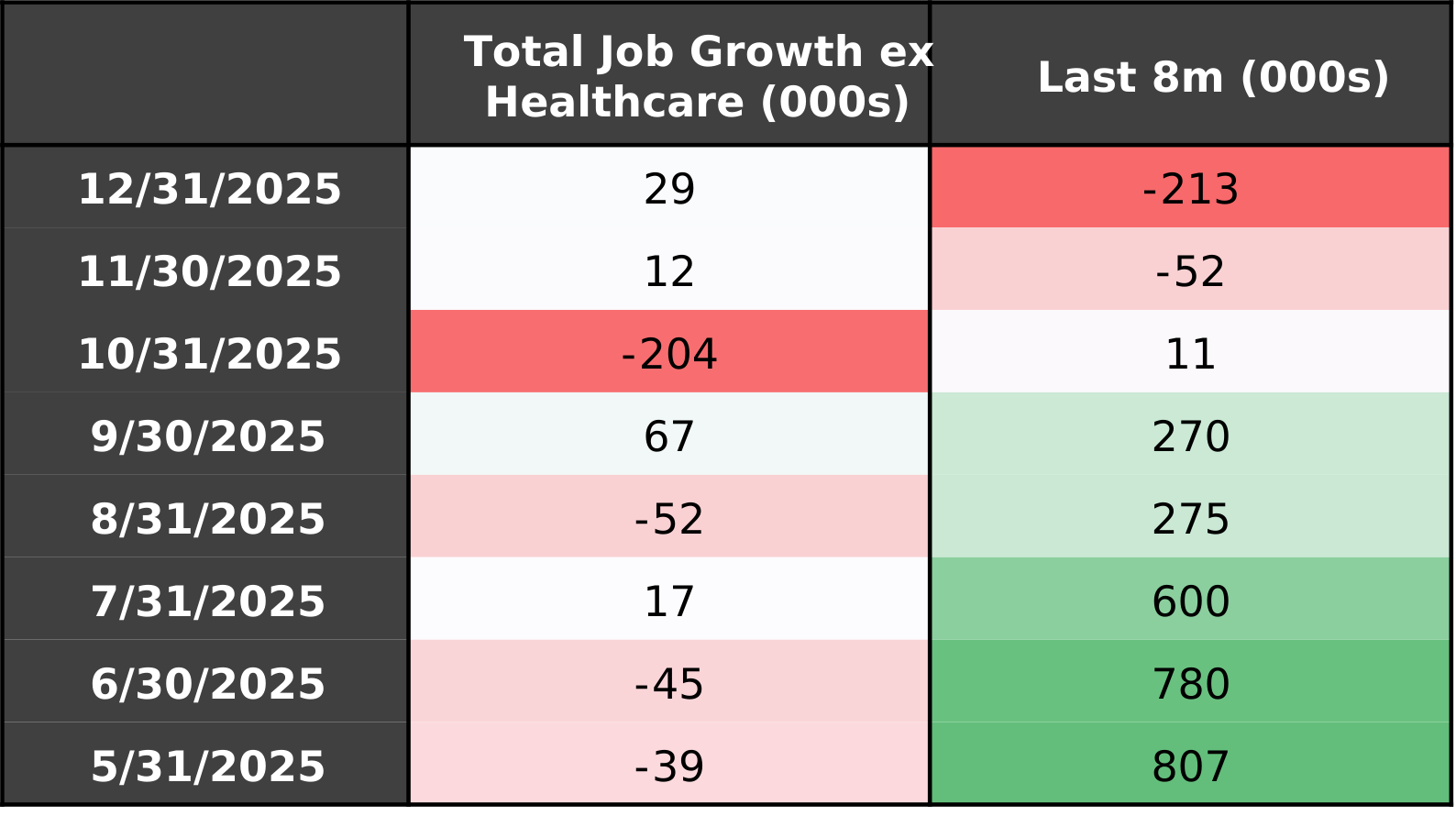
Bureau of Labor Statistics, as of 12/31/2025
The burden is also not evenly shared. The employment-to-population ratio for ages 55–64 has risen to the point where that group is now more likely to be working than ages 20–24. This is a uniquely challenging backdrop for new entrants.
If inflation is no longer the central pothole, labor may be the one policymakers, and investors, must navigate most carefully in 2026.
Productivity is rising, without the hiring that used to come with it
The unusual feature of this cycle is that growth has been holding up without the typical labor intensity. Real GDP likely averaged above 4% over the last two quarters of 2025 with negative job growth.
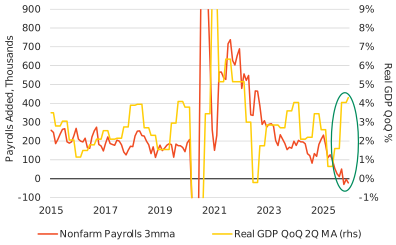
Bureau of Labor Statistics and Bureau of Economic Analysis, as of 12/31/2025
In prior cycles, growth at that speed generally required substantially more hiring. The fact that it hasn’t may be an early signal that productivity is doing more of the work, even before AI implementation really takes hold. The economic implications are not just about new revenue streams, it’s about cost structure.
Labor costs are roughly 55% of business sector output. In an illustrative scenario, a 5% reduction in labor’s share of costs implies about $1.17 trillion of annualized labor cost savings. That flows quickly into corporate profitability. With annual corporate profits around $2.79 trillion and profit margins near 12%, an illustrative 4% increase in margins would imply about $878 billion in incremental yearly profit, a 31% lift.1
This is why 2026 may feel “fine” in aggregate while still being challenging underneath: productivity can extend expansion, but it can also shift labor demand and change the mix of hiring. That tends to create dispersion across households, companies, and sectors.
What gravity means for markets in 2026
If this is a year where gravity matters more, the practical implication is not “risk off.” It’s higher selectivity and higher dispersion.
Equities: the hurdle rate is higher
Equities can plausibly rise on strong earnings growth, but the valuation anchor is tighter when the risk-free alternative offers meaningful income. The environment is also likely to reward businesses with real cash generation and clear paths to productivity-driven margin expansion, while being less forgiving of “momentum without mass” (high valuations without cash flows that can defend them).
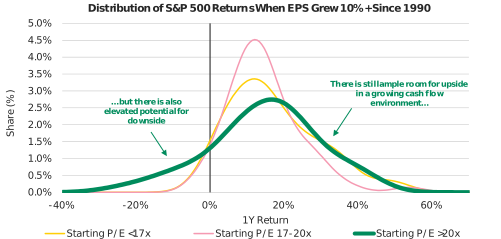
Bloomberg, as of 01/07/2026
Credit: spreads are tight, which changes the playbook
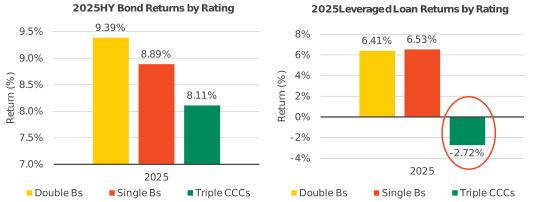
Within credit, spreads sit at very tight historical levels. Current spread levels for HY BB and B are near their 1st–3rd percentile since 2000.2
When compensation is that thin, outcomes become more idiosyncratic. Both security selection and being tactical matter over raw beta.
JP Morgan, as of 12/31/2025
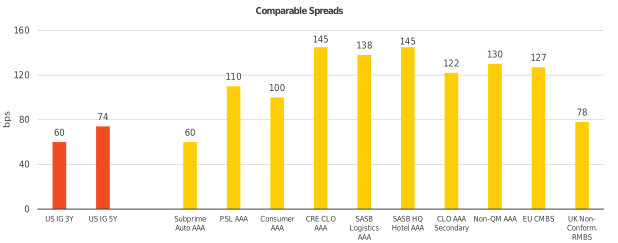
Dispersion isn’t limited to corporate credit. We’re seeing it clearly across securitized markets too, particularly in new-issue pricing, where spreads on comparable deals can look very different depending on the collateral and the structure. That kind of gap creates opportunity, but it also raises the bar for selectivity. The right part of the stack and the right underlying exposure can matter as much as the headline rating.
Fixed income: income is the return cushion
This is still, in our view, an unusually compelling setup for earning return through income.
A stable ~6% income stream is achievable in fixed income against roughly ~2.5% inflation, creating a margin of safety that has been absent for much of the last two decades. For context, investment grade bonds across the U.S., Europe, and the U.K. have spent about 66% of the last 20 years at lower yield levels than today.3
Not only can fixed income potentially generate over 6% today, but it can be done with less reliance on US credit beta, which matters when spreads and valuations are already rich. That is why we particularly like overwriting in fixed income and foreign exchange markets as a source of diversified, premium based income.
In bonds, the upside is naturally more bounded than in equities, so monetizing volatility has a lower opportunity cost. And when fixed income is priced at or near the tights, the next leg is frequently about carry and roll down, not additional spread compression. Historically, when spreads are below their 10th percentile, the next three months have tended to see widening, rather than continued tightening, averaging about 3 basis points for investment grade and about 26 basis points for high yield.4
In that setup, harvesting option premium can be a more repeatable return source than relying on further tightening.
BlackRock Trading Desk, as of 01/05/2026
We also see numerous other ways to diversify income away from corporate credit beta. Securitized markets can offer attractive income and diversification because the risks are tied to collateral performance and structure rather than corporate performance and refinancing conditions. This is an asset class where underwriting expertise and tranche selection are particularly accretive.
Mortgages are another key part of the opportunity set for 2026. They can offer durable income with different risk drivers than corporate credit, and the return profile looks attractive as rate volatility continues to come down.
Outside the U.S., selective global rates and EM local markets can add carry with a different set of macro drivers. Used thoughtfully, they become another lever for income and diversification. In a market defined by wider dispersion, broad beta matters less, and a broader toolkit matters more.
What We’re Focused on in 2026
1. Build return around income.
When the distribution of outcomes widens, income becomes the thing that lets you sleep well at night even through bouts of volatility. Earning mid-single-digit income in high-quality assets creates an attractive ballast for portfolios today.
2. Look for diversified sources of carry, not just credit beta.
With credit spreads historically tight, bespoke structures and overwriting can offer ways to generate income that diversify away from pure credit risk—often with better liquidity characteristics than investors expect.
3. Be deliberate in lower-quality credit.
When spreads are tight, you’re not getting paid much for being wrong. That doesn’t mean there are no opportunities, greater dispersion means it’s a year to be more surgical, focus on idiosyncratic setups, and avoid reflexive reaching down in quality.
4. Treat AI as both an opportunity and a filter.
The productivity math is powerful, and potentially margin-expanding in a way that compounds. But it is unlikely to be evenly distributed. Companies that can translate AI into durable cost advantages and cash flow resilience should separate from those that can’t.
Bottom line
2026 starts with a backdrop that is supportive in aggregate. Inflation is behaving, growth has been resilient, and productivity looks like it may be entering a stronger regime.
But the internal composition of the cycle is shifting. Labor is weakening, policy uncertainty remains real, spreads are tight, and valuations have little upside.
In that kind of market, outcomes widen and discipline matters more. We think 2026 will reward portfolios built on income, resilience, and selectivity. Ultimately return will come from what you own and how you structure it, not from assuming markets will do the work for you.
Performance data quoted represents past performance and is no guarantee of future results. To obtain more information on the fund(s) including the Morningstar time period ratings and standardized average annual total returns as of the most recent calendar quarter and current month end, please click on the fund tile.
The Morningstar Rating for funds, or "star rating", is calculated for managed products (including mutual funds, variable annuity and variable life subaccounts, exchange-traded funds, closed-end funds, and separate accounts) with at least a three-year history. Exchange-traded funds and open-ended mutual funds are considered a single population for comparative purposes. It is calculated based on a Morningstar Risk-Adjusted Return measure (excluding any applicable sales charges) that accounts for variation in a managed product's monthly excess performance, placing more emphasis on downward variations and rewarding consistent performance. The top 10% of products in each product category receive 5 stars, the next 22.5% receive 4 stars, the next 35% receive 3 stars, the next 22.5% receive 2 stars, and the bottom 10% receive 1 star. The Overall Morningstar Rating for a managed product is derived from a weighted average of the performance figures associated with its three-, five-, and 10-year 60-119 months of total returns, and 50% 10-year rating/30% five-year rating/20% three-year rating for 120 or more months of total returns. While the 10-year overall star rating formula seems to give the most weight to the 10-year period, the most recent three-year period actually has the greatest impact because it is included in all three rating periods.

Rick Rieder
Chief Investment Officer of Global Fixed Income and Head of the Global Allocation Investment Team

Russell Brownback
Head of Global Macro Positioning Team within Global Fixed Income

Navin Saigal
Head of Fundamental Fixed Income, Asia Pacific

Dylan Price
Director, Global Fixed Income

Charlotte Widjaja
Director, Global Fixed Income
Investments
Insights
Retirement
Tools
Resources
About Us


1 Source: Bureau of Economic Analysis, as of 6/30/2025 and BlackRock Analysis, as of 12/31/2025
2 Source: Bloomberg, as of 01/07/2026
3 Source: Bloomberg, as of 01/07/2026
4 Source: Bloomberg, as of 01/07/2026
Investing involves risks, including possible loss of principal. Past performance is no guarantee of future results. Index performance is shown for illustrative purposes only. It is not possible to invest directly in an index.
Performance data quoted represents past performance and is no guarantee of future results. Investment returns and principal values may fluctuate so that an investor’s shares, when redeemed, may be worth more or less than their original cost. All returns assume reinvestment of dividends and capital gains. Current performance may be lower or higher than that shown. Refer to blackrock.com for most recent month-end performance.
Carefully consider the Funds' investment objectives, risk factors, and charges and expenses before investing. This and other information can be found in the Funds' prospectuses or, if available, the summary prospectuses which may be obtained by visiting www.iShares.com or www.blackrock.com. Read the prospectus carefully before investing.
Fixed income risks include interest-rate and credit risk. Typically, when interest rates rise, there is a corresponding decline in bond values. Credit risk refers to the possibility that the bond issuer will not be able to make principal and interest payments. International investing involves risks, including risks related to foreign currency, limited liquidity, less government regulation, and the possibility of substantial volatility due to adverse political, economic, or other developments. These risks may be heightened for investments in emerging markets. International investing involves risks, including risks related to foreign currency, limited liquidity, less government regulation and the possibility of substantial volatility due to adverse political, economic or other developments. These risks may be heightened for investments in emerging markets.
Stock and bond values fluctuate in price so the value of your investment can go down depending on market conditions. Non-investment-grade debt securities (high-yield/junk bonds) may be subject to greater market fluctuations, risk of default or loss of income and principal than higher rated securities. Asset allocation strategies do not assure profit and do not protect against loss.
Actively managed funds do not seek to replicate the performance of a specified index, may have higher portfolio turnover, and may charge higher fees than index funds due to increased trading and research expenses. There is no guarantee that an active fund will meet its investment objective.
This material is not intended to be relied upon as a forecast, research, or investment advice, and is not a recommendation, offer or solicitation to buy or sell any securities or to adopt any investment strategy. The opinions expressed are as of December 31st, 2025, and may change as subsequent conditions vary.
The information and opinions contained in this commentary are derived from proprietary and non-proprietary sources deemed by BlackRock to be reliable, are not necessarily all-inclusive and are not guaranteed as to accuracy. As such, no warranty of accuracy or reliability is given and no responsibility arising in any other way for errors and omissions (including responsibility to any person by reason of negligence) is accepted by BlackRock, its officers, employees, or agents.
This commentary may contain “forward-looking” information that is not purely historical in nature. Such information may include, among other things, projections, and forecasts. There is no guarantee that any forecasts made will come to pass. Reliance upon information in this post is at the sole discretion of the reader.
Prepared by BlackRock Investments, LLC, member FINRA.
©2026 BlackRock, Inc. or its affiliates. All rights reserved. BLACKROCK is a trademark of BlackRock, Inc., or its affiliates. All other marks are the property of their respective owners.
MKTG0126-5166062-EXP0127