Buffer ETFs

Expanding your options for downside protection

KEY TAKEAWAYS

  1. Buffer ETFs can help investors and advisors mitigate risk by targeting a level of downside protection, while still maintaining some upside potential.
  2. Whether looking for clearer outcomes over a specific period, or wanting more consistent protection, BlackRock offers choice to advisors:
    • Max buffers, which seek to provide full downside protection over each 12-month hedge period.
    • 10% target buffers, which seek to provide downside protection against the first 10% of underlying ETF losses over each 12-month hedge period.
    • Laddered buffers, which seek to provide a more consistent experience by holding multiple buffers with staggered maturities.
  3. iShares Buffer ETFs can be used strategically in portfolios to gain exposure to equities, and as a complement to their fixed income or alternatives. They can also be used as a tactical trade allowing advisors to pursue higher returns.

EXPANDING YOUR OPTIONS FOR TARGETED DOWNSIDE PROTECTION

Financial advisors have been considering more ways to seek downside protection for 3 main reasons -

1. The portfolio problem:

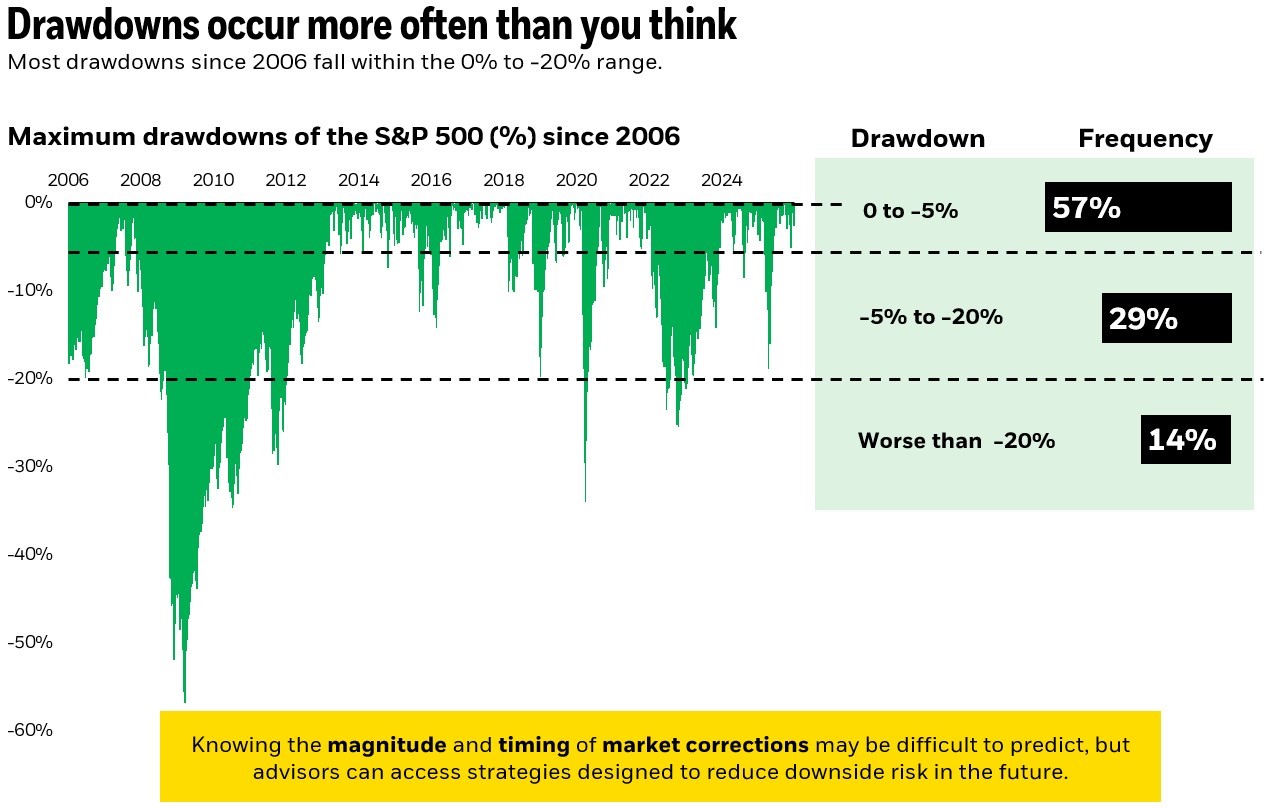
As many investors experienced first-hand in 2020 and 2022, traditional diversification levers such as stocks and bonds may not always provide enough risk mitigation against changing market conditions. At the same time, sitting on the sidelines in cash or trying to time markets can prevent investors from achieving their financial goals.

Maximum drawdowns of the S&P 500 (%) since 2008

Maximum drawdowns for the S&P 500 since 2008.

S&P 500 Index returns are based on price returns, the performance of an index or asset based strictly on its current price relative to a previous price, excluding dividends. Source: Bloomberg, BlackRock Calculation from 1/1/2008 to 12/31/2025. Daily return series used for max drawdown calculation, which is defined as: The peak to trough decline during a specific record period of an index. It is usually quoted as the percentage between the peak (highest point) to the trough (lowest point). Index performance is for illustrative purposes only. Index performance does not reflect any management fees, transaction costs or expenses. Indexes are unmanaged and one cannot invest directly in an index. Past performance does not guarantee future results.


2. An attractive opportunity for targeted downside protection:

Advisors have more options today beyond structured notes or index-linked annuities to seek targeted downside protection. The rapid pace of innovation in the ETF industry has provided advisors an opportunity to utilize innovative strategies to seek such outcomes and move towards a recurring fee-based model for their appropriate clients.

3. A new tool to strengthen client relationships:

By providing access to buffer ETFs, advisors are better able to manage client expectations, which can promote healthier relationships.

WHAT ARE BUFFER ETFs?

By utilizing a combination of options, iShares Buffer ETFs seek to mitigate drawdowns and dampen volatility while offering some upside potential:

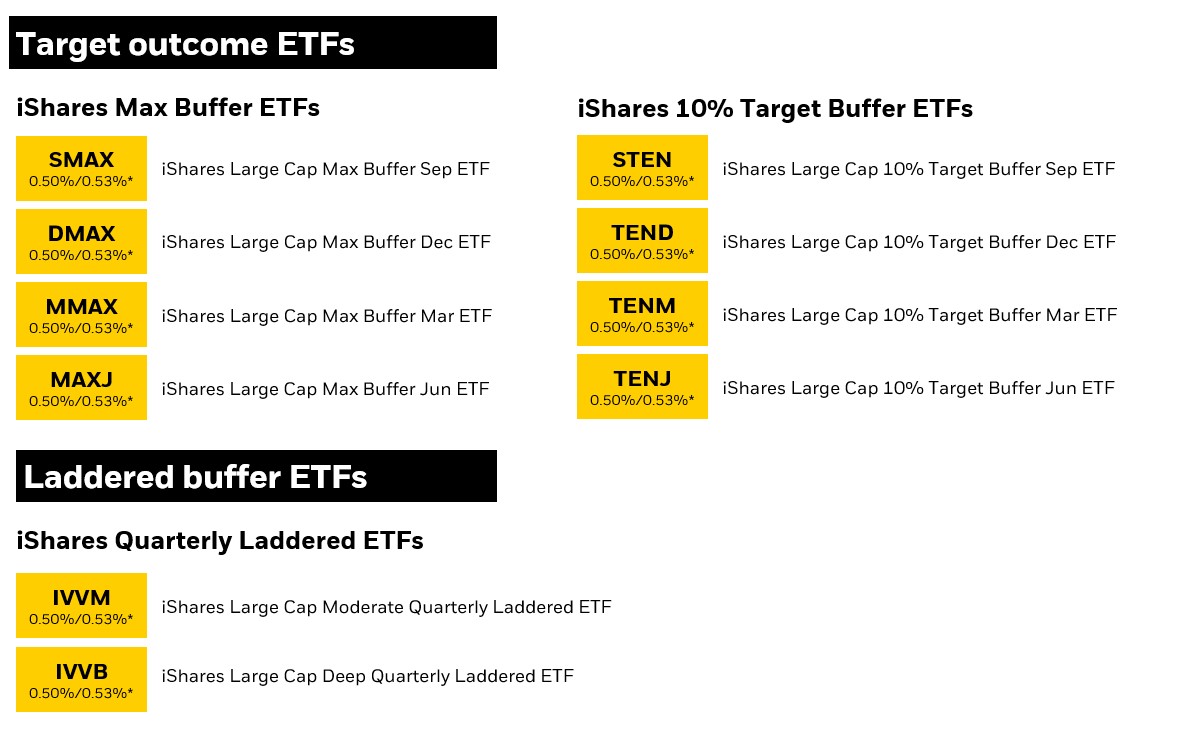
iShares offers two types of buffer ETFs, both of which hold the iShares Core S&P 500 ETF (IVV) as its underlying exposure:

  1. Target outcome ETFs: Seek to offer clearer levels of downside protection and upside participation for investors who intend to hold for the full outcome period.
  2. Laddered buffer ETFs: Seek to provide more continuous downside protection and upside participation for investors who are comfortable with less defined outcomes.
 iShares Buffer ETF product table

HOW DO BUFFER ETFS FIT IN A PORTFOLIO?

A strategic allocation

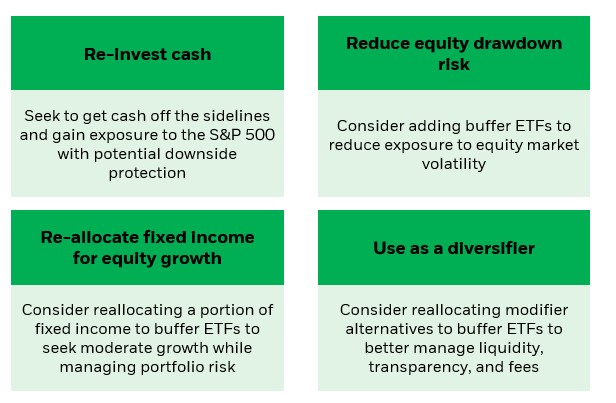
These buy-and-hold ETFs are designed to be used in a long-term, strategic allocation within a portfolio. Where it fits within a portfolio depends on the investor’s overall risk tolerance and other holdings in the portfolio. We believe there are four primary ways that Buffer ETFs can be used in portfolios:

This graphic outlines the four main applications of Buffer ETFs in portfolio management. They can be utilized to reinvest cash, mitigate equity drawdown risks, reallocate fixed income for equity growth, and serve as an alternative investment option.

An investment in ETFs is not equivalent to and could involve significant risks not associated with an investment in cash.


A tactical trade

Understanding the return caps that are set at the start of each buffer period allows advisors to provide attractive trade ideas to their clients.

For example, if an investor was concerned about market uncertainty but still wanted the ability to capture upside, they could have bought the iShares Large Cap 10% Target Buffer Dec ETF (TEND) at the beginning of the outcome period (January 1st, 2026). With a starting cap of 16.15%, the investor could seek a return on the iShares S&P 500 ETF while being protected on the first 10% of losses for the period. The remaining cap for TEND can be found on the fund’s product page and was 14.99% as of January 30, 2026.1

CONCLUSION

iShares Buffer ETFs enables investors to seek a new targeted level of protection in their portfolios with one common goal – to mitigate risk while seeking clearer outcomes.

iSHARES FUNDS

Explore a range of iShares ETFs to meet your clients’ investing goals.