

Core

May 22, 2026|ByJay Jacobs
Key takeaways
- Geopolitical increased market volatility in Q1, reinforcing the need for managing downside risk, while staying invested to capture a potential rebound.
- iShares buffer ETFs can balance these two objectives, offering downside protection within a defined range and upside participation up to a cap, over a specific outcome period.
- The higher volatility backdrop improved the opportunity for investors seeking protection and upside participation.
- Advisors have increased their use of buffer ETFs, which may help solve specific client outcome needs and scale risk management across portfolios.
MARKET BACKDROP
Investors have spent the early part of 2026 navigating a rapidly changing geopolitical environment, concerns with AI disruption, with both roads leading to sharp spikes in volatility with the VIX, which measures the S&P 500’s volatility, reached its highest level since April 2025.
Despite headlines around inflation and growth shocks and potential risks on the horizon, we think the backdrop supports staying invested in equities, while being more deliberate about managing downside risk against an expanding array of potential shocks.
During periods of heightened volatility and uncertainty, advisors may consider buffer ETFs to seek greater predictability through the uncertainty of markets. Buffer ETFs can help provide a defined level of downside protection should markets continue to dip but also can position portfolios for a rebound by capturing market upside up to a cap over a specific outcome period.
HOW CAN MARKET TURBULENCE IMPACT BUFFER ETFS?
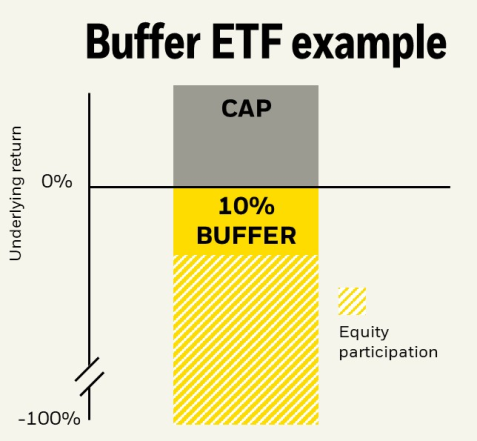
While buffer ETFs seek to provide downside protection, the levels of potential protection are often at a fixed level (e.g., a 10% buffer). On the other hand, the caps they offer aren’t fixed, they are shaped by market conditions. This is important during periods of turbulence, as market conditions like higher volatility can lead to higher upside caps. That means investors may be poised for more attractive upside opportunities should markets appreciate. Of course, buffers still have downside risk beyond their initial buffer.
The key ingredient to buffer ETFs that drives this relationship is options, which are used to establish downside buffer ranges and upside caps. Volatility is an important factor in how options are priced. When volatility has risen, the value of options has increased, which may have benefited buffer ETFs that sold (“or wrote”) options to create caps. Simply put, when the risk of drawdowns increased, investors demanded more upside potential, leading to higher caps for certain types of buffer ETFs.
HOW HAS VOLATILITY IMPACTED RECENT CAPS ON ISHARES BUFFER ETFS?
TENM, the iShares Large Cap 10% Target Buffer Mar ETF, reset with a cap of 18.39% (net of fees) for its one-year outcome period that started on April 1st, meaning investors who hold for the full outcome period could potentially earn a return 10% above all-time highs if markets rally, while still mitigating a further 10% selloff from when TENM reset. This happened when the VIX , which measures the S&P 500’s volatility, was elevated relative to the start of the year and is the highest cap for any of the iShares Large Cap 10% Target Buffer ETF suite.
Compare this to TEND, the iShares Large Cap 10% Target Buffer Dec ETF, which reset with a cap of 16.15% (net of fees) for its one-year outcome period that started on January 1st. This happened when the VIX was much lower.
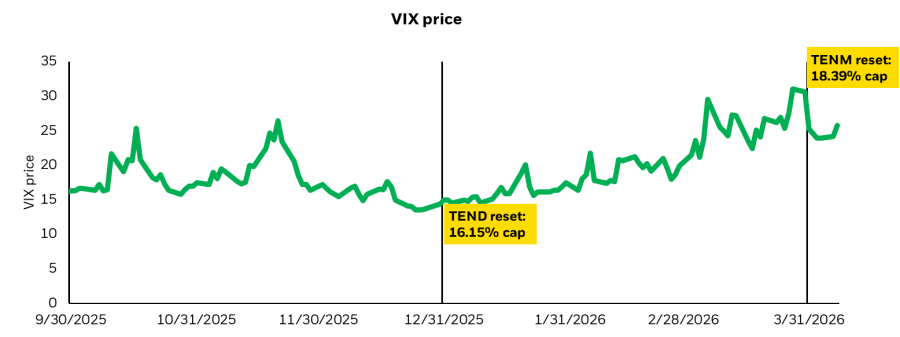
Source: Morningstar, as of 4/7/2026. The starting cap or cap is the approximate maximum possible return of the Funds if held through the entire hedge period.
The Funds employ an options strategy that seeks to track the price return of the iShares Core S&P 500 ETF (“the Underlying ETF” or the “Reference Asset”) while providing an approximate downside buffer (the “Buffer”) in exchange for an approximate cap (the “Cap”) on upside potential. The Buffer may help reduce volatility and mitigate the effects of a decline in the value of the Funds to a set range of potential losses for investors who hold Fund shares over the entire Hedge Period.
ARE ALL BUFFER ETF CAPS IMPACTED BY VOLATLITY?
No, not all buffer ETFs have caps that are sensitive to volatility. Some may be more sensitive to other factors, like interest rates. For example, the iShares Max Buffer ETFs (e.g., MMAX), which seek to provide up to 100% downside protection over a 1-yr outcome period, have been less sensitive to volatility and more sensitive to interest rates. Buffer ETFs that offer less protection (or greater market participation), tend to be more sensitive to volatility.
HOW ARE ADVISORS USING BUFFER ETFS?
As buffer ETF adoption has increased, advisors may see value beyond small tactical applications and have sought to use them to meaningfully change portfolio outcomes with larger allocations. Since buffer ETFs launched in 2019, the average allocation for adopters has increased from a mere 3.2% to 13.8% in 2025.*
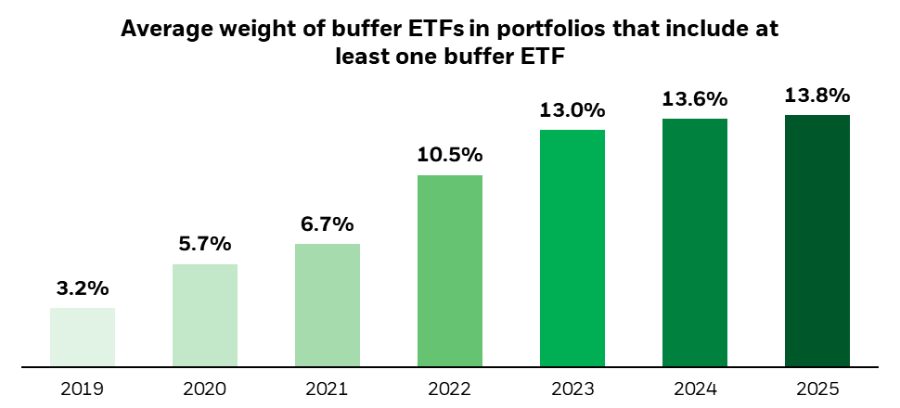
*Source: BlackRock Global Business Intelligence (GBI) as of 12/31/2025. Advisor data analysis includes 23,931 advisor models collected by BlackRock.
Advisors have used buffer ETFs in two ways:
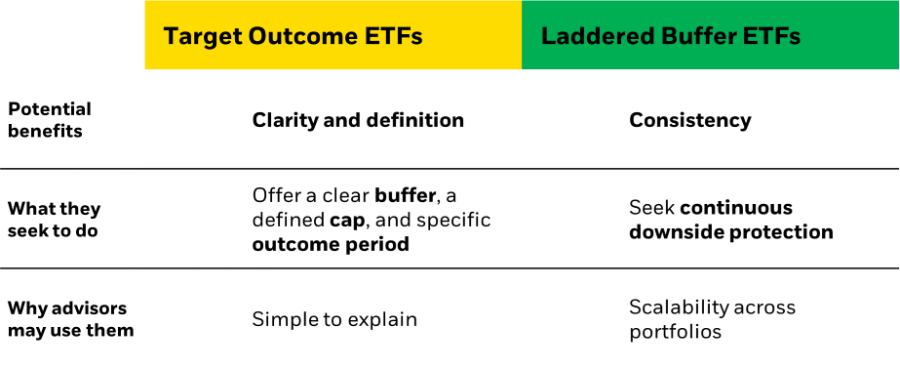
1. Solve client specific challenges with target outcomes, which seek to provide clarity and definition to clients with clear buffer levels, caps, over a specific outcome period.
Advisors may use target outcomes to align with client specific goals as well as their own market outlook. Advisors and individual investors can utilize our buffer tool to see how a fund has performed over its outcome period, and our new “potential outcome scenario” tool to see how each target outcome ETF may behave in different market conditions. (See TENM for example)
2. Scale buffer strategies across portfolios with laddered buffer ETFs, which seek to provide more continuous downside and a consistent risk management experience. As buffer ETF adoption has increased, advisors have sought ways to implement them at scale across client portfolios with less sensitivity to entry points. Laddered buffer ETFs differ from target outcome ETFs by holding multiple buffers inside of the ETF, which can help create more continuous downside protection.
WHAT’S NEXT FOR BUFFER ETFS?
As more advisors may look to implement buffer ETFs, one key question they should ask is “how do I build a total portfolio with buffer ETFs?”
For financial professionals seeking a diversified approach to buffer strategies, partnering with BlackRock through our Portfolio Design Services provides access to expert guidance and custom solutions. Our team can help integrate multiple buffer ETFs into your model portfolios.
CONCLUSION
Buffer ETFs can help advisors navigate volatility by offering targeted downside protection and, in periods of heightened volatility, potentially higher upside potential for clients compared to periods of lower volatility.
As advisors consider how to utilize buffer ETFs, BlackRock offers choice:
- Targeted outcomes to seek clarity and definition
- Laddered buffers to target continuous downside protection and scalability
- Partnership with Blackrock on how to implement buffer ETFs into their model portfolios.

Jay Jacobs
Head of U.S. Equity ETFs
Co-author
Jacob Goldberg, CFP
Sr. Outcome ETF Product Strategist
Contributor
More articles loaded. Use Shift+Tab keys to browse.
Total articles:


Investments
Insights
Retirement
Tools
Resources
About Us


Carefully consider the Funds' investment objectives, risk factors, and charges and expenses before investing. This and other information can be found in the Funds' prospectuses or, if available, the summary prospectuses which may be obtained by visiting www.iShares.com or www.blackrock.com. Read the prospectus carefully before investing.
Investing involves risk, including possible loss of principal.
There can be no guarantee that the Buffered Funds will be successful in their strategy to provide downside protection against Underlying ETF losses. The Funds do not provide principal protection or non-principal protection, and, despite the Approximate Buffer (the “Buffer”), an investor may experience significant losses on their investment, including the loss of their entire investment. In the event an investor purchases Fund shares after a Outcome Period begins or sells Fund shares prior to the end of the Outcome Period, the returns realized by the investor will not match those that the Funds seeks to provide. In periods of extreme market volatility, the Funds' return may be subject to downside protection significantly lower than the Buffer and an upside limit significantly below the Approximate Cap (the "Cap"). A new Cap is established during each Rebalance Period and is dependent upon current market conditions. As such, the Cap is likely to change, sometimes significantly, from one Outcome Period to the next.
The Buffered Funds invest in FLEX Options that derive their value from the Underlying ETF. FLEX Options are subject to counterparty risk, which is the risk that the other party in the transaction will not fulfill its contractual obligation, and may be less liquid than other securities. The value of FLEX Options may be affected by interest rate changes, dividends, actual and implied volatility levels of the Underlying ETF’s share price, and the remaining time until the FLEX Options expire. Because of these factors, the Funds' NAV may not increase or decrease at the same rate as the underlying ETF’s share price.
There can be no guarantee that a Laddered Buffer Fund will be successful in its strategy to provide downside protection against underlying ETF losses. The Fund does not provide principal protection or non-principal protection, and an investor could experience significant losses on their investment, including the loss of their entire investment. In periods of extreme market volatility, the Fund’s return may be subject to downside protection significantly lower, and an upside limit significantly below what the fund seeks to provide. There can be no guarantee that the Fund will be successful in its strategy to match the increase, if any and subject to the upside limit, of the share price return of the underlying ETF.
Actively managed funds do not seek to replicate the performance of a specified index, may have higher portfolio turnover, and may charge higher fees than index funds due to increased trading and research expenses. There is no guarantee that an active fund will meet its investment objective.
The strategies discussed are strictly for illustrative and educational purposes and are not a recommendation, offer or solicitation to buy or sell any securities or to adopt any investment strategy. There is no guarantee that any strategies discussed will be effective. The information presented does not take into consideration commissions, tax implications, or other transactions costs, which may significantly affect the economic consequences of a given strategy or investment decision.
The Funds are distributed by BlackRock Investments, LLC (together with its affiliates, “BlackRock”).
The iShares Funds are not sponsored, endorsed, issued, sold or promoted by S&P Dow Jones Indices LLC, nor does this company make any representation regarding the advisability of investing in the Funds. BlackRock is not affiliated with S&P Dow Jones Indices LLC.
©2026 BlackRock, Inc. or its affiliates. All Rights Reserved. BLACKROCK and iSHARES are trademarks of BlackRock, Inc. or its affiliates. All other trademarks are those of their respective owners.
GPS0526-5387218-EXP0527