

Inside alternatives

Oct 08, 2026
Key takeaways
- Direct lending economics have improved: Higher US base rates and wider spreads have increased prospective yields for newly originated loans.
- Stronger economics don’t necessarily mean greater risk: Lenders can benefit from tighter underwriting, stronger documentation and enhanced lender protections.
- Selectivity remains critical: Resilient borrower fundamentals—particularly among larger companies—reinforce the importance of disciplined underwriting and manager selection.
A reset in US interest rate expectations and widening of credit spreads have shifted the direct lending dynamics for investors. In turn, we believe private credit has become increasingly attractive over the course of this year.
Multiple drivers of yield enhancement
At the start of 2026, market participants broadly anticipated multiple US interest rate cuts, and the forward curve would suggest a SOFR level of approximately 3.2% in the second quarter of 2027.1 However, persistent inflation and a more resilient economic backdrop have materially altered the outlook, with forward markets now implying that US rates could rise north of 4.6% by mid-2027.1 As a result, private credit strategies, which typically feature floating rate structures, are well-positioned to benefit from a prolonged ‘higher-for-longer’ rate environment.
Exhibit 1: SOFR base rates and forward curve
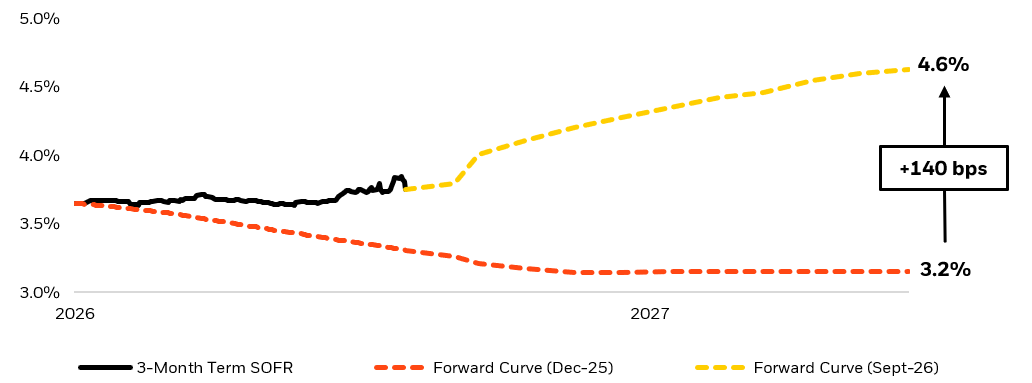
Source: Bloomberg. SOFR = CME Term SOFR 3 Month. Forward curve forecasts as of December 31, 2025 and September 15, 2026 , as applicable.
Importantly, the improvement in yield expectations is not solely a function of higher US interest rates. Credit spreads have also widened as lenders have become more selective amid elevated market uncertainty.2 While dry powder remains relatively accessible, we believe underwriting standards have tightened, and lenders are demanding greater compensation for risk, resulting in more attractive economics on newly originated transactions. In our view, the combination of higher US base rates and wider spreads has meaningfully enhanced prospective yields across the asset class.
New investments in focus
These dynamics have driven a significant increase in expected returns for new investments. Gross asset yield expectations have risen from approximately 8.5% at the beginning of the year to ~10% today, representing one of the most meaningful improvements in direct lending economics in recent years.1,3 For investors seeking income –oriented strategies, we believe the current market offers an attractive opportunity to deploy capital at yields that are substantially higher than those available just months ago while maintaining exposure to senior, floating-rate assets.
Exhibit 2: Potential all-in gross yield
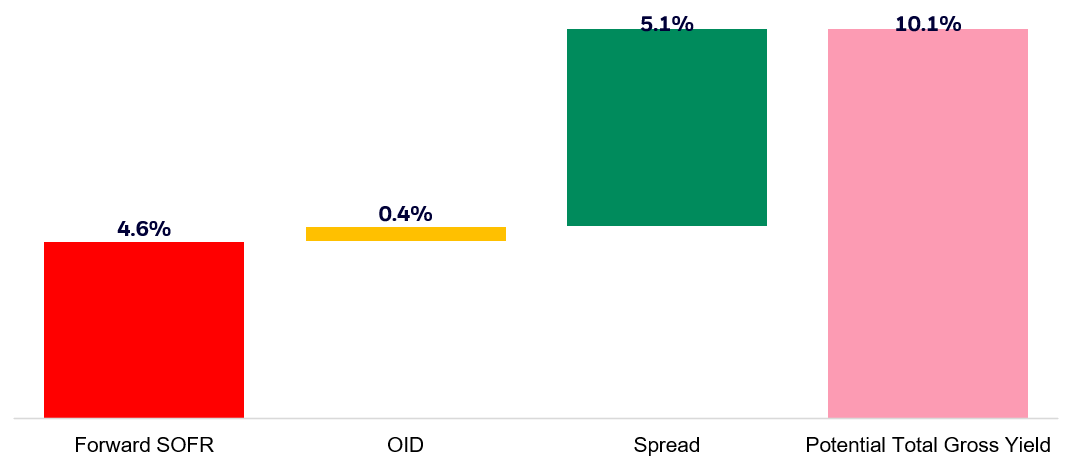
Source: Bloomberg. SOFR = CME Term SOFR 3 Month. Forward curve forecasts as of December 31, 2025 and September 15, 2026, as applicable. KBRA DLD as of June 30, 2026. Spread does not reflect the return of direct lending funds, which will be reduced by, among other things, fees and expenses, or the return that may ultimately be realized on an investment. Higher spreads may represent higher cost of capital for borrowers, and such costs may increase the risk of default or the risk that the loan may otherwise become impaired. KBRA DLD as of June 30, 2026. OID of 1.15% is amortized over a three-year horizon. Potential total gross yield reflects the sum of (i) forward SOFR expectations for mid-2027 (determined as of September 15, 2026), (ii) direct lending OID information as of June 30,2026 and (iii) direct lending spread information as of June 2026. The information provided herein is included to show the general trend in the applicable markets in the periods indicated and is not intended to imply that the yields herein are achievable or guaranteed. Actual yields earned over the life of an investment could differ materially from the potential yields presented above. Higher yields represent higher cost of capital for borrowers and such costs may increase the risk of default or the risk that the loan may otherwise become impaired. Potential yield does not reflect the return of any fund, which will be reduced by, among other things, fees and expenses, or the return that may ultimately be realized on this investment.
The current backdrop is especially compelling, in our view, because the potential for enhanced yield can still be achieved while maintaining disciplined underwriting standards. In our view, heightened uncertainty has encouraged private credit managers to focus on resilient businesses, conservative capital structures, and enhanced lender protections. As a result, many newly originated transactions are offering higher yields alongside improved documentation, tighter covenant packages, and greater downside protection than was available during the more competitive lending environment of recent years.3
Furthermore, we believe this represents a particularly attractive environment because improved gross yield potential is being driven by stronger market fundamentals rather than increased risk-taking. Borrowers continue to place significant value on the speed, certainty, and flexibility of private capital that is often unavailable in public markets, enabling lenders to maintain disciplined underwriting standards while capturing higher yields and enhanced downside protections.
Larger companies continue to remain attractive
Borrower fundamentals, particularly for larger, well-established companies, continue to remain resilient.5 Bigger businesses often benefit from diversified business models, strong free cash flow generation, and enhanced financial flexibility, which can help them to better navigate higher interest rate and uncertain macroeconomic environments than smaller issuers. In our view, this has created favorable market conditions for private credit managers focused on upper-middle-market businesses, where credit performance has been resilient.5
Exhibit 3: Year-over- year last twelve months’ EBITDA growth by company size (Based on EBITDA)
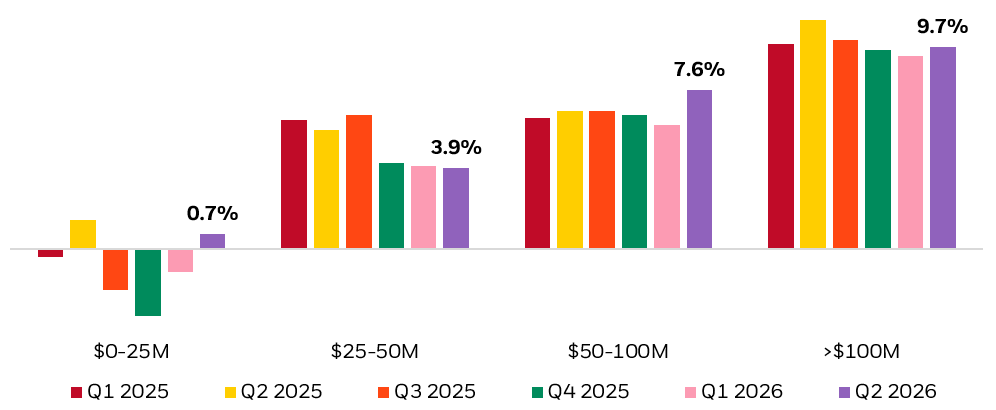
Source: Lincoln VOG Proprietary Private Market Database © 2026 Lincoln Partners Advisors LLC. All rights reserved. Use of these materials without Lincoln’s consent is prohibited. Includes data from the database through the second quarter of 2026.
Record institutional fundraising
Institutional investors appear to be increasingly recognizing the attractiveness of the private credit opportunity set. According to Preqin, direct lending drawdown funds raised a record $72 billion in the second quarter of 2026, underscoring what we believe to be continued institutional conviction in both the durability and long-term value of the asset class. In contrast, repurchase requests across ten of the largest non-traded BDCs reached an average of 9.9% of shares in the second quarter following a sharp increase over the prior three quarters.⁶ In our view, this divergence highlights a distinction between institutional investors, who remain focused on the asset class's underlying fundamentals and improving return profile, and portions of the wealth channel, where flows have been more heavily influenced by short-term market headlines.
Exhibit 4: Aggregate fundraising for direct lending funds
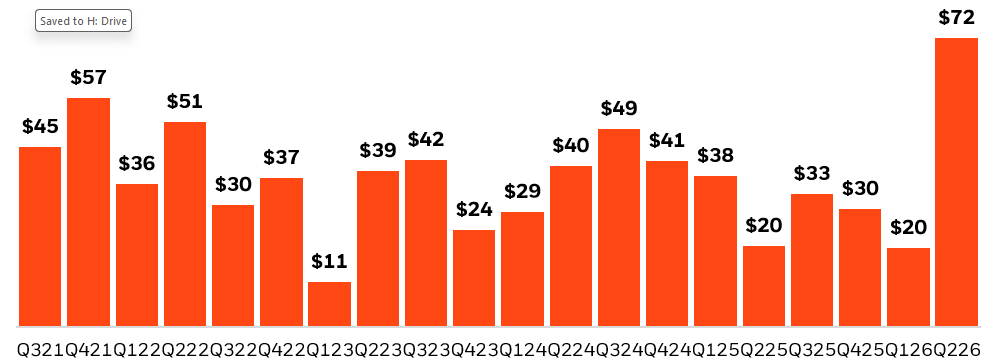
Source: Preqin as of June 30, 2026. Fundraising figures include closed end direct lending funds.
Conclusion
While market conditions will inevitably evolve, we believe today's environment highlights the value of disciplined capital deployment and rigorous credit selection. Taken together, the current combination of enhanced income potential, resilient borrower fundamentals, and sustained institutional demand supports a highly constructive outlook for direct lending and what we believe is one of the most attractive vintage opportunities in recent years.
Looking for more Private Credit content? Check out: Explore Private Markets and Alternatives | BlackRock
Investments
Insights
Retirement
Tools
Resources
About Us


1. Source: Bloomberg. SOFR = CME Term SOFR 3 Month. Forward curve forecasts as of December 31, 2025 and September 15, 2026, as applicable.
2. Based on HPS market observations.
3. Source: KBRA DLD as of June 30, 2026. Spread does not reflect the return of direct lending funds, which will be reduced by, among other things, fees and expenses, or the return that may ultimately be realized on an investment. Higher spreads may represent higher cost of capital for borrowers, and such costs may increase the risk of default or the risk that the loan may otherwise become impaired. Source: KBRA DLD as of June 30, 2026. OID of 1.15% is amortized over a three-year horizon.
4. Potential total gross yield reflects the sum of (i) forward SOFR expectations for mid-2027 (determined as of September 15, 2026), (ii) direct lending OID information as of June 30,2026 and (iii) direct lending spread information as of June 2026. The information provided herein is included to show the general trend in the applicable markets in the periods indicated and is not intended to imply that the yields herein are achievable or guaranteed. Actual yields earned over the life of an investment could differ materially from the potential yields presented above. Higher yields represent higher cost of capital for borrowers and such costs may increase the risk of default or the risk that the loan may otherwise become impaired. Potential yield does not reflect the return of any fund, which will be reduced by, among other things, fees and expenses, or the return that may ultimately be realized on this investment.
5. Source: Lincoln VOG Proprietary Private Market Database © 2026 Lincoln Partners Advisors LLC. All rights reserved. Use of these materials without Lincoln’s consent is prohibited. Includes data from the database through the second quarter of 2026.
6. Source: Preqin as of June 30, 2026. Fundraising figures include closed end direct lending funds
This material is intended for information purposes only, and does not constitute investment advice, a recommendation or an offer or solicitation to purchase or sell any securities to any person in any jurisdiction in which an offer, solicitation, purchase or sale would be unlawful under the securities laws of such jurisdiction. This material may contain estimates and forward-looking statements, which may include forecasts and do not represent a guarantee of future performance. This information is not intended to be complete or exhaustive and no representations or warranties, either express or implied, are made regarding the accuracy or completeness of the information contained herein. The opinions expressed are as of September 2026 and are subject to change without notice. Reliance upon information in this material is at the sole discretion of the reader.
Investing involves risk, including possible loss of principal. This material is strictly for illustrative, educational, or informational purposes and is subject to change. There can be no assurance that an investment strategy will be successful.
Past performance is no guarantee of future results. It is not possible to invest in an unmanaged index.
Incorporating alternative investments into a portfolio presents the opportunity for signicant losses including in some cases, losses which exceed the principal amount invested. Also, some alternative investments have experienced periods of extreme volatility and in general, are not suitable for all investors. Asset allocation and diversication strategies do not ensure prot or protect against loss in declining markets.
Private market investments should only be considered for investors who can tolerate the risk. A fund’s investments in private companies are subject to a number of risks. Private companies are generally not subject to SEC reporting requirements, are not required to maintain their accounting records in accordance with generally accepted accounting principles and are not required to maintain effective internal controls over financial reporting. As a result, the Sub Advisor may not have timely or accurate information about the business, financial condition and results of operations of the private companies in which the Fund invests.
© 2026 BlackRock, Inc. or its afliates. All Rights Reserved. BLACKROCK is a trademark of BlackRock, Inc. or its afliates. All other trademarks are those of their respective owners. Prepared by BlackRock Investments, LLC.
MKTG1026-H-5999095-EXP1027