

CONTACT US
Additional questions?
Schedule a meeting with a BlackRock private credit specialist.
Private credit refers to debt investments originated and held by non-bank lenders, typically through privately negotiated agreements. Unlike public bonds or syndicated loans, private credit investments are illiquid, customized and often structured with strong lender protections.
Private credit lending happens on a bilaterally negotiated basis where lenders work with borrowers to create bespoke solutions that address companies’ unique needs. By engaging directly with borrowers, private credit lenders have more flexibility to negotiate terms, covenants and pricing, which can lead to better protections and higher yields for investors relative to traditional fixed income instruments.
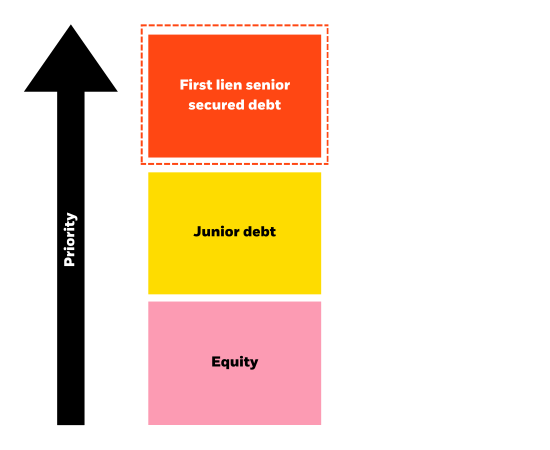
The largest segment of private credit is direct lending, which focuses on senior secured loans to middle- and upper-middle-market companies. These loans typically feature regular cash interest payments and sit at the top of the capital structure, which means they hold the highest priority in the capital structure above other debt and equity.
As outlined in our Introduction to Private Credit, the other primary categories of private credit are opportunistic credit and special situations and distressed debt. Here we will focus on direct lending.
Illustrative capital structure
Companies historically turned to banks when they needed a loan to finance operations, expansion or growth. That changed over the past 20 years as a combination of industry consolidation and post-2008 financial crisis regulatory changes made private, sub-investment-grade loans economically unattractive holdings on bank balance sheets.
Banks’ remaining capital allocations for lending have increasingly focused on larger companies with other revenue adjacencies. Mid-sized companies, generally those with up to $1 billion in revenue, have simultaneously faced declining access to the two primary sources of public credit ― broadly syndicated loans and high yield bonds ― as both markets have gravitated toward larger offering sizes and bigger companies.
Meanwhile, demand for private debt financing among middle-market companies has increased substantially, as companies stay private longer and the role of private equity investment firms continues to grow. Non-bank players such as private credit investment managers, insurers and finance companies have stepped in to fill the void, seizing the opportunity to lend directly to middle-market companies. As a result, direct lending has grown and matured significantly over the past two decades.
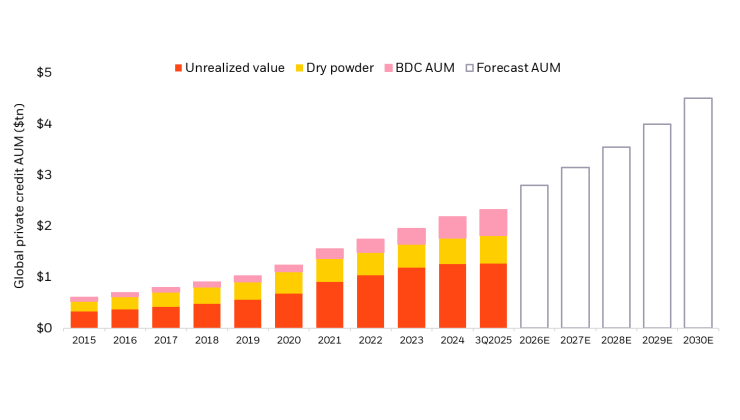
The current private credit market is estimated to be more than $2 trillion globally, surpassing the size of the leverage loan and high yield markets.1 The private credit market is expected to continue to scale, more than doubling to $4.5 trillion by 2030, with direct lending continuing to play a leading role, as shown in the chart below.
Growth in direct lending
Private credit global assets under management, 2016-2030E
Source: Preqin, Cliffwater, BlackRock. Historical (actual) data from Preqin and Cliffwater as of each calendar year-end and June 2025 (most recent available for Preqin). 2026E to 2030E are BlackRock estimates. There is no guarantee any forecasts may come to pass.
As private credit has grown, so has its importance in driving economic growth and business development. By providing financing to companies that may not have access to traditional bank loans or public debt markets, private credit can help businesses to hire, invest, innovate and scale. This is particularly important for middle-market companies. Without access to private credit, many of these businesses could face significant constraints on their ability to grow, compete and create jobs.
The attractiveness of private credit for potential borrowers is a key factor driving its growth. Both corporate borrowers and private equity sponsors have demonstrated a willingness to pay the generally higher costs of private credit relative to the public market alternatives in order to take advantage of what they perceive as several attractive relative characteristics. These include:
Speed and certainty of execution. Public markets can be affected by macroeconomic volatility, causing dislocations and pullbacks in lending. Private credit funding, including direct lending, tends to be less affected, making it more available while providing less variation in terms throughout market environments. In addition, private credit deals are often executed more efficiently because they typically involve a single or small group of lenders compared to public markets, which could require input from hundreds of lenders.
Customization and flexibility. Direct lending deals offer customized terms to meet the specific needs of a company rather than the standard terms offered by public markets. The flexibility to draw capital down over time and align capital with a company’s growth needs is an example of a potential key feature in private credit deals.
Heightened degree of confidentiality. Direct lending transactions are typically negotiated with a single or limited group of counterparties, resulting in enhanced confidentiality throughout the transaction process as opposed to public credit markets. Companies are often sensitive to public disclosure considerations and may pursue private credit solutions to achieve greater discretion and confidentiality.
A partnership-oriented lending relationship. Deals with private credit managers come with access to their expertise, insights and commercial network.
Direct lending strategies offer several potentially attractive features to prospective investors, including:
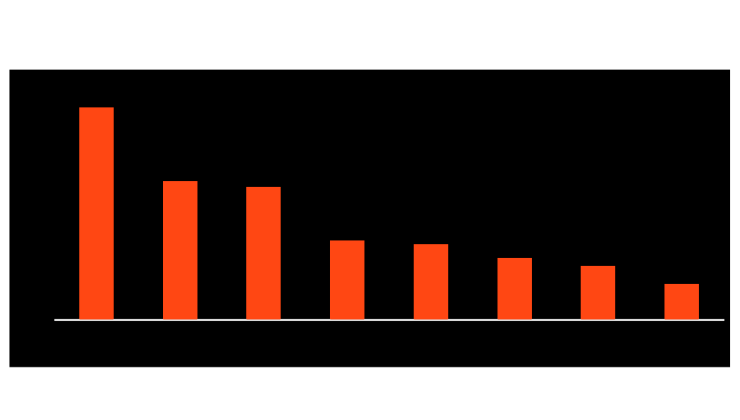
Premium yield and returns. Direct lending has historically offered higher yields than other income-oriented investments such as traditional fixed income alternatives and high-dividend-paying stocks, as shown below. These higher yields have not historically been offset by higher realized losses. Direct lending has generated yields 3.7% higher than broadly syndicated loans and 4% higher than high yield, on average, over the past 10 years. In addition, direct lending has achieved total annualized returns that are 3.6% higher than broadly syndicated loans and nearly 3% higher than high yield over the same period.2
Historically higher yields from direct lending
Yields across select assets, 10-year average
Sources: All data other than Cliffwater Direct Lending Senior Index is sourced from Bloomberg, as of Dec. 31, 2025 (latest available for all constituents). Direct lending is represented by Cliffwater Direct Lending Senior Index; leveraged loans by the LSTA Leveraged Loan Index; high yield by the Bloomberg Barclays U.S. High Yield Index; REITs by the MSCI U.S. REIT Index; and corporate fixed income by the Bloomberg Barclays U.S. Investment Grade Index. Barclays Aggregate is the Bloomberg Barclays U.S. Aggregate Index. Yield is defined as dividend yield for equity, yield to maturity for loans, yield to worst for bonds, and yield to three-year for direct lending. The yield metrics presented herein are derived using different methodologies across asset classes and, accordingly, are not directly comparable. Differing methodologies are utilized because comparable yield metrics may not be uniformly available or applicable across each asset class. These differing assumptions and calculation methodologies may result in certain asset classes appearing more or less favorable to others. Investors should consider the underlying methodologies and assumptions when evaluating such comparisons. Past performance is not indicative of current or future results. It is not possible to invest directly in an index.
Seniority and security of loans. Direct lending predominantly focuses on senior secured loans. Investments are generally secured by the borrower’s cash flows, physical and financial assets, and tend to be very senior in the capital structure ― ahead of equity and any subordinated debt. Loan amounts are typically only 30% to 60% of total asset value, creating a substantial cushion against any potential impairment.
Strong contractual protections. Direct lending loans also typically carry a robust set of contractual protections for the lender, called covenants. In addition to the contractual obligation to pay regular interest and repay loan principal on a set schedule, covenants often limit the total amount of debt a borrower can have outstanding and prevent the borrower from incurring additional debt that is more senior to the direct loans or reducing the collateral securing the direct loans. These types of protections can help to create downside protection while also functioning as early indicators of weakening borrower performance.
Floating-rate structure. Floating-rate loans ― where the cash coupon of the loan is reset as interest rates change ― typically account for most direct lending portfolios. This benefits investors in elevated interest rate environments and should better insulate investors in sustained inflationary periods compared to other fixed income instruments and equity. At the same time, these loans are often structured with reference interest rate floors that provide additional yield protection in very low-interest-rate environments.
Incorporating direct lending into a diversified portfolio may improve overall income, reduce reliance on public market performance, and enhance resilience across economic cycles. For individual investors, this creates an opportunity to build portfolios that are not only return-oriented but also more balanced and durable. As a result, an allocation to direct lending may be worthy of consideration for investors who are:
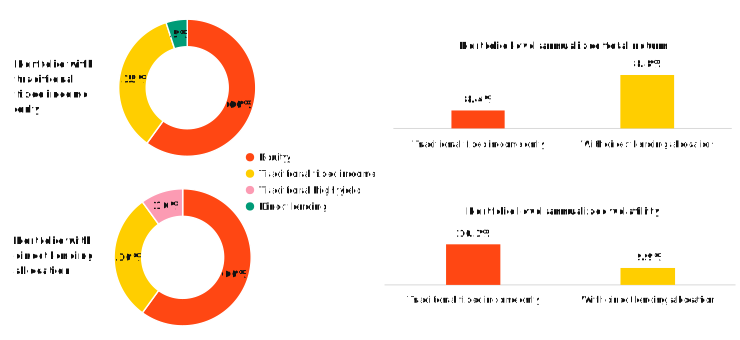
For investors with a traditional 60% equity and 40% fixed income allocation, direct lending can serve as a complementary component that enhances both return and risk characteristics. By introducing an asset class with a lower correlation to public equities and bonds, portfolios may benefit from improved diversification and reduced overall volatility.
Over a long-term investment horizon of the last 20 years, portfolios that included a 10% allocation to direct lending outperformed and had lower volatility than traditional 60/40 portfolios.
Improved risk/return efficiency with direct lending
Sources: Direct lending is represented by the Cliffwater Direct Lending Index (CDLI); equity by the S&P 500 Total Return Index; traditional fixed Income by the Bloomberg U.S. Aggregate Total Return Index; traditional high yield by the Bloomberg U.S. Corporate High Yield Bond Total Return Index. “Portfolio-level annualized total return” represents the annualized total return of the indices (in the proportions set forth in the charts showing the “Portfolio with traditional fixed income only” and “Portfolio with direct lending allocation”) from Sept. 30, 2005, through Dec. 31, 2025, for all indices, where return is defined as gross income return, net realized gains (losses), and net unrealized gains (losses) and is prior to any fees and expenses. “Portfolio-level annualized volatility” is defined as the standard deviation of quarterly index returns from Sept. 30, 2005, through Dec. 31, 2025, for all indices (in the proportions set forth in the charts showing the “Portfolio with traditional fixed income only” and “Portfolio with direct lending allocation”). Index information provided herein is included to show the general trend in the applicable markets in the periods indicated and is not intended to imply that direct lending is similar to any index in composition or element of risk. Past performance is not indicative of current or future results. It is not possible to invest directly in an index.
In our view, the steady income, reduced mark-to-market fluctuations, and differentiated risk exposures create a more efficient portfolio with improved risk-adjusted returns over time.
Individual investors most often access direct lending strategies through private credit funds, typically non-traded business development companies (BDCs) that provide access to capital for small and mid-sized businesses in the U.S. Investments in direct lending funds carry a number of potential risks. The investments of a direct lending fund have credit risk to the underlying borrowers, substantially all of which are sub-investment grade or not rated. These investments may be subject to markdown or loss of capital. In addition, most private credit funds have the ability to employ leverage that could ultimately result in the magnification of any potential investment losses.
The underlying investments of direct lending strategies are illiquid. Depending on the type of private credit fund and its terms, an investment in the fund may have limited or no liquidity; therefore, investors may not have the ability to liquidate their investment when desired or at all. As a result, direct lending is not a suitable investment for investors who cannot absorb losses or who require regular or immediate liquidity. Investments in direct lending funds are typically subject to fees and expenses, which lower the fund’s investment returns to shareholders and are also subject to potential conflicts of interest.
Before making the decision to invest in any private credit strategy, investors should consult their financial, tax and accounting advisors and read the fund’s prospectus carefully for a full list of risks associated with an investment in the fund, as well as a description of any fees and expenses.
Historically, direct lending strategies have provided investors with attractive risk-adjusted returns, predominantly driven by high cash yield. We believe the historically consistent high-single digit returns, low relative volatility and correlation with traditional investments, and potential for relative resiliency in the face of elevated interest rates and/or sustained inflation make private credit strategies worthy of consideration as part of an income-focused investor’s diversified investment portfolio.
This article features insights and represents the views of HPS, a part of BlackRock.
Schedule a meeting with a BlackRock private credit specialist.
1 Source: Preqin, Cliffwater, BlackRock. Historical (actual) data from Preqin and Cliffwater as of each calendar year-end and June 2025 (most recent available for Preqin). 2026E to 2030E are BlackRock estimates. There is no guarantee any forecasts may come to pass.
2 Sources: Cliffwater, based on Cliffwater Direct Lending Senior Index returns from 2016 through 2025; LSTA Leveraged Loan Index; and Bloomberg Barclays U.S. High Yield Index. It is not possible to invest directly in an index.
This material is intended for information purposes only, and does not constitute investment advice, a recommendation or an offer or solicitation to purchase or sell any securities to any person in any jurisdiction in which an offer, solicitation, purchase or sale would be unlawful under the securities laws of such jurisdiction. This material may contain estimates and forward-looking statements, which may include forecasts and do not represent a guarantee of future performance. This information is not intended to be complete or exhaustive and no representations or warranties, either express or implied, are made regarding the accuracy or completeness of the information contained herein. The opinions expressed are as of July 2026 and are subject to change without notice. Reliance upon information in this material is at the sole discretion of the reader.
Investing involves risk, including possible loss of principal. This material is strictly for illustrative, educational, or informational purposes and is subject to change. There can be no assurance that an investment strategy will be successful.
Past performance is no guarantee of future results. It is not possible to invest in an unmanaged index.
Incorporating alternative investments into a portfolio presents the opportunity for significant losses including in some cases, losses which exceed the principal amount invested. Also, some alternative investments have experienced periods of extreme volatility and in general, are not suitable for all investors. Asset allocation and diversification strategies do not ensure profit or protect against loss in declining markets.
Private market investments should only be considered for investors who can tolerate the risk. A fund's investments in private companies is subject to a number of risks. Private companies are generally not subject to SEC reporting requirements, are not required to maintain their accounting records in accordance with generally accepted accounting principles and are not required to maintain effective internal controls over financial reporting. As a result, the Sub-Advisor may not have timely or accurate information about the business, financial condition and results of operations of the private companies in which the Fund invests.
© 2026 BlackRock, Inc. or its affiliates. All Rights Reserved. BLACKROCK is a trademark of BlackRock, Inc. or its affiliates. All other trademarks are those of their respective owners.
Prepared by BlackRock Investments, LLC.
MKTG0726-5731856-EXP0727