


CONTACT US
Additional questions?
For additional information or questions, please contact a BlackRock private markets specialist.
EXPLORE MORE ALTERNATIVES
Hi, I’m Grishma Parekh, Co-Head of Core Senior Lending at HPS, a part of BlackRock.
Here are three things we’re thinking about with the evolution of private credit and what we believe makes it a compelling asset class.
First, private credit plays an important role in today’s financial system. Our work provides companies with flexible, customized capital solutions that public markets often can’t. That flexibility allows businesses to keep investing, growing and navigating complex situations.
Second, our teams have gotten to play a role in helping a once niche asset class evolve and scale into a key allocation for investors over the past decade. What began primarily as an institutional market has expanded significantly as more investors access private credit as a portfolio diversifier with the potential to generate attractive income and returns.
Third, private credit is ultimately a relationship business. Long-term partnerships with management teams, private equity firms and investors are central to how the private credit market functions. And, those relationships are built on trust, integrity and consistency over time.
Grishma Parekh, Co-Head of Core Senior Lending at HPS, a part of BlackRock, shares three things we’re thinking about with the evolution of private credit and what we believe makes it a compelling asset class.
Private credit is a form of debt in which non-bank lenders, such as asset managers, loan capital directly to borrowers who cannot access financing from banks, or want more flexible, customized solutions that public markets do not offer. These loans are not traded in public markets.
Private credit has grown significantly after the Global Financial Crisis (GFC), when regulatory changes caused banks to pull back from leveraged lending. Now, with more companies staying private for longer and needing capital to support their growth, acquisitions and leveraged buyouts, private credit managers are stepping in to help fill the financing void.
In private credit markets, companies access financing directly from lenders. This differs from companies transacting in syndicated high-yield or bank loan markets, where financing is obtained with the help of a bank or intermediary.
Private lending happens through direct negotiation; lenders partner with borrowers to create bespoke solutions that address companies’ unique needs. By working directly with borrowers, private credit lenders have more flexibility to negotiate terms, covenants and pricing. This can lead to better protections and higher yields for investors relative to public credit markets. Borrowers can work with lenders to craft loan terms for their specific needs and access flexible capital faster and more easily.
Private credit loans typically use a floating rate structure, where the cash coupon of the loan is reset as interest rates change. These loans are often structured with reference interest rate floors that provide additional yield protection in very low-interest rate environments.
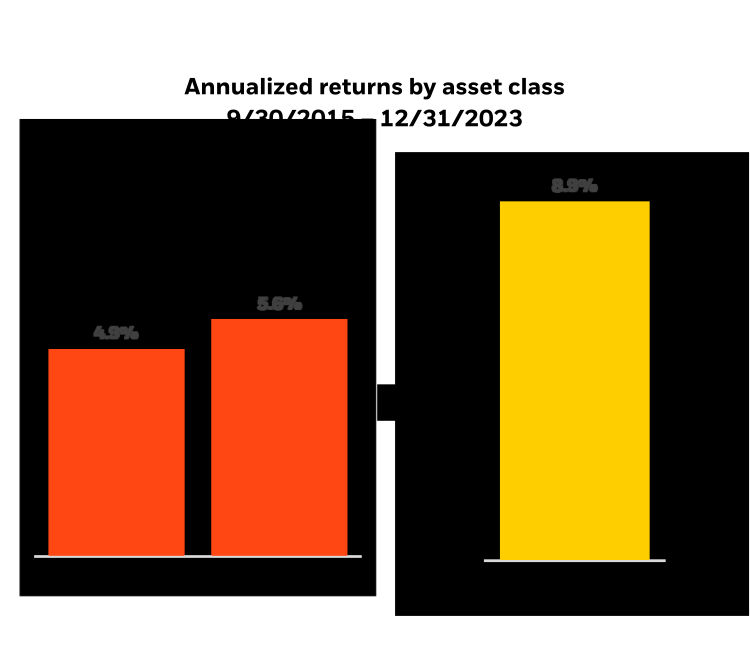
Private credit strategies cover a range of risk and return profiles and private credit funds can differ by strategy, the type of debt provided, and position in the capital structure. Capital structure refers to the way a company is financed based on the proportion and type of debt and equity on its balance sheet. This determines how, and in what order, capital is repaid in the event of bankruptcy. For example, senior debt is at the top of the capital structure and repaid first, making it lower risk, while junior or subordinated debt sits near the bottom of the capital structure just above equity, which is repaid last. Strategies with lower risk typically provide lower return than those with higher risk.
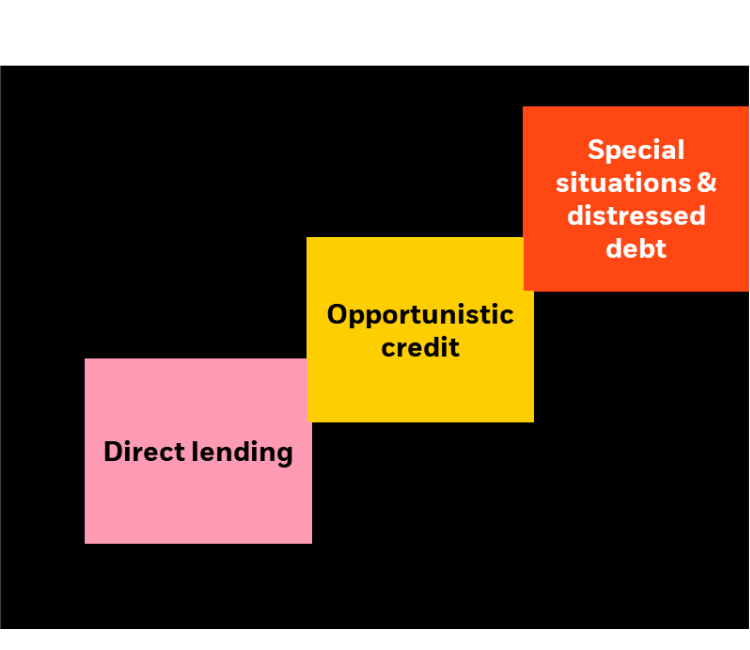
Three common private credit strategies are:
Direct lending. Provides senior debt financing, often in the form of secured loans, to “middle market” companies with enterprise values between $100 million and $2.5 billion. Returns are driven primarily by income. Historically, direct lending has been the most widely used strategy in the private credit space.
Opportunistic credit. Focuses on debt investments driven by corporate transformations or market disruption. Returns are typically higher than in direct lending but lower than in special situations and distressed investing.
Special situations and distressed debt. Targets companies facing unique circumstances, including businesses showing signs of stress or distress as well as healthy, growing businesses that face legal complexities, time-sensitive capital needs, or other factors that make conventional financing unavailable. These strategies may involve a broader range of instruments and risk profiles. Returns are typically driven by income, price appreciation or equity participation.
Private debt investments are less liquid and more complex than traditional assets, which can create hurdles for individual investors. That said, illiquidity and complexity premiums (the compensation for these higher risks, in the form of higher return potential or attractive negotiated rates) can be a useful tool in portfolio construction to offset more traditional risk exposures
Private credit can be a compelling alternative to traditional fixed income investing and has historically demonstrated lower risk compared to other alternative asset classes, such as private equity, given its higher position in the capital structure.
Potential benefits of private credit investing include:
Individual investors often have less exposure to private credit than institutions, but new structures such as interval funds, business development companies (BDCs), and managed accounts are making access easier.
Private credit investments involve market, credit and operational risks. Private loans are typically less liquid than publicly traded bonds and may offer limited transparency given that they are not subject to public reporting and regulatory requirements. Because private credit investments are not actively traded, investors expect higher returns as compensation for reduced liquidity and increased complexity.
Private credit offers investors a differentiated way to access income and diversification by lending directly to companies outside of public markets, often with stronger structural protections than traditional credit. While these investments involve lower liquidity and greater complexity, investors have historically been compensated through higher yields and attractive risk-adjusted returns. For those able to tolerate these trade-offs, private credit can play a valuable role alongside traditional fixed income in a diversified portfolio.
For additional information or questions, please contact a BlackRock private markets specialist.
*Subject to change.
Please consider the investment objectives, risks, charges and expenses of the funds carefully before investing. The prospectuses and, if available, the summary prospectuses contain this and other information about the funds and are available, along with information on other BlackRock funds, by calling 800-882-0052 or at www.blackrock.com/funds The prospectuses and, if available, the summary prospectuses should be read carefully before investing.
Investing involves risk, including possible loss of principal. This material is strictly for illustrative, educational, or informational purposes and is subject to change. There can be no assurance that an investment strategy based will be successful.
Past performance is no guarantee of future results. It is not possible to invest in an unmanaged index.
Incorporating alternative investments into a portfolio presents the opportunity for significant losses including in some cases, losses which exceed the principal amount invested. Also, some alternative investments have experienced periods of extreme volatility and in general, are not suitable for all investors. Asset allocation and diversification strategies do not ensure profit or protect against loss in declining markets.
Private market investments should only be considered for investors who can tolerate the risk. A fund s investments in private companies is subject to a number of risks. Private companies are generally not subject to SEC reporting requirements, are not required to maintain their accounting records in accordance with generally accepted accounting principles and are not required to maintain effective internal controls over financial reporting. As a result, the Sub Advisor may not have timely or accurate information about the business, financial condition and results of operations of the private companies in which the Fund invests.
© 2026 BlackRock, Inc. or its affiliates. All Rights Reserved. BLACKROCK and iSHARES are trademarks of BlackRock, Inc. or its affiliates. All other trademarks are those of their respective owners.
Prepared by BlackRock Investment, LLC, member FINRA.
MKTG0426-5406994-EXP0427
