
Fixed Income
Apr 28, 2026|ByKaren Veraa-Perry, CFAStephen Laipply
Client portfolios have become more complex.
Over the past decade, investors have gained access to a broader opportunity set — including private markets, thematic strategies, and digital assets. While these allocations can offer new sources of potential return and diversification, they may also introduce new challenges: different liquidity profiles, higher volatility, and greater demands on portfolio construction.
For financial advisors, this raises a critical question: how do you build portfolios that can adapt to innovation without sacrificing stability?
In our latest bond ETF thought leadership, A Durable Foundation: How bond ETFs are powering a portfolio revolution, we outline how fixed income ETFs are helping investors navigate the defining trends shaping the market today, including:
- Elevated cash balances
- The demand for income helping drive the rise of active and systematic fixed income ETF strategies
- Expanding private market allocations
- Accelerating digital asset exposure
Cash has been rising – but so has opportunity cost
Cash balances have reached new highs1, reflecting both cyclical trends including elevated policy rates and macro volatility, as well as a longer-term view that as capital markets deepen and expand, structural liquidity pools have grown alongside them.
The key question for investors is not whether holding liquidity has been prudent—but whether it remains optimal as the rate cycle evolves. When interest rates declined in prior cycles, cash yields tended to reset quickly.2 Bonds, by contrast, often provided higher income and price appreciation as yields declined.
For clients seeking to redeploy cash while managing risk, bond ETFs, particularly short-duration or term-maturity strategies, could offer incremental yield pickup, while maintaining daily liquidity and flexibility.
Figure 1: Short Duration Bond ETFs to help manage excess cash allocations
30 Day SEC Yields of Select iShares Fixed Income ETFs (%)
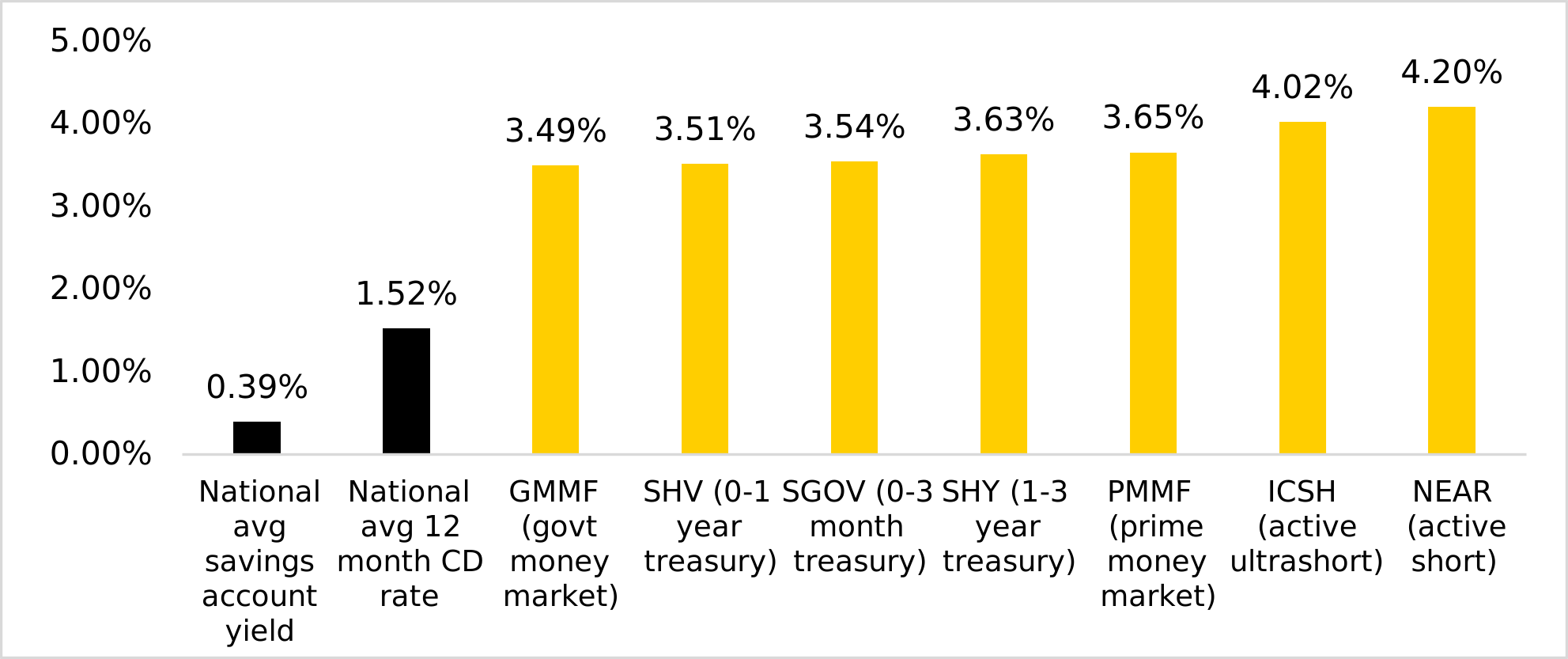
Source: BlackRock, FDIC, iMoneyNet, as of March 31, 2026. National average savings account yield represents average interest rate paid on savings deposit accounts at U.S. insured depository institutions. National average 12-month CD rate is the average interest rate on 12-month certificates of deposit (CDs) with balances less than $100 million offered by insured U.S. depository institutions (banks and credit unions). iShares ETF yields are 30-Day SEC yields. It’s important to note that there are material differences between Savings accounts, CDs and ETFs, including investment objectives, risks, fees, and expenses. CDs are fixed income investments that generally pay a set rate of interest over a fixed time period until maturity, whereupon the principal is typically returned plus any interest earned. Early withdrawal from CDs may result in interest penalties. Most savings accounts pay compound interest, meaning earnings are added to the balance to create a larger base on which future interest is paid. Most savings accounts allow you to add or withdraw money at any time without incurring a fee. Both Savings accounts and CDs principal investments are insured by the FDIC up to applicable FDIC limits, while ETFs are not FDIC insured and may lose value. Most ETFs seek to track an index, before fees and expenses. ETFs trade on exchanges intraday and may incur brokerage commissions. ETF shares can be sold at market price, which may be higher or lower than NAV, and are not individually redeemable from the fund. Diversification may not protect against market risk. Transactions in shares of ETFs may result in brokerage commissions and tax consequences. There can be no assurance that an active trading market for shares of an ETF will develop or be maintained. Short term bond ETFs may experience greater volatility than cash equivalents.
Performance data represents past performance and does not guarantee future results. Investment return and principal value will fluctuate with market conditions and may be lower or higher when you sell your shares. Current performance may differ from the performance shown. For standardized performance and most recent month end performance, click on the fund’s ticker symbol: GMMF | SHV | SGOV | SHY | PMMF | ICSH | NEAR.
Chart description: Bar chart showing that yields on short-term bond ETFs are currently higher than those of conventional savings vehicles.
For clients seeking to capture today’s yields, term maturity bond ETFs such as iShares iBonds® ETFs offer diversified exposure, regular income, and the flexibility of an ETF structure — while helping investors plan around known time horizons. iBonds ETFs are similar economically to term deposits but with the ability to trade out of the exposure before maturity.
Beyond traditional beta — seeking income through an expanded fixed income ETF toolkit
Income remains a top priority for many clients — but reaching for yield can potentially introduce unintended risks. Extending duration or moving down the credit spectrum can increase sensitivity to rate moves or economic slowdowns.
The iShares fixed income platform now offers advisors a broader toolkit to address this challenge. In addition to traditional index exposures, advisors can incorporate:
- Active bond ETFs, such as the iShares Flexible Income Active ETF (BINC), which offer investors access to harder-to-reach fixed income sectors through the convenience of an ETF wrapper.
- Systematic Fixed Income ETFs, such as the iShares Systematic Bond ETF (SYSB), which combine human expertise with quantitative, data-driven techniques to refine risk and income.
- Outcome‑oriented ETFs, such as the iShares 20+ Year Treasury Bond BuyWrite Strategy ETF (TLTW), which are designed to target specific objectives such as enhanced income or reduced rate sensitivity.
Used together, these tools allow advisors to build potentially more resilient income allocations, while maintaining transparency, scalability, and operational efficiency.
For clients seeking more tax-aware solutions, municipal bond ETFs allow investors to efficiently access diversified portfolios of municipal bonds while maintaining liquidity, transparency, and ease of implementation. In today’s market environment, the tax-equivalent yields of certain municipal bond sectors compared favorably to taxable bond sectors.
Figure 2: Taxable Bond Category Yields vs. iShares Municipal Bond ETFs
*Taxable equivalent yield assumes highest federal tax rate (40.8%)
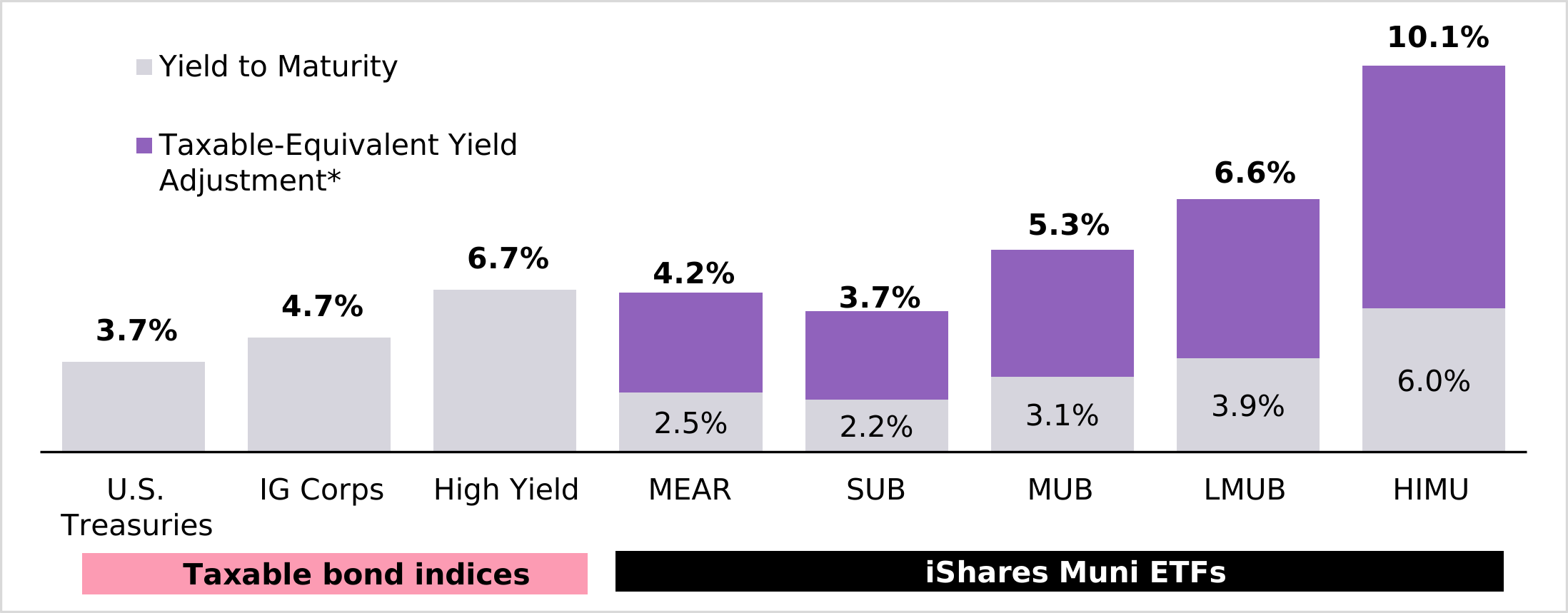
Source: US Treasuries universe measured by the Bloomberg U.S. Treasury Bond Index; IG Corp universe measured by the Bloomberg Corporate Bond Index & High Yield universe measure by the Bloomberg High Yield Bond Index. As of February 27, 2026. Yields for funds are on a gross basis.
Performance data represents past performance and does not guarantee future results. Investment returns and principal value will fluctuate with market conditions and may be lower or higher when you sell your shares. Current performance may differ from the performance shown. For most recent month-end performance see www.iShares.com.
Chart description: Bar chart showing yields across taxable and municipal bond categories.
Interest in private markets has surged — liquidity must expand to meet investor needs
Private markets allocations are predicted to grow – in fact, 70% of advisors say they expect to begin using private markets exposures by 20273.
As private exposure grows, liquidity management becomes more important. Bond ETFs can help balance this dynamic. Their exchange‑traded structure allows for intraday trading and price transparency, even during periods of market stress. Advisors can use bond ETFs as a liquidity sleeve, helping them meet client cash needs, rebalance portfolios, and maintain flexibility alongside less liquid investments.
Did you know? In 2026, Bond ETFs traded an average of $60B a day year-to-date, up from $20B in 2020.
Figure 3: Global bond ETF industry trading volumes
Rolling 20D average daily volumes, USD $B
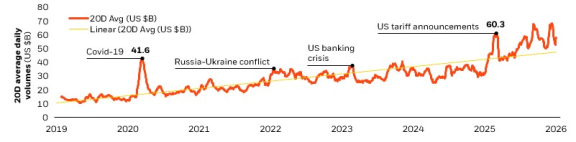
Source: BlackRock, Bloomberg, big xyt as at March 31, 2026. Rolling 20‑day average daily volume is the average number of shares traded per day over the 20 trading days ending on the date referenced. Past performance does not guarantee future results. There can be no assurance that an active trading market for shares of an ETF will develop or be maintained.
Chart description: Line chart showing the growth of global bond ETF trading volume from 2019 to March 31, 2026.
Portfolios with larger allocations to digital assets need broader stabilizers
Digital assets have grown as more investors allocate to the asset class. Cryptocurrency assets as one example, have grown rapidly. The total crypto market cap is now $2.4 trillion4, while ETPs providing access to cryptocurrency have grown from $4 billion to $120 billion in just 3 years, with now 300+ listed ETPs5. >75% of institutional investors are expected to increase allocations to digital assets and 59% planned to allocate >5% of AUM to cryptocurrencies6. These allocations may introduce more volatility in portfolios.
High‑quality fixed income can help serve as an anchor in these portfolios, by providing income, diversification, and stability. Bond ETFs can help mitigate drawdown and tail risk, or the risk of extreme or unexpected market losses, by ensuring diversified duration/credit exposure and consolidating exposure into a single vehicle to simplify implementation, and the ability to efficiently rebalance.
Built for today’s advisor — and tomorrow’s portfolio
Portfolio construction has become more complex, but the need for durable foundations has not changed.
Fixed income has evolved beyond its traditional role, and bond ETFs can be a central way advisors implement, manage, and rely on bonds in modern portfolios.
As new asset classes emerge and client needs evolve, portfolios built on liquidity, income, and resilience are better positioned to endure. For many advisors, fixed income ETFs are not simply a component of the portfolio — we believe they will continue to evolve to support the revolution to come for portfolios and the assets within them.

Stephen Laipply
Managing Director, Global Co-Head of iShares Fixed Income ETFs

Karen Veraa-Perry
Managing Director, Head of iShares US Fixed Income Strategy
Investments
Insights
Retirement
Tools
Resources
About Us


1. Source: Federal Reserve Bank of St. Louis. As of March 11, 2026, there was $18.8 trillion in bank deposits and $7.7 trillion in money market funds.
2. In prior rate-cutting cycles, the one-year average return on cash after cuts began again after a pause of 3 months of longer was approximately 2.8%, reflecting the rapid repricing of short-term yields. By contrast, bonds have historically delivered 7–9% over the same period. Source: BlackRock, Bloomberg. Cash represented by Bloomberg US T-Bills 1-3 Month Index; USD Aggregate bonds represented by Bloomberg USD Aggregate Index; Short duration USD IG corporate bonds represented by Bloomberg US Corporate 1-5 Year Index. Average 1yr total returns for the post-rate hike periods 30/10/1990-30/10/1991, 10/04/1992-10/04/1993, 20/12/1995 – 19/12/1996, 26/06/2003 – 25/06/2004, 19/10/2008 – 19/10/2009, 04/03/2020 – 04/03/2021. Past performance does not guarantee or indicate future results. Index performance is for illustrative purposes only. You cannot invest directly in the index.
3. Source: 2026 BlackRock Advisor Insights Trends survey with data from 1,023 advisors as of September 7, 2025.
4. Source: TradingView, as of March 31, 2026.
5. Source: BlackRock Global Business Intelligence, as of March 31, 2026.
6. Source: Coinbase & EY Parthenon Institutional Investor Digital Assets Survey, Jan 2025. Survey findings are based on responses from 352 institutional investors. https://www.ey.com/content/dam/ey-unified-site/ey-com/en-us/insights/financial-services/documents/ey-growing-enthusiasm-propels-digital-assets-into-the-mainstream.pdf
Carefully consider the Funds' investment objectives, risk factors, and charges and expenses before investing. This and other information can be found in the Funds' prospectuses or, if available, the summary prospectuses, which may be obtained by visiting the iShares Fund and BlackRock Fund prospectus pages. Read the prospectus carefully before investing.
Investing involves risk, including possible loss of principal.
Fixed income risks include interest-rate and credit risk. Typically, when interest rates rise, there is a corresponding decline in the value of debt securities. Credit risk refers to the possibility that the debt issuer will not be able to make principal and interest payments.
Non-investment-grade debt securities (high-yield/junk bonds) may be subject to greater market fluctuations, risk of default or loss of income and principal than higher-rated securities.
Actively managed funds do not seek to replicate the performance of a specified index, may have higher portfolio turnover, and may charge higher fees than index funds due to increased trading and research expenses. There is no guarantee an active fund will meet its investment objective.
iShares Prime Money Market ETF: You could lose money by investing in the Fund. Unlike a traditional money market fund, the Fund operates as an exchange traded fund (“ETF”). As an ETF, the Fund’s shares will be traded on an exchange and will generally fluctuate in accordance with changes in net asset value (“NAV”) per share as well as the relative supply of, and demand for, shares on the exchange. Because the share price and NAV of the Fund will fluctuate, when shares are sold (or redeemed, in the case of an Authorized Participant), they may be worth more or less than what was originally paid for them. The Fund may impose a fee upon sale of shares by Authorized Participants. The Fund generally must impose a fee when net sales of Fund shares exceed certain levels. An investment in the Fund is not a bank account and is not insured or guaranteed by the Federal Deposit Insurance Corporation or any other government agency. The Fund’s sponsor is not required to reimburse the Fund for losses, and you should not expect that the sponsor will provide financial support to the Fund at any time, including during periods of market stress.
iShares Government Money Market ETF: You could lose money by investing in the Fund. Although the Fund will seek to qualify as a “government money market fund,” it will not seek to maintain a stable net asset value (“NAV”) per share using the amortized cost method of valuation. Instead, the Fund will calculate its NAV per share based on the market value of its investments. In addition, unlike a traditional money market fund, the Fund operates as an exchange traded fund (“ETF”). As an ETF, the Fund’s shares will be traded on an exchange and will generally fluctuate in accordance with changes in NAV per share as well as the relative supply of, and demand for, shares on the exchange. Because the share price and NAV of the Fund will fluctuate, when shares are sold (or redeemed, in the case of an Authorized Participant), they may be worth more or less than what was originally paid for them. An investment in the Fund is not a bank account and is not insured or guaranteed by the Federal Deposit Insurance Corporation or any other government agency. The Fund’s sponsor is not required to reimburse the Fund for losses, and you should not expect that the sponsor will provide financial support to the Fund at any time, including during periods of market stress.
Diversification and asset allocation may not protect against market risk or loss of principal.
This material represents an assessment of the market environment as of the date indicated; is subject to change; and is not intended to be a forecast of future events or a guarantee of future results. This information should not be relied upon by the reader as research or investment advice regarding the funds or any issuer or security in particular.
This material is not intended to be relied upon as a forecast, research or investment advice, and is not a recommendation, offer or solicitation to buy or sell any securities or to adopt any investment strategy. The opinions expressed are as of the date indicated and may change as subsequent conditions vary. The information and opinions contained in this material are derived from proprietary and non-proprietary sources deemed by BlackRock to be reliable, are not necessarily all-inclusive and are not guaranteed as to accuracy. As such, no warranty of accuracy or reliability is given and no responsibility arising in any other way for errors and omissions (including responsibility to any person by reason of negligence) is accepted by BlackRock, its officers, employees or agents. This material may contain “forward-looking” information that is not purely historical in nature. Such information may include, among other things, projections and forecasts. There is no guarantee that any of these views will come to pass. Reliance upon information in this material is at the sole discretion of the viewer.
This material contains general information only and does not take into account an individual's financial circumstances. This information should not be relied upon as a primary basis for an investment decision. Rather, an assessment should be made as to whether the information is appropriate in individual circumstances and consideration should be given to talking to a financial professional before making an investment decision.
Prepared by BlackRock Investments, LLC, member FINRA.
© 2026 BlackRock, Inc or its affiliates. All Rights Reserved. BLACKROCK and iSHARES are trademarks of BlackRock, Inc. or its affiliates. All other trademarks are those of their respective owners.
GPS0426-5334676-EXP0427