


ENHANCE YOUR PORTFOLIO
Start your investment journey
Discover how to invest through a financial advisor, online investment platform or investment partner.

Retirement should be a time of fun and adventure, setting aside the complexities of working life. But you need your finances to work hard to support it. It’s become harder to retire in comfort, as life expectancy increases, and governments and companies reduce their contributions. Nevertheless, with forward planning, and careful saving, a prosperous retirement is within reach.

People retiring today could be looking at a retirement of 30 years or more. The average 50 year old has a one in four chance of reaching 95, and a one in 10 chance of reaching 99.1 At the same time, fewer people have defined benefit schemes: retirees need to be self-reliant to finance a secure retirement.
This comes at a time when the nature of retirement is changing. Increasingly, retirement is not a point in time, but a slowing paring back – potentially involving consultancy, entrepreneurship, part time work. People may be in work for longer. Retirement planning needs to be flexible.
This is currently £230.25 a week.2 Everyone is entitled to it, as long as they have 35 years or more of National Insurance contributions. The age of eligibility varies, but someone who is 50 years old today can claim their state pension at age 67.3
All workplaces have to offer their employees above the age of 22 and who earn over a certain level access to a workplace pension scheme.4 Your employer needs to contribute a minimum of 3%, while you will pay 5% and then the government will add tax relief on top.
This is a pension you set up yourself, perhaps if you are self-employed, or you don’t believe that the state or workplace pension will be enough. These are often called SIPPs (self-invested personal pensions) and you can invest in a SIPP through investment platforms, or life and pensions providers.
People retiring today could be looking at a retirement of 30 years or more.
The average 50 year old has a one in four chance of reaching 95, and a one in 10 chance of reaching 99. There are important factors to take into account when building wealth for your retirement.
1 Gov.uk - Tax on your private pension contributions - April 2025
2 MSCI - MSCI World - 31 March 2025
3 RL360 - impact of inflation calculator - April 2025
Please note, there is no guarantee that a positive investment outcome will be achieved.
In this phase, the priority is to save as much as you can, for as long as you can. You should have four areas of focus:

Make the most of pension tax breaks. In England and Wales, basic rate taxpayers get 20% tax relief on contributions, while higher and additional rate taxpayers get 40% or 45%. You can claim relief on contributions up to 100% of your annual earnings, though this is capped for the highest earners.5

Ensuring that you take advantage of your workplace scheme where it is offered. The contribution offered by your employer is very useful, and can help contribute to faster growth in your pension pot.

Starting as early as possible and saving as much as you can give you the best possible chance of growing your retirement pot. The effects of compound interest, often referred to as investing for growth, can be significant over time.

Ensuring that the investment mix is right when investing for retirement income – It may go against your instinct, but it is important not to be too cautious with your retirement pot. You need your capital to grow, and to protect yourself against inflation. Adopting a very cautious, or cash-based approach may not allow this to happen.
Planning how to generate income in retirement is one of the most important financial decisions you will make. The choices can feel overwhelming, but starting with your long-term objectives will help you create a strategy that matches your needs. By clarifying what kind of retirement lifestyle you want, and then reviewing the resources you already have, you can build a clear picture of how to fund the years ahead.
Ask yourself what kind of retirement you want to enjoy:
Understanding your priorities helps determine the income required for a comfortable retirement.
Review all sources of retirement income, including:
Combining these gives you a realistic overview of your financial position.
If your projected retirement income falls short of your goals, there are only a few solutions:
Each approach carries different implications for risk, flexibility, and long-term security.
Your retirement strategy should reflect both your age and your attitude to risk. Ask yourself:
These questions will guide the balance between fixed-income products and growth-focused investments.
One option is to use part or all of your pension pot to buy an annuity. An annuity provides a guaranteed income for life, offering certainty but limiting flexibility.
Factor in additional income streams such as the State Pension, rental income, or dividends from investments. A diversified approach can reduce reliance on a single source.
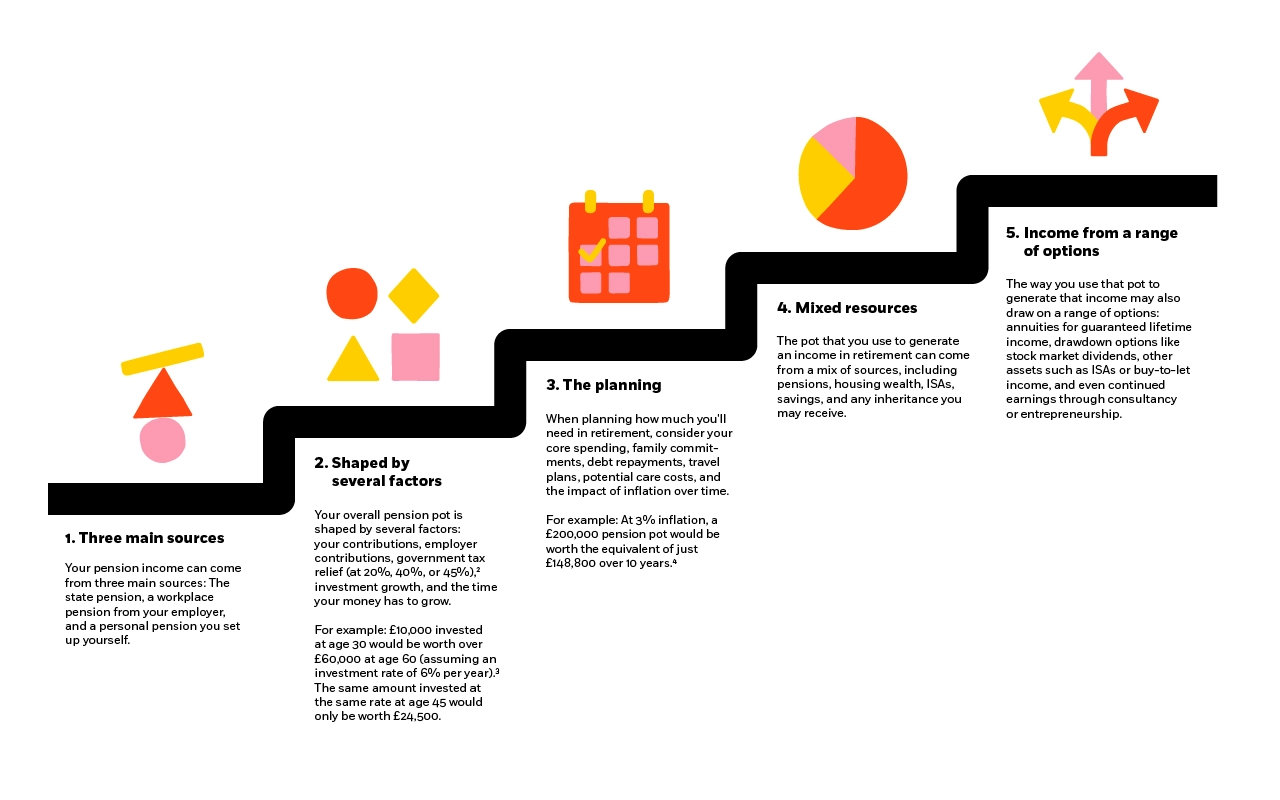
Inflation can erode the value of your savings significantly. For example, at 3% annual inflation, a £200,000 pension pot would only have the purchasing power of £148,800 after 10 years.6 Planning for inflation is essential to preserve long-term security.
Investments in the stock market may deliver stronger long-term growth but also come with higher volatility and the possibility of capital loss. Balancing growth and stability is key.
Retirement planning involves complex decisions that have lasting consequences. Seeking independent financial advice at this stage can help you:
A well-structured retirement income strategy, supported by professional advice, can give you the confidence that your financial future is secure.
Whatever your journey looks like, BlackRock can help. We provide you with a wide range of investment trusts to choose from. Each has its own dedicated webpage where you can explore useful information about the trust to understand if it is a good match for your portfolio.
A useful place to start are our trust factsheets or explainer videos where you’ll find more information about the trust including some of the investments it holds, the level of growth it aims for and its level of risk.
The impact of compounding is significant over time. £10,000 invested at age 30 would be worth over £60,000 at age 60 (assuming an investment rate of 6% per year). The same amount invested at the same rate at age 45 would only be worth £24,500. Starting early is a powerful tool.
You have a range of tax-free savings options for your long-term savings. Contributions to a self-invested personal pension (SIPP) will attract pension tax credits, and any income and gains will accumulate tax free. You won’t be able to use the capital before age 55 (57 from April 2028). The Lifetime ISA is for under-40s and contributions also attract tax relief. It can be used to buy a first home, or for retirement, but you can only contribute up to £4000 per year. Junior Sipps are for those under the age of 18.
As early as possible. The sooner you can start contributing to your pension, the sooner you can get the compound effect working in your favour. In terms of planning for your retirement, you should start thinking about it at least a decade before the date you want to retire.
A Junior Sipp is a tax efficient way of investing for your child. The Junior SIPP allowance for the 2024/25 tax year is £3,600, but you only have to put in £2,880 and the government will top up the rest.7 The child cannot touch the money until they are 57 (as it stands), but the impact of compounding returns over 40-50 years can be significant.
Investment trusts can help as you save for your retirement, harnessing growth opportunities in the global economy. Investment trusts can use gearing to give you greater exposure to stock market returns. They can help you target more unusual and less exploited areas of global stock markets, helping with diversification.
Investment trusts can also be a useful source of dividends. Dividends can help your income grow ahead of inflation. To create resilient income, you need to be diversified. With investment trusts, income can come from a range of sources. Investment trusts have certain structural advantages that can help deliver a steadier income over time. For example, they can reserve income during buoyant periods to pay it out during tougher periods, helping smooth returns for investors.
There are a lot of useful calculators online that can help you work out your retirement income. They will help you add up all your retirement savings and give you an indicative income based on current annuity rates. As a rule of thumb, dividing your retirement savings by 25 can give you an approximate idea of the income you can expect.8
Discover how to invest through a financial advisor, online investment platform or investment partner.
1 Office for National Statistics - Life Expectancy Calculator - February 2025
2 Gov. UK - The new State Pension - 23 February 2025
3 Gov. UK - State Pension age calculator - 23 February 2025
4 Gov. UK - Joining a Workplace Pension - 23 February 2025
5 Gov.UK - Pension tax relief - February 2026
6 Royal London - Inflation calculator - 12 February 2025
7 Hargreaves Lansdown - What is a Junior SIPP - February 2025
8 Money Week - How much you need to follow the 25x retirement rule - 26 August 2025
Risk Warnings
Investors should refer to the prospectus or offering documentation for the funds full list of risks.
Capital at risk. The value of investments and the income from them can fall as well as rise and are not guaranteed. Investors may not get back the amount originally invested.
Levels and basis of taxation may change from time to time and depend on personal individual circumstances.

MKTG0526-5360209-EXP0527