

PRACTICE MANAGEMENT

Sep 10, 2026|ByMark DiSipio, CIMA®
2026 marks 30 years since Congress created the 529 plan,i an investment vehicle built specifically for education savings. In the decades since, 529 plan benefits have expanded well beyond college and graduate school costs to include K-12, vocational training, continuing education, credentialing, apprenticeships, and more.ii And with the ability to roll up to $35,000 in unused funds into a Roth IRA over a lifetime, the “what if my child doesn’t go to college?” concern that once drove clients toward other vehicles carries far less weight today.iii
Yet clients continue to default to custodial accounts, Roth IRAs, brokerage accounts, and savings accounts as an education savings strategy often without realizing what they’re giving up. Each of those vehicles has its place, but when education is the goal, none matches the combination of benefits a 529 provides:
- Tax-free growth and tax-free withdrawals for qualified education expenses;
- State income tax deductions or credits for contributions in nearly 40 states;iv
- No income limits to contribute and high maximum contribution limits;
- The account owner, not the beneficiary, retains control of the funds and the right to change beneficiaries (or withdraw funds for any reason);*
- Minimal financial aid impact – 529 plans owned by a parent or dependent student are treated as a parent asset on the Free Application for Federal Student Aid (FAFSA) and counted at a maximum 5.64% of account value.v
Here’s a closer look at the trade-offs your clients may unknowingly be making by choosing a different vehicle for an education savings goal.
Custodial accounts (UGMA/UTMA)
The appeal of these accounts is straightforward: no contribution limits and no restrictions on how funds are used. Parents can save for a car, a down payment, or other future expenses for their child including college costs.
However, for a parent saving for education, the trade-offs of using a custodial account instead of a 529 plan can be significant:
- Irrevocability: contributions to a custodial account are irrevocable gifts which cannot be reclaimed or redirected to another child. Assets become the child’s property at age of majority (usually between 18 and 21 depending on the state of residence), at which point the child can manage and access the funds directly for any purpose they choose.vi
- Financial aid impact: UGMA/UTMA accounts are treated as a student asset on the FAFSA which can reduce aid eligibility by 20% of the account value vs. a maximum of 5.64% for parental assets.vii
- Tax liabilities: No tax-free growth; unearned income above the $2,700 thresholdviii is subject to “kiddie tax”; withdrawals are subject to capital gains taxes.
If the parent contributes to a 529 plan instead, they can ensure the funds are spent on their child’s education or career development, enjoy more favorable financial aid treatment, benefit from tax-free growth, and avoid paying capital gains taxes on withdrawals for qualified education expenses.
Roth IRA
The Roth IRA has a genuine appeal for education savings: tax-free growth, no 10% early withdrawal penalty on qualified education expenses (though ordinary income tax may apply to earnings)ix, and the "dual purpose" argument that unused funds simply stay in retirement. These are real advantages. But clients who lean on a Roth IRA as their primary education savings vehicle should understand what they're trading away:
- Accounts are subject to annual contribution limits, $7,500 or $8,600 for age 50+ in 2026, which can slow the long-term growth of the accountx;
- Income limits apply: MAGI must be less than $153k (single)/$242k(married) to make full contributionxi;
- Financial aid impact: retirement accounts are not reported on the FAFSA, but distributions will count as income in the following year’s FAFSA;xii
- Opportunity cost: Early withdrawal sacrifices years of tax-free growth and shortchanges your client’s retirement plan.
By contrast, 529 plan contributions are not limited by the account owner’s income, and many plans offer high aggregate contribution limits of over $500,000.xiii Equally important, a dedicated 529 plan allows clients to have transparent conversations with their children about what the family has set aside for education, helping students make informed decisions about school choice, borrowing, and spending – all without drawing down retirement savings to do it.
Taxable brokerage accounts
The brokerage account's appeal is easy to understand: no contribution limits, no restrictions on use, full investment flexibility, and complete owner control. For clients who already have taxable accounts, the path of least resistance is simply earmarking existing investments for education rather than opening something new. But that convenience comes at a cost — and for clients whose primary goal is education savings, the trade-offs are worth spelling out:
- No tax shelter: Dividends, interest, and capital gains are taxable annually; clients forgo years of tax-free compounding that a 529 provides. And capital gains taxes are payable on withdrawals.
- Investment risk: Unlike a 529 plan, a brokerage account is rarely optimized around a college savings glidepath – the gradual de-risking that aligns the portfolio with a fixed withdrawal date. As a result, a market downturn in the years just before enrollment could expose clients to sequence-of-returns risk at the worst possible time, forcing the sale of depreciated assets to cover tuition bills that won’t wait.
- Behavioral risk: Without a dedicated "education" account, clients are more likely to repurpose funds for other goals.
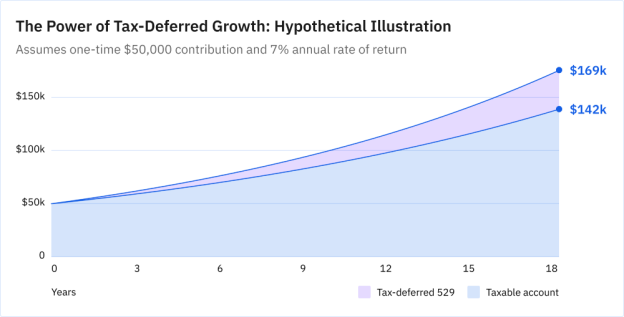
**Assumes a yearly tax drag would reduce the effective annual rate of return of the taxable account from 7% to 5.95%, i.e., an annual tax cost of 1.05% (https://www.blackrock.com/us/financial-professionals/insights/tax-center). Assumes a $50k initial contribution that is compounded annually (at the respective rate of return) over 18 years. The difference between the two funds after 18 years only reflects the value of the tax-deferral, it does not include potential tax savings of tax-free withdrawals for education from the 529 plan.
With a 529 plan, clients can align investment risk with their withdrawal timelines while enjoying tax-free growth and withdrawals for education expense. With regular contributions over a 15- to 18-year time horizon, the tax benefits of the 529 plan can be substantial. Plus, a dedicated 529 helps keep funds earmarked for education separate from other goals.
Savings accounts / CDs
For many clients, income may be automatically deposited to a savings account as it’s received. These accounts offer familiarity, simplicity, and safety in the form of FDIC insurance. But clients should be aware of the drawbacks of using funds in cash accounts as a primary source of funding for education, including:
- Purchasing power loss: Higher education costs have historically outpaced general inflation.xiv Cash equivalents rarely keep pace, leaving families with a growing gap.
- Taxes: While clients won’t pay taxes on withdrawals, interest is fully taxable as ordinary income, eroding real returns each year.
- Behavioral risk: Similar to brokerage accounts, clients are more likely to re-direct funds from a general savings account to competing goals.
While savings accounts may be appropriate for near-term goals, they are not well-suited for a long-term education funding strategy. For clients who may be risk averse or seeking to preserve earnings, many 529 plans offer access to money market or stable value portfolios that allow them to be in a cash equivalent fund while enjoying tax-free growth and withdrawals for qualified education expenses.
Key takeaways
Clients often default to familiar savings vehicles not because they've weighed the trade-offs, but because no one has walked them through the comparison. The costs – tax drag, financial aid exposure, lost control, and the behavioral risks of funds drifting toward other goals – tend to surface late, when there's little time to course-correct.

When education savings comes up in a planning conversation, it’s your opening to walk clients through both the trade-offs of other vehicles and the advantages of the one built for the job. For most clients, that conversation leads to the same place. Purpose-built for education savings, 529 plans combine tax advantages, favorable financial aid treatment, goal clarity, and account-owner control in one dedicated vehicle.

Mark DiSipio
Head of 529 Distribution
Mark DiSipio CIMA®, is Director and Head of 529 Distribution at BlackRock, responsible for business development and platform strategy for BlackRock’s 529 college savings platform.

Stephen Jagard
529 Sales Specialist
Stephen Jagard is a Vice President and 529 Sales Specialist at BlackRock, providing support with the distribution of BlackRock's 529 plans and helping manage the relationships of our state clients and partner firms.
529 benefits continue to grow
529 plans continue to expand and grow in their flexibility and usage, making them an ideal fit for even more clients. Parents, grandparents and self-starters can realize great benefits from opening and contributing to 529 plans.

More articles loaded. Use Shift+Tab keys to browse.
Total articles:


Investments
Insights
Retirement
Tools
Resources
About Us


*The exception to this rule is if it is a custodial 529 account, where the beneficiary would retain control of the plan once they reach age of majority per local state law.
i H.R.3448, Small Business Job Protection Act of 1996, Pub. L. 104-188 (enacted Aug. 20, 1996), which added Section 529 to the Internal Revenue Code. https://www.govinfo.gov/content/pkg/PLAW-104publ188/html/PLAW-104publ188.htm
ii K-12 expansion: Tax Cuts and Jobs Act of 2017, https://www.congress.gov/bill/115th-congress/house-bill/1/text. Apprenticeships and credentialing: SECURE 2.0 Act of 2022; IRS Publication 5834, Qualified Tuition Programs (IRC Sec. 529), https://www.irs.gov/pub/irs-pdf/p5834.pdf.
iii SECURE 2.0 Act of 2022, Section 126 (effective Jan. 1, 2024). See IRS Publication 590-A, Contributions to Individual Retirement Arrangements (IRAs), https://www.irs.gov/publications/p590a#en_US_2025_publink1000231030. Lifetime rollover limit of $35,000 per beneficiary; subject to annual Roth IRA contribution limits and 15-year account age requirement.
iv SavingForCollege.com, “How Much Is Your State’s 529 Plan Tax Deduction Really Worth?” https://www.savingforcollege.com/article/how-much-is-your-state-s-529-plan-tax-deduction-really-worth. State tax treatment varies; consult a tax advisor for state-specific guidance.
v U.S. Department of Education’s Federal Student Aid, Student Aid Index and Pell Grant Eligibility Guide, https://fsapartners.ed.gov/sites/default/files/2025-06/202627StudentAidIndexSAIandPellGrantEligibilityGuide.pdf. Parent-owned 529 assets are assessed at a maximum rate of 5.64% in the Student Aid Index (SAI) formula.
vi Age of majority ranges from 18 to 21 (and up to 25 in some states) depending on state law and account terms. Finaid, “Age of Majority and Trust Termination,” https://finaid.org/savings/ageofmajority/.
vii Federal Student Aid, U.S. Department of Education, “How Financial Aid Is Calculated,” https://studentaid.gov/complete-aid-process/how-calculated. Student-owned assets (including UGMA/UTMA accounts) are assessed at 20% in the SAI formula, compared to a maximum of 5.64% for parent-owned assets.
viii IRS, “Topic No. 553: Tax on a Child’s Investment and Other Unearned Income (Kiddie Tax),” https://www.irs.gov/taxtopics/tc553. For 2026, unearned income above $2,700 is taxed at the parent’s marginal rate. See also IRS Form 8615 instructions, https://www.irs.gov/pub/irs-pdf/i8615.pdf.
ix IRS Publication 590-B, “Distributions from Individual Retirement Arrangements (IRAs),” https://www.irs.gov/publications/p590b. Distributions for qualified higher education expenses are exempt from the 10% additional tax; however, the earnings portion may be subject to ordinary income tax if the account has been open for less than five years.
x IRS, "401(k) Limit Increases to $24,500 for 2026, IRA Limit Increases to $7,500," https://www.irs.gov/newsroom/401k-limit-increases-to-24500-for-2026-ira-limit-increases-to-7500. 2026 Roth IRA contribution limit: $7,500; $8,600 for taxpayers age 50 and older (includes $1,100 catch-up contribution).
xi IRS, "401(k) Limit Increases to $24,500 for 2026, IRA Limit Increases to $7,500," https://www.irs.gov/newsroom/401k-limit-increases-to-24500-for-2026-ira-limit-increases-to-7500. For 2026, the Roth IRA phase-out range is $153,000-$168,000 (single/head of household) and $242,000-$252,000 (married filing jointly).
xii Federal Student Aid, U.S. Department of Education, “Financial Information,” https://studentaid.gov/articles/things-you-need-for-fafsa/. Retirement accounts are not reported as assets on the FAFSA; however, untaxed distributions are reported as income and may affect aid eligibility in the subsequent award year.
xiii SavingForCollege.com, “529 Contribution Limits 2026: Maximums by State and More,” https://www.savingforcollege.com/article/maximum-529-plan-contribution-limits-by-state. State aggregate limits range from approximately $235,000 to over $600,000.
xiv College Board, “Trends in College Pricing 2025,” https://research.collegeboard.org/trends/college-pricing. Over the 30-year period from 1995–96 to 2025–26, average published tuition and fees at public four-year institutions rose from $5,940 to $11,950 after adjusting for inflation.
Investing involves risk, including possible loss of principal. Asset allocation models and diversification do not promise any level of performance or guarantee against loss of principal.
Investors should consider before investing whether the investor’s or beneficiary’s home state offers any state tax or other benefits that are only available for investment in such state’s qualified tuition program.
Any tax statements contained herein were not intended or written to be used, and cannot be used for the purpose of avoiding U.S., federal, state or local tax penalties.
Prepared by BlackRock Investments, LLC, member FINRA.
©2026 BlackRock, Inc. or its affiliates. All Rights Reserved. BLACKROCK and iSHARES are trademarks of BlackRock, Inc. or its affiliates. All other trademarks are those of their respective owners.
Incorporating alternative investments into a portfolio presents the opportunity for significant losses including in some cases, losses which exceed the principal amount invested. Also, some alternative investments have experienced periods of extreme volatility and in general, are not suitable for all investors. Asset allocation and diversification strategies do not ensure profit or protect against loss in declining markets.
Private market investments should only be considered for investors who can tolerate the risk. A fund’s investments in private companies are subject to a number of risks. Private companies are generally not subject to SEC reporting requirements, are not required to maintain their accounting records in accordance with generally accepted accounting principles and are not required to maintain effective internal controls over financial reporting. As a result, the Sub Advisor may not have timely or accurate information about the business, financial condition and results of operations of the private companies in which the Fund invests.
USWA1026-MH-6016215-EXP1027