

Inside the market

Key takeaways
- We anticipate volatility to continue, suggesting additional focus on diversification and risk management.
- Volatility can create opportunity: We have seen managers capitalize on dispersion across stock and bond markets.
- Advisor portfolio biases may be driving underperformance this year: an overweight to small caps, underweight to international assets and overweight cash could limit upside.
It’s been a roller coaster of a year so far, and we’re not even halfway through. The S&P 500 has moved by 2% or more on 12 trading days this year, with the big moves equally split between positive and negative days.1
Volatility has calmed since peaking in April, but we may not be out of the woods yet. This year has reminded us of the importance of staying invested, staying diversified and being nimble in taking advantage of opportunities.
Here’s how our asset allocators are trying to navigate these choppy waters: We favor equities, but have less conviction in active regional exposures, leaning on security selectors to try to capture higher dispersion. We are concerned about the outlook for longer-term bonds and are seeking additional forms of diversification that can be less sensitive to interest rates.
Three misplaced bets advisors are making
There are three big bets advisors have been making that could challenge performance going forward. BlackRock managers are positioning differently.
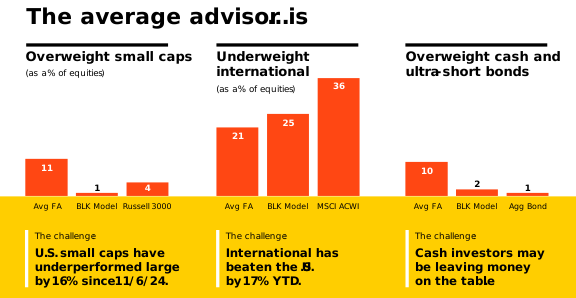
“Avg FA” data is as of 4/30/25, and refers to the 22,270 models analyzed in the 12 months ending 4/30/25. U.S. small caps as represented by Russell 2000 Index, international as represented by MSCI ACWI ex USA Index. The portfolios analyzed represent a subset of the industry, and not its entirety. As such, there may be certain biases present in the data that reflect the advisors who choose to work with BlackRock to analyze their portfolios. Allocations are calculated using only models that contain at least one product from that category. See Important Notes slide for descriptions of each category. The “BLK models” allocations are based on the holdings of the BlackRock Target Allocation ETF 100/0 model portfolio for the equity categories and 60/40 model for the cash/bond analysis as of 5/20/25. This information is strictly for illustrative and educational purposes and is subject to change. Allocations are targets and subject to change. All performance figures are approximate.
Let’s review each bet:
The average advisor is overweight small caps vs. the broad market
Small caps have had a challenging run. After rallying in late 2024 on optimism around falling interest rates and potentially lower taxes, the Russell 2000 Small Cap Index fell 27% between November 25th and April 8th.2
Small caps may have a difficult path ahead. If growth stays resilient, the Fed may not cut rates, leaving smaller cap companies to pay more in interest expense (roughly half of small cap debt is either floating rate or maturing in the next two years).3 But if growth slows meaningfully, the benefits from lower interest rates may be offset by smaller caps’ greater sensitivity to economic downturns.
For those reasons, our Target Allocation model portfolios team continues to underweight this space, and instead prefers to seek outperformance through large caps.
One strategy to consider is the iShares Thematic Rotation Active ETF (THRO), which aims to dynamically rotate across U.S. market themes the portfolio managers believe could drive performance. The top theme today is consumers tightening their belts: Portfolio managers are investing in the budget retailers, department stores, consumer staples and grocers that could benefit from consumers focusing on the essentials amid slowing growth.
The “consumer” basket of THRO has outperformed traditional sector indexes, benefiting from weakening consumer sentiment earlier this year.
Dispersion across stocks creates opportunity for active manager
Cumulative returns for THRO consumer basket vs. sector indexes, Nov 2024-April 2025
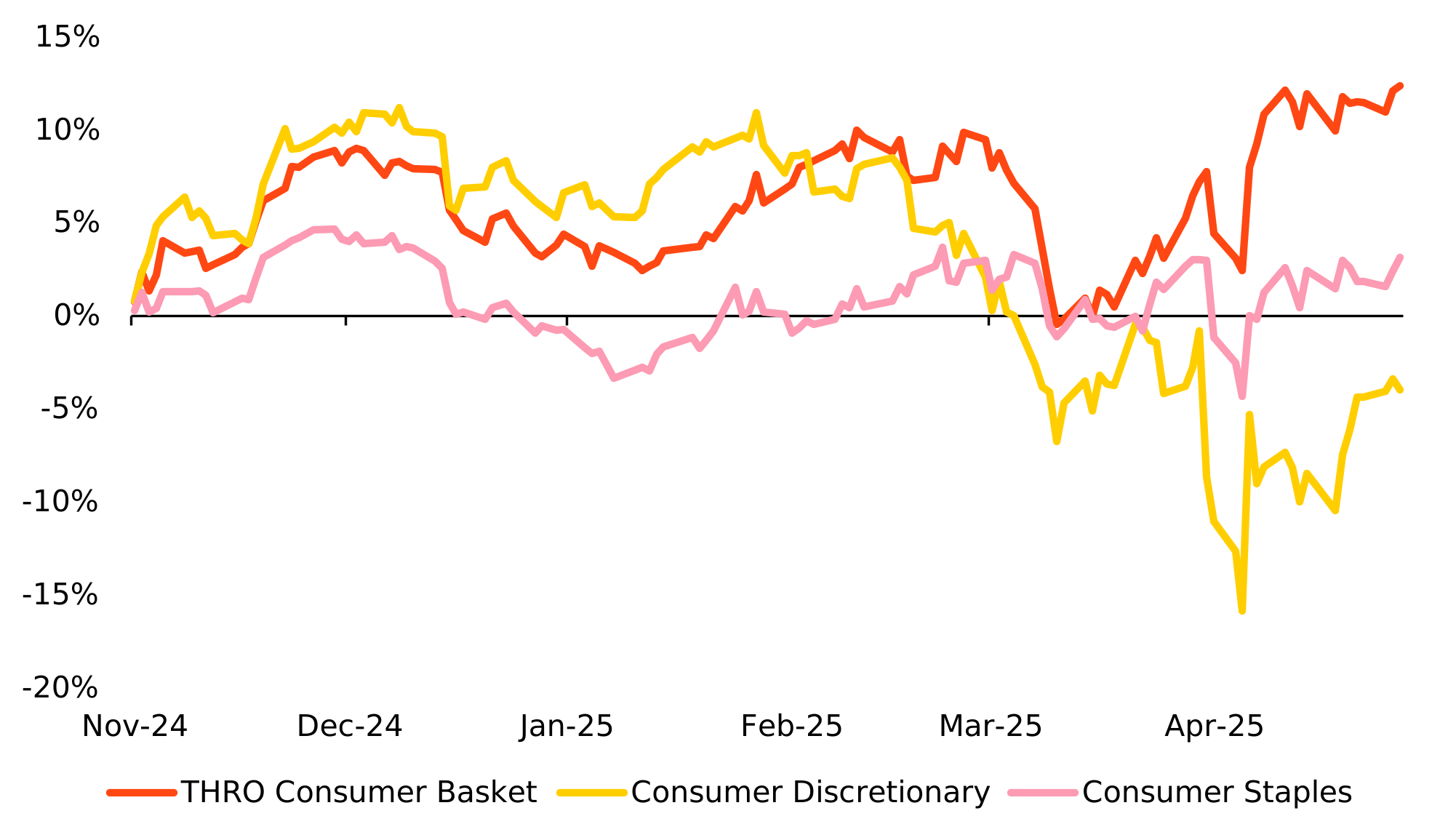
Source: BlackRock Systematic, as of April 30, 2025. Sector returns calculated by BlackRock Systematic using data from BlackRock, MSCI Barra. THRO consumer basket is a custom basket that has been constructed using the systematic Theme identification framework outlines in the Fund prospectus. The THRO “Consumer basket” seeks to capture exposure to companies expected to outperform with a shift towards lower-cost, downstream consumer spending. Holdings subject to change. Performance data represents past performance and does not guarantee future results. Investment return and principal value will fluctuate with market conditions and may be lower or higher when you sell your shares. Current performance may differ from the performance shown. For most recent month-end performance and standardized performance, click here.
The average advisor may not have enough international exposure
The more uncertain markets are, the more diversification can help balance out risks.
International equities – as represented by the MSCI EAFE Index – are beating the S&P 500 by 16% YTD through May.4 But the average advisor is underweight, with just 21% of the average equity portfolio allocated to international equities (versus the MSCI ACWI’s 36%).
Tailwinds, including the possibility of more dovish global central banks, higher defense and infrastructure spending in Europe and potentially re-wired supply chains could all support a higher allocation to international equities. In fact, our Target Allocation model portfolios team recently reduced its underweight to international equities in its models that hold equities.
We see a similar under-allocation in international bonds: The average advisor allocates 15% of their fixed income sleeve here, but international bonds make up 59% of the global bond universe.5 The Bloomberg Global Aggregate ex USD Index is beating the Bloomberg U.S. Aggregate Bond Index’s U.S. bonds by over 5% YTD through May.6 Our portfolio managers think we could see more upside in this space, since a slower growth and lower inflation outlook could support international bond performance.
The average advisor may hold too much cash
Volatile bond markets may have driven many advisors to seek out safety in cash. Longer-term Treasuries have certainly been under pressure – 20+ year treasuries have meaningfully underperformed shorter tenors – but an over-allocation to cash may be leaving money on the table.
Long bonds have been under pressure
YTD performance of U.S. treasury indexes (%)
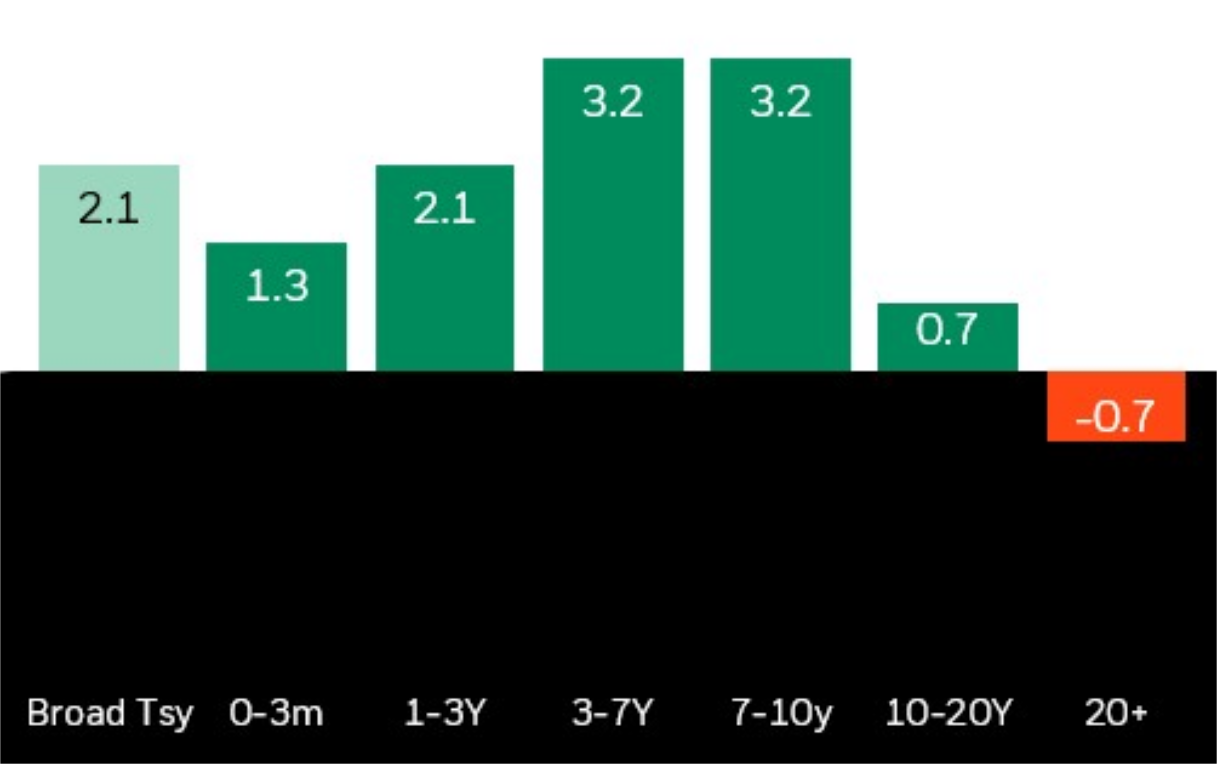
Source: Bloomberg as of 5/29/25. “Broad Tsy” refers to the Bloomberg U.S. Treasury Index; the other figures refer to the Bloomberg U.S. Treasury Index corresponding to each of the defined tenors. Index performance is for illustrative purposes only. Index performance does not reflect any management fees, transaction costs or expenses. Indexes are unmanaged and one cannot invest directly in an index. Past performance does not guarantee future results.
Our teams have been seeking to build in ballast through a mix of flexible fixed income strategies that can dynamically position along the curve and alternative strategies with low correlations to stocks and bonds. As an example, nearly half of the “40” of the Target Allocation Hybrid with Alts 60/40 portfolio is allocated to liquid alternative strategies.
Some alternative strategies – such as the BlackRock Global Equity Market Neutral Fund (BDMIX) – have been able to take advantage of security dispersion and high cash rates. BDMIX has outperformed the S&P 500 by 8% YTD through 5/31, with less than 1/3 of the volatility.7
Performance data represents past performance and does not guarantee future results. Investment return and principal value will fluctuate with market conditions and may be lower or higher when you sell your shares. Current performance may differ from the performance shown. For most recent month-end performance and standardized performance, click here.
And indeed, when we polled advisors on the May 29th “In the Know” webinar, 39% cited cash as the position they were most likely to reduce in the next 3-6 months, in favor of adding to international equities (43%), alternatives (42%) or U.S. equities (35%).8
Portfolio considerations as we enter summer
- Revisit your equity allocation: International stocks have had lower correlations to large cap U.S. equities than domestic small caps, and have a lower standard deviation of returns. Those still overweight small caps may want to consider diversifying abroad instead.
- Consider your active/indexed blend and ensure that your active managers are delivering. Today’s higher dispersion could create opportunity for active managers to deliver higher alpha.
- Expand beyond long bonds for diversification. Assets with low correlations to equities are in short supply, but are critical portfolio components when risk spikes. Expand your diversifier universe to include alternatives and seek out managers that have been able to maintain low correlations to traditional asset classes while delivering consistent returns.
BlackRock can help you construct well-diversified portfolios designed for today’s markets. Contact your BlackRock representative for more information or explore our online investment tools and resources.
Explore the Advisor Outlook – BlackRock’s monthly market outlook for financial advisors – for more details on our latest market and portfolio insights.
Aaron Task, Erin Manifase, Faye Witherall, and Ben Wallach contributed to this article.
Related Resources
More articles loaded. Use Shift+Tab keys to browse.
Total articles:


Access exclusive tools and content
Obtain exclusive insights, CE courses, events, model allocations and portfolio analytics powered by Aladdin® technology.
Investments
Insights
Retirement
Tools
Resources
About Us


1. Source: Morningstar as of 5/28/25
2. Source: Bloomberg as of 5/28/25. Indexes are unmanaged and one cannot invest directly in an index. Past performance does not guarantee future results.
3. Source: Bloomberg, Goldman Sachs Global Investment Research. As of 5/16/2025
4. Source: Bloomberg as of 5/31/25. Indexes are unmanaged and one cannot invest directly in an index. Past performance does not guarantee future results.
5. Source: BlackRock, Bloomberg as of 4/30/25. Refers to the Bloomberg Global Aggregate Bond Index’s breakdown of USD vs. non-USD weights. “Advisor models” data is as of 4/30/25, and includes the 22,270 models collected by BlackRock over the 12 months ending 4/30/25. The portfolios analyzed represent a subset of the industry, and not its entirety. As such, there may be certain biases present in the data that reflect the advisors who choose to work with BlackRock to analyze their portfolios.
6. Source: Bloomberg as of 5/31/25. Indexes are unmanaged and one cannot invest directly in an index. Past performance does not guarantee future results.
7. Source: Bloomberg as of 5/31/25. 90d volatility is 8% for BDMIX and 28% for the S&P 500. The performance quoted represents past performance and does not guarantee future results. Investment return and principal value of an investment will fluctuate so that an investor’s shares, when sold or redeemed, may be worth more or less than the original cost. Current performance may be lower or higher than the performance quoted. Performance data current to the most recent month end may be obtained by visiting the products' respective overview pages
8. Source: In the Know webinar poll on 5/29/25. 208 advisors responded to the question “Where do you expect to increase allocations in the next 3-6 months?” and 186 responded to the question “Where do you expect to decrease allocations in the next 3-6 months?”
Carefully consider the investment objectives, risk factors, charges and expenses of funds within the model portfolios before investing. This and other information can be found in the funds’ prospectuses or, if available, the summary prospectuses which may be obtained by visiting each fund company's website or calling their toll-free number. For BlackRock and iShares Funds, please visit www.blackrock.com or www.iShares.com.
Investing involves risk, including possible loss of principal. Asset allocation and diversification may not protect against market risk, loss of principal, or volatility of returns.
The BlackRock model portfolios are provided for illustrative and educational purposes only. The BlackRock model portfolios do not constitute research, are not personalized investment advice or an investment recommendation from BlackRock to any client of a third party financial professional, and are intended for use only by a third party financial professional, with other information, as a resource to help build a portfolio or as an input in the development of investment advice for its own clients. The BlackRock model portfolios themselves are not funds.
BlackRock intends to allocate all or a significant percentage of the BlackRock model portfolios to funds for which it and/or its affiliates serve as investment manager and/or are compensated for services provided to the funds ("BlackRock Affiliated Funds"). Clients will indirectly bear fund expenses relating to assets allocated to funds, including BlackRock Affiliated Funds. BlackRock has an incentive to (a) select BlackRock Affiliated Funds and (b) select BlackRock Affiliated Funds with higher fees over BlackRock Affiliated Funds with lower fees.
This material is not intended to be relied upon as a forecast, research or investment advice, and is not a recommendation, offer or solicitation to buy or sell any securities or to adopt any investment strategy. The opinions expressed are as of the date indicated and may change as subsequent conditions vary. The information and opinions contained in this material are derived from proprietary and nonproprietary sources deemed by BlackRock to be reliable, are not necessarily all-inclusive and are not guaranteed as to accuracy. As such, no warranty of accuracy or reliability is given and no responsibility arising in any other way for errors and omissions (including responsibility to any person by reason of negligence) is accepted by BlackRock, its officers, employees or agents. This material may contain “forward-looking” information that is not purely historical in nature. Such information may include, among other things, projections and forecasts. There is no guarantee that any of these views will come to pass. Reliance upon information in this material is at the sole discretion of the viewer.
Alternative investments present the opportunity for significant losses and some alternative investments have experienced periods of extreme volatility. Alternative investments may be less liquid than investments in traditional securities. There is no guarantee that any fund will pay dividends. Short selling is a trading strategy to speculate on the decline of an investment.
Fixed income risks include interest-rate and credit risk. Typically, when interest rates rise, there is a corresponding decline in the value of debt securities. Credit risk refers to the possibility that the debt issuer will not be able to make principal and interest payments. Actively managed funds do not seek to replicate the performance of a specified index, may have higher portfolio turnover, and may charge higher fees than index funds due to increased trading and research expenses.
International investing involves risks, including risks related to foreign currency, limited liquidity, less government regulation and the possibility of substantial volatility due to adverse political, economic or other developments. These risks often are heightened for investments in emerging/developing markets or in concentrations of single countries.
Active funds are subject to management risk, which means the fund manager's techniques may not produce desired results, and the selected securities may not align with the fund's investment objective. Legislative, regulatory, or tax developments may also affect the fund manager's ability to achieve the investment objective.
Diversification and asset allocation may not protect against market risk or loss of principal.
Funds that concentrate investments in specific industries, sectors, markets, or asset classes may underperform or be more volatile than other industries, sectors, markets or asset classes and the general securities market. This material does not constitute any specific legal, tax or accounting advice. Please consult with qualified professionals for this type of advice.
The iShares Funds are not sponsored, endorsed, issued, sold or promoted by MSCI Inc., nor does this company make any representation regarding the advisability of investing in the Funds. BlackRock is not affiliated with MSCI Inc.
The Funds are distributed by BlackRock Investments, LLC (together with its affiliates, “BlackRock”).
©2026 BlackRock, Inc. or its affiliates. All Rights Reserved. iSHARES and BLACKROCK are trademarks of BlackRock, Inc., or its affiliates. All other marks are the property of their respective owners.
GPS0226-5246818-EXP0626
iCRMH0625U/S-4540959