

Fixed Income

Munis carry outperformance into the summer
- Strong demand continued to absorb record issuance, supporting municipal market performance.
- Summer reinvestment flows should provide a supportive technical backdrop, although elevated issuance may temper the seasonal tailwind.
- Municipal credit fundamentals remain broadly healthy, although rich relative valuations support a more measured approach to adding risk.
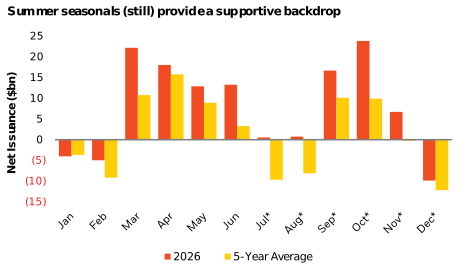
Source: BlackRock, Siebert, as of 6/30/26.
*BlackRock forecast.
Subscribe to Municipal insights
Get timely market outlooks and portfolio positioning insights delivered to your inbox each month.
Please try again


Patrick Haskell
Head of Municipal Bonds
Patrick Haskell, Managing Director, Head of the Municipal Bond Group within the Portfolio Management Group (PMG) as well as Global Head of Financial Institutions Group Investments Business.

Sean Carney
CIO of Municipal Bond Funds
Sean Carney, Managing Director and Head of the Municipal Strategy team within BlackRock's Municipal Fixed Income business in BlackRock's Portfolio Management Group.

James Schwartz, CFA
Head of Municipal Credit Research
Jim Schwartz, CFA, Managing Director, is Head of Municipal Credit Research with Municipal Fixed Income business in BlackRock's Portfolio Management
Related resources
Performance data quoted represents past performance and is no guarantee of future results. Investment returns and principal values may fluctuate so that an investor’s shares, when redeemed, may be worth more or less than their original cost. All returns assume reinvestment of dividends and capital gains. Current performance may be lower or higher than that shown. Refer to blackrock.com for most recent month-end performance.
To obtain more information on the funds, including the Morningstar time period ratings and standardized average annual total returns as of the most recent calendar quarter and current month-end, please visit High Yield Municipal Fund, Short Maturity Municipal Fund and National Municipal Fund.
The Morningstar RatingTM for funds, or "star rating," is calculated for managed products (including mutual funds, variable annuity and variable life subaccounts, exchange-traded funds, closed-end funds, and separate accounts) with at least a three-year history. Exchange-traded funds and open-ended mutual funds are considered a single population for comparative purposes. It is calculated based on a Morningstar Risk-Adjusted Return measure that accounts for variation in a managed product's monthly excess performance, placing more emphasis on downward variations and rewarding consistent performance. The top 10% of products in each product category receive 5 stars, the next 22.5% receive 4 stars, the next 35% receive 3 stars, the next 22.5% receive 2 stars, and the bottom 10% receive 1 star. The Overall Morningstar Rating for a managed product is derived from a weighted average of the performance figures associated with its three-, five-, and 10-year (if applicable) Morningstar Rating metrics. The weights are: 100% three-year rating for 36-59 months of total returns, 60% five-year rating/40% three-year rating for 60-119 months of total returns, and 50% 10-year rating/30% five-year rating/20% three-year rating for 120 or more months of total returns. While the 10-year overall star rating formula seems to give the most weight to the 10-year period, the most recent three-year period actually has the greatest impact because it is included in all three rating periods.
Investments
Insights
Retirement
Tools
Resources
About Us


Investing involves risk, including possible loss of principal.
Carefully consider the Funds' investment objectives, risk factors, and charges and expenses before investing. This and other information can be found in the Funds' prospectuses or, if available, the summary prospectuses which may be obtained by visiting www.blackrock.com or www.iShares.com. Read the prospectus carefully before investing.
This information should not be relied upon as investment advice, research, or a recommendation by BlackRock regarding (i) the funds, (ii) the use or suitability of the model portfolios or (iii) any security in particular. Only an investor and their financial professional know enough about their circumstances to make an investment decision.
This material is provided for educational purposes only and is not intended to constitute investment advice or an investment recommendation within the meaning of federal, state or local law. You are solely responsible for evaluating and acting upon the education and information contained in this material. BlackRock will not be liable for direct or incidental loss resulting from applying any of the information obtained from these materials or from any other source mentioned. BlackRock does not render any legal, tax or accounting advice and the education and information contained in this material should not be construed as such. Please consult a qualified professional for these types of advice.
Fixed income risks include interest-rate and credit risk. Typically, when interest rates rise, there is a corresponding decline in bond values. Credit risk refers to the possibility that the bond issuer will not be able to make principal and interest payments. Non-investment-grade debt securities (high-yield/junk bonds) may be subject to greater market fluctuations, risk of default or loss of income and principal than higher-rated securities. Principal of mortgage- or asset-backed securities normally may be prepaid at any time, reducing the yield and market value of those securities. Obligations of U.S. govt agencies are supported by varying degrees of credit but generally are not backed by the full faith and credit of the US govt. Securities with floating or variable interest rates may decline in value if their coupon rates do not keep pace with comparable market interest rates. The fund’s income may decline when interest rates fall because most of the debt instruments held by the Fund will have floating or variable rates.
Mortgage-backed securities (“MBS”) and commercial mortgage-backed securities (“CMBS”) are subject to prepayment and extension risk and therefore react differently to changes in interest rates than other bonds. Small movements in interest rates may quickly and significantly reduce the value of certain mortgage-backed securities.
Collateralized Debt Obligations (“CDOs”) carry additional risks including, but not limited to: (i) the possibility that distributions from collateral securities will not be adequate to make interest or other payments; (ii) the risk that the collateral may default or decline in value or be downgraded, if rated by a nationally recognized statistical rating organization; (iii) the Fund may invest in tranches of CDOs that subordinate to other tranches; (iv) the lack of a readily available secondary market for CDOs.
There may be less information on the financial condition of municipal issuers than for corporate issuers. The market for municipal bonds may be less liquid than for taxable bonds. Some investors may be subject to federal or state income taxes on the Alternative Minimum Tax (AMT). Capital gains distributions, if any, are taxable.
A portion of the income may be taxable.
Actively managed funds do not seek to replicate the performance of a specific index, may have higher portfolio turnover, and may charge higher fees than index funds due to increased trading and research expenses. There is no guarantee that an active fund will meet its investment objective.
Index performance is for illustrative purposes only. Index performance does not reflect any management fees, or expenses. Indexes are unmanaged and one cannot invest directly in an index. Past performance does not guarantee future results.
This material is not intended to be relied upon as a forecast, research or investment advice, and is not a recommendation, offer or solicitation to buy or sell any securities or to adopt any investment strategy.
The opinions expressed are as of July 22, 2026, and may change as subsequent conditions vary.
The information and opinions contained in this material are derived from proprietary and nonproprietary sources deemed by BlackRock to be reliable, are not necessarily all-inclusive and are not guaranteed as to accuracy. As such, no warranty of accuracy or reliability is given and no responsibility arising in any other way for errors and omissions (including responsibility to any person by reason of negligence) is accepted by BlackRock, its officers, employees or agents. This material may contain “forward-looking” information that is not purely historical in nature. Such information may include, among other things, projections and forecasts. There is no guarantee that any forecasts made will come to pass. Reliance upon information in this material is at the sole discretion of the reader.
Prepared by BlackRock Investments, LLC, member FINRA.
BlackRock provides compensation in connection with obtaining or using third-party ratings and rankings
Not FDIC Insured | May Lose Value | No Bank Guarantee
©2026 BlackRock, Inc. or its affiliates. All rights reserved. iSHARES and BLACKROCK are trademarks of BlackRock, Inc. or its affiliates. All other trademarks are those of their respective owners.
MKTG0726-5774273-EXP0727