I'm Faye Witherall, an investment strategist here to discuss our November Advisor Outlook. Now, October was a sharp reminder of just how quickly market sentiment can shift. The Nasdaq 100 suffered its worst month of the year, and investors started to question the economics of the AI build out, even as Q3 corporate earnings continued to impress. So here's what we're watching.
Markets have historically rallied once election uncertainty passes, but shifting fiscal negotiations and growing scrutiny of data center developments introduce risks worth watching. The AI trade is under pressure, but the earnings are being strong. Demand continues to accelerate even amid concerns around AI financing.
And finally, higher yields are changing the diversification equation. Rising term premiums are pushing yields higher, while AI related borrowing is increasing the overlap between equity and credit risks. So we're looking through volatility. We are following the earnings and we're seeking diversification into year end.
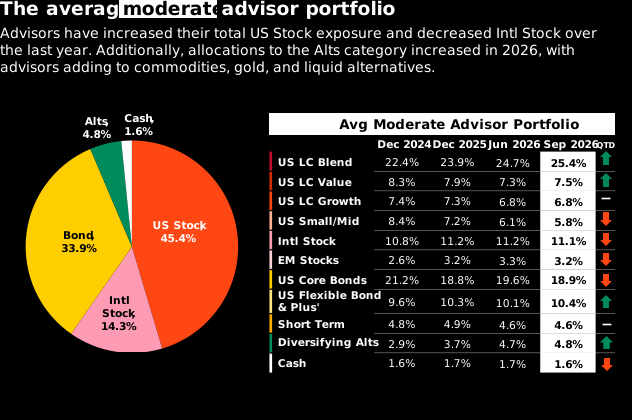
Thanks, Faye, for setting the market backdrop. I'm Maxine and I'll walk through how advisors are positioning the diversified sleeves of their portfolios across alternatives and fixed income, starting with alternatives. Advisors are rethinking the sleeve. About 40% of advisor portfolios across conservative, moderate, and aggressive risk profiles hold alternatives, with an average allocation of roughly 9%. The bigger story, though, is the mix within that sleeve.
Between March and September, advisors rotated away from commodities and toward liquid alternatives. Liquid alts rose from about 56% to 65% of the sleeve. Commodities fell from about 39% to 30%. Clients still look to alternatives for diversification, but what they're gravitating toward is changing, and so is how advisors implement the sleeve.
Advisors access alternatives through active mutual funds 57% of the time, index ETFs 30% of the time, and active ETFs 13% of the time.
Turning to fixed income, the average duration across moderate portfolios is around 4.8 years, shorter than the roughly six years of the Bloomberg US Aggregate Index. Yet even with that short duration tilt already in place, duration is increasingly coming up in client conversations as a source of diversification to balance market volatility.
Check out the full Advisor outlook and Advisor Portfolio Insights for more of our best thinking, and reach out to your local market team, or call 877. Ask one BLC to dive deeper into any of these themes.
iCRDSPMH1126U/S-6085627