

CONTACT US
Additional questions?
Connect with a BlackRock private markets specialist to discuss any questions and explore how these strategies may fit into your portfolio.
EXPLORE MORE ALTERNATIVES

For decades, portfolios built on public equities and fixed income have provided a reliable foundation for investors. Today, that model is under increasing pressure.
The diversification benefits of stocks and bonds have become less consistent, particularly during periods of market stress when correlations can rise unexpectedly. At the same time, equity market performance has grown more concentrated, with a narrow group of companies accounting for an outsized share of returns.
These dynamics have made it more challenging to generate stable income, manage downside risk, and achieve long-term growth using public markets alone. As a result, advisors are increasingly evaluating additional sources of potential return.
Private markets can serve as a complementary allocation, broadening the opportunity set and introducing differentiated return drivers that are less reliant on public market conditions.
At BlackRock, we view private markets as a way to help enhance portfolio construction by:
In an environment where correlations are heightened and AI as a theme dominates market risk, private markets can unlock areas of the market such as music and sports royalties that can bring truly uncorrelated risk with attractive yield characteristics.
As with any allocation, implementation should be grounded in client-specific considerations. Time horizon, liquidity needs, and risk tolerance remain central to determining the appropriate role for private markets within a portfolio.
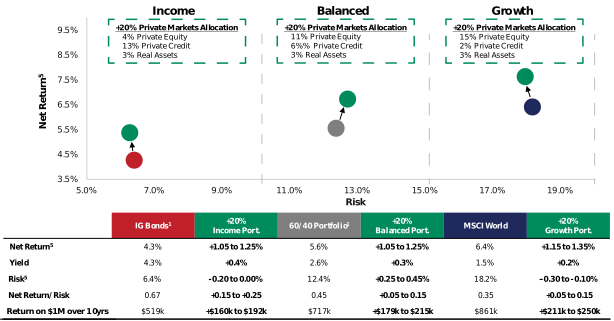
Risk-Return Frontier Analysis:
Adding a 20% private markets allocation to public portfolios2,3,4 (9/30/2010 – 9/30/2025)
Source: BlackRock. As of 9/30/2025. Index returns are for illustrative purposes only and do not represent actual fund performance. Index performance returns do not reflect any management fees, transaction costs or expenses. Indexes are unmanaged and one cannot invest directly in an index. Past performance is no guarantee of future performance. A 15-year lookback was selected to capture multiple market cycles, smooth short-term noise, and align with long-term investments horizons.
Incorporating private markets into portfolio construction requires a more nuanced approach to risk measurement. Because private assets are valued less frequently, reported volatility can understate their true risk and correlation characteristics. To address this, we use an economic risk framework that estimates how private assets would behave if priced continuously. This approach provides a more comprehensive view of portfolio dynamics, helping advisors better understand how private and public exposures interact across different market environments. Our public and private market assumptions are informed by datasets from Preqin for private asset performance, alongside BlackRock’s Aladdin and eFront systems to enable comprehensive portfolio construction, risk modeling, and scenario analysis across both liquid and illiquid exposures.
The bottom line: How can private markets strengthen modern portfolios?
As portfolio construction evolves, the case for incorporating private markets continues to strengthen. Across income, balanced, and growth portfolios, our analysis shows that private markets can enhance diversification and improve risk-adjusted outcomes. For advisors, they represent an increasingly important tool in building resilient portfolios designed to meet a broader range of client objectives over the long term.
Connect with a BlackRock private markets specialist to discuss any questions and explore how these strategies may fit into your portfolio.
Asset allocation and diversification strategies do not guarantee a profit and may not protect against loss. Past performance does not guarantee or indicate future returns. Indices are unmanaged and used for illustrative purposes only and are not intended to be indicative of any fund’s performance. It is not possible to invest directly in an unmanaged index.
1. The public equities and bonds returns are measured by data from September 30th, 2010, to September 30th, 2025 and is represented by the following indices: IG Bonds are represented by the BBG Barclays US Credit Index, 60/40 Portfolio represents a 60% allocation to the MSCI World and a 40% allocation to the BBG Barclays US Credit Index.
2. Public equities are represented by the MSCI World Index, and public bonds are represented by the Bloomberg Barclays US Credit Index. The Income Portfolio +20% allocation consists of 80% public bonds and 20% private markets. The Balanced Portfolio +20% allocation consists of 48% equities, 32% public bonds, and 20% private markets. The Growth Portfolio +20% allocation consists of 80% equities and 20% private markets.
3. Private markets returns are measured by data from September 30th, 2010, to September 30th, 2025 and is represented by the following indices: Preqin Private Equity, Preqin Growth, Preqin Direct Lending, Preqin Infrastructure and 1-3 Month T-BIll to account for the cash exposure that semi-liquid evergreen funds have.
4. Economic Risk is calculated using 180 months of equal weighted return data as of September 30th, 2025. Efficient frontiers show optimized portfolios with highest return at each risk level, given public/private allocation constraints.
Important Information This material is provided for informational purposes only and is not intended to be relied upon as a forecast, research or investment advice, and is not a recommendation, offer or solicitation to buy or sell any securities or to adopt any investment strategy. The opinions expressed are subject to change. References to specific securities, asset classes and financial markets are for illustrative purposes only and are not intended to be and should not be interpreted as recommendations. Reliance upon information in this material is at the sole risk and discretion of the reader. The material was prepared without regard to specific objectives, financial situation or needs of any investor.
Opinions, assumptions and estimates offered constitute our judgment and are subject to change without notice, as are statements of financial market trends, which are based on current market conditions. We believe the information provided here is reliable, but do not warrant its accuracy or completeness. This communication and its content represent confidential information. This material has been prepared for informational purposes only, and is not intended to provide, and should not be relied on for, accounting, legal or tax advice. You should consult your tax or legal adviser regarding such matters.
Certain historical performance information of other investment vehicles or composite accounts managed by BlackRock, Inc. and/or its subsidiaries (together, “BlackRock”) has been included in this material, such performance information is presented by way of example only. No representation is made that the performance presented will be achieved, or that every assumption made in achieving, calculating or presenting either the forward-looking information or the historical performance information herein has been considered or stated in preparing this material. Any changes to assumptions that may have been made in preparing this material could have a material impact on the investment returns that are presented herein by way of example.
Past performance is not a guarantee of future results. Asset allocation and diversification strategies do not guarantee profit and may not protect against loss. Risk management and due diligence processes seek to mitigate, but cannot eliminate, risk nor do they imply low risk. Investment involves risk, including a risk of total loss.
Incorporating alternative investments into a portfolio presents the opportunity for significant losses including in some cases, losses which exceed the principal amount invested. Also, some alternative investments have experienced periods of extreme volatility and in general, are not suitable for all investors. Asset allocation and diversification strategies do not ensure profit or protect against loss in declining markets. Investing in alternative strategies such as a long/short strategy, presents the opportunity for losses which exceed the principal amount invested. Utilizing private equity involves significant risks along with the opportunity for substantial losses.
Private market investments should only be considered for investors who can tolerate the risk. A fund's investments in private companies is subject to a number of risks. Private companies are generally not subject to SEC reporting requirements, are not required to maintain their accounting records in accordance with generally accepted accounting principles and are not required to maintain effective internal controls over financial reporting. As a result, the Sub-Advisor may not have timely or accurate information about the business, financial condition and results of operations of the private companies in which the Fund invests.
The information and opinions contained in this material are derived from proprietary and non-proprietary sources deemed by BlackRock, Inc. and/or its affiliates (together, “BlackRock”) to be reliable, are not necessarily all inclusive and are not guaranteed as to accuracy. There is no guarantee that any forecasts made will come to pass. Any research in this document has been procured and may have been acted on by BlackRock for its own purpose. The results of such research are being made available only incidentally. The views expressed do not constitute investment or any other advice and are subject to change. They do not necessarily reflect the views of any company in the BlackRock Group or any part thereof. BlackRock believes that the information in this document was correct at the time of compilation, but no warranty of accuracy or reliability is given and no responsibility arising in any other way for errors and omissions (including responsibility to any person by reason of negligence) is accepted by BlackRock, its officers, employees or agents.
©2026 BlackRock, Inc. or its affiliates. All rights reserved. BLACKROCK is a trademark of BlackRock, Inc. or its affiliates. All other trademarks are those of their respective owners.
USWA0626-5564631-EXP0627