
CONTACT US
Additional questions?
For additional information or questions, please contact a BlackRock private markets specialist.
You're on the BlackRock site for advisors. Do you want to change your user type to advisor?

Private markets are no longer just for institutions; they’re becoming essential for modern portfolios. Here are three things we’re thinking about as we help advisors capture the opportunity in alternatives and private markets.
First, they expand your opportunity set. More companies are staying private longer, meaning investors can access growth that public markets may miss. Increased concentration has more investors looking for differentiated sources of return.
Second, private markets offer the potential for higher returns, but that comes with longer investment horizons and some illiquidity.
And third, access is improving through new fund structures—but manager selection is key. Getting alternatives right often depends on the skill of the manager and their ability to navigate complexity.
Hear from Ken Lantigua, Head of Alternatives Distribution for U.S. Wealth, as he shares three things we’re thinking about to help advisors capture the opportunity in alternatives and private markets.
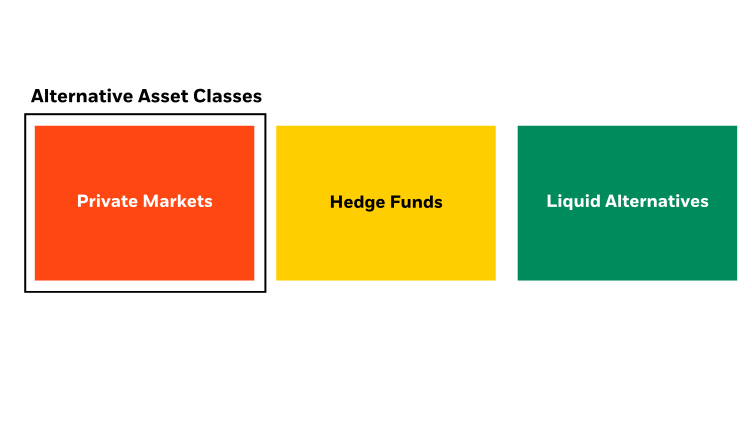
In the context of alternative investments, private markets are distinguished by the fact that they are not listed and traded on public exchanges. Once harder to access, the evolution of private markets may present a new set of opportunities for investment portfolios.
In recent years, product innovation has allowed more investors to allocate solutions ranging from private equity and private credit to real estate and infrastructure. Private markets are overall moving from a niche allocation used primarily by large institutions to becoming a core component of modern portfolio construction.
Core exposures to consider are:
Private markets are not traded on a public exchange like stocks and bonds, although they can now be accessed through non-traded, registered fund vehicles. Private investments typically prioritize long-term value creation over quarterly results.
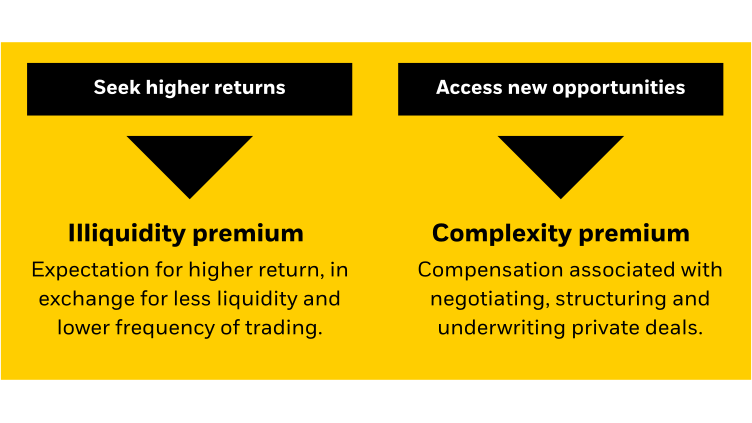
Private market investing happens over a longer time horizon. These assets are generally less liquid than those on public markets, meaning they take more time or are more difficult to sell; by contrast, publicly traded mutual funds are designed to provide daily liquidity. In return for this lower liquidity, investors have historically been able to expect higher returns – this is commonly referred to as “illiquidity premium.”
Another differentiator in private markets is complexity. Success in private markets depends on specialized skills and experience. The best managers know how to uncover unique opportunities and navigate complex investments to drive potential returns, which makes manager selection critical.
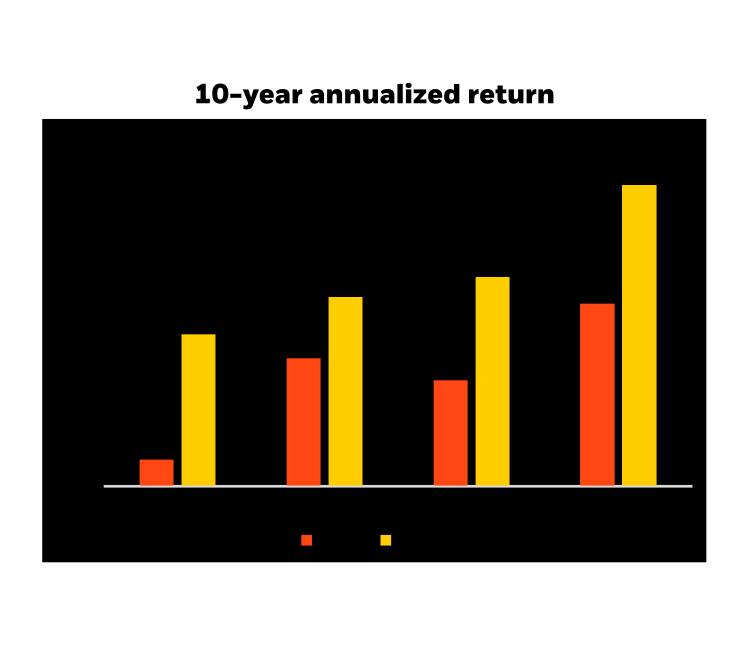
Exhibit 1: Private markets may offer long-term return opportunity
Source: Preqin Insights+, S&P CapIQ. Federal Reserve, MSCI. Data as of May 16, 2025. Note: Data for 10-year returns is based on rolling returns ending Q4 2024 with annualized geometric average. Public indices are total return. Index returns are for illustrative purposes only and do not represent actual fund performance. Index performance returns do not reflect any management fees, transaction costs or expenses. Indexes are unmanaged and one cannot invest directly in an index. Past performance is no guarantee of future performance.
Asset class proxies are the following: Public REIT: S&P Global REITs TR Index, Public Infra: S&P Global Infrastructure Index, U.S. high yield: ICE BofA US High Yield Index, Russell 2000: Russell 2000 Total Return index, S&P 500: S&P 500 Total Return Index. Real Estate, Private Debt, Infrastructure, and Private Equity are calculated through Preqin®’s proprietary benchmarking team and are not based on publicly available indexes.
Long-term trends continue to support the case for private markets.
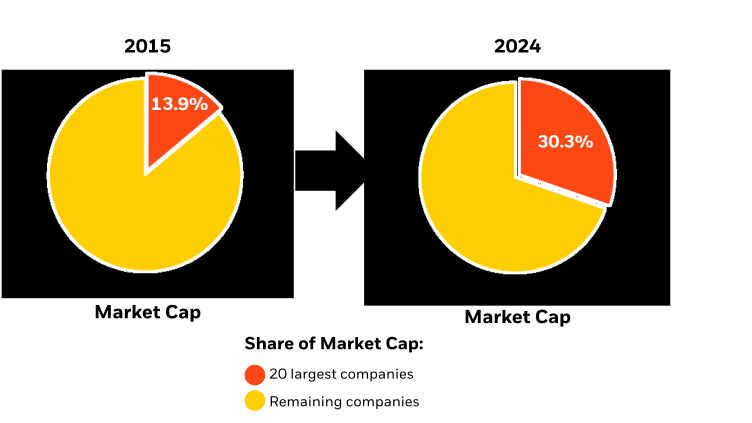
Risk has become increasingly concentrated in public markets as large indexes are dominated by growth-oriented technology stocks. Among the number of total listed companies, the 20 largest names now represent more than 30% of global stock market capitalization versus just under 14% in 2015 (See Exhibit 1). This coincides with a shrinking number of public stock issuance over the past decade as companies stay private longer.
Exhibit 2: Public stocks have become increasingly concentrated
Source: Preqin Insights+, Aladdin, MSCI Data as of November 2025, Based in the Market Capitalization of the MSCI ACWI IMI. For illustrative purposes only. Asset allocation and diversification strategies do not guarantee a profit and may not protect against loss. Indexes are unmanaged and index performance is shown for illustrative purposes only. It is not possible to invest directly into an index.
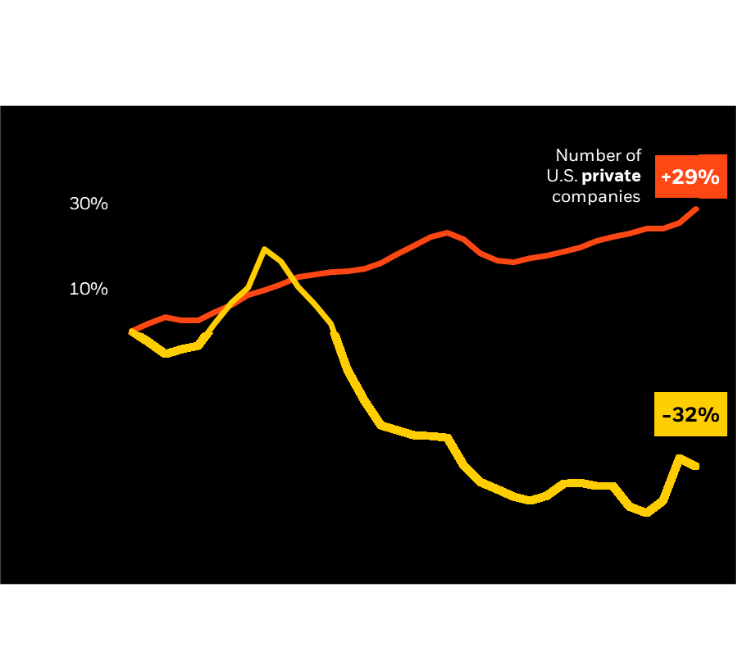
Capital formation increasingly takes place in private markets – today, 81% of companies with revenues over $100m are private. With banks reducing lending and public markets shrinking, private capital has become essential to funding business investment, innovation and economic growth. As a result, investors are rethinking traditional exposures and exploring how private markets can expand their opportunity set.
Exhibit 3: A growing opportunity set
Source: U.S. Census Bureau - Center for Economic Studies - Business Dynamics Statistics (2022) and World Federation of Exchanges database; for more information on the World Federation, please refer to the Important Notes. Both sources, represents the latest data as of 2022 as derived on 2 April 2025. The graph denotes the growth or decline for both U.S. public and private companies from 1988 until 2022. Past performance is no guarantee of future performance.
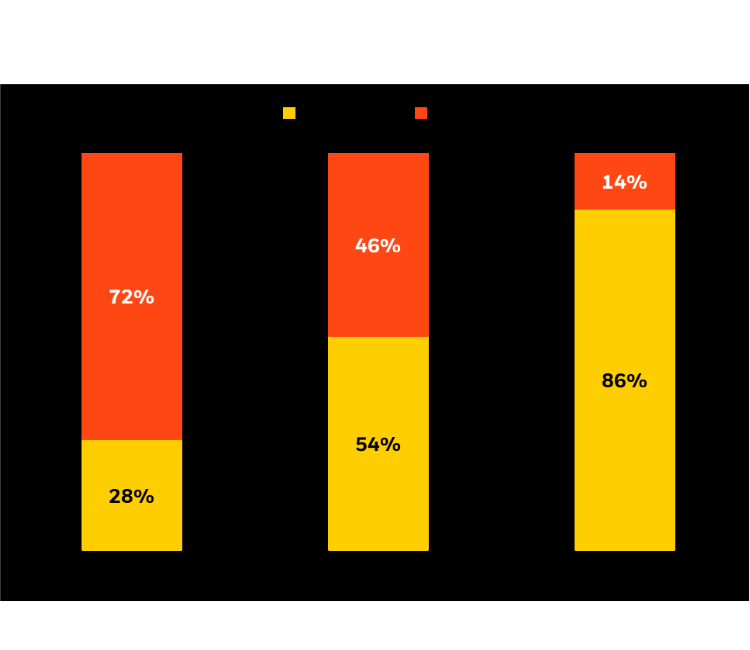
Exhibit 4: Banks retreating from credit markets has created private financing opportunities
Market share, leveraged loan market, 1994-2023
Past performance is no guarantee of future results. Diversification does not assure a profit and may not protect against loss of principal. For illustrative purposes only. 1 Demonstrated in footnote 4. 2 Demonstrated on page 2. 3 S&P LCD, Pitchbook LCD as of 3/31/24. Both displays as of latest reported data. Select dates are shown to illustrate a trend over 20+ years. Non-bank lenders refer to financial institutions without a full banking license and those which cannot accept public deposits. This includes venture capitalists, insurance companies, micro-loan firms, and currency exchange (Source: World Bank). 4 Source Capital IQ, BlackRock as of 12/31/24. Represents the number of companies with annual revenues greater than $100 million.
With private markets offering a potentially compelling risk/return profile, more investors may seek to allocate to private markets alongside traditional stocks and bonds.
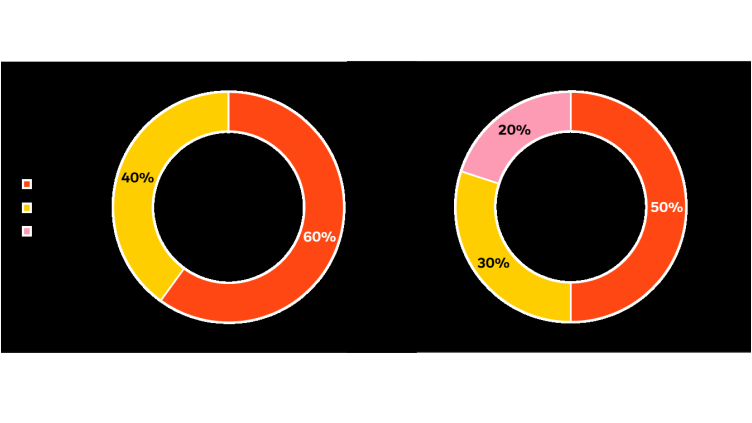
Exhibit 5: Traditional portfolios are evolving.
Source: BlackRock Alternative Portfolio Solutions. This information is not intended as a recommendation to invest in any particular asset class or strategy or as a promise – or even an estimate - of future performance. Historical example looks at a 60% MSCI ACWI, 38% Bloomberg Agg Bond Index, and 2% cash portfolio vs. a 51% MSCI ACWI, 22% Bloomberg Agg Bond Index, 2% cash, 9% Burgiss Private Equity Manager Universe (which includes 7.727 private equity funds, vintages 1978-2023, and time-weighted quarterly returns), 6% Cliffwater Direct Lending Index, and 10% “diversifying alternatives” sleeve made up of the Credit Suisse Equity Market Neutral, Credit Suisse Multi-Strategy, and Credit Suisse Global Macro Indexes.
Private markets are reshaping how investors think about portfolio construction. As access continues to improve, private equity, credit, infrastructure and real estate are playing a growing role alongside traditional stocks and bonds. With thoughtful implementation and a long-term perspective, private markets can help expand opportunity sets and lead to superior investment outcomes.
For additional information or questions, please contact a BlackRock private markets specialist.
*Subject to change.
Please consider the investment objectives, risks, charges and expenses of the funds carefully before investing. The prospectuses and, if available, the summary prospectuses contain this and other information about the funds and are available, along with information on other BlackRock funds, by calling 800-882-0052 or at www.blackrock.com. The prospectuses and, if available, the summary prospectuses should be read carefully before investing.
Investing involves risk, including possible loss of principal. This material is strictly for illustrative, educational, or informational purposes and is subject to change. There can be no assurance that an investment strategy will be successful.
Past performance is no guarantee of future results. It is not possible to invest in an unmanaged index.
Incorporating alternative investments into a portfolio presents the opportunity for significant losses including in some cases, losses which exceed the principal amount invested. Also, some alternative investments have experienced periods of extreme volatility and in general, are not suitable for all investors. Asset allocation and diversification strategies do not ensure profit or protect against loss in declining markets.
Private market investments should only be considered for investors who can tolerate the risk. A fund's investments in private companies is subject to a number of risks. Private companies are generally not subject to SEC reporting requirements, are not required to maintain their accounting records in accordance with generally accepted accounting principles and are not required to maintain effective internal controls over financial reporting. As a result, the Sub-Advisor may not have timely or accurate information about the business, financial condition and results of operations of the private companies in which the Fund invests.
©2026 BlackRock, Inc. or its affiliates. All Rights Reserved. BLACKROCK and iSHARES are trademarks of BlackRock, Inc. or its affiliates. All other trademarks are those of their respective owners.
Prepared by BlackRock Investments, LLC, member FINRA.
MKTG0626-5543584-EXP0627
