


Insights and resources
LifePath® target date strategies
Our target date approaches aim to address one retirement challenge: improving participant outcomes with great certainty and consistency.

Income paths across occupations could disperse and widen, making earnings less predictable and compounding financial planning risk.
When workers can anticipate potential earning shifts, they may be able to make earlier adjustments and achieve smoother outcomes.
AI could help lengthen lives, which could require savers to make modest early-retirement spending cuts and consider more stable-income strategies.
Artificial intelligence (AI) is rapidly transforming industries, altering how people work—and earn their paychecks. It’s also impacting life expectancy, with medical advancements that are aiming to improve research and healthcare. As these trajectories evolve, the implications for retirement planning are significant. Advisors will play a critical role in helping clients navigate the shifting income patterns and potentially longer lives that may impact their ability to afford a more financially secure retirement.
To evaluate these changes, we modeled how AI-driven shifts in wages and life expectancy could influence saving behaviors, investment decisions, and long-term retirement spending ability. This research integrates lifecycle modeling with empirical analysis of AI exposure across job tasks, offering a forward-looking perspective on how financial planning must adapt to this new era.
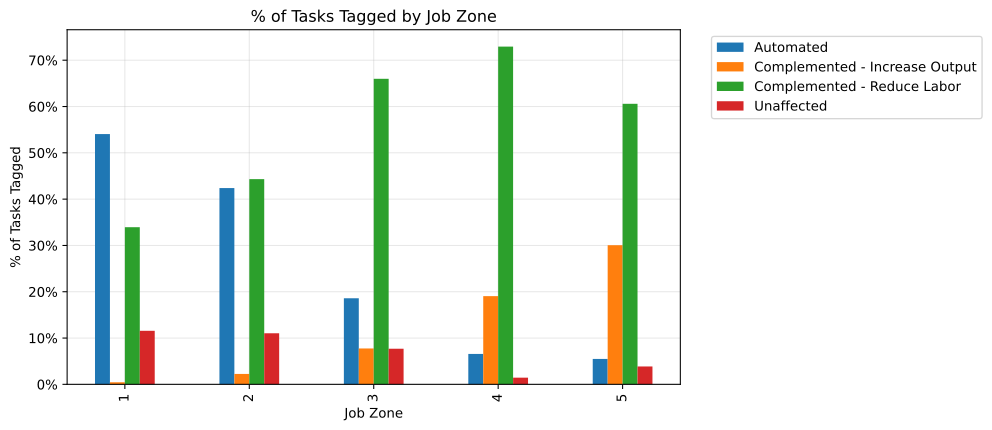
This research suggests that AI is likely to affect wages across most occupations, but not evenly. By looking at how tasks within jobs have changed in the past—and using AI to estimate how current tasks may evolve—the study finds a wide range of potential wage outcomes across occupations. Some roles may benefit from productivity gains and new tasks, while others may face pressure from automation or reduced labor demand.
BlackRock. As of August 2025.
Occupations appear to be exposed to AI in two areas: repeated tasks and technological tasks. Our findings, shown in the chart above, are as follows:
Importantly, this work is still at an early stage: AI adoption is evolving quickly, and the full economic impact is not yet known. The goal is not to predict exact winners and losers, but to highlight that income paths may diverge meaningfully.
Why does this matter for retirement? Consistent saving during working years is the critical driver of retirement readiness, and so understanding and preparing for AI’s potential and uneven impact across occupations can help ensure people stay on track despite a changing labor market.
During a person’s working years, labor income is their primary fuel for savings. Even small, persistent changes in wages—positive or negative—can compound over decades into very different retirement outcomes. If AI dampens wage growth in certain occupations, savings capacity may decline; if it boosts productivity and that flows into wages, savings potential improves. Just as with other potential shocks, the key insight is that anticipating these shifts early allows:
Our lifecycle model incorporates assumptions about income, mortality and market returns, drawing on foundational data from the Panel Study of Income Dynamics (PSID), the Current Population Survey (CPS) and mortality tables from the Society of Actuaries. These datasets are central to our evolving Retirement Solutions toolkit and provide a foundation for simulating optimal savings and equity allocations under normal economic conditions.
We introduce the impact of AI into the model as an externally driven income shift, either positive or negative, and as a factor that may reshape earnings trajectories across occupations. Our broader empirical research shows that AI widens the dispersion of potential income paths, even when average income growth remains steady. The core planning challenge is that income becomes less predictable, and the effects of that unpredictability can compound over time.
The model illustrates these effects through three scenarios that highlight how timing and anticipation shape outcomes.
| Scenario Description | Scenario Outcome |
|---|---|
| Immediate AI-driven income shift | When income shifts abruptly, households can adjust quickly. A positive impact can increase spending and reduce the need for risk-taking, while a negative shift leads to higher equity exposure and lower spending levels. |
| Gradual, unanticipated AI-driven income change over 10 years | When wage changes are not expected, income evolves differently than planned. Households must cut spending more sharply or take on more risk later in life because earlier decisions no longer fit their actual earnings path. |
| Gradual, anticipated AI-driven income impact over 10 years | When households expect future wage changes, they can adjust early by saving more or shifting spending sooner. This could reduce the need for large portfolio changes later and potentially lead to smoother wealth accumulation and higher long-run spending ability. |
AI’s influence extends beyond labor markets. Advances in healthcare, diagnostics and personalized treatments may increase life expectancy. To assess the financial implications, we modeled higher average lifespans without changing overall age-based mortality patterns.
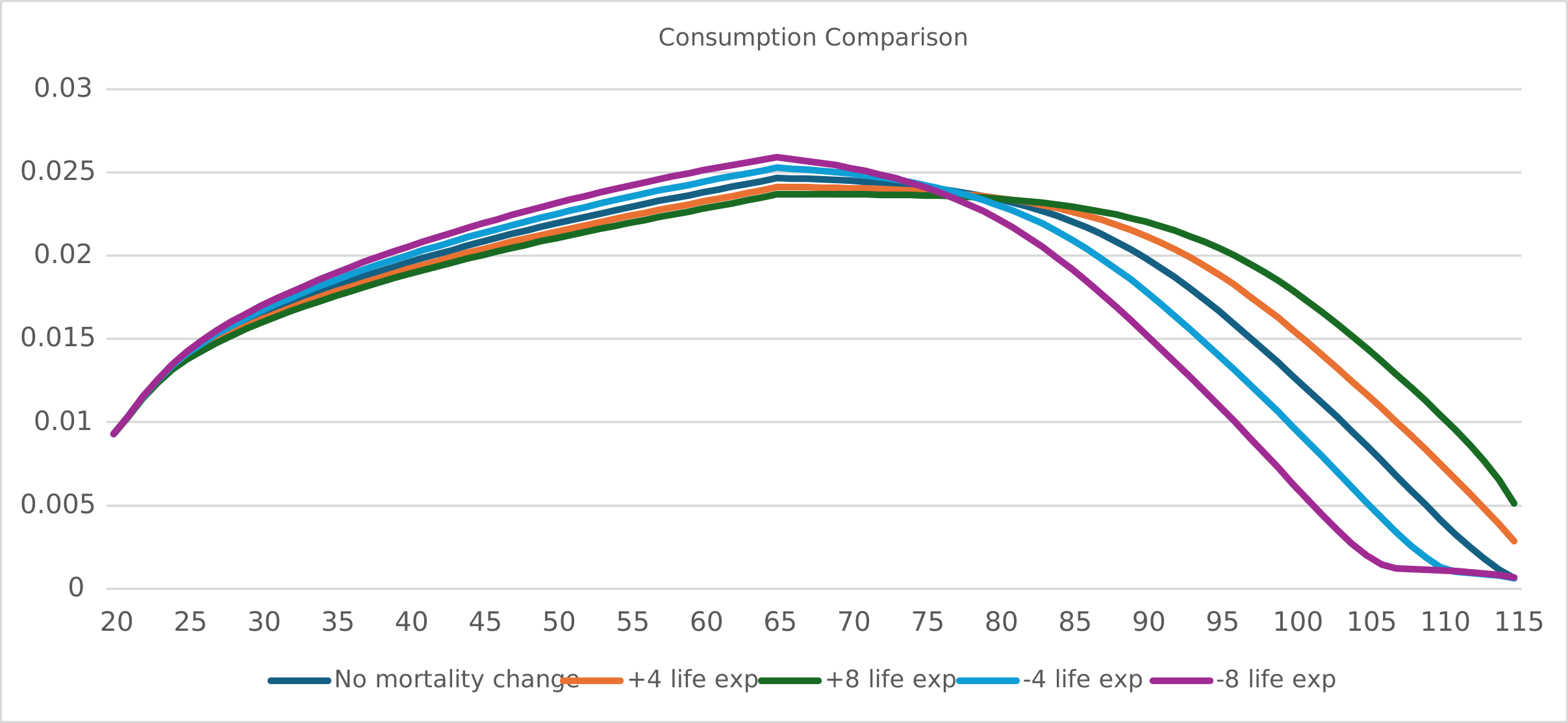
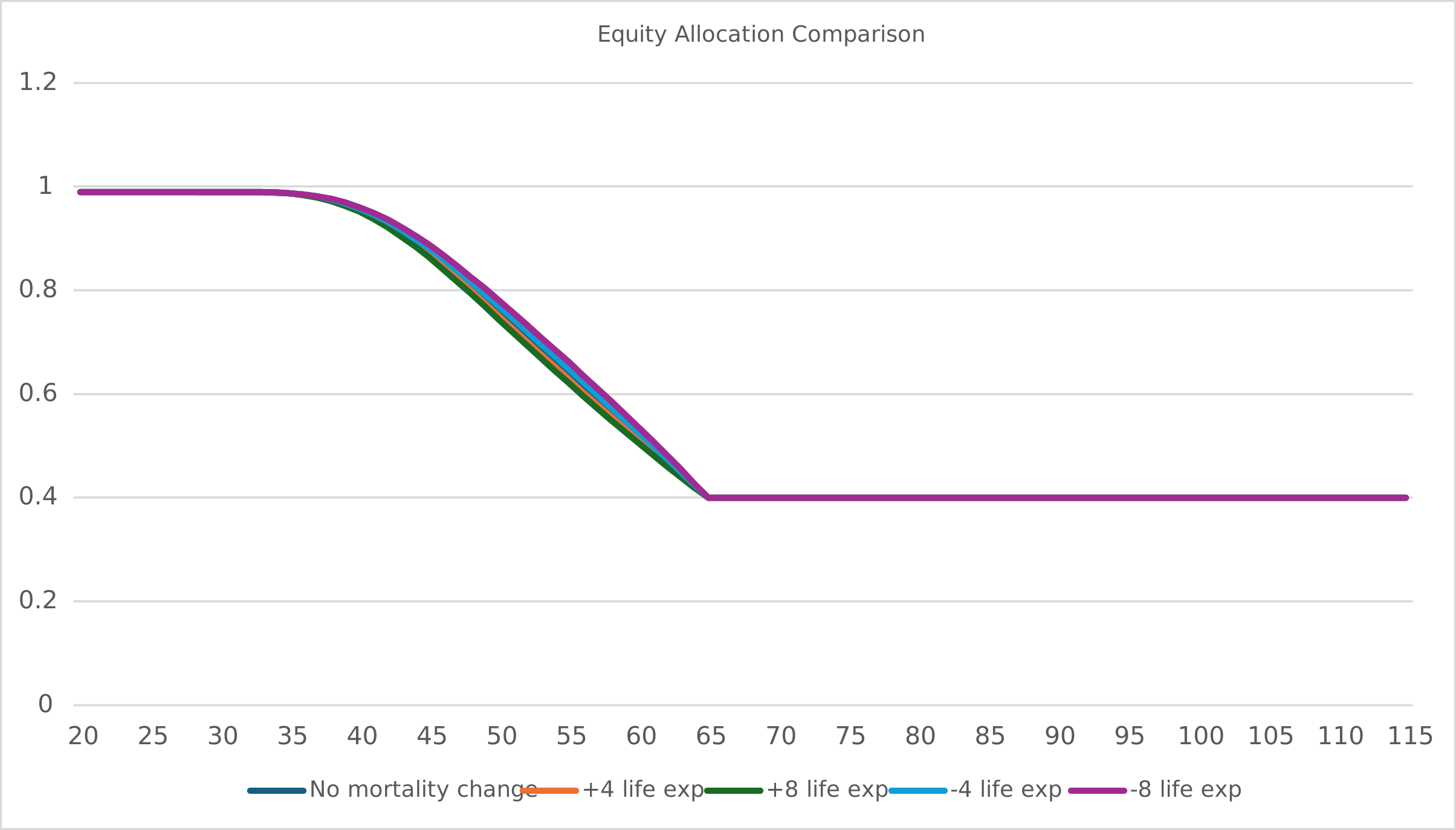
As lifespans lengthen, our modeling illustrates that individuals can support spending for a greater number of retirement years through a modest reduction in spending in early retirement years. This is shown in the top chart below. As shown in the bottom chart, equity allocations also moderate slightly as households look to plan for more consistent spending over an extended horizon, although maintaining appropriate risk-taking remains essential. Longer lives mean longer drawdown periods, increasing exposure to market volatility, sequence risk and inflation, which raises the importance of strategies that can support stable income over time.
Average consumption for different shocks to life expectancy. Source: BlackRock. As of August 2025.
Average equity allocation for different shocks to life expectancy. Source: BlackRock. As of August 2025.
Source: BlackRock. For illustrative purposes only. The income, consumption rates and wealth values shown are hypothetical estimates generated using Monte Carlo simulation, which is a statistical modeling technique that forecasts a set of potential future outcomes based on the variability or randomness associated with historical occurrences. Projections are hypothetical in nature, do not reflect actual investment results and are not guarantees of future results. No representation is made that an investor will achieve results similar to those shown. Actual values could be higher or lower based upon a number of factors and circumstances not addressed herein.
Together, the AI labor and longevity shocks applied in our analysis highlight that AI increases the range of possible financial futures, not necessarily their average trajectory. This creates a clear imperative to help clients navigate greater uncertainty with more adaptive planning tools.
Our research identifies several strategies that can help individuals mitigate the financial effects of income volatility and longer lifespans.
AI is introducing new forms of uncertainty across both labor markets and healthcare. For retirement planning, the growing variability in lifetime income and longevity is a core challenge. These forces make anticipation, flexibility, and resilience more important than ever.
The BlackRock Retirement Solutions team, armed with our lifecycle strategies, active capabilities, income solutions, and analytic tools, is uniquely positioned to help advisors and plan sponsors navigate this evolving environment. By integrating forward-looking planning, disciplined risk management, and reliable income strategies, clients can build confidence in their long-term financial futures, even as technology continues to change how we work, invest and retire.
The model compares three scenarios. If income shifts abruptly, households can adjust quickly. But gradual, unanticipated changes can force sharper spending cuts or more risk later because earlier choices no longer match reality. Savers who are able to anticipate gradual, anticipated changes can save earlier and adjust spending which could result in smoother wealth accumulation.
Even if average wage growth stays steady, AI can widen the dispersion of income paths across occupation, making earnings less predictable. That unpredictability can compound over time and become a core planning challenge because labor income is the main “fuel” for retirement saving.
Medical advances may increase life expectancy. In our modeling, longer lives can be funded with a modest reduction in spending in early retirement, while equity allocations moderate slightly to support more consistent spending over a longer horizon. Longer drawdowns also increase exposure to volatility, sequence risk and inflation—raising the value of stable-income strategies.
Our target date approaches aim to address one retirement challenge: improving participant outcomes with great certainty and consistency.
Carefully consider the Funds' investment objectives, risk factors, and charges and expenses before investing. This and other information can be found in the Funds' prospectuses or, if available, the summary prospectuses, which may be obtained by visiting www.blackrock.com. Read the prospectus carefully before investing.
The funds are actively managed and characteristics will vary.
Fund of funds are subject to the risks associated with the underlying BlackRock funds in which it invests.
Stock and bond values fluctuate in price so the value of your investment can go down depending on market conditions.
International investing involves special risks including, but not limited to currency fluctuations, illiquidity and volatility. These risks may be heightened for investments in emerging markets.
Fixed income risks include interest-rate and credit risk. Typically, when interest rates rise, there is a corresponding decline in bond values. Credit risk refers to the possibility that the bond issuer will not be able to make principal and interest payments.
Asset allocation strategies do not assure profit and do not protect against loss.
The funds may use derivatives to hedge its investments or to seek to enhance returns. Derivatives entail risks relating to liquidity, leverage and credit that may reduce returns and increase volatility.
The target date in the funds names are the approximate date an investor plans to start withdrawing money. The principal value is not guaranteed at any time, including at the target date.
Investing involves risk, including possible loss of principal.
This material is provided for educational purposes only and should not be construed as research. The information presented is not a complete analysis of the global retirement landscape.
The opinions expressed may change as subsequent conditions vary. The information and opinions contained in this material are derived from proprietary and non-proprietary sources deemed by BlackRock, Inc. and/or its subsidiaries (together, “BlackRock”) to be reliable. No representation is made that this information is accurate or complete. There is no guarantee that any forecasts made will come to pass. Reliance upon information in this material is at the sole discretion of the reader.
This material does not constitute a recommendation by BlackRock, or an offer to sell, or a solicitation of any offer to buy or sell any securities, product or service. The information is not intended to provide investment advice. BlackRock does not guarantee the suitability or potential value of any particular investment.
Prepared by BlackRock Investments, LLC, member FINRA.
©2026 BlackRock, Inc. or its affiliates. All Rights Reserved. BLACKROCK, LIFEPATH and LIFEPATH PAYCHECK are trademarks of BlackRock, Inc. or its affiliates. All other trademarks are those of their respective owners.
MKTG0526-5488249-EXP0527