

Fixed Income

Jun 09, 2026|ByChris Ryan, CFP®
Key takeaways
- Ratings are a great place to start—but they’re snapshots, so strong muni investing means keeping up with character, capacity, and capital as the story evolves.
- Munis trade over the counter, so information and liquidity aren’t always evenly distributed—doing the homework goes a long way.
- Credit research is about the path, not just the destination—watch the early warning signs, keep a margin of safety, and don’t be surprised when headlines move markets.
In 2025, BlackRock saw a plateau and normalization of credit quality from unusually strong post-pandemic levels. With such tailwinds headed into 2026, there is nothing to worry about from a credit perspective, right? Unfortunately, credit ratings represent a snapshot in time, and need to be reassessed on a regular basis, but how?
Imagine three siblings came to you to borrow money, but you had enough to lend to only one sibling, how would you choose? You’d weigh trustworthiness, ability to repay, and financial cushion—the same “3 C’s” used in lending:
- Character: willingness to repay, reflected in history, transparency, and governance)
- Capacity: ability to service debt from stable cash flow, considering income and leverage
- Capital: financial stake and loss-absorption before creditors are harmed
Whether you’re financing a home, buying a car, or applying for a credit card, one factor ties it all together: your credit score. Imagine again, those three siblings have their credit score posted on their shirt, this would certainly help shorten your review process. Credit scores are just aggregated data from lenders and public records looking at payment history, leverage, and borrowing behavior—ultimately defining borrower quality and borrowing costs. Municipal bond ratings work the same way: the major rating agencies act as credit bureaus, assigning ratings that directly influence yields. AAA rating is akin to an 850 FICO score—highest quality, lowest borrowing cost—while a low or unrated issuer resembles subprime credit with higher risk and funding costs.
So—is picking municipal bonds as easy as sorting by credit rating? If it were, I’d be updating my resume. The reality is that credit work has to go beyond a static grade: investors need to gauge not only a municipality’s ability to pay, but also its willingness to take action when conditions get tougher—so proactive, forward-looking research really matters. And because munis trade over-the-counter (not on a centralized exchange), the market can be a bit of a patchwork: disclosure isn’t always consistent, liquidity can vary a lot bond-to-bond, and two bonds that look almost identical on paper (same state, maturity, even rating) can behave very differently when markets get choppy. Comparing the municipal bond market to the corporate bond market, it becomes clear that while smaller in size, it is larger in issuer diversification. The tens of thousands of municipal issuers - states, cities, schools, utilities; GOs vs. Revs; all varying drastically in size and scale - make it difficult to have exact uniform disclosures. That’s why credit analysis is not optional in this space.
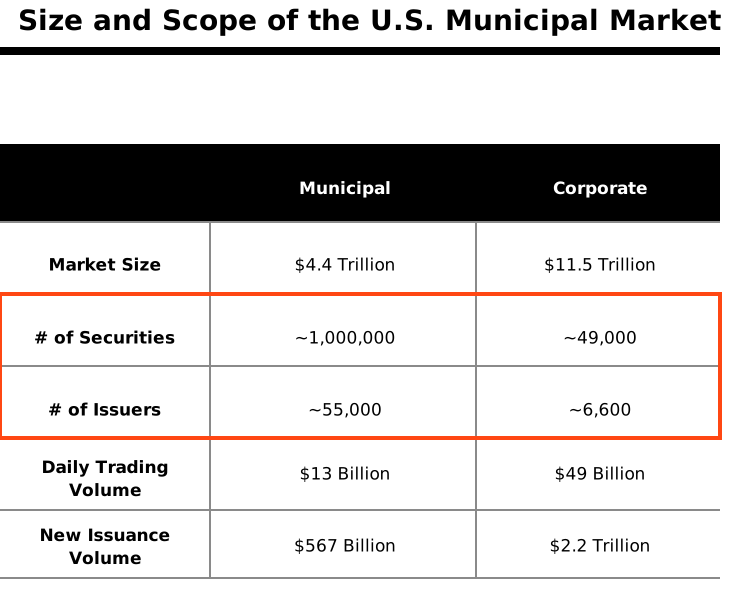
The municipal bond market is vastly larger than the corporate bond market as seen with the number of securities and issuers. Source: SIFMA, Federal Reserve, MSRB, BlackRock as of 12/31/25
Character
Quick muni history (the “why we can’t just assume everything is AAA” edition): Prior to the Global Financial Crisis in 2008, roughly one‑third of new municipal issuance — and more than half of outstanding par at the market’s peak — carried AAA insurance wraps, according to Federal Reserve and academic research
That extra layer of support often meant less focus on the issuer’s underlying credit. After the financial crisis, the monoline insurers’ grip on the market loosened fast—and credit work got a lot more hands-on. Some insurers had meaningful exposure to stressed credits like Puerto Rico, the City of Detroit, and Stockton, CA, which in practice looked more like a liquidity backstop than true credit protection. Many insurers ultimately exited the space, and today AAA-insured bonds represent less than 10% of new issuance. With over 80% of high yield municipal issuance now non-rated, the market has become inherently less transparent and more dispersed favoring investors with the resources and expertise to underwrite credit independently.
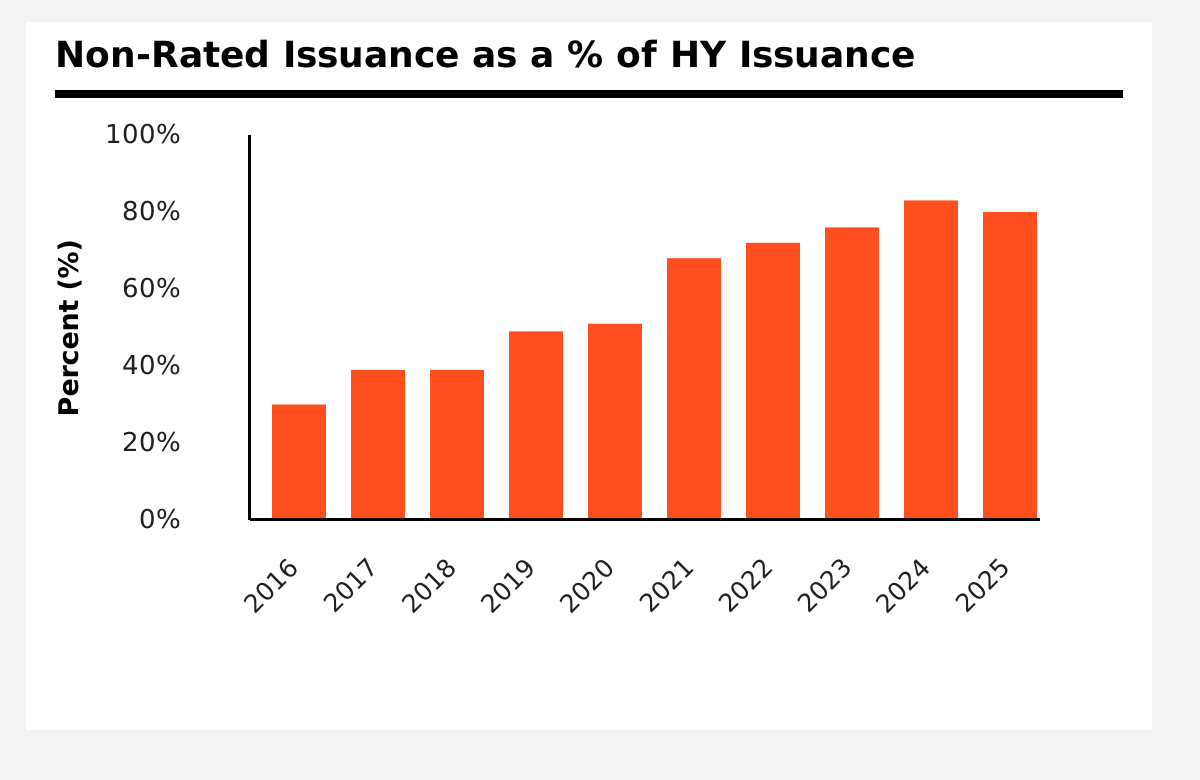
Over the years the amount of non-rated high yield issuance has continued to rise. Source: J.P. Morgan, BlackRock, as of 12/31/25
When we look at a potential muni investment, we don’t just take the rating agency grade at face value (Moody’s, S&P, and Fitch). We follow those ratings closely, but our credit analysts are also expected to kick the tires—sanity-check the assumptions, challenge the agencies when needed, and do our own independent, forward-looking work beyond what’s in the rating reports. The goal is simple: build municipal portfolios with the strongest, best-fit credits for each strategy.
Here’s a recent example of how “character” can show up in real time (early 2025): Harvard University faced heavy pressure from multiple directions—talk of higher taxes on the endowment, federal funding threats, and greater scrutiny around admissions and faculty. Despite the headline noise, we viewed the underlying credit as resilient. The bonds, typically trading around -5/+5 bps, widened to about +25 bps at the peak of the uncertainty. While the broader market stepped back, BlackRock added exposure at those levels, and spreads have since tightened back toward the -5/+5 bps range.
One more important point: our internal ratings aren’t “set it and forget it.” We revisit bonds regularly and update our view when the facts change.

Advisor takeaway: Focus on the issuer’s track record and behavior—reputation, credit history, how often they come to market, how they communicate, and (most importantly) whether they’ve shown they can be counted on to do what it takes to repay debt.
Capacity
From a lending perspective, capacity is measured by a borrower’s ability to service debt from sustainable cash flow, assessed through income stability, cash flow coverage ratios, and existing leverage. Municipal governments and nonprofits are harder to evaluate than corporations because their decisions are driven by political and social factors, not economics alone. Measuring ability to pay is largely quantitative; assessing willingness to pay requires qualitative judgment and experienced analysis. This means understanding legal, political, and cultural frameworks, as well as the essentiality and structure of a bond financing. Recognizing the limited disclosure often available in municipal markets, BlackRock focuses both on the probability of default and the overall margin of safety. Analysts look for early signs of financial stress—evaluating liquidity, short-term borrowing usage, liability management, and an issuer’s propensity to meet obligations today versus defer them. The objective is to anticipate risks before they materialize and apply those insights to portfolio construction.
A good “capacity can change fast” : Santee Cooper and SCANA (South Carolina Electric & Gas) kicked off the V.C. Summer Nuclear Project in 2013 to add two AP-1000 reactors. What followed was a long stretch of delays, design issues, and cost overruns—until the project was ultimately called off in July 2017, after roughly $9 billion had been spent with no reactors completed. Not surprisingly, Santee Cooper was downgraded and bond prices fell quickly. We chose to hold the bonds at the time, supported by the issuer’s ability to pass construction costs through rates from 2013–2017, continued market access, and sustained positive free operating cash flow. That said, cash flow adequacy started to soften before the downgrades, which is exactly why we focus on margin of safety—not just yesterday’s cash flow. Once the project was abandoned, the story shifted from a cash flow-driven credit to one more shaped by balance sheet, governance, and political risk. In late 2025, Brookfield was selected to lead the project’s completion, and BlackRock has maintained—and grown—our position as prices moved back toward more typical levels.
Advisor takeaway: Capacity isn’t a one-time math check—muni credit can turn on policy, projects, and politics, so the job is to watch the early warning lights and keep a margin of safety before spreads do the talking.
Capital
From a monetary lens, we try to spot financial stress before it shows up in the headline numbers—because by then, the market has usually already noticed. We take a close look at liquidity: how often (and why) an issuer taps the short-term market, whether the borrowing entity is quietly covering operating gaps, and whether tools like stretched payables or receivable securitizations are doing the heavy lifting for cash flow. We also pay attention to how durable the political or institutional support is for long-term debt funded projects. On the liability side, we separate issuers who prefer pay as you go from those who routinely push costs into the future via more borrowing or restructuring. The aim is to catch potential deterioration early and translate it into smarter, forward-looking portfolio decisions. And when we pair scenario analysis technology with our analysts’ issuer knowledge, we can assign probabilities to different outcomes and use that to guide positioning.
Here’s what that looks like in the wild (literally). On January 7, 2025, 14 destructive wildfires hit the Los Angeles metro area and San Diego County, and they weren’t fully contained for 25 days. The result: roughly 12 fatalities, 6,837 structures lost, and 23,448 acres burned. Our initial read after the Palisades Fire was that LADWP’s electrical infrastructure was unlikely to be the ignition source (nearby lines were underground and overhead facilities weren’t close to the origin). But the water system questions—especially the empty reservoir—were enough for us to trim exposure beyond three years. Between January and February 2025, we exited longer dated positions as litigation risk grew, with potential damages increasingly discussed above $10 billion. Spreads widened meaningfully, from about +20 bps in late 2024 to +70 in early 2025, tightened to the +30s in late fall, and then widened again to around +40 after recent court developments allowed lawsuits to proceed. We stayed comfortable in shorter maturities given the long runway for litigation and appeals—more than 14 months have already passed since the fires, and trials still appear distant.
Stepping back, BlackRock’s credit research platform is a big reason why clients and financial advisors trust BlackRock, and why we are one of the largest municipal bond managers available. We pair rigorous analysis with real market access: meaningful participation in the primary market and long-standing relationships with 90+ dealers in the secondary market, which helps both information flow and execution. This kind of reach—which many individual investors (and even smaller managers) simply don’t have—helps our teams surface risks earlier, find opportunities faster, and turn research into decisions. The bottom line is a research driven approach built to deliver across market cycles for our clients. Please visit our municipal bond page as well as our fixed income SMA page for more information.

Christopher Ryan
Fixed Income Portfolio Manager


Important Notes:
Investing involves risk, including possible loss of principal. Asset allocation and diversification may not protect against market risk, loss of principal or volatility of returns. There is no guarantee that any investment strategy discussed herein will work under all market conditions. Many factors affect performance, including changes in market conditions and interest rates, as well as other economic, political, or financial developments.
Two significant risks related to fixed income investing are interest rate risk and credit risk. Typically, when interest rates rise, there is a corresponding decline in the market value of bonds. Credit risk refers to the possibility that the issuer of the bond will not be able to make principal and interest payments. There may be less information available on the financial condition of issuers of municipal securities than for public corporations. The market for municipal bonds may be less liquid than for taxable bonds. A portion of the income may be taxable. Some investors may be subject to Alternative Minimum Tax (AMT). Capital gains distributions, if any, are taxable. Municipal securities may not be suitable for all investors. There is no guarantee that these investment strategies will work under all market conditions or are suitable for all investors and each investor should evaluate their ability to invest long term, especially during periods of downturn in the market. No representation is being made that any account, product, or strategy will or is likely to achieve profits. This material has been prepared for informational purposes only, and is not intended to provide, and should not be relied on for, accounting, legal or tax advice. You should consult your tax or legal advisor regarding such matters. This material is not intended to be relied upon as a forecast, research or investment advice, and is not a recommendation, offer or solicitation to buy or sell any securities or to adopt any investment strategy
You should not assume that investment decisions we make in the future will be profitable or will equal the investment performance of the past. With respect to the description of any investment strategies, simulations, or investment recommendations, we cannot provide any assurances that they will perform as expected and as described in our materials. Past performance is not indicative of future results.
Any tax information provided herein is for illustrative purposes only and does not constitute the provision of tax advice by BlackRock Due to the complexity of tax law, not every single taxpayer will face the situations described herein exactly as calculated or stated, i.e., the examples and calculations are intended to be representative of some, but not all, taxpayers. Since each investor’s situation may be different in terms of income tax, estate tax, and asset allocation, there may be situations in which the calculations would not apply. Please discuss any individual situation with tax and investment advisors first before proceeding. For those clients using tax advantaged indexing, taxpayers paying lower tax rates than those assumed, or without taxable income, would earn smaller tax benefits from tax-advantaged indexing (or even none at all) compared to those described.
©2026 BlackRock, Inc., or its affiliates. All rights reserved. BLACKROCK is a trademark of BlackRock, Inc., or its affiliates. Other trademarks are the property of their respective owners.
MKTG0626-5555404-EXP0627