

Practice Management

Key takeaways
- Merger-and-acquisition activity in the financial advice industry remains strong, presenting opportunities for buyers and sellers alike.
- Assessing the value of your firm at least annually helps ensure you are prepared at any time for a sale or succession. It can also uncover opportunities to drive better business results over time.
- Improve your firm’s valuation by reducing key risks and boosting your growth potential through your investment process, business efficiency and client acquisition strategies.
The advisor M&A market is robust with opportunity
The financial advice industry posted a record year for merger and acquisition (M&A) activity with 239 transactions closed in 20241 as the rebound in stock markets brought renewed optimism for business growth. The M&A marketplace continues to be busy in 2025 with large, systematic buyers aggressively pursuing their acquisition strategies and mid-sized firms seeking to invest in talent, operational efficiency, specialized services and access to additional geographic or niche markets. Amid strong demand and high valuations, an external sale is an attractive exit strategy for advisors nearing retirement without a succession plan.
Valuations, which are a function of a firm’s adjusted EBITDA and a deal multiple, have broadly risen in recent years, driven largely by demand from private equity investors. After a period of uncertainty around advisors’ revenue stability in 2023, pent up demand led to all-time high valuations in 2024, with deal multiples reaching a median of 11 times the target firm’s adjusted EBITDA. Notably, buyers demonstrated a strong preference for recurring revenues. The average valuation of a $500-million hybrid RIA was 20% less than similarly sized RIAs that derive more than 95% of their revenues from recurring fees.2
Deal multiples continue to rise
Median multiples of adjusted EBITDA
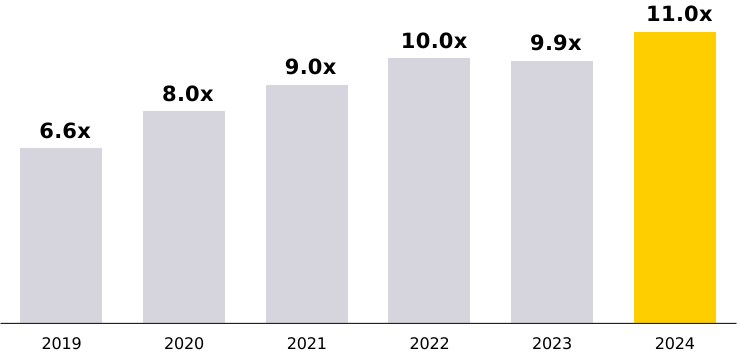
Source: Advisor Growth Strategies, “The RIA Deal Room,” 2025.
Buyers have been coupling higher valuations with greater risk-sharing in the form of contingent consideration (ongoing revenue-sharing, known as ‘earn outs,’ or any form of payment that is contingent upon future financial results). In 2024, contingent consideration comprised a significantly larger portion of the average deal structure (24%) than in previous years, while cash continued to diminish (51%) and equity decreased slightly (25%).2
Know what your firm is worth
If you want to participate in today’s fast-moving, highly competitive M&A market as a buyer or a seller, you need to maximize your value and be prepared to showcase it to prospective partners.
Even if you are not considering M&A, it’s important to know what is contributing to your firm’s value and what might be a detractor. The same traits that would increase valuation in an M&A transaction can help you drive more organic growth.
Periodically assessing your firm’s value allows you to monitor the health of your business and identify areas where you could improve its financial strength and longevity. Consider valuing your firm at least annually as it could help you drive better business results, and when you decide to retire, you will be prepared.
Some advisors calculate the value of their firm on their own or with the help of tools such as Truelytics, but if you are considering an M&A transaction, it may be worth hiring a third party who can provide an accurate and objective assessment as well as other consulting services. Establishing your valuation at the beginning of the M&A process helps to avoid uncertainties when negotiating and closing the deal.
Calculate your valuation
Truelytics is a data-driven tool that helps advisors make informed business decisions. Calculate the value of your business using Truelytics valuation models, benchmark your performance, forecast revenues and more.

Value is in the eye of the beholder
Your firm is worth more than a sum of accounting figures. In an M&A transaction, the value of a firm, ultimately, is what a buyer is willing to pay. Consider the real estate market, where a realtor estimates the market value of your home, but each prospective buyer values it differently depending on how well your home meets the goals of their purchase. If you live in a town with a desirable school district, a buyer with young children will likely be motivated to pay a little more for your house than would a buyer whose children are in college.
Similarly, a third-party M&A consultant can calculate the value of a selling firm, but a buyer may be willing to pay a premium if the firm matches its M&A goals and offers above-average growth potential. For example, sellers with a deep bench of next-generation talent are in a good position to negotiate a premium with buyers in search of young talent.
Whether you are thinking about selling your firm or acquiring one, keep in mind that all M&A participants have objectives. Your valuation is likely to be higher and your combined firm is more likely to be successful when both partners understand and solve for each other’s needs.
Also consider the unquantifiable element of a firm’s value found within its people and culture. There is meaningful value in the passion and dedication of your team, the impact of your leadership and the loyalty of your clients. When you evaluate your own firm or a prospective M&A partner, think beyond the numbers on paper and consider the value of these intangible assets.
Assess risks that affect value
A firm’s value reflects its potential for growth opportunities as well as its levels of risks in the current industry environment relative to your peers. Assess risk factors in these key areas:
- Revenue risk – A firm’s mix of recurring revenue (e.g., fee-based business) vs. non-recurring (e.g., brokerage fees) and history of revenue growth are indicators of revenue risk or stability.
- Business risk – Teams lacking in breadth or depth of expertise are less able to generate consistently positive business results. Even with the right expertise, a poorly structured team — where strengths are not aligned with responsibilities or advisors serve too many clients — is not positioned for optimal performance. A firm’s service model can also create business risk if the fee structure doesn’t maximize profit potential, services are not properly aligned to client needs, or the segmentation is not appropriate. Additionally, lacking a contingency or succession plan can leave a firm vulnerable if a key person is suddenly out of the picture.
- Client risk – Firms with a small number of clients or a homogenous client base (e.g., primarily retirees, concentrated within one profession) have more risk than those with a broader client base. Even with a large and diverse clientele, the risk can be high if the team cannot adapt to changing client needs over time.
Increase your valuation
Broadly, firms attracting premium bids in the M&A market today demonstrate above-market growth, strong team leadership and expertise, and a focus on services that are sticky and repeatable. Conversely, valuations tend to be discounted when teams lack depth, processes are siloed and difficult to transfer, and growth is below market.
The BlackRock Business Consulting team has engaged with thousands of advisors seeking to increase the value of their firm. We have found that advisors who focus on the following best practices are generally able to reduce key risks and boost their growth potential:
1. Streamline your investment approach.
Having a defined, repeatable investment process often bolsters the consistency of fee-based revenue and allows more time for you to build out diverse revenue streams, enhance your service model, prospect for new clients and deepen relationships with existing clients. Advisors have successfully streamlined their approach by using custom model portfolios for their higher tier clients and third-party models for the rest of their clients. Buyers often pay a premium for firms that outsource portfolio management or use models given the ease of transferring client accounts and integrating into a different platform.
2. Invest in efficiency.
Evaluate how well your service model aligns with the needs of your ideal client. Identify any services you offer that are not valued by your ideal client. Consider the amount of time your team spends on these services and how that time might be better spent. Likewise, identify the services your ideal client most appreciates and how you might better scale those offerings. Additionally, consider whether there are services you can efficiently add to better serve your ideal client.
Next, ensure each team member’s time and talents are being used in ways that optimize the value you deliver to clients:
- Align the roles and responsibilities of each team member with their personal strengths. Clearly define and document each role and share it with your team.
- Look for ways to increase your team’s efficiency, perhaps by outsourcing non-client-facing functions to free up their time or offering training opportunities that could deepen their skills or expertise.
- Implement a process for acquiring and retaining the next generation of talent. Young talent is one of the most coveted assets in the industry today as they offer fresh perspectives and innovative solutions, excel with technology and social media, and can easily make authentic connections with young investors.
3. Evolve your client base for the future.
Women investors, the next generation and individuals across increasingly diverse racial and cultural backgrounds are seeking financial advice. These are the clients of the future. They want more outcome-based planning and investment strategies tailored to their personal convictions and goals. Advisors who evolve their practice to attract tomorrow’s clients will be better positioned for future growth.
BlackRock can help
An advisory firm with a streamlined investment approach, efficient service model, well-structured team and evolving client base is better positioned to drive strong business results. Emphasizing these growth factors helps you mitigate key risks and increase the value of your firm. The BlackRock Business Consulting team has helped thousands of advisors accelerate organic growth and achieve high valuations for M&A.
If you are thinking about selling your firm, BlackRock can connect you with helpful resources, including tools like Truelytics or M&A consultants like Advisor Growth Strategies. These resources can help you assess and improve your firm’s value and transaction readiness, and find potential deal partners. If you have already sold your firm, we can help you work toward performance targets for deal contingencies and drive organic growth.
Ask your BlackRock Market Leader for more information and explore our M&A resources online.

Jim Renitsky, CIMA®
Director, BlackRock Business Consulting
Jim Renitsky, CIMA®, Director, is the Senior Growth Consultant on the BlackRock Business Consulting (BBC) team within USWA Advisor Engagement.
Related Resources
More articles loaded. Use Shift+Tab keys to browse.
Total articles:


Investments
Insights
Retirement
Tools
Resources
About Us


1 Fidelity Investments, “A decade in review: Examining M&A transaction trends and activity in the wealth management industry,” 2025.
2 Advisor Growth Strategies, "The RIA Deal Room,” 2025.
This information should not be relied upon as research, investment advice, or a recommendation regarding any products, strategies, or any security in particular. This material is strictly for illustrative, educational, or informational purposes and is subject to change. This material represents an assessment of the market environment as of the date indicated; is subject to change; and is not intended to be a forecast of future events or a guarantee of future results. Reliance upon information in this material is at the sole discretion of the viewer.
The information and opinions contained in this material are derived from proprietary and nonproprietary sources deemed by BlackRock to be reliable, are not necessarily all-inclusive and are not guaranteed as to accuracy. As such, no warranty of accuracy or reliability is given and no responsibility arising in any other way for errors and omissions (including responsibility to any person by reason of negligence) is accepted by BlackRock, its officers, employees or agents.
The strategies discussed are strictly for illustrative and educational purposes and are not a recommendation, offer or solicitation to buy or sell any securities or to adopt any investment strategy. There is no guarantee that any strategies discussed will be effective. The information presented does not take into consideration commissions, tax implications, or other transactions costs, which may significantly affect the economic consequences of a given strategy or investment decision.
Prepared by BlackRock Investments, LLC, member FINRA.
© 2026 BlackRock, Inc. or its affiliates. All Rights Reserved. BLACKROCK and iSHARES are trademarks of BlackRock, Inc. or its affiliates. All other trademarks are those of their respective owners.
USRRMH0625U/S-4533762