The power of private markets in DC
In recent years, Defined Contribution (DC) schemes have increased their integration of private market investments, driven by growing size, scale and sophistication to ultimately deliver higher quality defaults for their end members. Paired with a more favourable regulatory environment via the establishment of fund structures such as the Long Term Asset fund (“LTAF”), we believe the current landscape is well primed for DC schemes to consider investing in private markets.

Capital at risk. The value of investments and the income from them can fall as well as rise and are not guaranteed. Investors may not get back the amount originally invested.
1 Preqin “The Future of Alternatives 2029” Report, September 2024 .Values relate to end of year. All figures are in USD.
Why private markets for DC?
2 Broadridge Navigator Report: UK Defined Contribution and Retirement Income 2023.
3 Cambridge Associates, as of 31 March 2025. Please refer to the table below for more details on the indexes used. The figures shown relate to past performance. Past performance is not a reliable indicator of current or future results.
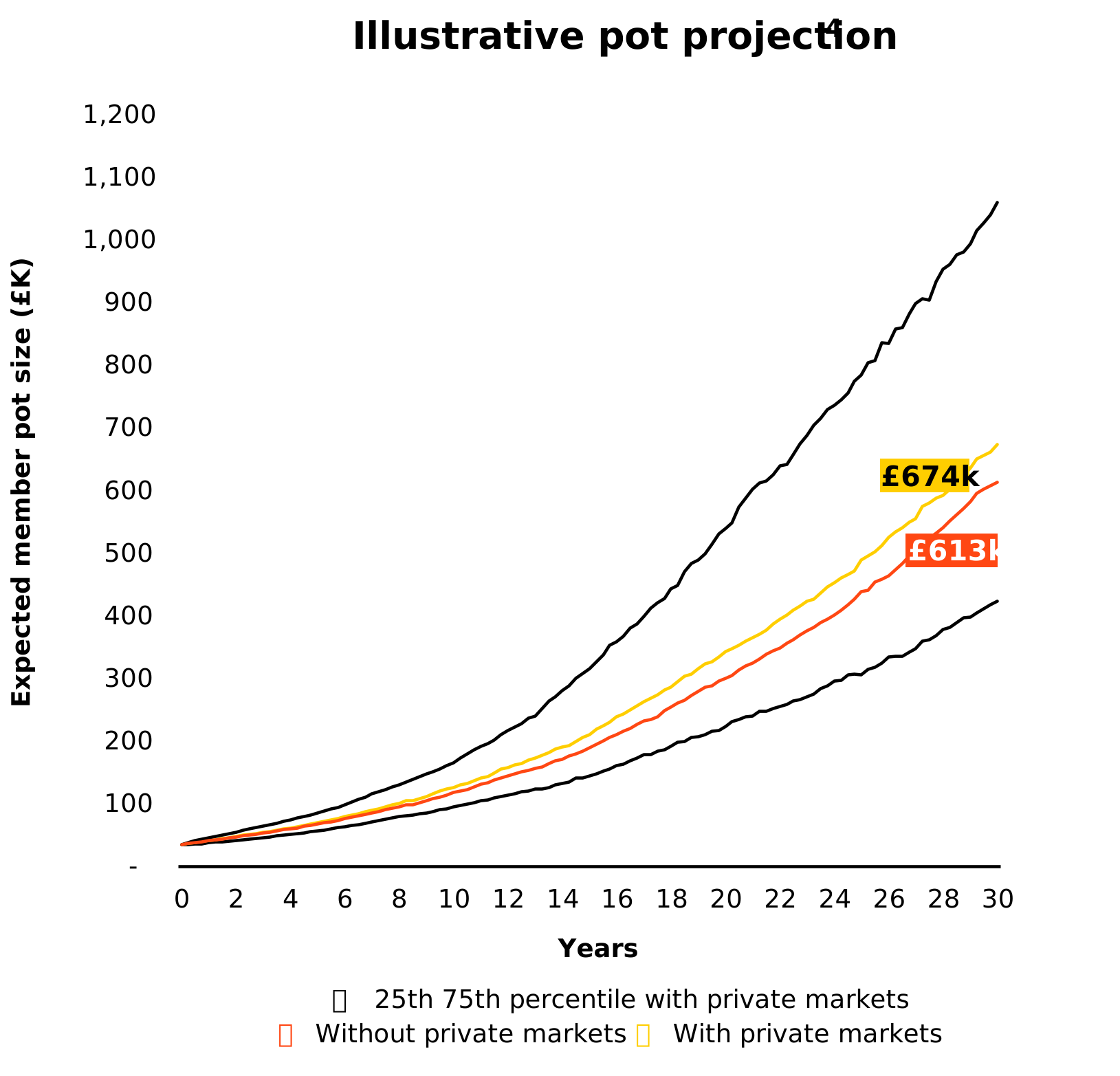
4 BlackRock, CMA data as of 30 June 2024, currency: GBP; time period: 30 years. Return assumptions are total nominal returns. Asset return expectations are net of fees. Indices are unmanaged and one cannot invest directly in an index. These portfolios represent a sample of the various possible solutions on the efficiency frontier. BlackRock has not considered the specific needs of the client and is not making any recommendation of any particular option. You should consider the most appropriate allocation for your needs.
Around 40% of DC savers are not on track for the Pensions UK Minimum Retirement Living Standard. Access to private markets could help through diversification and improved growth potential.
UK DC schemes now manage over £600bn,2 giving them the scale to access private markets. The average 40-year investment horizon also means they support long-term strategies and tolerate illiquidity.
Private markets have historically delivered 3.5–6% higher risk-adjusted returns than public markets,3 driven by the illiquidity premium, active value creation and a broader opportunity set.
Long Term Asset Fund (LTAF)
The LTAF is a UK regulated vehicle for long-term assets. The vehicle has been designed with a diversified approach to alternatives in mind, aiming to improve DC member outcomes on both return and risk. The benefits of the LTAF wrapper include:
- Dynamic portfolio management. LTAFs are an open-ended vehicle, so DC schemes can build up their investment and contribute to the LTAF without the requirement to continually launch new funds.
- Allow investments in a wide range of private assets and mandates managers to own ‘long term’ investments meaning that members invest directly into private assets as opposed to liquid proxies.
- LTAFs are part of the ‘permitted link’ regime4 which supports defaults accessing the vehicle.
LTAF investment case studies
-
Evolve is a global logistics and freight-forwarding platform that helps businesses move complex, high-value and time-sensitive shipments around the world. It operates a full spectrum of forwarding services across an integrated air, road and ocean network; a combination that is uncommon in the industry. This network spans 158 stations globally, with a focus in the Americas (42% of stations) and Europe (36%) and an emerging presence across Asia, India and the Middle East (21%). BlackRock invested in April 2026 alongside a specialist logistics and industrials sponsor.
Investment Highlights
- Structural demand tailwind: Evolve is well positioned to benefit from increasing demand for specialised, time-sensitive logistics solutions, including the rapid expansion of data-centre and AI-related freight. As grid capacity, and next-generation GPUs unlock incremental build activity, scaled providers with established carrier programs and integrated networks stand to capture a disproportionate share of growth.
- Differentiated, integrated platform: Evolve offers a full spectrum of forwarding services with integrated capabilities across air, road and ocean, supported by a global network of 158 stations across the Americas, Europe and emerging markets.
- Strong commercial traction and revenue visibility: The company holds deep, embedded relationships with major hyperscale technology customers, providing future revenue visibility, alongside commercial momentum across additional large accounts that create room for further revenue gains.
- Multiple value-creation levers: The investment offers several avenues for value creation: organic expansion, strategic M&A and operational execution.
Evolve is a scaled, embedded provider to some of the world's largest technology customers, with meaningful exposure to the fast-growing data-centre logistics market. This is an area underpinned by the global build-out of AI compute infrastructure. U.S. data-centre freight spend is expected to experience strong growth in the coming years, which could disproportionately benefit established, certified platforms like Evolve.
Global logistics platforms of this scale and complexity typically create most of their value away from public markets. Building integrated air-to-road networks, securing carrier certifications and proving SLA performance requires patient capital, operational expertise and time ie conditions best suited to private ownership. Public markets rarely offer exposure to this phase of value creation, meaning much of the upside is captured before any listing. For defined contribution pension schemes, private market allocations are essential to access opportunities of this kind.
-
Project Demeter is a leading European biomethane platform which aims to convert locally sourced organic waste into renewable gas. It comprises a portfolio of 12 secured assets, including three operational plants in Germany and the UK, six under construction across Spain and Italy, and three under conversion in Benelux. The business model is to convert locally sourced organic waste into biomethane at its plants, then sell the renewable gas under long-term contracts that are generally supported by government subsidies and regulatory decarbonisation targets. By transforming agricultural and food waste into clean energy, Demeter seeks to provide critical infrastructure that supports Europe’s decarbonisation goals while delivering stable, long‑term contracted revenues.
Investment Highlights
- Proven Technology and Scalable Platform: Demeter’s integrated model processes manure, slurry, and food waste into biomethane that can be injected into the natural gas grid or used as transport fuel. With a portfolio spanning multiple European markets and a strong pipeline of development and conversion projects, the platform appears well positioned to scale production and broaden its impact across the continent.
- Stable Cashflows Underpinned by Policy: Approximately 70% of revenues are secured through long-term agreements supported by EU and national subsidy schemes, including feed‑in tariffs, green certificates, and the UK Renewable Heat Incentive. These mechanisms may provide visibility on cash generation and align the platform with Europe’s policy push toward renewable gas and circular‑economy solutions.
- Potentially Attractive Market and Strong Growth: Demand for biomethane is expected to grow materially as European governments target rapid expansion of renewable gas infrastructure. With six plants under construction and three additional assets undergoing conversion, Demeter could be positioned to benefit from structural tailwinds and increasing investor appetite for low‑carbon, waste‑to‑energy infrastructure.
Demeter delivers substantial environmental and social impact highlighted by the platform’s contribution to waste valorisation by diverting agricultural and food waste from landfill, improving resource efficiency, and reducing methane emissions. Biomethane generated from manure provides one of the strongest carbon abatement profiles among renewable technologies. The operational model depends on partnerships with local farms and cooperatives, strengthening rural economies and embedding the platform within local communities. Risk areas such as odour, noise, and digestate management are actively monitored, supported by stakeholder engagement, certification initiatives, and pilots in on‑site solar and advanced wastewater treatment.
Project Demeter exemplifies how LTAF aggregator portfolios can seek to deliver on dual mandates: generating competitive financial returns while advancing the transition to a low-carbon, circular economy. By leveraging innovative waste-to-energy solutions, robust ESG frameworks, and deep local partnerships, Demeter aims to drive tangible positive change for communities and the environment across Europe while creating value for investors.
4 “Permitted link” refers to rules put in place by the FCA that are designed to ensure that if a natural person ultimately bares the investment risk of a unit linked life policy, the underlying assets are appropriate for retail investors. Source: Eversheds Sutherland, UK FCA policy statement on long term assets funds (LTAFs), 29 October 2021.
Why BlackRock?
-
01
Established private markets platform
With $676bn in assets under management and $42bn in multi-alternative portfolios.5
-
02
Technological and data capabilities
Providing greater transparency into the sources of risk and return and powered by industry-leading technology: Aladdin and eFront.
-
03
Experience managing assets in DC
BlackRock currently manages $281bn6 for UK defined contribution members and has managed DC schemes’ assets for several decades.
5 BlackRock, 15 January 2026, Q4 2025 Earnings Release Supplement.
6 BlackRock as of October 2024.
Unlocking Private markets for DC Members
Private market investments are increasingly being considered by defined contribution (DC) pension schemes of all sizes, including single-employer trusts.
In this video, Mercer’s lead DC Consultant Tej Patel and BlackRock Director Hannah Wallis discuss how private markets can enhance DC default strategies. They explore the role of private markets within a diversified portfolio, considerations around member demographics and allocation sizing, and the operational and governance frameworks needed to implement these investments responsibly. The discussion also looks ahead to how access to private markets in DC pensions is likely to evolve as the market matures.


