



iBonds ETF ladder

Build bond ladders with iShares iBonds ETFs

Defined maturity bond ETFs can help advisors build diversified bond ladders and manage client cash needs. Use the iBonds Ladder Tool to create a customized bond ladder in just a few clicks.

The iBonds advantage

For more than a decade, many advisors have used iShares iBonds ETFs to build bond ladders while seeking to manage cash flow needs and access diversified fixed income exposure.

#1
Term maturity ETF manager by AUM1
5
asset classes
15+
Years since iShares launched the industry’s first term maturity bond ETFs
100+
iBonds launched since 2010

What are iBonds ETFs?

iBonds ETFs are diversified portfolios of bonds that mature in the same year, spanning Corporates, Municipals, Treasuries, TIPS, and High Yield. Each fund is designed to provide regular interest payments and a final payout at maturity — similar to an individual bond, but with the ease and diversification benefits of an ETF.

How iBonds ETFs work

scheduler icon

Mature like a bond

Similar to individual bonds, iBonds ETFs have a specified maturity date, so there is less exposure to interest rate risk as maturity approaches.

arrows rotating icon

Trade like a stock

iBonds ETFs trade throughout the day on an exchange, just like stocks, helping investors avoid the over-the-counter bond market.

lines showing diversification

Diversify like a fund

iBonds ETFs provide exposure to hundreds of bonds in a single fund, diversified across sectors, ratings, and revenue sources.

Find iShares iBonds ETFs by asset class

Caption:

Table showing 5 asset classes (U.S. Treasuries, U.S. corporate, municipals, high yield bonds, and U.S. TIPS) of potential iBonds ETFs to help you build customized portfolio strategies.

YearU.S.
Treasuries
U.S.
Corporate
MunicipalsHigh
Yield
U.S.
TIPS
2026IBTGIBDRIBMOIBHFIBIC
2027IBTHIBDSIBMPIBHGIBID
2028IBTIIBDTIBMQIBHHIBIE
2029IBTJIBDUIBMRIBHIIBIF
2030IBTKIBDVIBMSIBHJIBIG

Our iBonds Ladder Tool enables you to:

5 year ibonds ladder
Visualize bond ladders
Customize for specific client needs
Export and share client ready report

Ways advisors can use iBonds ETFs

Build bond ladders

A bond ladder is a series of bonds that mature in consecutive calendar years. Then when the shortest-duration bonds mature, you buy the following year.

Save for a future purchase

Whether your clients aim to buy a home or fund college tuition in a set period of time, iBonds ETFs can help them invest, maturing and becoming available when cash is needed.

Put cash to work

Adding some longer maturity iBonds can diversify holdings and may offer more yield over a longer time frame.

What happens when iBonds ETFs mature?

iBonds ETFs typically mature in Q4 of the maturity year. As the bonds within each iBond mature, holdings transition to cash equivalents. Once the final bond matures, the ETF closes and distributes proceeds to shareholders—much like an individual bond reaching maturity. Our guide below gives ideas on how to reset your bond ladders as they come due.
money sign on black leaf

Building individual bond ladders can be time consuming and inefficient, especially with liquidity and access issues. Scale your practice with iBonds ETFs instead.

If you like the definition and predictable cash flows of individual bonds, are moving to fee-based, and like the mechanics of ETFs, iBonds ETFs can be a great way to help scale your practice — designed to mature like a bond, trade like a stock, and diversify like a fund.
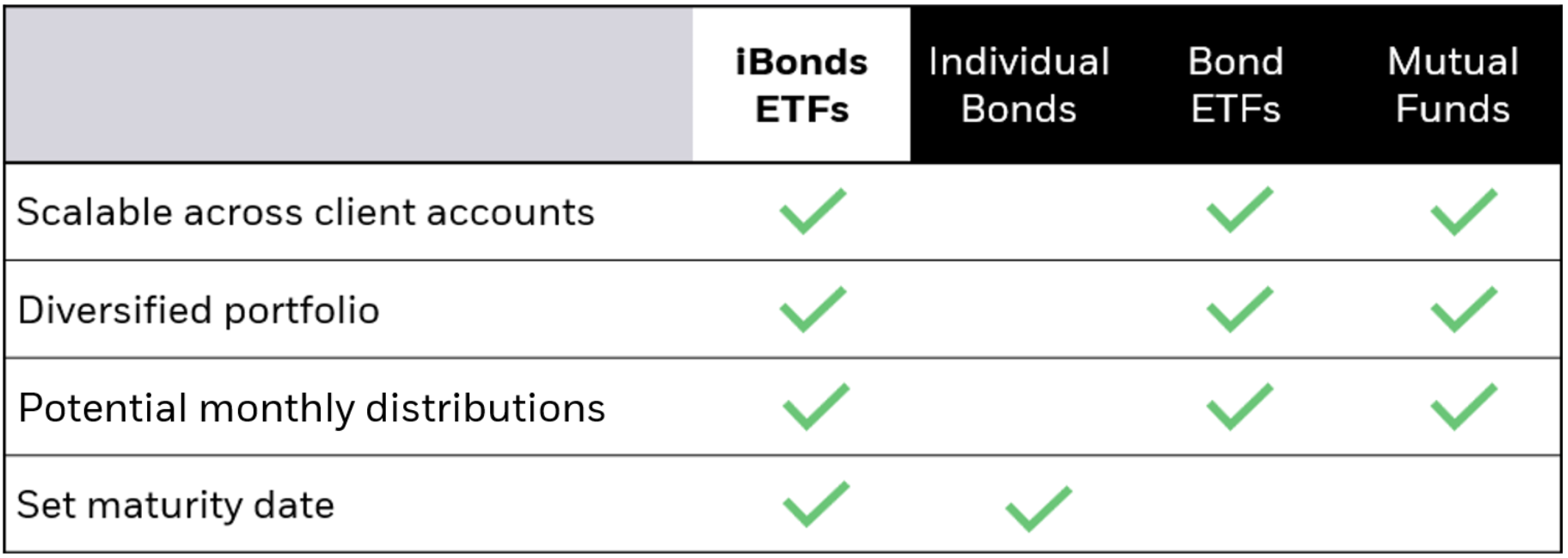
ibonds chart

iBonds ETFs pass through the underlying bonds’ income each month and pay a final distribution of all the matured bonds, at which point the ETF will delist from the exchange. The income distributions can vary as bonds are added or removed at different yield levels; however, the final payment tends to offset any changes in income. As monthly income distributions increase, final NAV payouts tend to decrease and vice versa.

An iBonds ETF provides cash flows similar to a portfolio of bonds. Like a ladder there is some variability in cash flows, but investors can observe the approximate average YTM of the underlying bond portfolio at the time of purchase.

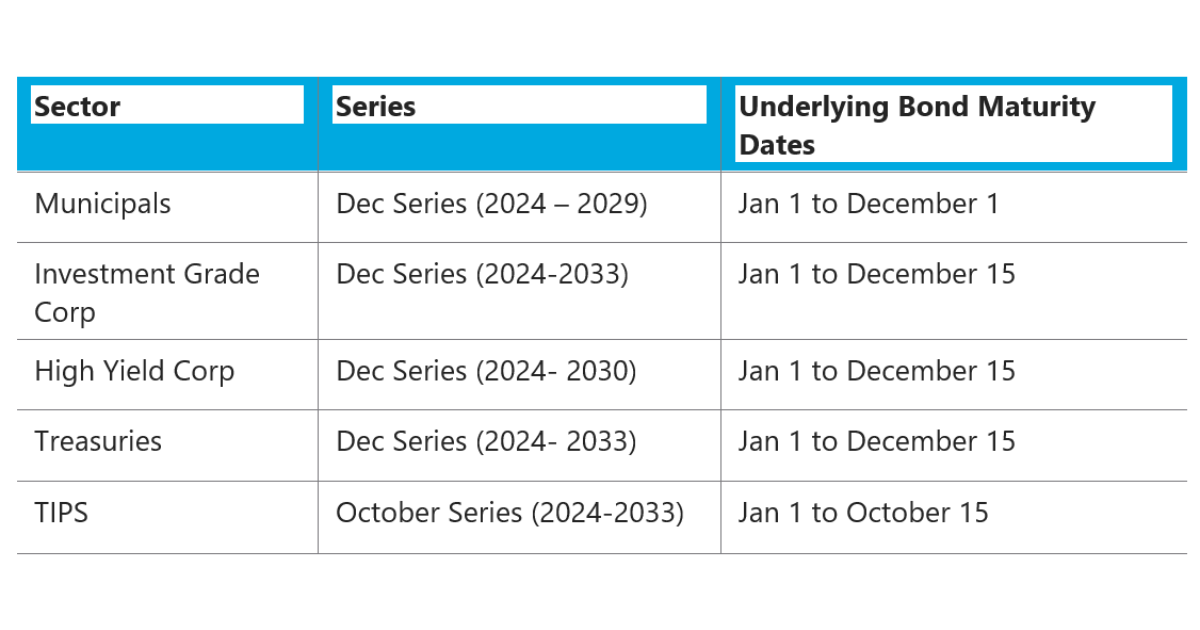
iBonds ETFs invest in bonds scheduled to mature throughout the calendar year starting January 1st. For the investment grade, high yield, treasury and TIPS iBonds ETFs, 12-6 months prior to maturity, the proceeds from coupons and maturities will be reinvested back into index eligible bonds. Beginning 6 months prior to maturity, these proceeds will be invested into cash equivalents. For the municipal iBonds ETF franchise, transition to cash equivalents begins 12 months prior to maturity. The underlying bond maturity schedule for the different series are as follows:

Table of bond maturity schedule for the different series

Investors will receive the final net asset value per share, which includes the proceeds from bond maturities and any undistributed interest.

The distribution, as reflected on Form 1099s to be received by shareholders, may have the following classifications:

  • Liquidation Distribution – one form of a return of capital that is not taxable to the investor, but each investor needs to determine their cost basis to verify if they had a capital gain or loss.
  • Exempt-Interest Dividend – not subject to income tax as long as the ETF had more than 50% assets invested in municipal bond investments. Municipal iBonds have paid tax exempt-interest dividends since inception.*
  • Taxable Interest Dividend – subject to income tax. This is the classification of distribution the Corporate iBonds have paid since inception.*

While iBonds are designed to provide a similar experience to holding an individual cash bond, several factors may impact NAV total return on annualized basis relative an investors’ initial net acquisition yield:

  • Reinvestment Risk- as is the case for an individual bond’s yield to maturity, an investor’s net acquisition yield assumes all future cash flows will be reinvested at the same yield. When interest rates go down, monthly distributions may be reinvested at lower yields relative to the initial net acquisition yield, which can cause a drag on performance. In the final 6 months before maturity (final 12 months for Muni iBonds) as maturing bonds transition into cash equivalents, if cash yields are different relative to when the investor purchases the iBond, then reinvestment risk may impact total returns. In the case of rising interest rates, reinvestment risk may positively impact total returns.
  • Credit events- the corporate and municipal iBonds suites track investment grade indices. If a bond is downgraded from investment grade to high yield, the security may be removed from the index and may correspondingly leave the portfolio. If the bond is removed at a lower price than it originally entered the portfolio, it may negatively impact the NAV of the fund and could affect net acquisition yield targets.
  • Realized Inflation- investors who hold the TIPS iBonds ETFs to maturity can earn approximately the real yield (net of fees) at the time of purchase, plus realized inflation. Future levels of inflation are unpredictable, so its improbable to forecast total realized returns of the TIPS iBonds ETFs.