

CONTACT US
Additional questions?
Schedule a meeting with a BlackRock private credit specialist.
Paid-In-Kind (PIK) interest has become more topical in recent years within the private credit markets. We believe PIK can be a potential differentiator for companies that are evaluating private credit versus public credit solutions for their financing needs. With PIK interest, companies defer making cash interest payments, and instead accrue additional interest to the principal balance, preserving cash flow in the near term for other purposes.
In an environment of higher-for-longer interest rates and sticky inflation, some worry PIK is obscuring stress on borrowers and is a sign of deteriorating fundamentals. However, it is important to distinguish “good PIK” from “bad PIK.” In our view, PIK interest should be used strategically and, if structured and priced appropriately, can be accretive to both investors and companies.
PIK interest is a feature of certain debt and preferred equity investments whereby interest expense is permitted to accrue to the principal balance rather than be paid out in cash. Given its deferred payout, PIK interest is typically priced at a premium to cash interest. Additionally, there are often limitations on the duration that a borrower may elect to defer paying cash interest and/or on the portion of the interest rate of a credit instrument that can be PIK.
PIK interest may be structured in several ways, including:
We believe the amount and duration of PIK interest utilization should be structured for each company’s specific situation and the amount of flexibility available to a company should be factored into the pricing.
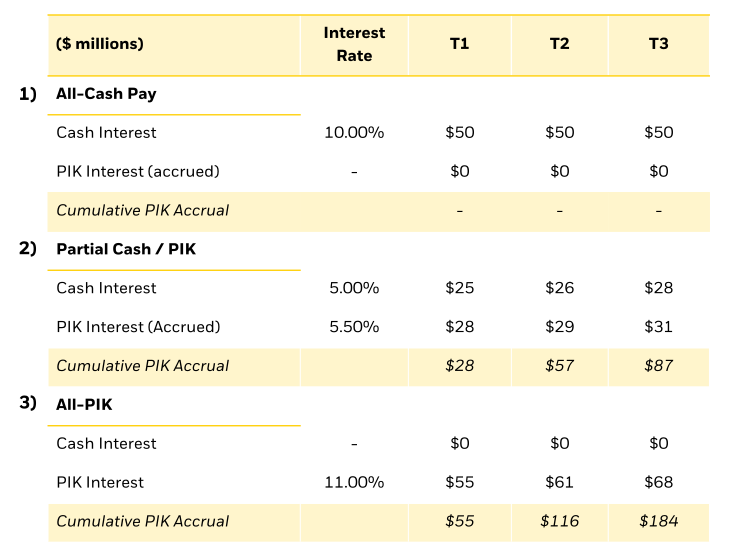
The table below shows the interplay of cash and PIK interest for an illustrative fixed-rate $500 million investment with the option to pay i) 10% cash interest, ii) partial PIK (50% of the rate at a 50-basis-point premium) or iii) full PIK (100-basis-point premium over three periods). As seen in this example, the more PIK is utilized, the more cashflow a borrower preserves near term while accruing more debt longer term.
Illustrative PIK accrual
Source: HPS as of June 2026.
It is worth noting that fixed-rate instruments, which are more typical in junior capital structures, can offer PIK flexibility on the entire interest rate. In senior secured loans, however, interest is often floating rate and PIK flexibility typically only applies to a portion or all of the spread over the base rate and not the base rate.
A key benefit of PIK interest is that it provides borrowers the flexibility to manage their liquidity. This can be especially helpful during high growth periods when companies pursue strategic growth initiatives and/or acquisitions. It can also help companies navigate periods of tighter financial conditions, such as rising-interest-rate environments and volatile macroeconomic conditions, as well as short-term underperformance.
We saw an increased focus on PIK in the market amid the Federal Reserve’s unprecedented 500-basis-point rise in base rates over a four-quarter period between 2022-2023 and the resulting rise in cash interest expense burden for businesses. In some instances, during this period, cash interest owed by companies more than doubled, squeezing cash flow margins and limiting such companies’ ability to pursue growth initiatives.
Another indirect benefit from the use of PIK interest is tax deductibility. Interest payments, including PIK interest, are tax deductible in most jurisdictions. When using PIK, that deductibility reduces a company’s overall tax burden without requiring the company to pay out the cash interest in the near term.
While the focus on PIK interest has grown, it is not a new feature of capital markets. PIK has historically been a part of the private credit market where direct negotiations with a single or limited group of investors generally enable greater flexibility and customization. PIK has also been selectively used in the high yield market during periods of economic volatility or reduced liquidity. However, in recent years, as private credit has gained market share, we have seen PIK usage decline in high yield.
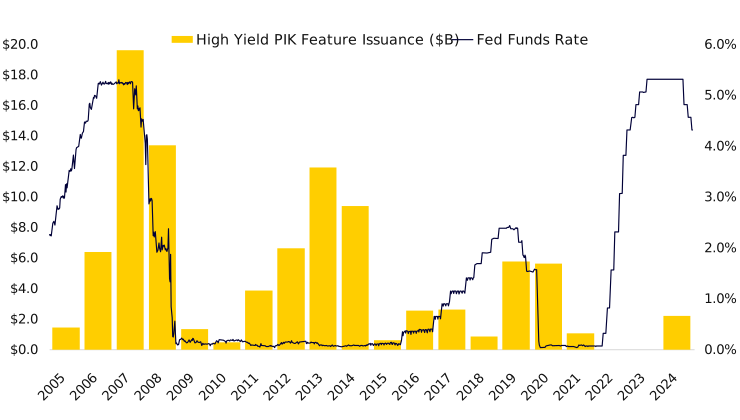
A U.S.-specific analysis, shown in the chart below, revealed increased use of PIK interest in the high yield market in three notable periods over the last 20 years. The first was in 2007 and 2008 when PIK interest was included in 14% and 19% of U.S. high yield issuance, respectively. This period coincided with the Federal Reserve’s rate hike cycle from 2005-2007 when the fed funds rate rose from ~1% to more than 5%. Increased issuance of PIK in the high yield market was observed again in 2013, coinciding with the “taper tantrum” caused by the Fed’s announcement of tapering its policy of quantitative easing and reducing asset purchases. We saw a subsequent PIK increase in high yield during the Fed’s hiking cycle over 2018-2020, which increased base rates from the zero lower bound to 2.5% before COVID disrupted the economy.
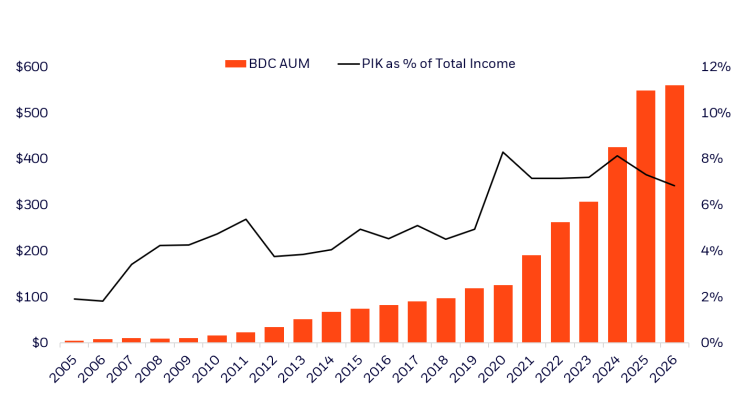
Yet PIK issuance as a percentage of total high yield issuance showed a consecutive decline across these three periods, which we believe is in part driven by the growth in the private credit market. Most recently, as the Fed rapidly raised rates throughout 2022-2023, we did not see a similar spike in PIK issuance in the high yield market. Instead, instances of PIK increased in private credit during this financial tightening cycle, as illustrated below.
Historical PIK features in high yield issuance
Source: Pitchbook | LCD, Bloomberg, as of June 3, 2026.
The growth of the assets under management (AUM) of business development companies (BDCs) and their use of PIK can serve as a proxy for the broader private credit market. The private credit market is much larger than the BDC universe with an additional ~$1.6 trillion of AUM outside of BDCs.1 However, because of the public nature of BDC regulatory filings, we think the empirical data on the usage of PIK interest within BDC structures can be instructive on the trend of PIK interest in the broader private credit market. It is worth noting that BDCs are subject to liquidity requirements whereby they must distribute 90% of their interest income to investors, and thus there is a constraint on the usage of PIK within BDCs that may not exist for other private credit funds.
Growth in private credit BDC AUM
Source: Cliffwater Direct Lending Index, as of March 31, 2026.
PIK features are generally not available in the broadly syndicated loan (BSL) market due to structural restrictions common to CLOs, the largest source of demand for such loans. CLOs are typically limited to having 5% or less of their assets that are permitted to use PIK and are unable to buy assets that are paying PIK interest at the time of purchase.2
Private credit markets, which typically are not subject to the same restrictions as CLOs and the broadly syndicated loan market, are able to offer greater structuring flexibility and customization. In the current market, private credit managers are able to commit over $1 billion per transaction and regularly compete with banks on both LBO and corporate transactions. Competition between the two sources of capital has led to differentiation on terms ― generally, private credit managers can offer PIK and other structural advantages, while banks can deliver a lower overall cost of capital.
PIK has historically been a feature of junior capital instruments,3 which represent the portion of an issuer’s capital structure between first-lien senior secured debt and common equity. Issuers often seek junior capital solutions in lieu of more expensive equity capital to support growth initiatives, fund acquisitions and refinance existing indebtedness. Given its position in the capital structure, junior capital typically commands a higher premium over senior debt. PIK features in private junior capital investments are generally structured upfront and typically include the ability to PIK in full or in part throughout the life of the investment. Junior capital solutions with PIK flexibility can help optimize a company’s balance sheet and maximize cash flow.
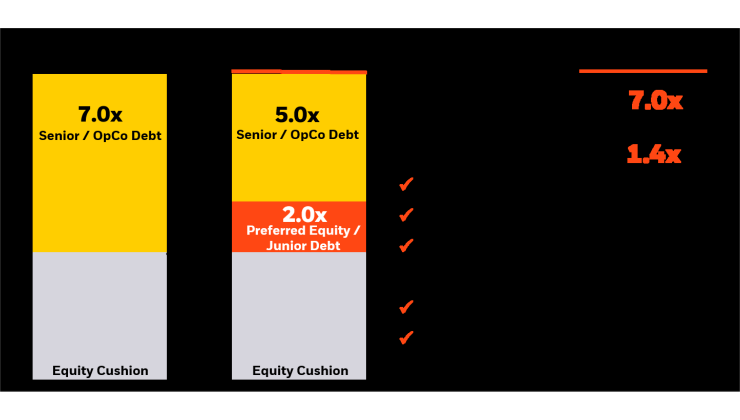
We believe there is a significant opportunity in today’s economic environment to provide performing companies with PIK flexibility as they adapt to higher interest rates. For example, companies that have a capital structure financed in a low-interest-rate environment may now face liquidity pressures from the rise in base rates, which could lead to refinancing risk in an all-senior structure. Introducing a junior capital solution with PIK flexibility can help de-lever senior or OpCo debt and improve senior leverage and cash coverage ratios, which in turn can position the company for an improved senior debt profile or rating agency treatment and lower the cost of capital on its senior debt. PIK flexibility also increases free cash flow available for existing and new growth plans.
Hypothetical junior capital PIK refinancing solution
Source: HPS. Hypothetical scenario based on $100 million of EBITDA, three-month term SOFR base rate of 4.30% as of Dec. 31, 2024, and cash interest expense assumes senior debt pricing of S+600 and S+500 for pre-transaction capital structure and Junior Capital PIK solution capital structure, respectively.
Similar to the junior capital market, PIK interest can be structured in several ways in the senior debt market. The utilization, however, is typically limited with more stringent parameters around the duration of PIK flexibility (e.g., 18-24 months) and/or the portion of interest that is allowed to PIK (e.g., only half of the cash spread is eligible).
Historically, using PIK may have been viewed as a negative indicator or precursor to financial stress. However, in the current higher-for-longer interest-rate environment, we are seeing PIK being used by performing companies as a capital structure and liquidity management tool. A private credit manager’s ability to structure customized capital solutions (including using PIK features) and to offer greater certainty of execution can serve as a critical differentiator when companies are evaluating between public and private financing options.
PIK is further bifurcated into “good” and “bad” PIK ― the former use case can be a powerful tool when originating new debt that, when implemented thoughtfully, could provide benefits to both borrowers and lenders. In environments where interest rates are increasing, structuring some degree of PIK flexibility up front can help alleviate the pressure of higher cash interest burdens on borrowers and can support a company’s ability to continue to grow. Alternatively, if short-term underperformance has been identified in a company’s financial history, a private credit manager may offer some degree of PIK flexibility upfront to allow the borrower the opportunity to address those issues.
Private credit managers typically benefit from this form of PIK via an economic premium received for extending flexibility to borrowers. However, lenders need to be selective when considering whether to extend PIK flexibility for senior debt and evaluate each business independently to determine if the contemplated capital structure is sustainable on a long-run, cash-pay basis. Additionally, in situations where there has been recent underperformance that the borrower expects will abate, potential lenders must make their own determination as to the viability of the turnaround story.
In both the junior and senior credit markets, “bad PIK” typically refers to PIK terms put in place through an amendment based on a borrower’s request to convert some or all of its cash interest to PIK interest due to underperformance of the business. These situations vary greatly from borrower to borrower, and thoughtful evaluation of each situation is critical. As previously described, since PIK interest is added to the principal balance of the investment, it can further exacerbate a capital structure that is over-levered. Where the underperformance is short-term in nature with a clear path to resolution, temporary PIK relief can be a useful bridging tool for borrowers without triggering a default, which may not ultimately be beneficial for the investor.
Broadly syndicated loan issuers may face limited options during periods of underperformance or tight liquidity, and investors may have relatively limited protections given the typical covenant-lite nature of BSLs, whereas private credit managers may be able to offer an amendment for PIK flexibility during an equivalent period of an issuer’s underperformance. Further, liability management exercises (LME), which are transactions designed to modify a company's debt obligations (including through exchange of existing debt with new debt), have gained prevalence in the BSL market, and in such a scenario, the lender may be forced to take a significant haircut on its existing investment. Comparatively, in private credit transactions, PIK flexibility relief can allow a borrower time to grow out of temporary underperformance instead of potentially incurring an LME-driven loss on the investment.
As is the case with “good PIK,” PIK interest driven by underperformance of an existing investment must be approached with great care and discipline on a case-by-case basis.
We believe PIK interest is a differentiator for private credit, and when structured successfully, it can support the growth and stability of a company across cycles in exchange for a premium to investors. Acquisitions and growth projects typically take time for accretive cash flow to materialize, and paying cash interest on incremental debt financing may be overly punitive in the short term. Offering upfront PIK flexibility while these growth investments unfold can be a significant value-enhancing tool. PIK flexibility can also help companies adapt to changing economic environments and direct cashflow to where it is needed most.
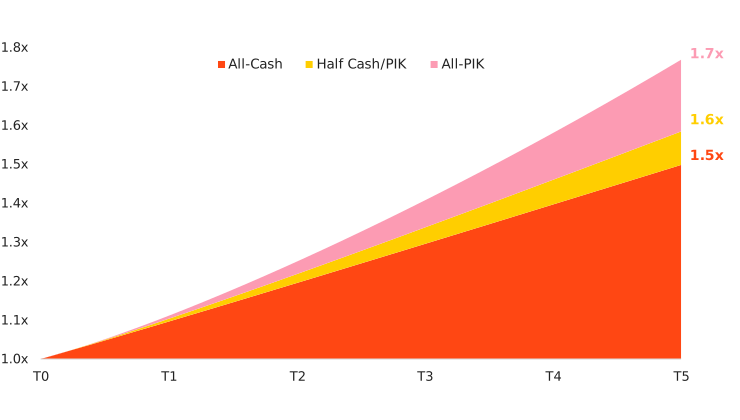
The premium investors could receive for providing PIK flexibility includes an increased interest rate relative to the cash-pay alternatives and the benefit of compounding as PIK interest accrues on a growing principal balance. The chart below shows the multiple on invested capital (MOIC) for the hypothetical example given earlier: a fixed-rate $500 million loan with the option to pay i) 10% cash interest, ii) partial PIK (50% of the rate at a 50-basis-point premium) or iii) full PIK (100-basis-point premium). The full-PIK-pay option has the potential to generate an additional 0.2x MOIC compared to the all-cash-pay option over five periods.
Hypothetical MOIC progression for PIK-pay vs. cash-pay investment
Source: HPS as of June 2026. For illustrative purposes only.
PIK interest usage has grown in recent years as the economy transitioned from a low-interest-rate environment to a higher-for-longer rate environment. We believe PIK interest can be a valuable tool for both investors and companies alike. While PIK interest is not a new feature in leveraged finance markets, its use has largely shifted from the public high yield to the private credit markets over the last two decades and is now a differentiator for private credit managers. Further, it is important to consider the different aspects of “good PIK” and “bad PIK” when making decisions with respect to new and existing investments. When structured and priced thoughtfully, we believe PIK interest presents an attractive opportunity to help performing companies while earning a premium that can be accretive to an investor’s portfolio.
This article features insights and represents the views of HPS, a part of BlackRock.
Schedule a meeting with a BlackRock private credit specialist.
1 Source: Preqin, as of June 30, 2024.
2 Source: KBRA DLD.
3 Source: DeMarzo, PM, Hart, J, and Cotton, R (2021) Introduction to Leveraged Buyouts Note. Board of Trustees of the Leland Stanford Junior University. Stanford Graduate School of Business.
This material is intended for information purposes only, and does not constitute investment advice, a recommendation or an offer or solicitation to purchase or sell any securities to any person in any jurisdiction in which an offer, solicitation, purchase or sale would be unlawful under the securities laws of such jurisdiction. This material may contain estimates and forward-looking statements, which may include forecasts and do not represent a guarantee of future performance. This information is not intended to be complete or exhaustive and no representations or warranties, either express or implied, are made regarding the accuracy or completeness of the information contained herein. The opinions expressed are as of July 2026 and are subject to change without notice. Reliance upon information in this material is at the sole discretion of the reader.
Investing involves risk, including possible loss of principal. This material is strictly for illustrative, educational, or informational purposes and is subject to change. There can be no assurance that an investment strategy will be successful.
Past performance is no guarantee of future results. It is not possible to invest in an unmanaged index.
Incorporating alternative investments into a portfolio presents the opportunity for significant losses including in some cases, losses which exceed the principal amount invested. Also, some alternative investments have experienced periods of extreme volatility and in general, are not suitable for all investors. Asset allocation and diversification strategies do not ensure profit or protect against loss in declining markets.
Private market investments should only be considered for investors who can tolerate the risk. A fund’s investments in private companies are subject to a number of risks. Private companies are generally not subject to SEC reporting requirements, are not required to maintain their accounting records in accordance with generally accepted accounting principles and are not required to maintain effective internal controls over financial reporting. As a result, the Sub Advisor may not have timely or accurate information about the business, financial condition and results of operations of the private companies in which the Fund invests.
©2026 BlackRock, Inc. or its affiliates. All Rights Reserved. BLACKROCK is a trademark of BlackRock, Inc. or its affiliates. All other trademarks are those of their respective owners.
Prepared by BlackRock Investment, LLC.
MKTG0726-5733339-EXP0727