
CONTACT US
Additional questions?
Schedule a meeting with a BlackRock private markets specialist.
As banks retreated from traditional lending markets in the years following the 2008 Global Financial Crisis (GFC), the door opened for private credit managers to fill the void.
The private credit asset class has now grown to $1.8 trillion in assets under management,1 primarily representing assets of corporate credit investment strategies, including direct lending, mezzanine and distressed and special situations. For investors looking to diversify their portfolios, private asset-based finance (ABF) offers the potential for uncorrelated returns to existing corporate-focused fixed income allocations across private and liquid markets.
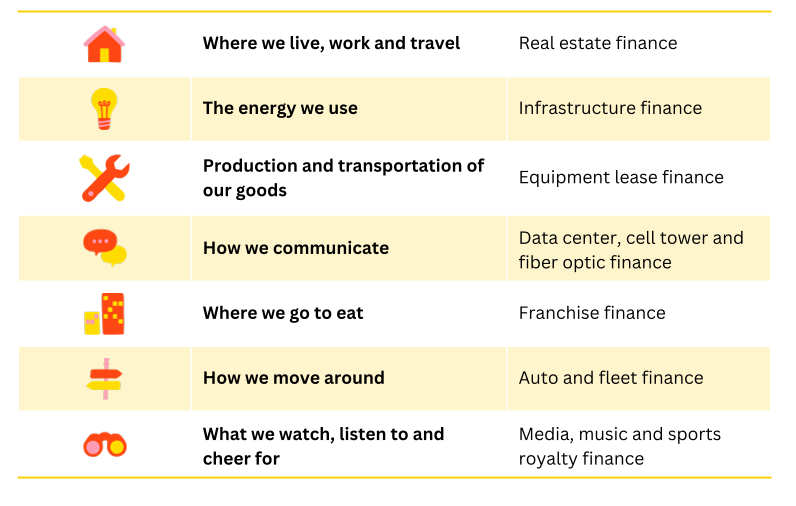
Asset-based finance encompasses a broad spectrum of investment opportunities, often backed by assets used on a daily basis by businesses and individuals. The underlying collateral supporting such financings ranges from machinery and equipment that produce the goods we use to the infrastructure that generates our electricity, to the buildings in which we live and work and the media content we consume.
Traditional financing solutions offered by banks and securitization markets have long existed to provide asset-based financing. However, bank appetite for balance sheet exposure is becoming more limited and availability of securitization capital often fluctuates depending on market conditions.2 As a result, private credit is emerging as a viable alternative capital provider to borrowers seeking capital stability and customized financing solutions. We believe these private asset-based opportunities will emerge as a growth vector in private markets for the following reasons:
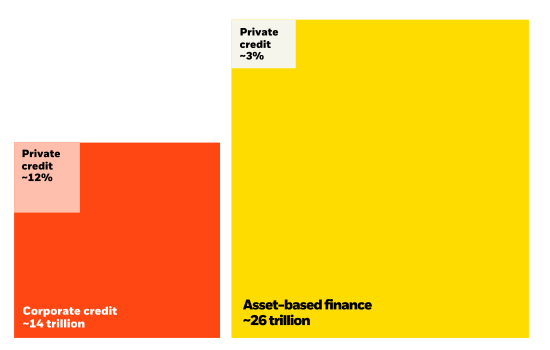
Scalable and growing investment opportunity: ABF represents a large investment opportunity, with an addressable global market that HPS estimates to be $26 trillion, which is larger than the estimated $14 trillion corporate credit market, as shown below. However, private credit only holds an estimated 3% market share in ABF compared to 12% in corporate credit. Over the next several years, we expect private credit to increase its presence in the ABF market with its ability to provide scaled and flexible financing solutions, expanding its market share, similar to private credit’s trajectory in the corporate credit market over the last decade.
Private credit’s share of corporate credit and ABF markets
ABF private credit AUM based on Oliver Wyman’s assumptions in the “Private Credit’s Next Act” series (April 2024 and February 2026), plus Preqin Real Estate Debt and Infrastructure Debt AUM data as of June 2025. ABF market sizing data comes from the Federal Reserve, Federal Reserve Bank of St. Louis, Federal Reserve Bank of New York, JPMorgan Securities, Secured Finance Network and IJGlobal. Data as of December 2025. Corporate credit market data from the following sources: ICE Bank of America as of December 2025 (Ticker C0A0 for IG Corporate, H0A0 for HY Corporate), Credit Suisse Leveraged Loans Index as of December 2025, and Preqin Private Credit AUM as of June 2025.
Tailwinds at the asset level should be supportive of credit quality: Certain sectors within ABF are benefiting from positive tailwinds. Several asset-intensive sectors of the global economy, including the energy, power and digital infrastructure sectors, are projected to see increases in capital expenditures over the next several years.3 For example, artificial intelligence (AI) and related digital infrastructure capital expenditures alone are projected to be approximately $7 trillion over the next six years.4 Additionally, power demand is inflecting higher due to growth in AI and data center development, as well as reshoring of manufacturing capabilities, which is supportive of power prices for existing generation assets and driving demand for new assets.3, 4 Further, in the U.S., residential housing stock is undersupplied by an estimated 3-4 million units, which has resulted in higher housing prices over the last several years.5
Regulatory pressures could result in continued bank disintermediation: Following the GFC, many banks addressed increasing levels of regulation by scaling back capital-inefficient lending units while prioritizing customers with longstanding relationships.6 In our view, even a potentially looser near-term regulatory environment is unlikely to fully reverse the retreat of banks from select lending markets as a result of these constraints.
We believe the addition of private ABF investments to investor portfolios may be advantageous from a portfolio construction perspective. While the actual impact will depend on each investor’s specific allocation, we believe investing in ABF could provide the following benefits, among others:
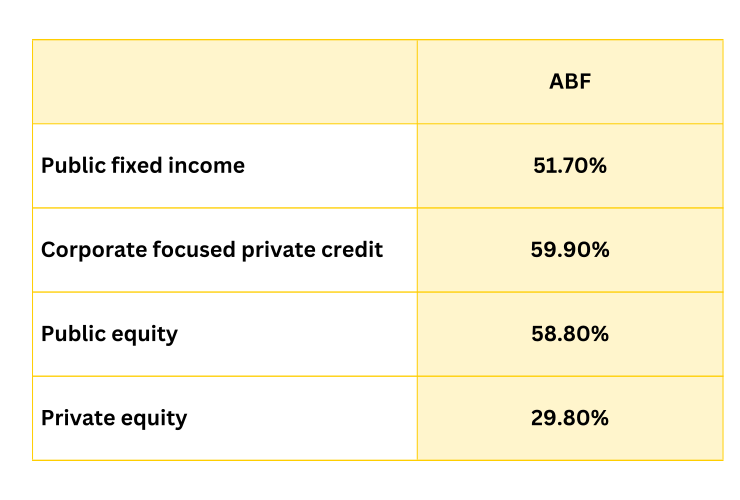
Diversification: The inclusion of ABF in a portfolio can offer diversification benefits across several dimensions. Exposure is typically oriented toward non-corporate assets, which can provide differentiated return drivers from traditional corporate credit allocations. Within a multi-strategy ABF portfolio, underlying subsectors and asset types are often not highly correlated with one another, with individual investments frequently backed by a collateral pool comprised of individual cashflow streams supported by a large number, in some cases thousands, of distinct assets. To create the collateral pools, managers typically seek to include assets with varying underlying characteristics, which can provide inherent diversification within a single investment. Additionally, the performance of these assets is generally tied more to idiosyncratic asset-level factors than macroeconomic changes. With ABF assets generally supported by hard asset collateral, we believe these assets can generally be viewed as a natural inflation hedge. Taken together, these ABF characteristics generally contribute to lower correlation relative to other public and private investments, as highlighted in the table below.
ABF exhibits lower correlation to other asset classes
HPS analysis. Correlations shown in this analysis are based on historical index total return data from June 30, 2012, through Dec. 31, 2025, and were calculated using quarterly returns. Public fixed income is represented by the Bloomberg U.S. Aggregate Bond Index. Corporate focused private credit is represented by the Cliffwater Direct Lending Index. Public equity is represented by the S&P 500 Index. Private equity is represented by the Preqin Private Equity Index. ABF is represented by the JP Morgan Asset Backed Securities Index. The JP Morgan Asset Backed Securities Index tracks both fixed-rate and floating-rate ABS, categorized by Auto and Equipment, Credit Card, FFELP Student Loan, Private Student Loan, Floorplan, Unsecured Consumer and Other ABS. Other ABS may include ABS backed by timeshare, containers, franchise, settlement, stranded assets, tax liens, insurance premium, railcar leases and other esoteric assets. Net returns for the public fixed income, public equity and ABF indices were derived by applying annual expense ratios of similar market ETFs (as of Dec. 31, 2025). Net returns for private credit were derived using a linear regression analysis between the Cliffwater Direct Lending Index and the Cliffwater Direct Lending Index – Unlevered – Net of Fees. There can be no assurance that historical trends will continue in the future.
Risk mitigation: ABF investments are often structured through bankruptcy-remote special purpose vehicles, such that performance is tied to the underlying assets rather than the parent company. Transactions also generally incorporate bespoke covenants and other lender protections designed to enhance downside resilience. In addition, because the collateral is typically a hard asset with an observable market value, lenders may, in the event of a default, have the ability to take possession of and sell the asset to support a partial or full recovery of principal.
Targeted risk and return characteristics: Many ABF investments are supported by long-dated contractual cashflows and for certain investments, self-amortizing or front-loaded repayment profiles, with principal typically repaid over time through contracted payment streams such as mortgage payments, lease payments or royalty fees from a diversified base of underlying obligors. This cashflow visibility can enable managers to tailor transaction structures to specific risk and return objectives. For example, a collateral pool may be tranched into senior and junior securities to create differentiated investment outcomes.
As noted above, ABF investments can be structured to meet a wide range of investor risk and return objectives. As a result, a variety of investor types, both individual and institutional, may benefit from introducing private ABF to their portfolios.
For example, investors seeking a yield premium to existing liquid corporate loan and bond investments, like insurance companies, may find investment-grade opportunities in the private ABF market to be a potential source of return premium and reduced correlation. Yield-conscious investors, from individuals to pensions and other institutions, may also find private ABF a diversified income solution. Even total return investors may find the non-investment-grade opportunities to provide potentially attractive risk-adjusted returns to complement corporate private credit exposures.
Given private ABF offers a wide variety of investment opportunities, including single- and multi-sector solutions, in areas such as equipment finance, real estate, traditional infrastructure or digital infrastructure, investors have a diverse set of options to formulate the best solution for their individual portfolio needs.
We expect private ABF to grow and become a meaningful part of the overall private credit universe. This market has the potential to offer investors a large, diversified set of investment opportunities, which could provide risk and return benefits to a portfolio. However, given the broad and diverse investment universe, sourcing and structuring capabilities will be important factors for investors to assess when considering investments in private ABF opportunities.
This article features insights and represents the views of HPS, a part of BlackRock.
Schedule a meeting with a BlackRock private markets specialist.
1 Source: Preqin, “Dry Powder & AUM” as of June 2025.
2 Source: Deloitte, “2025 banking and capital markets outlook,” October 2024. References to capital retention and credit risk transfers in the section “Executing financial arrangements to reduce capital needs.” Securitization issuance data sourced from S&P Global’s “Global Structured Finance 2024 Outlook,” January 2024.
3 Goldman Sachs, “Tracking Trillions: The Assumptions Shaping the Scale of the AI Build-Out,” May 2026.
4 Rabobank, “The U.S. scrambles to meet surging power demand by 2030,” January 2026.
5 Goldman Sachs, “The Outlook for U.S. Housing Supply and Affordability,” October 2025.
6 Source: Certain banks reduced mortgage origination as a result of stricter capital requirements imposed in 2013, as noted in the Financial Stability Oversight Council’s May 2024 report called “Report on Nonbank Mortgage Servicing.” The nature of bank relationships noted in The Wall Street Journal article “Midsize Companies Are Big Business for Wall Street’s Megabanks” from June 2024.
This material is intended for information purposes only, and does not constitute investment advice, a recommendation or an offer or solicitation to purchase or sell any securities to any person in any jurisdiction in which an offer, solicitation, purchase or sale would be unlawful under the securities laws of such jurisdiction. This material may contain estimates and forward-looking statements, which may include forecasts and do not represent a guarantee of future performance. This information is not intended to be complete or exhaustive and no representations or warranties, either express or implied, are made regarding the accuracy or completeness of the information contained herein. The opinions expressed are as of July 2026 and are subject to change without notice. Reliance upon information in this material is at the sole discretion of the reader.
Investing involves risk, including possible loss of principal. This material is strictly for illustrative, educational, or informational purposes and is subject to change. There can be no assurance that an investment strategy will be successful.
Past performance is no guarantee of future results. It is not possible to invest in an unmanaged index.
Incorporating alternative investments into a portfolio presents the opportunity for significant losses including in some cases, losses which exceed the principal amount invested. Also, some alternative investments have experienced periods of extreme volatility and in general, are not suitable for all investors. Asset allocation and diversification strategies do not ensure profit or protect against loss in declining markets.
Private market investments should only be considered for investors who can tolerate the risk. A fund's investments in private companies is subject to a number of risks. Private companies are generally not subject to SEC reporting requirements, are not required to maintain their accounting records in accordance with generally accepted accounting principles and are not required to maintain effective internal controls over financial reporting. As a result, the Sub-Advisor may not have timely or accurate information about the business, financial condition and results of operations of the private companies in which the Fund invests.
Prepared by BlackRock Investments, LLC.
©2026 BlackRock, Inc. or its affiliates. All rights reserved. BLACKROCK is a trademark of BlackRock, Inc. or its affiliates. All other trademarks are those of their respective owners.
MKTG0726-5732019-EXP0727