
Equity

Apr 30, 2026
Learn how rising S&P 500 concentration affects portfolios and how iShares Build ETFs can help fine-tune mega-cap exposure and manage concentration risk.
Key takeaways
- The S&P 500 has become increasingly concentrated,1 with mega-cap stocks driving a growing share of market returns.2
- Investors may have less mega-cap exposure relative to broad benchmarks due to strategic tilts, reliance on active large-cap funds, and/or structural diversification constraints.
- iShares Build ETFs can help fine-tune mega-cap exposure. For example, TOPT can close the mega-cap gap bringing exposures closer to benchmark, while XOEF can help reduce mega-cap and AI exposure.
Why many portfolios have less exposure to mega-cap stocks
The shape of the U.S. equity market has evolved, with mega-cap stocks and sector concentration reaching historic highs. The top 20 companies of the S&P 500 now account for 49% of the index3 and contributed 64% to its five-year return.4
However, 83% of U.S. asset manager (AM) moderate models are underweight mega-caps5 and the average financial advisor model is ~7% underweight large caps compared to their respective benchmarks.6 These underweights may reflect strategic tilts such as favoring smaller caps for diversification, growth potential, opportunities for excess returns in less efficient markets, or using equal-weight approaches that may reduce mega-cap exposure and increase allocations to smaller companies.
However, mega-cap underweights are often unintentional, stemming from benchmark drift rather than deliberate portfolio decisions. This may reflect the usage of active funds to access large-cap exposure, as 63% of U.S. large blend active funds are underweight mega-cap names.7 The underweight may reflect diversification limits that cap aggregate company weights, as well as active managers differentiating from passive index strategies by maintaining a more balanced market cap allocation. As a result, advisors relying on active funds for large-cap exposure may inadvertently underweight mega-cap stocks.
How mega-cap exposure may impact portfolio risk and returns
Mega-cap companies have continued to drive market performance, supported by strong fundamentals and durable competitive advantages. The top 20 names in the S&P 500 delivered 10.5% revenue growth over the past year— nearly double that of the next 480.8 And 15 of these companies hold wide economic moats, characterized by high network effects, substantial intangible assets, cost advantages, high switching costs, or efficient scale.9
Furthermore, with Technology and Financials representing ~62% of the top 20 names,10 2025 returns for these sectors were driven by earnings growth rather than valuation expansion (Fig. 1).11
Given this backdrop, underexposure to mega-cap stocks may cause investors to leave potential returns on the table and efforts to diversify away from them could represent larger active calls. Over the last year, the S&P 500 rose 18% vs. 11% for its equal-weighted counterpart.12
Fig. 1: U.S. sources of return
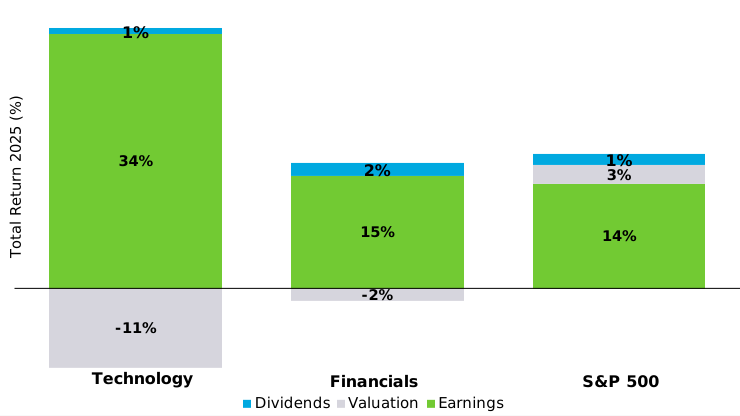
Figure 1: Refinitiv, as of 12/31/25. Sectors as represented by S&P 500 GICS sector classification indices. Index performance is for illustrative purposes only. Index performance does not reflect any management fees or expenses. Indexes are unmanaged and one cannot invest directly in an index. Past performance does not guarantee future results.
At the same time, market leadership comes with important trade-offs. Valuation and concentration risk remain key considerations as investor exposure becomes increasingly reliant on a small group of companies. The largest 20 stocks in the S&P 500 have also exhibited higher total risk in 2025 relative to the broader index,13 underscoring the need for thoughtful monitoring as investors balance the benefits of mega-cap leadership against the potential for heightened volatility.
The bottom line is that all investors may want to review their portfolios for mega-cap positioning and many may want to fine-tune exposure to mega caps to reflect their views.
Using ETFs to adjust mega-cap exposure
The iShares Build ETF Suite provides a flexible set of tools to fine-tune exposure across the U.S. large-cap universe. By segmenting the S&P 500 into building blocks, iShares Build ETFs empower investors to adjust mega-cap positioning as market conditions, valuation perspectives, or risk appetites evolve.
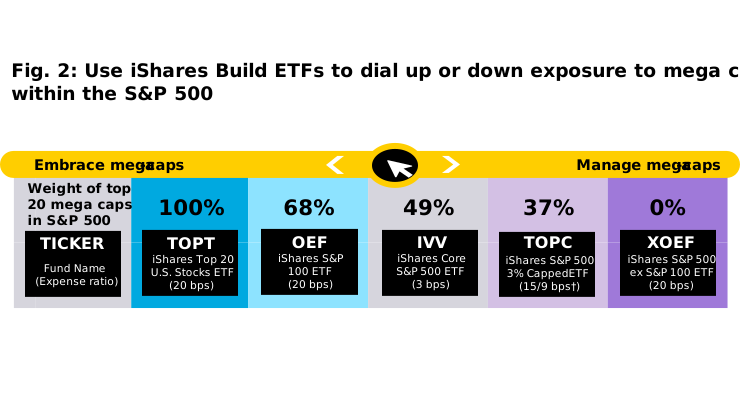
Figure 2: As of 12/31/25. For illustrative purposes only. Subject to change. †Subject to change. Gross Expense Ratio of TOPC is 15 bps. BlackRock Fund Advisors, the investment adviser to the Fund and an affiliate of BlackRock Investments, LLC, has contractually agreed to waive a portion of its management fees through July 31, 2031. Please see the Fund’s prospectus for additional details.
The following case studies show how iShares Build ETFs can help investors adjust mega-cap positioning in U.S. equities across a range of portfolio needs.
1. Closing the mega-cap gap with TOPT: The average asset manager (AM) moderate model is less exposed to mega-cap stocks relative to broad benchmarks like the MSCI ACWI IMI (Fig.3).14 Adding the iShares Top 20 U.S. Stocks ETF (TOPT) could close an underweight to mega-cap stocks more efficiently by requiring a smaller portfolio allocation than an S&P 500 fund used for the same purpose. Note, the hypothetical alternative portfolio will still differ geographically from the MSCI ACWI IMI.
Fig. 3: Consider adding TOPT to help more efficiently close the mega-cap underweight
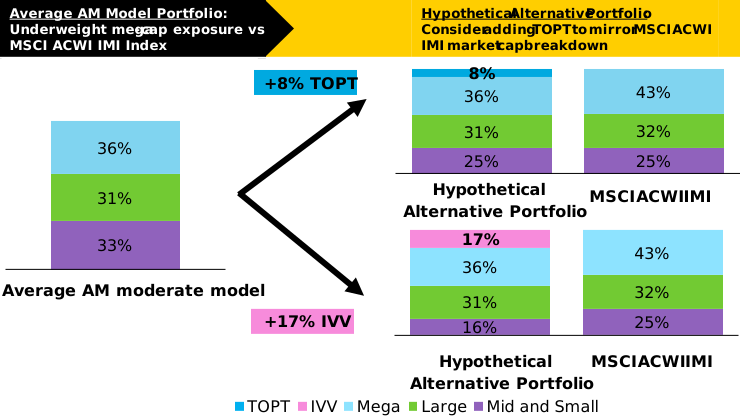
Figure 3: Morningstar, as of 12/31/25 or most recent portfolio date. Mega caps represented by Morningstar’s “Giant” Market Cap Category. Relative to the MSCI ACWI IMI Index. Geographical breakdowns of MSCI ACWI IMI and hypothetical alternative portfolios may differ.
2. Rebuilding the S&P 500 using OEF and XOEF: The iShares S&P 100 ETF (OEF) and the iShares S&P 500 ex S&P 100 ETF (XOEF) can be used as modular building blocks to construct the S&P 500, helping provide greater control and precision over mega-cap exposure.
3. Reduce or increase AI exposure within the S&P 500: The iShares S&P 500 ex S&P 100 ETF (XOEF) can reduce exposure to AI companies, resulting in ~8% AI exposure versus ~33% in the iShares S&P 500 ETF (IVV) (Fig. 4).15
Fig. 4: Use iShares Build ETFs to dial up or down exposure to AI within the S&P 500
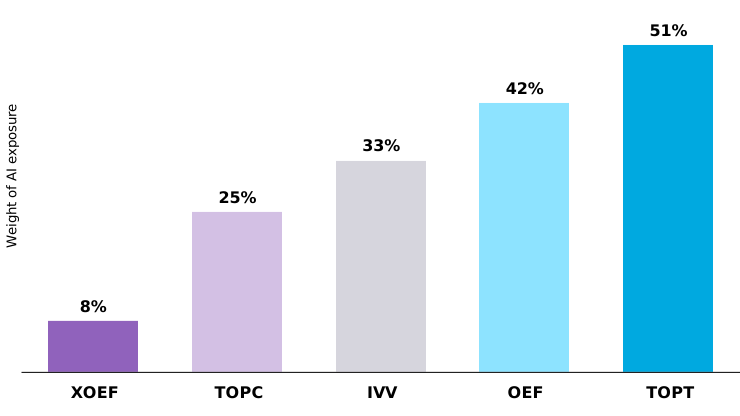
Figure 4: BlackRock and Morningstar as of 12/31/25. Subject to change. ARTY and BAI holdings are used as a proxy for AI exposure. 8% AI exposure in XOEF represents the weight of XOEF holdings that are in ARTY and BAI. 33% AI exposure in the S&P 500 Index represents the weight of the S&P 500 Index holdings that are in ARTY and BAI.
4. Diversifying concentrated single-stock positions: Investors can consider harvesting losses from concentrated single stock mega-cap positions and reallocating to the iShares Top 20 U.S. Stocks ETF (TOPT), reducing reliance on individual stock outcomes in a market where dispersion has been high.
5. Managing mega-cap concentration risk: Investors seeking to reduce concentration risk while maintaining exposure to large-cap equities can shift a portion of their S&P 500 exposure to the iShares S&P 500 3% Capped ETF (TOPC). TOPC’s index caps holdings in the S&P 500 to 3%, reining in tech and mega-cap exposure while seeking to keep the risk-return profile and tracking error close to the S&P 500 compared to equal-weight strategies.
Conclusion
We believe as the market continues to evolve. maintaining a deliberate and dynamic approach to mega-cap exposure is becoming increasingly more important. The dominance of technology and other mega-cap stocks has redefined the structure of U.S. equity performance, creating both opportunities and concentration risks for investors. The iShares Build ETF Suite provides a flexible toolkit to help investors as they seek to capture key market returns drivers while managing concentration risk.

Tanvi Pradhan
Head of Equity Platform Strategy for U.S. iShares
Co-author

Kaitlin Arciaga
VP, Equity Platform Strategy for U.S. iShares
Co-author

Maxine Vidal
Portfolio Consultant
Contributor
Lindsay Zentner
Portfolio Consultant
Contributor
Joshua Oakley
Portfolio Consultant
Contributor
Clairey Yang
Equity Platform Strategist for U.S. iShares
Contributor
More articles loaded. Use Shift+Tab keys to browse.
Total articles:


Investments
Insights
Retirement
Tools
Resources
About Us


1. Morningstar, as of 12/31/25. The top 20 stocks in the S&P 500 made up 29% of the index as of 1995 YE and 49% as of 2025 YE. Past performance does not indicate future results.
2. BlackRock as of 12/31/25. Index performance is for illustrative purposes only. Index performance does not reflect any management fees or expenses. Indexes are unmanaged and one cannot invest directly in an index. Past performance does not guarantee future results.
3. Morningstar, as of 12/31/25. Past performance does not indicate future results.
4. BlackRock as of 12/31/25. Index performance is for illustrative purposes only. Index performance does not reflect any management fees or expenses. Indexes are unmanaged and one cannot invest directly in an index. Past performance does not guarantee future results.
5. Morningstar, as of 12/31/25 or most recent portfolio date. Mega caps represented by Morningstar’s “Giant” Market Cap Category. Benchmarked to the MSCI ACWI IMI Index.
6.Morningstar, 12/31/25 or most recent reported portfolio date. Based on BlackRock analysis of more than 4,395 financial advisor portfolios. The equity allocation in the average moderate advisor model portfolio has 68% allocated to large + mega cap stocks while the MSCI ACWI has 75% allocated to large and mega-cap stocks.
7. Morningstar, as of 12/31/25 or most recent portfolio date. 63% of U.S. large blend active funds relative to the S&P 500 Index.
8. Bloomberg as of 12/31/25. Index performance is for illustrative purposes only. Index performance does not reflect any management fees or expenses. Indexes are unmanaged and one cannot invest directly in an index. Past performance does not guarantee future results.
9. Morningstar of 12/31/25; Morningstar’s definition of a wide MOAT as characterized by high network effects, substantial intangible assets, cost advantages, high switching costs, or efficient scales which can also give them a competitive edge.
10. Morningstar as of 12/31/25
11. Refinitiv, as of 12/31/25. Sectors as represented by S&P 500 GICS sector classification indices. Index performance is for illustrative purposes only. Index performance does not reflect any management fees or expenses. Indexes are unmanaged and one cannot invest directly in an index. Past performance does not guarantee future results.
12. Morningstar. One-year total returns for S&P 500 and S&P 500 equal-weight Indexes as of 12/31/25. Index performance is for illustrative purposes only. Index performance does not reflect any management fees or expenses. Indexes are unmanaged and one cannot invest directly in an index. Past performance does not guarantee future results.
13. Source: Morningstar as of 12/31/25. Risk measures are defined by annualized standard deviations for the S&P Top 20 Select and S&P 500 over a 1-year time period. Standard deviation measures how dispersed returns are around the average. A higher standard deviation indicates that returns are spread out over a larger range of values and thus, more volatile.
14. Morningstar, as of 12/31/25 or most recent portfolio date. Mega caps represented by Morningstar’s “Giant” Market Cap Category. Relative to the MSCI ACWI IMI Index. Geographical breakdowns of MSCI ACWI IMI and hypothetical alternative portfolios may differ.
15. Source: BlackRock and Morningstar as of 12/31/25. ARTY and BAI holdings are used as a proxy for AI exposure. 8% AI exposure in XOEF represents the weight of XOEF holdings that are in ARTY and BAI. 33% AI exposure in the S&P 500 Index represents the weight of the S&P 500 Index holdings that are in ARTY and BAI.
Carefully consider the Funds' investment objectives, risk factors, and charges and expenses before investing. This and other information can be found in the Funds' prospectuses or, if available, the summary prospectuses which may be obtained by visiting www.iShares.com or www.blackrock.com. Read the prospectus carefully before investing.
Investing involves risk, including possible loss of principal.
Consider the wash-sale rule when tax loss harvesting. Wash sale restrictions prevent investors from realizing a loss on a sale and then buying a “substantially identical” security 30 days before and after the sale of the security. Please note that iShares ideas do not take wash sale rule considerations into account and BlackRock does not provide tax advice. We urge you to consult a tax professional regarding the potential consequences of this rule.
Funds that concentrate investments in specific industries, sectors, markets or asset classes may underperform or be more volatile than other industries, sectors, markets or asset classes and the general securities market.
AI technology relies on large data sets, which can lead to inaccuracies. Companies in AI face competition, rapid obsolescence, and depend on demand from various industries. Regulatory scrutiny could limit AI development, with data collection facing closer examination and potential fines. Country-specific regulations could also impact AI and big data companies.
Diversification and asset allocation may not protect against market risk or loss of principal.
The strategies discussed are strictly for illustrative and educational purposes and are not a recommendation, offer or solicitation to buy or sell any securities or to adopt any investment strategy. There is no guarantee that any strategies discussed will be effective.
The information presented does not take into consideration commissions, tax implications, or other transactions costs, which may significantly affect the economic consequences of a given strategy or investment decision.
This material is provided for educational purposes only and does not constitute investment advice. The information contained herein is based on current tax laws, which may change in the future. BlackRock cannot be held responsible for any direct or incidental loss resulting from applying any of the information provided in this publication or from any other source mentioned. The information provided in this material does not constitute any specific legal, tax or accounting advice. Please consult with qualified professionals for this type of advice.
The Funds are distributed by BlackRock Investments, LLC (together with its affiliates, “BlackRock”).
The iShares Funds are not sponsored, endorsed, issued, sold or promoted by S&P Dow Jones Indices LLC. None of these companies make any representation regarding the advisability of investing in the Funds. BlackRock Investments, LLC is not affiliated with the companies listed above.
©2026 BlackRock, Inc. or its affiliates. All Rights Reserved. BLACKROCK, ALADDIN and iSHARES are trademarks of BlackRock, Inc. or its affiliates. All other trademarks are those of their respective owners.
GPS0726-5778216-EXP0727