Even before the election was in focus, 2026 has seen periods of sharp volatility sparked by the conflict in the Middle East, higher energy prices, and shifting interest rate expectations.1 As focus shifts to the U.S. midterms, investors may be wondering what could move markets next and how the election cycle could impact their portfolios.
The short answer is: midterm elections have historically been among the weakest performing years for the U.S. stock market, compared to both presidential election years and non-election years, but performance has historically been dispersed by sector – and investors risk losing money if they make decisions based on party.2 In this article, we break down stock market performance during past midterm cycles, how this cycle is shaping up and reasons to stay invested no matter the market.
When looking at annual U.S. stock market returns, midterm years, on average, have been the weakest, rising just 7.5% vs. an average of 12.4%.3 The two most recent midterms, 2022 with -18.1% and 2018 -4.4%, have been the two worst years for the S&P since 2008.4 It’s also worth noting there have never been three consecutive, negative midterm cycles. The highest performing years linked to elections have been presidential elections (+12.1%). Outside of elections, odd-numbered years have been the best performing (+14.9%).5
There has also been some dispersion based on sectors. Healthcare (10.7% avg) and Energy (8.9% avg) have historically held up better, while Industrials (0.6% avg) and Financials (-0.6% avg) have tended to drag the market down in midterm years.6
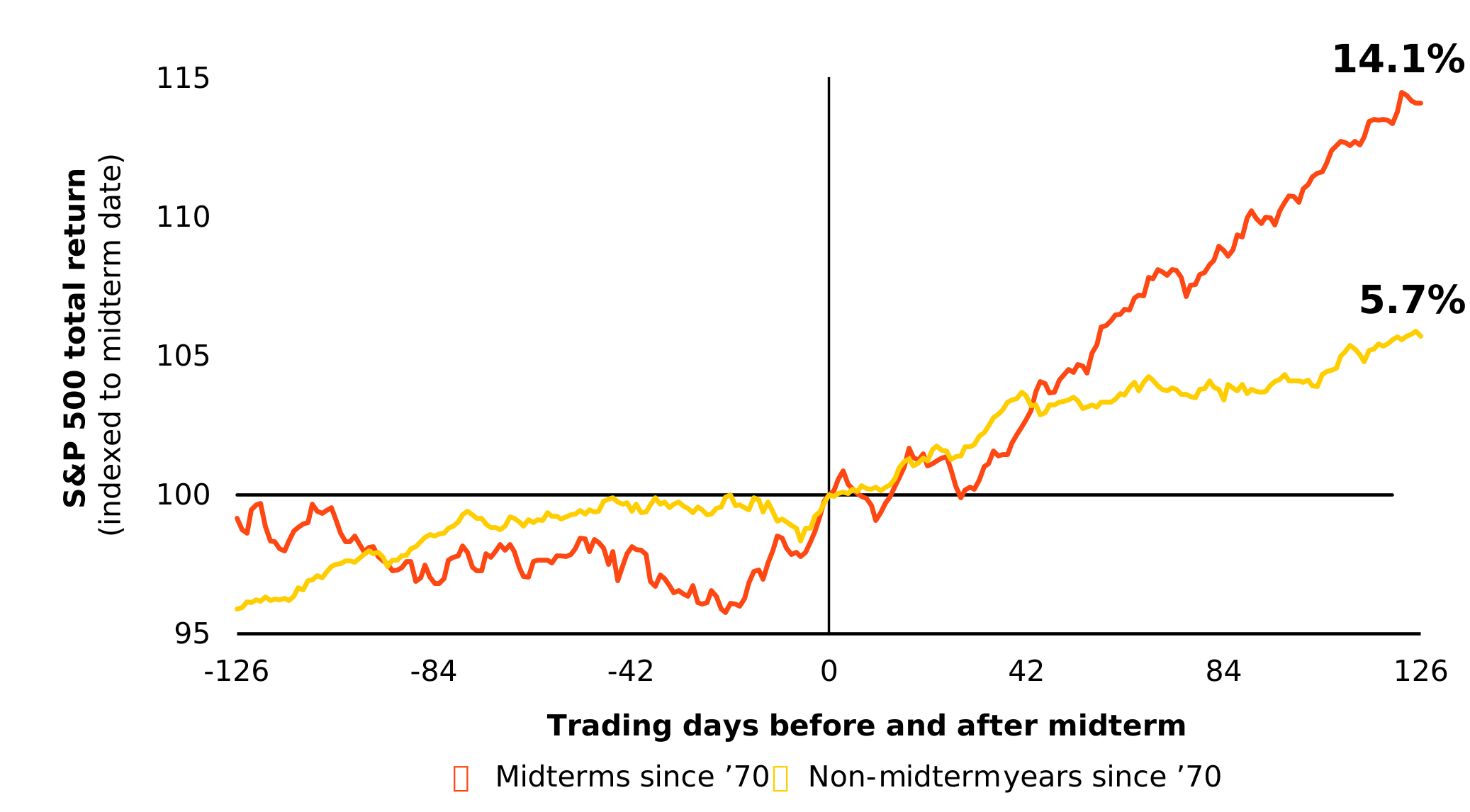
Performance has varied but one clear pattern has been around event risk, as shown in Figure 2. Since 1970, the market historically rallied on average around a month, or 22 trading days, before a midterm election as polling data provided clearer expectations of the outcome. As that uncertainty began to fade, equities pulled higher, with an average return of 14.1% in the six months following the election.
Election outcomes have also mattered. Scenarios where one party lost control of the political trifecta (holding the presidency, and majorities in the House and Senate) saw material underperformance in the six months after midterms (10.4%) compared to when control was gained or Congress remained divided (16.1%).7 Thus, the market has still rallied, but it was likely hampered in part by the market re-pricing the expected ability of the government to pass legislation.
Figure 1: S&P 500 total return performance, pre & post midterm years since 1970
Source: Bloomberg, data as of March 30, 2026. Based on Average S&P total return since 1970 indexed to midterm dates for midterm years: 1970, 1974, 1978, 1982, 1986, 1990, 1994, 1998, 2002, 2006, 2010, 2014, 2018, 2022. The “0” on the x-axis represents the Midterm election date, which falls on the first Tuesday in November. Month approximations based on average of 21 trading days in a month. Y-axis numbers represent total return of approximately 6 months before and after a midterm indexed to midterm date, with the value of the midterm date being 100. “Lost Control” defined as scenarios where government was controlling the presidency and both chambers of congress heading into the midterms, and lost control of at least one of them. Index performance is for illustrative purposes only. Index performance does not reflect any management fees or expenses. Indexes are unmanaged and one cannot invest directly in an index. Past performance does not guarantee future results.
For investors, the biggest question is what could this history mean for portfolio decisions now. Historically, the bigger risk in a midterm year has not been volatility, but rather how investors have responded to it.
Since 2013, a $100,000 investment in the S&P 500 would have grown to $398,000 by the start of 2026 if left fully invested. But investors who moved their money out of the market to cash whenever their preferred political party was out of power saw dramatically lower returns - ending with $214,000 (Republican-timed exodus) or $186,000 (Democrat-timed). Letting politics guide investment decisions has come at a significant cost.8
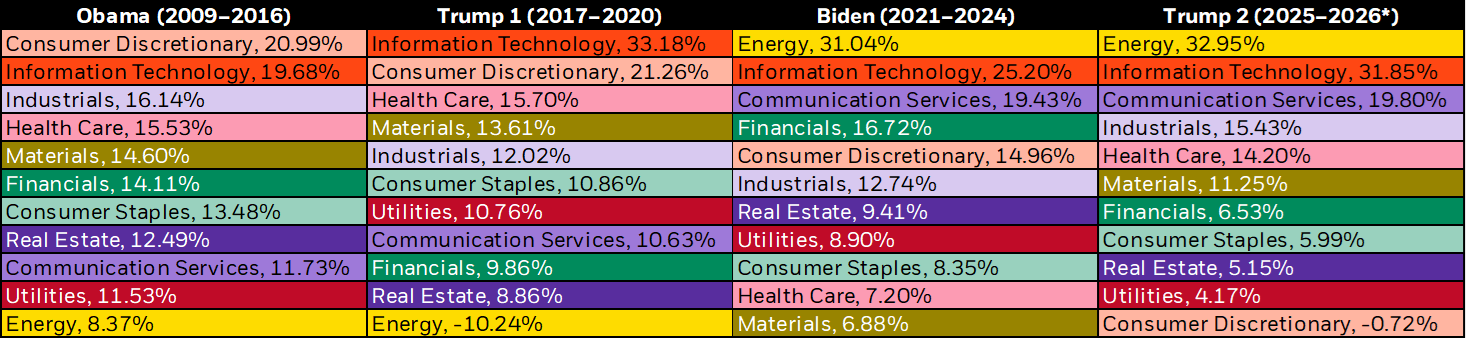
That dynamic has also shown up at the sector level. Investors have often mapped sectors to political outcomes, but market leadership has rarely followed a party script. As shown in Figure 3, Energy, for example, was the worst-performing sector under Obama and Trump’s first term, yet among the best under Biden and Trump’s second. Meanwhile, Technology has ranked among the top two sectors across the last four presidencies. Sector performance varies - but it has been far less tied to politics than many assume.
Portfolios may be best served when they are built around core, low-cost ETFs rather than narrative-led trading.
Figure 2: Sector performance (average annual return for length of presidency by S&P 500 sector)
Source: Morningstar as of 4/30/26. Technology represented by the S&P 500 information technology sector index, Health care represented by the S&P 500 health care sector index, Financials represented by the S&P 500 financial sector index, Industrials represented by the S&P 500 industrial sector index, Materials represented by the S&P 500 materials sector index, Consumer discretionary represented by the S&P 500 consumer discretionary sector index, Communication services represented by the S&P500 communication services sector index, Real estate represented by the S&P 500 real estate sector index, Energy represented by the S&P 500 energy sector index, Utilities represented by the S&P 500 utilities sector index and Consumer staples represented by the S&P 500 consumer staples sector index. Past performance does not guarantee or indicate future results. Index performance is for illustrative purposes only. You cannot invest directly in the index. Bush time period from 12/14/2004 to 11/4/2008, Obama time period from 11/5/2008 to 11/8/2016 and Trump 1 time period from 11/9/2016 to 11/3/2020. Biden period is from 11/4/2020 to 11/5/24, Trump 2 11/6/2024 to 4/30/26.
One area where politics and markets have intersected more directly this year has been Artificial Intelligence (AI). AI has been a primary driver of market leadership and economic growth and was one of the key themes we analyzed in our Investment Directions. Yet recently AI has been also increasingly facing political scrutiny.
AI data centers have proliferated rapidly and could take up 17% of all electricity generated in the U.S. by 2030.9 Some states have already seen significant surges in energy usage, with data centers capturing 25% of electricity in Virginia in 2025. Heightened demand can affect electricity bills, especially in areas with capacity constraints; coupled with overall inflation, this could create pockets of economic strain. These constraints have already had real-world implications as $156 billion in data center investments were stalled in 2025.10 As AI infrastructure becomes more visible, so too does the public debate around its costs and potential consequences.
We believe AI will be among top voter concerns given it is a rapidly growing space. In a recent poll, 46% of voters viewed AI negatively, compared to 26% positively, while 57% believe the risks of AI outweigh the benefits.11 Yet so far, outside of legislation in jurisdictions such as Maine, aimed at limiting data center growth, we have not seen many successful efforts to slow AI expansion.
This makes AI an important area to watch as investors assess where policy, public sentiment and market leadership may overlap.
The 2026 midterm elections come at a deeply polarized moment, and headlines are likely to intensify as the election approaches. But despite the temptation to react at the first sign of volatility, the more important lesson could be to stay invested. Rather than making sweeping sector bets based on political assumptions, investors may be better served by focusing on long-term discipline and broad market exposure. For even more on how staying invested in election cycles matters, please check out our Student of the Market: Midterm Election Year Special.
Performance data represents YTD performance. Performance data quoted represents past performance. Past performance and does not guarantee future results. Investment return and principal value will fluctuate with market conditions and may be lower or higher when you sell your shares. Current performance may differ from the performance shown. For most recent month-end performance and standardized performance, click on the fund names above.
The Morningstar RatingTM for funds, or "star rating", is calculated for managed products (including mutual funds, variable annuity and variable life subaccounts, exchange-traded funds, closed-end funds, and separate accounts) with at least a three-year history. Exchange-traded funds and open-ended mutual funds are considered a single population for comparative purposes. It is calculated based on a Morningstar Risk-Adjusted Return measure that accounts for variation in a managed product's monthly excess performance, placing more emphasis on downward variations and rewarding consistent performance. The top 10% of products in each product category receive 5 stars, the next 22.5% receive 4 stars, the next 35% receive 3 stars, the next 22.5% receive 2 stars, and the bottom 10% receive 1 star. The Overall Morningstar Rating for a managed product is derived from a weighted average of the performance figures associated with its three-, five-, and 10-year (if applicable) Morningstar Rating metrics. The weights are: 100% three-year rating for 36-59 months of total returns, 60% five-year rating/40% three-year rating for 60-119 months of total returns, and 50% 10-year rating/30% five-year rating/20% three-year rating for 120 or more months of total returns. While the 10-year overall star rating formula seems to give the most weight to the 10-year period, the most recent three-year period actually has the greatest impact because it is included in all three rating periods.
BlackRock provides compensation in connection with obtaining or using third-party ratings, rankings, or data.