


CONTACT US
Additional questions?
For additional information or questions, please contact a BlackRock private markets specialist.
EXPLORE MORE ALTERNATIVES
Hello, I’m Thomas Mueller-Borja, Global Co-Head for Real Estate at BlackRock.
Our work in private real estate is helping us power the future for our communities – the ways we live and work – in 3 key ways:
Firstly, private real estate addresses today’s needs for critical infrastructure, including i) social; ii) industrial and iii) digital infrastructure. We get to develop buildings i) for everyday people by providing housing; ii) for small businesses by providing supply chains and production facilities; and iii) for hyperscalers and larger corporates by providing data centers that power the future.
Secondly, as a private real estate investor, I get to improve the built environment by anticipating tomorrow’s tenants’ needs. This means making living, working and entertainment spaces more enjoyable and more connected for a lasting positive impact on body, mind and soul.
And thirdly, the long-term nature of private real estate allows us to build lasting partnerships with the communities and clients who entrust us with their land and capital. Together we are able to deliver on their long-term investment goals.
Tune in as Thomas Mueller-Borja, Global Co-Head for Real Estate, shares three ways our work in private real estate is helping us power the future of our communities.
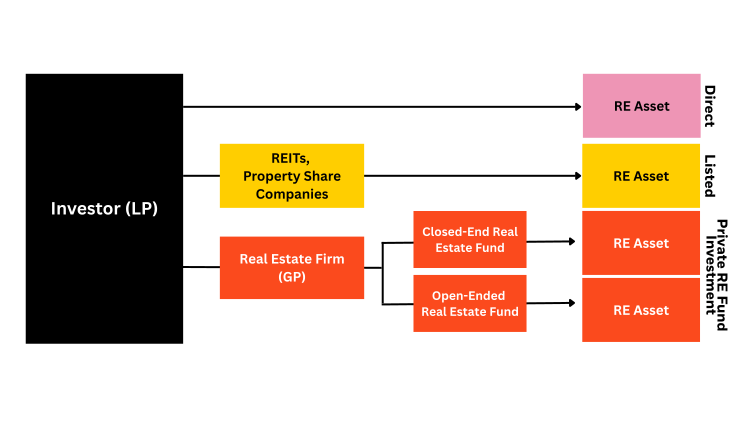
While real estate can be accessed through public markets, another way to access real estate is through unlisted, private real estate. Private real estate involves the acquisition of property outside of publicly listed real estate and can operate at both the individual and institutional level. Often, for institutional private real estate owners, acquisitions are funded using a mix of direct capital investment and property‑level debt, similar to how an individual buys a home with a mortgage. The debt is usually non‑recourse, meaning it is secured only against the property itself and not against the broader balance sheet of the owner. Assets are largely held in special purpose vehicles, which are standalone legal entities created solely to own a specific asset and are domiciled in tax-friendly jurisdictions.
Exhibit 1: Ways to access real estate
For illustrative purposes only.
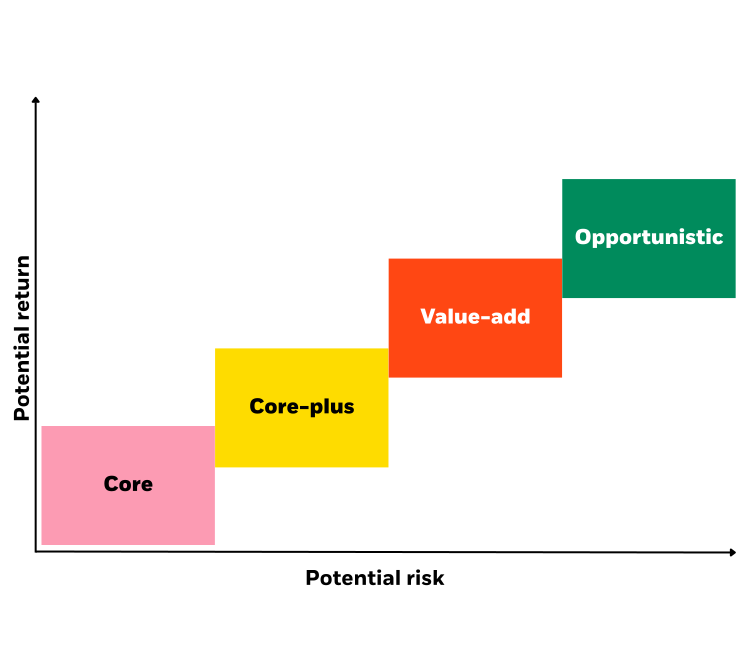
Within private real estate investing, assets can be held in closed-end or open-ended funds, depending on the nature of the underlying investment. Private real estate investments are often categorized into four main categories (see Exhibit 2), each with various potential levels of risk and return. Private real estate can also be accessed through distressed or debt strategies.
Exhibit 2: The four main strategies of private real estate investing
This is for illustrative purposes only and does not represent actual performance or specific investments. The strategies shown are generalized and their characteristics may vary.
Example: A stabilized, high-quality property in a major metropolitan area.
Example: A stabilized, undermanaged, multifamily property in a metropolitan area with potential for operational improvement.
Example: A 50-year-old multifamily property requiring renovation, where following improvements may support repositioning and potential changes in tenant profile, rental income and asset value.
Example: Purchase of land and construction of a new office building.
Distressed and debt real estate strategies can encompass similar potential risk and return profiles to any of the above.
Private real estate seeks to offer several compelling benefits for investors, including income generation, inflation sensitivity and diversification. Properties may generate monthly or quarterly income, and the level of potential income is commonly assessed using the capitalization rate (or cap rate), which is calculated by dividing a property’s net operating income by its value. Even during economic downturns, some real estate investments may continue to generate rental income as tenants may have multi-year lease agreements in place. In addition, real estate may serve as an inflation hedge, as property values and rental income tend to rise with inflation; housing rents are a component of CPI, and many tenancy contracts include inflation-linked rent increases. Finally, real estate may provide diversification benefits, offering investors exposure to a wide range of strategies, property types, and geographic markets within a single asset class.
Private real estate investments are subject to several key risks, including market and macro sensitivity, leverage and capital risk, and operational and asset‑specific considerations. Property values and cash flows can be highly sensitive to economic conditions, interest rates, and local supply‑and‑demand dynamics, which may pressure valuations and refinancing outcomes. The use of leverage can further amplify both gains and losses, increasing exposure to income shortfalls, covenant breaches, or defaults during periods of market stress. In addition, returns depend heavily on effective property management and asset‑level factors such as tenant quality, occupancy rates, maintenance requirements, and regulatory or environmental considerations.
For additional information or questions, please contact a BlackRock private markets specialist.
Important Information This material is provided for informational purposes only and is not intended to be relied upon as a forecast, research or investment advice, and is not a recommendation, offer or solicitation to buy or sell any securities or to adopt any investment strategy. The opinions expressed are subject to change. References to specific securities, asset classes and financial markets are for illustrative purposes only and are not intended to be and should not be interpreted as recommendations. Reliance upon information in this material is at the sole risk and discretion of the reader. The material was prepared without regard to specific objectives, financial situation or needs of any investor.
This communication is not an offer and should not be deemed to be a contractual commitment or undertaking between the intended recipient of this communication and BlackRock but an indication of what services may be offered subject to a legally binding contract between the parties and therefore no reliance should be placed on this document or its content. This material is not intended to be relied upon as a forecast, research or investment advice, and is not a recommendation, offer or solicitation to buy or sell any securities or to adopt any investment strategy. Any reference herein to any security and/or a particular issuer shall not constitute a recommendation to buy or sell, offer to buy, offer to sell, or a solicitation of an offer to buy or sell any such securities issued by such issuer.
Capital at risk. All financial investments involve an element of risk. Therefore, the value of the investment and the income from it will vary and the initial investment amount cannot be guaranteed.
Opinions, assumptions and estimates offered constitute our judgment and are subject to change without notice, as are statements of financial market trends, which are based on current market conditions. The opinions expressed are as of the date the material was created. We believe the information provided here is reliable, but do not warrant its accuracy or completeness. This communication and its content represent confidential information. This material has been prepared for informational purposes only, and is not intended to provide, and should not be relied on for, accounting, legal or tax advice. You should consult your tax or legal adviser regarding such matters.
This material may contain “forward-looking” information that is not purely historical in nature. Such information may include, among other things, projections, forecasts, estimates of yields or returns, and proposed or expected portfolio composition. Moreover, where certain historical performance information of other investment vehicles or composite accounts managed by BlackRock, Inc. and/or its subsidiaries (together, “BlackRock”) has been included in this material, such performance information is presented by way of example only. No representation is made that the performance presented will be achieved, or that every assumption made in achieving, calculating or presenting either the forward-looking information or the historical performance information herein has been considered or stated in preparing this material. Any changes to assumptions that may have been made in preparing this material could have a material impact on the investment returns that are presented herein by way of example.
Past performance is not a guarantee of future results. Asset allocation and diversification strategies do not guarantee profit and may not protect against loss. Risk management and due diligence processes seek to mitigate, but cannot eliminate, risk nor do they imply low risk. Investment involves risk, including a risk of total loss.
Incorporating alternative investments into a portfolio presents the opportunity for significant losses including in some cases, losses which exceed the principal amount invested. Also, some alternative investments have experienced periods of extreme volatility and in general, are not suitable for all investors. Asset allocation and diversification strategies do not ensure profit or protect against loss in declining markets.
Private market investments should only be considered for investors who can tolerate the risk. A fund's investments in private companies is subject to a number of risks. Private companies are generally not subject to SEC reporting requirements, are not required to maintain their accounting records in accordance with generally accepted accounting principles and are not required to maintain effective internal controls over financial reporting. As a result, the Sub-Advisor may not have timely or accurate information about the business, financial condition and results of operations of the private companies in which the Fund invests
The information and opinions contained in this material are derived from proprietary and non-proprietary sources deemed by BlackRock, Inc. and/or its affiliates (together, “BlackRock”) to be reliable, are not necessarily all inclusive and are not guaranteed as to accuracy. There is no guarantee that any forecasts made will come to pass. Any research in this document has been procured and may have been acted on by BlackRock for its own purpose. The results of such research are being made available only incidentally. The views expressed do not constitute investment or any other advice and are subject to change. They do not necessarily reflect the views of any company in the BlackRock Group or any part thereof. BlackRock believes that the information in this document was correct at the time of compilation, but no warranty of accuracy or reliability is given and no responsibility arising in any other way for errors and omissions(including responsibility to any person by reason of negligence) is accepted by BlackRock, its officers, employees or agents.
© 2026 BlackRock, Inc. or its affiliates. All Rights Reserved. BLACKROCK is a trademark of BlackRock, Inc. or its affiliates. All other trademarks are those of their respective owners.
MKTG0426-5407035-EXP0427
