


CONTACT US
Additional questions?
For additional information or questions, please contact a BlackRock private markets specialist.
EXPLORE MORE ALTERNATIVES
Hello, I’m Lynn Baranski, Global Co-Head of BlackRock Private Equity Partners.
In private equity, we think beyond the here and now - aiming to generate long-term value for our clients. Here are three ways we seek better outcomes for our sponsor companies and investors.
First, we seek to create fundamental, long-term value for investors. This means being part of an active, private equity ownership model that supports companies across various stages of their development in strengthening operations, refining strategy, and investing for sustainable growth - benefiting for owners, employees, communities and investors alike.
Second, as Private Equity investors, we also take an active role in driving innovation and growth, including the development and commercialization of AI and new technologies that are changing the world.
Third, we aim to help financial advisors and their clients think beyond the current cycle by focusing on differentiated deal origination, disciplined underwriting, thoughtful structuring, and strong alignment—enabling advisors to build stronger, more resilient, long‑term–oriented portfolios.
Lynn Baranski, Global Co-Head of Private Equity Partners, walks through three key ways we seek better outcomes for our sponsor companies and investors in our private equity strategies.
Private equity involves investing in companies that are not publicly traded, from early-stage startups to established businesses, with the aim of growing those companies’ value and eventually selling them for a profit, either to another private or strategic buyer or through an initial public offering (“IPO”).1
Private equity is a common form of accessing private markets and dates to the Industrial Revolution.2 Over time, it has evolved into a strategic allocation in portfolios, reflecting its growing role in long-term investment strategies.
The objectives of private equity investing are straightforward: buy, improve and sell at a higher valuation.
The private equity manager, commonly referred to as the General Partner (GP) or lead sponsor, typically takes a controlling ownership stake in a company and is responsible for driving strategic change. GPs typically take an active ownership role, influencing operational decisions, capital allocation, leadership changes and long-term planning to enhance value.
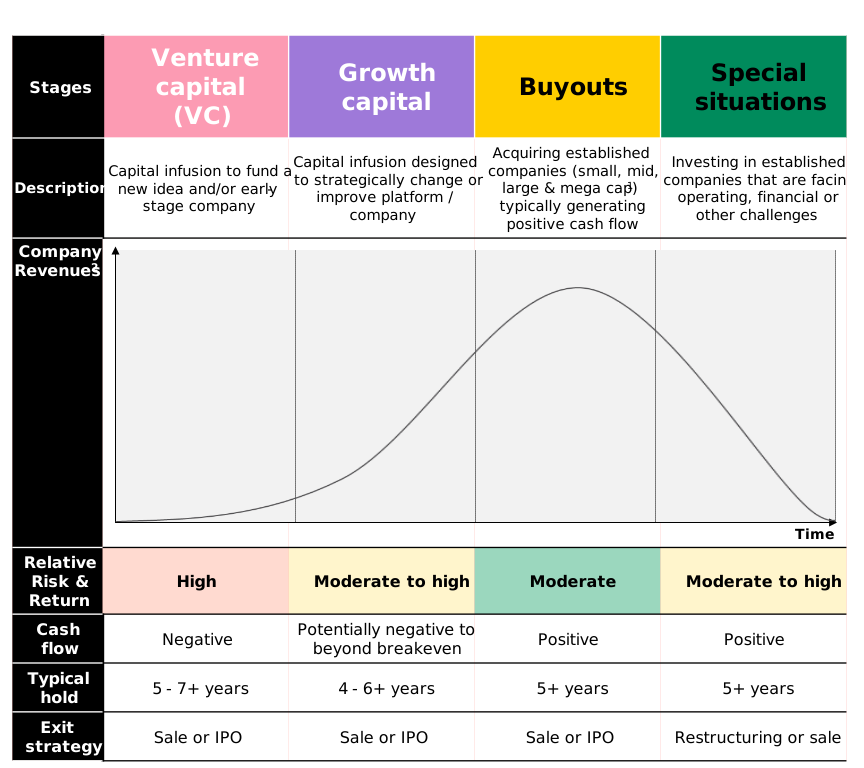
Private equity strategies differ depending on the target company’s stage of development, the level of ownership or control, and the purpose of the investment.
Four primary types are:
These four stages reflect a continuum of risk and return, as outlined below, allowing investors to construct portfolios aligned with their objectives and risk tolerance.
Exhibit 1: The four types of PE strategies
The above table is for illustration purposes only. It serves as a general summary and is not exhaustive.
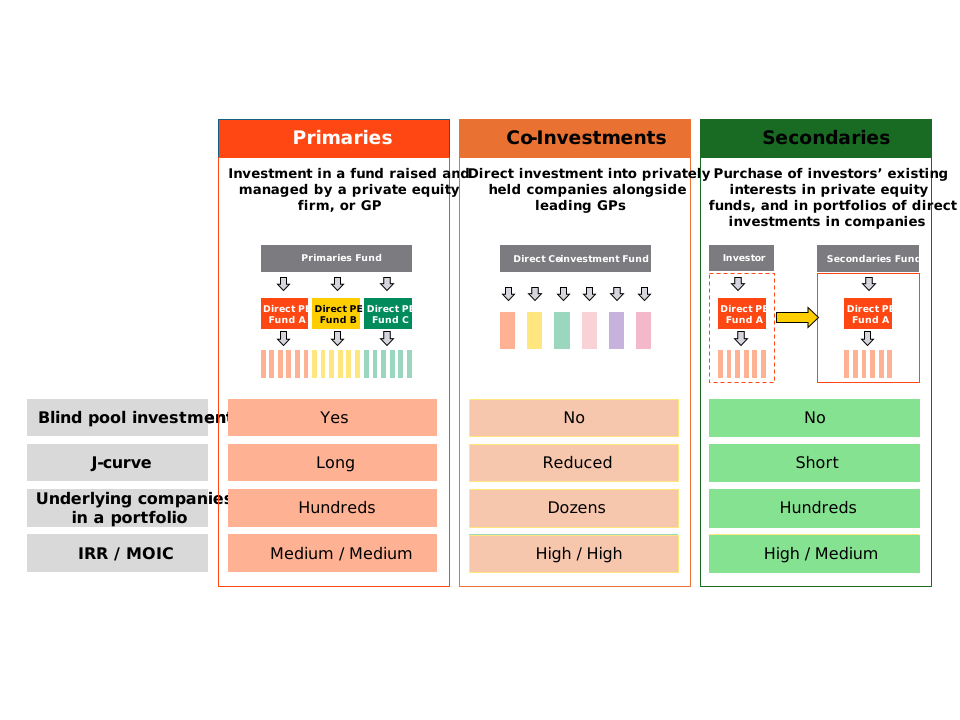
Investors generally access private equity in three ways:
Early in a fund’s investment period, as capital is deployed and fees are paid while portfolio companies are still being improved, investor returns may be negative. The fund’s net cash flow generally begins to increase in the later years when investments begin to mature and are sold, resulting in distributions. This progression from initial negative return to ultimately positive return is known as the J-curve effect.
Co-investments allow investors to gain exposure to a specific company as a co-owner. Because capital is deployed into a specific investment rather than committed to a blind pool of future opportunities, co-investments typically provide faster market exposure than primaries and can help mitigate the early phase of the J-curve. Co-investments can also enhance transparency and offer a two-tiered due diligence approach, first by the GP and then by the co-investor. In addition, they often carry lower fees than traditional private equity fund investments.
However, co-investments require significant underwriting expertise and internal resources to evaluate potential opportunities. They also involve higher concentration risk, as investors are exposed to a single company rather than a diversified portfolio, and execution risk, as not all transactions ultimately close.
Secondary interests are often purchased at a discount to the asset’s net asset value (NAV), generally not due to impairment in the underlying investments, but because of the illiquidity of the LP stake and the seller’s need to receive capital back sooner than originally anticipated.
Secondaries provide more immediate exposure to underlying portfolio companies and can reduce the impact of the J-curve by offering access to investments that are closer to realization or exit.
Exhibit 2: Building blocks of private equity investing
The above is for illustrative purposes only and is not exhaustive.
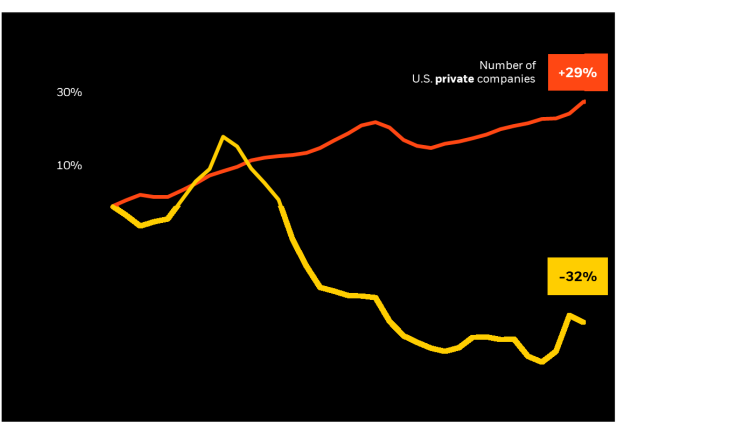
Exhibit 3: US public markets have been shrinking, while US private markets have been growing
Source: U.S. Census Bureau - Center for Economic Studies - Business Dynamics Statistics (2022) and World Federation of Exchanges database; for more information on the World Federation, please refer to the Important Notes. Both sources, represents the latest data as of 2022 as derived on 2 April 2025. The graph denotes the growth or decline for both US public and private companies from 1988 until 2022. Past performance is no guarantee of future performance.
As in public equities, investors in private equity are subject to market risk and operational risk. However, private equity carries additional risks including the illiquidity of the underlying assets, limited regulatory oversight and fewer reporting requirements relative to publicly traded counterparts. Investors expect a higher return for their private equity investments in exchange for these heightened risks.
Private equity offers investors access to a broad and growing universe of companies beyond public markets, with the potential for enhanced returns driven by active ownership and manager skill. While investments require a longer time horizon and involve higher illiquidity and complexity, these characteristics have historically been compensated through diversification benefits and attractive risk‑adjusted outcomes. For investors able to tolerate these tradeoffs, private equity can serve as a powerful complement to public equity within a diversified portfolio.
For additional information or questions, please contact a BlackRock private markets specialist.
For financial professional use.
1. Unless otherwise noted, sources for all data is BlackRock, as of March 2026.
2. Source: Preqin, a part of BlackRock, Private Equity and Venture Capital, Lesson 4.1: Private Equity & Venture Capital | Preqin Academy.
3. Source: U.S. Census Bureau - Center for Economic Studies - Business Dynamics Statistics (2022) and World Federation of Exchanges database; for more information on the World Federation, please refer to the Important Notes. Both sources, represents the latest data as of 2022 as derived on 2 April 2025. The graph denotes the growth or decline for both US public and private companies from 1988 until 2022. Past performance is no guarantee of future performance.
4. Source: Capital IQ, BlackRock as of 31 December 2024. Represents the number of companies with annual revenues greater than $100million.
5. Source: Preqin and Morningstar, as cited in Mackenzie Investments, The real reasons private assets exhibit lower volatility, September 2025.
Important Information. This material is provided for informational purposes only and is not intended to be relied upon as a forecast, research or investment advice, and is not a recommendation, offer or solicitation to buy or sell any securities or to adopt any investment strategy. The opinions expressed are subject to change. References to specific securities, asset classes and financial markets are for illustrative purposes only and are not intended to be and should not be interpreted as recommendations. Reliance upon information in this material is at the sole risk and discretion of the reader. The material was prepared without regard to specific objectives, financial situation or needs of any investor.
THE INFORMATION CONTAINED HEREIN MAY BE PROPRIETARY IN NATURE AND HAS BEEN PROVIDED TO YOU ON A CONFIDENTIAL BASIS, AND MAY NOT BE REPRODUCED, COPIED OR DISTRIBUTED WITHOUT THE PRIORCONSENT OF BLACKROCK, INC. (“BLACKROCK”). These materials are not an advertisement and are not intended for public use or dissemination.
This communication is not an offer and should not be deemed to be a contractual commitment or undertaking between the intended recipient of this communication and BlackRock but an indication of what services may be offered subject to a legally binding contract between the parties and therefore no reliance should be placed on this document or its content. This material is not intended to be relied upon as a forecast, research or investment advice, and is not a recommendation, offer or solicitation to buy or sell any securities or to adopt any investment strategy. Any reference herein to any security and/or a particular issuer shall not constitute a recommendation to buy or sell, offer to buy, offer to sell, or a solicitation of an offer to buy or sell any such securities issued by such issuer.
Capital at risk. All financial investments involve an element of risk. Therefore, the value of the investment and the income from it will vary and the initial investment amount cannot be guaranteed.
Opinions, assumptions and estimates offered constitute our judgment and are subject to change without notice, as are statements of financial market trends, which are based on current market conditions. The opinions expressed are as of the date the material was created. We believe the information provided here is reliable, but do not warrant its accuracy or completeness. This communication and its content represent confidential information. This material has been prepared for informational purposes only, and is not intended to provide, and should not be relied on for, accounting, legal or tax advice. You should consult your tax or legal adviser regarding such matters.
This material may contain “forward-looking” information that is not purely historical in nature. Such information may include, among other things, projections, forecasts, estimates of yields or returns, and proposed or expected portfolio composition. Moreover, where certain historical performance information of other investment vehicles or composite accounts managed by BlackRock, Inc. and/or its subsidiaries (together, “BlackRock”) has been included in this material, such performance information is presented by way of example only. No representation is made that the performance presented will be achieved, or that every assumption made in achieving, calculating or presenting either the forward-looking information or the historical performance information herein has been considered or stated in preparing this material. Any changes to assumptions that may have been made in preparing this material could have a material impact on the investment returns that are presented herein by way of example.
Past performance is not a guarantee of future results. Asset allocation and diversification strategies do not guarantee profit and may not protect against loss. Risk management and due diligence processes seek to mitigate, but cannot eliminate, risk nor do they imply low risk. Investment involves risk, including a risk of total loss.
Incorporating alternative investments into a portfolio presents the opportunity for significant losses including in some cases, losses which exceed the principal amount invested. Also, some alternative investments have experienced periods of extreme volatility and in general, are not suitable for all investors. Asset allocation and diversification strategies do not ensure profit or protect against loss in declining markets.
Private market investments should only be considered for investors who can tolerate the risk. A fund's investments in private companies is subject to a number of risks. Private companies are generally not subject to SEC reporting requirements, are not required to maintain their accounting records in accordance with generally accepted accounting principles and are not required to maintain effective internal controls over financial reporting. As a result, the Sub-Advisor may not have timely or accurate information about the business, financial condition and results of operations of the private companies in which the Fund invests
The information and opinions contained in this material are derived from proprietary and non-proprietary sources deemed by BlackRock, Inc. and/or its affiliates (together, “BlackRock”) to be reliable, are not necessarily all inclusive and are not guaranteed as to accuracy. There is no guarantee that any forecasts made will come to pass. Any research in this document has been procured and may have been acted on by BlackRock for its own purpose. The results of such research are being made available only incidentally. The views expressed do not constitute investment or any other advice and are subject to change. They do not necessarily reflect the views of any company in the BlackRock Group or any part thereof. BlackRock believes that the information in this document was correct at the time of compilation, but no warranty of accuracy or reliability is given and no responsibility arising in any other way for errors and omissions (including responsibility to any person by reason of negligence) is accepted by BlackRock, its officers, employees or agents.
© 2026 BlackRock, Inc. or its affiliates. All Rights Reserved. BLACKROCK is a trademark of BlackRock, Inc. or its affiliates. All other trademarks are those of their respective owners.
MKTG0426-5404210-EXP0427
