


CONTACT US
Additional questions?
For additional information or questions, please contact a BlackRock private markets specialist.
EXPLORE MORE ALTERNATIVES
Hi, I’m Michael Gates, BlackRock’s Head of Model Portfolio Solutions for the Americas and lead PM for our Target Allocation model portfolios. Three things I’m thinking about as we help advisors incorporate alternatives into client portfolios:
First, portfolio construction frameworks are evolving. For decades, portfolios were built around blends of stocks and bonds, or index and active exposures. Today, that framework is expanding into a broader universe — one where we can help advisors to navigate factor exposures, liquidity, cost, and implementation with discipline and intention.
Second, our role is to help advisors thoughtfully size and integrate alternatives, seeking to improve risk and return outcomes for their clients; because alternatives play an important role in building better portfolios — but how they’re used matters.
Third, we’re simplifying what can feel complex. Alternatives, manager selection, and portfolio integration can be challenging, but we help deliver these solutions in a way that’s scalable, disciplined, and easy for advisors to implement with confidence.
Hear from Michael Gates, Head of Model Portfolio Solutions for the Americas and lead PM for our Target Allocation model portfolios, as he shares three key themes on thoughtfully incorporating alternatives into portfolios.
Traditional diversified portfolios are typically anchored to broad public benchmarks. While public indexes are transparent, there are limitations from a portfolio construction perspective:
This means a traditional 60% equity/40% bond (60/40) portfolio can be structurally overexposed to two primary return drivers: equity beta and bond duration.
However, a wider range of investors are gaining access to a broader range of capital markets, and this translates to greater opportunity to potentially enhance portfolio outcomes by targeting new sources of risk and return.
Private markets are becoming critical exposures for those looking to access a broader set of portfolio building blocks, particularly as the proportion of opportunities shifts from public to private markets.
While the number of public companies has been shrinking in recent decades, the number of private companies is on the rise. In the U.S., the number of large private companies (those with 100+ employees) has grown by 46% over the past 30 years, while the number of public companies has fallen by 24%.1 The trend is not isolated to the U.S., as research shows the number of listed companies has declined across many developed economies.
Companies are also increasingly seeking private funding, with just 25% of the leveraged loan market funded by banks in 2024 compared to 72% 30 years earlier.2
Taken together, this illustrates that modern capital formation extends beyond public exchanges, creating a larger role for private markets and allowing portfolios to participate more fully in an evolving and expanding investment landscape.
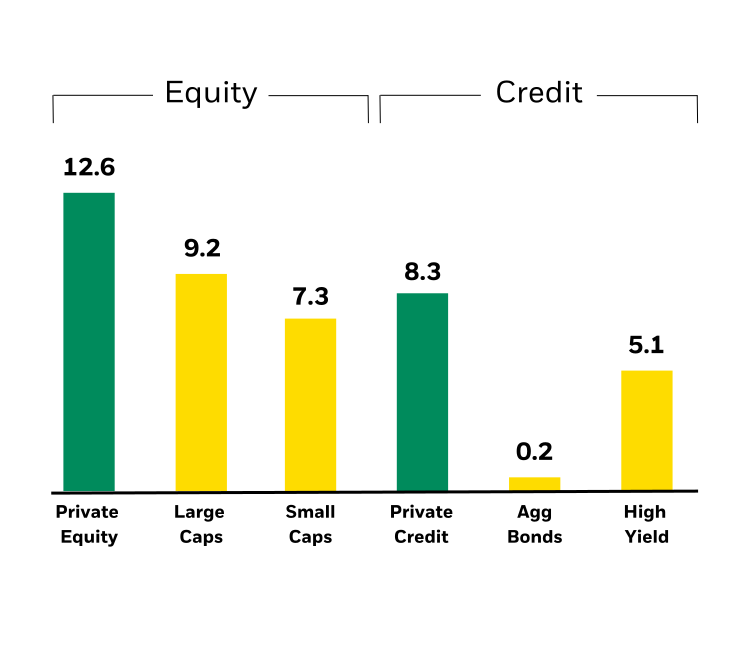
Private equity and private credit are two of the most common private market exposures. Both have delivered higher returns than traditional asset classes over the past decade, as shown in Exhibit 1.
Exhibit 1: An opportunity for enhanced returns: Ten-year average annual returns as of year-end 2024
Source: Bloomberg, MPI, measuring returns from 12/31/14 through 12/31/24. “Private Equity” represented by the Preqin Private Equity Index as of 9/30/24. “Large Caps” represented by the MSCI ACWI NR Index, “Small Caps” represented by the MSCI ACWI Small Cap NR. “Private Credit” refers to the Preqin Private Debt Index, “Agg Bonds” refers to the Bloomberg Global Aggregate TR Index, and “High Yield” refers to the ICE BofA US High Yield TR Index. Past performance does not guarantee or indicate future results. Index performance is shown for illustrative purposes only. It is not possible to invest directly in an index.
Real estate and infrastructure are two other popular private asset classes. Their role in portfolios is often to provide a mix of potential capital appreciation and income, as well as an inflation hedge given that they are real assets with tangible economic value.
Returns in private markets are driven by different structural factors than public markets, which can make them compelling complements in a diversified portfolio:
The “optimal” allocation to private markets will depend on the individual investor’s goals and risk tolerance. For example, is the investor seeking long-term growth or income, and are they sensitive to tax considerations?
While the decision can be decidedly individual, today’s market landscape does challenge the continued applicability of a traditional 60/40 portfolio. It may mean that the definition of ‘diversification’ needs to evolve along with the investing backdrop.
A 50/30/20 framework provides one way to reflect today’s broader opportunity set:
Effectively, this model suggests that equity exposure is moderated from 60% to 50% and fixed income is reduced from 40% to 30%, opening a 20% opportunity to add other diversified return drivers.
The funding of this new allocation will have a meaningful impact on a portfolio’s risk/return profile. Many of our BlackRock Portfolio Constructors suggest a like-for-like funding strategy wherever possible: funding strategies with equity-like risk profiles from equities and bond-like risk profiles from bonds.
Sourcing higher-risk allocations from bond sleeves can increase portfolio risk, while sourcing lower-risk allocations from stock sleeves could decrease risk and potentially also impact expected returns.
Modern capital markets extend well beyond traditional public equity and investment-grade bond benchmarks. Private markets offer access to unique opportunities that can complement positions in traditional assets.
While adoption of private markets among advisors is widespread, allocations are often modest in scale. In a 2025 BlackRock Advisor Center poll, 73% of respondents said they allocate at least 5% of high-net-worth portfolios (those with assets of $5 million or more) to private markets. Yet many remain below the 10%–15% range, with less than a third allocating 10% or more.3
Whether working toward a 20% allocation or another level better suited to client needs, we offer a four-step framework for thinking about and incorporating a private markets strategy:
For additional information or questions, please contact a BlackRock private markets specialist.
1. Source: U.S. Census Bureau – Statistics of U.S. Businesses, The World Bank World Federation of Exchange Databases as of December 2023. Represents the latest data available.
2. Source: S&P LCD, Pitchbook LCD as of March 31, 2024.
3. BlackRock as of June 24, 2025. 290 advisors responded to the question, “What % of a $5M+ portfolio would you invest in private markets?”.
Please consider the investment objectives, risks, charges and expenses of the funds carefully before investing. The prospectuses and, if available, the summary prospectuses contain this and other information about the funds and are available, along with information on other BlackRock funds, by calling 800-882-0052 or at www.blackrock.com/funds The prospectuses and, if available, the summary prospectuses should be read carefully before investing.
Investing involves risk, including possible loss of principal. This material is strictly for illustrative, educational, or informational purposes and is subject to change. There can be no assurance that an investment strategy based will be successful.
Past performance is no guarantee of future results. It is not possible to invest in an unmanaged index.
Incorporating alternative investments into a portfolio presents the opportunity for significant losses including in some cases, losses which exceed the principal amount invested. Also, some alternative investments have experienced periods of extreme volatility and in general, are not suitable for all investors. Asset allocation and diversification strategies do not ensure profit or protect against loss in declining markets.
Private market investments should only be considered for investors who can tolerate the risk. A fund's investments in private companies are subject to a number of risks. Private companies are generally not subject to SEC reporting requirements, are not required to maintain their accounting records in accordance with generally accepted accounting principles and are not required to maintain effective internal controls over financial reporting. As a result, the Sub-Advisor may not have timely or accurate information about the business, financial condition and results of operations of the private companies in which the fund invests.
© 2026 BlackRock, Inc. or its affiliates. All Rights Reserved. BLACKROCK and iSHARES are trademarks of BlackRock, Inc. or its affiliates. All other trademarks are those of their respective owners.
Prepared by BlackRock Investment, LLC, member FINRA.
MKTG0426-5407012-EXP0427
