Software selloff shows AI acceleration
Market take
Weekly video_20260217
Natalie Gill
Portfolio Strategist, BlackRock Investment Institute
Opening frame: What’s driving markets? Market take
Camera frame
The recent software selloff marks a dramatic shift in market perception around the AI narrative. The debate is no longer whether AI is real; now, markets are increasingly pricing in its potential to disrupt entire business models.
We think the sorting of winners and losers we see today reinforces AI’s massive buildout - and the leverage needed to finance it - that’s blurred the line between the micro and macro
Title slide: Software selloff shows AI acceleration
1: A market shift in the AI narrative
Last year, markets debated whether AI was real. Today, markets are pricing in the effect of AI as an active threat to business models.
As a result, the focus is shifting to finding companies exposed to AI disruption and sorting out the potential winners and losers. The phenomenon is rippling through sectors, but recent moves indicate that markets see software as ground zero.
The change in the AI narrative is showing up in the sharp performance divergence within tech: while software providers have underperformed in the past six months, sectors such as semiconductors and hardware have advanced.
2: Sorting winners and losers
We think we are still firmly in the AI buildout phase. Mega cap tech companies are spending heavily on chips and power infrastructure, while indicating more to come – a key reason why we like infrastructure.
What has seemingly changed is the market’s focus, which is now on how adoption will translate into real revenues and profits. This search for winners and losers means its prime time for active investing – something we emphasized in our 2026 Global Outlook.
And while software stocks have been hard hit amid the indiscriminate selloff, we see more nuance to the moves.
Not all software companies are created equal. Companies with proprietary data or strong customer relationships could leverage the AI disruption.
3: (Still) leveraging up
As the sorting process takes hold, the AI builders are locking in long-term financing to fund capital spending plans, like Alphabet’s plans to offer a 100-year sterling bond. But all this corporate borrowing adds supply to bond markets that are struggling with large, public deficits.
Greater leverage exacerbates any upward pressure on interest rates. This pressure could cool if AI-led productivity gains help the U.S. break out of its long-term 2% growth trend. We see a credible path for this to happen someday, but recent U.S. jobs data does not yet show that the sectors exposed to AI are cutting hiring.
These concerns keep us underweight U.S. Treasuries. We’re selective in credit, where we prefer high yield and European bonds as AI builders have largely tapped the U.S. investment grade market.
Outro: Here’s our Market take
We’re still in the buildout phase of the AI theme, though markets are now focused on identifying potential losers. We favor U.S. equities, but think selectivity is crucial. We also prefer select credit opportunities over long-duration U.S. Treasuries.
Closing frame: Read details: blackrock.com/weekly-commentary

The software selloff shows the market is recognizing AI’s disruptive power, with the focus shifting to potential losers. We favor U.S. equities and selected credit.
U.S. jobs surprised to the upside last week while core CPI met expectations. Underlying inflation pressures bolster the case for an extended Fed pause.
U.S. core PCE and Q4 GDP data this week could play into interest rate expectations, shaping financing conditions for the AI buildout.
The recent software selloff marks a dramatic shift in the AI narrative. A few months ago, the market debated whether AI was real. Today, it’s seen as an active threat to business models. We believe the hunt to sort the winners and losers reinforces AI’s massive buildout - and the borrowing spree by to finance it. The corporate micro spending has a macro impact, as increased leverage amplifies any upward pressure on interest rates. We like U.S. equities and credit, but get selective.
A market shift in the AI narrative
S&P sector performance, past 6 months
The figures shown relate to past performance. Past performance is not a reliable indicator of current or future results. It is not possible to invest in an index. Indexes are unmanaged and performance does not account for fees. Source: BlackRock Investment Institute with data from LSEG Datastream, February 2026. Note: The chart shows the performance for various S&P tech sector indexes.
The market has been laser-focused on identifying companies exposed to AI disruption - and sorting out which ones it thinks will be able to evolve and adapt. The phenomenon is rippling through industry sectors, but software has been ground zero. New AI agents can take on software-linked tasks, for example, potentially eroding the competitive moat some software companies have enjoyed for decades. The change in the AI narrative has triggered indiscriminate selling of these firms, resulting in a marked performance divergence within tech sectors. Software providers have underperformed sharply in the past six months, as the chart’s red line shows. By contrast, sectors essential to the AI buildout – such as semiconductors and hardware – have advanced.
Indeed, we are still firmly in the AI buildout phase. The mega cap tech companies are spending heavily on chips, data centers and power infrastructure. This is a key reason why we still like infrastructure. What has changed is the market’s focus: it now asks how AI adoption will translate into revenues and profits. This sorting of winners and losers means it’s prime time for active investing, as we emphasized in our 2026 Global Outlook. The broad software selloff shows how markets can miss nuances in the near term. Case in point: Software companies with proprietary data, mission-critical workflows or strong customer relationships can leverage AI disruption and thrive, we believe. It’s key to apply such a granular lens beyond public markets. Software makes up a sizeable portion of many private equity funds, so AI disruption could be existential for some portfolio companies. Private credit is likely more shielded, in our view, as much of its software exposure is in short-term and senior-secured debt.
Leveraging up theme in action
As the sorting process accelerates, the AI builders are locking in long-term financing to fund capex. Alphabet recently raised $20 billion in the U.S. investment grade market and is reportedly preparing a 100-year sterling bond. The issuance bonanza reflects our Outlook’s leveraging up theme: Investment is occurring now, and revenues will follow later, with credit bridging the gap. The problem: Rising corporate borrowing adds supply to bond markets struggling to digest large public deficits. The AI mega force is so powerful that it drives the macro environment, compounding any upward pressure on interest rates.
Such pressures simmered in last week’s U.S. jobs report, which showed wage growth consistent with inflation settling above the Federal Reserve’s 2% target. The pressure could abate if AI productivity gains can break U.S. growth out of its longstanding 2% trend. We see a credible path for that to happen some day, but recent U.S. jobs data do not yet show that sectors exposed to AI are cutting hiring. We stay underweight long-term U.S. Treasuries as a result, and we’re selective in credit. The AI builders have largely tapped the U.S. investment grade market, so we prefer high yield and European bonds.
Our bottom line
We’re still in the AI buildout – but markets are now focused on a search for losers in the AI adoption phase. We favor U.S. equities, with selectivity crucial as dispersion widens. We prefer selected credit over long U.S. Treasuries.
Market backdrop
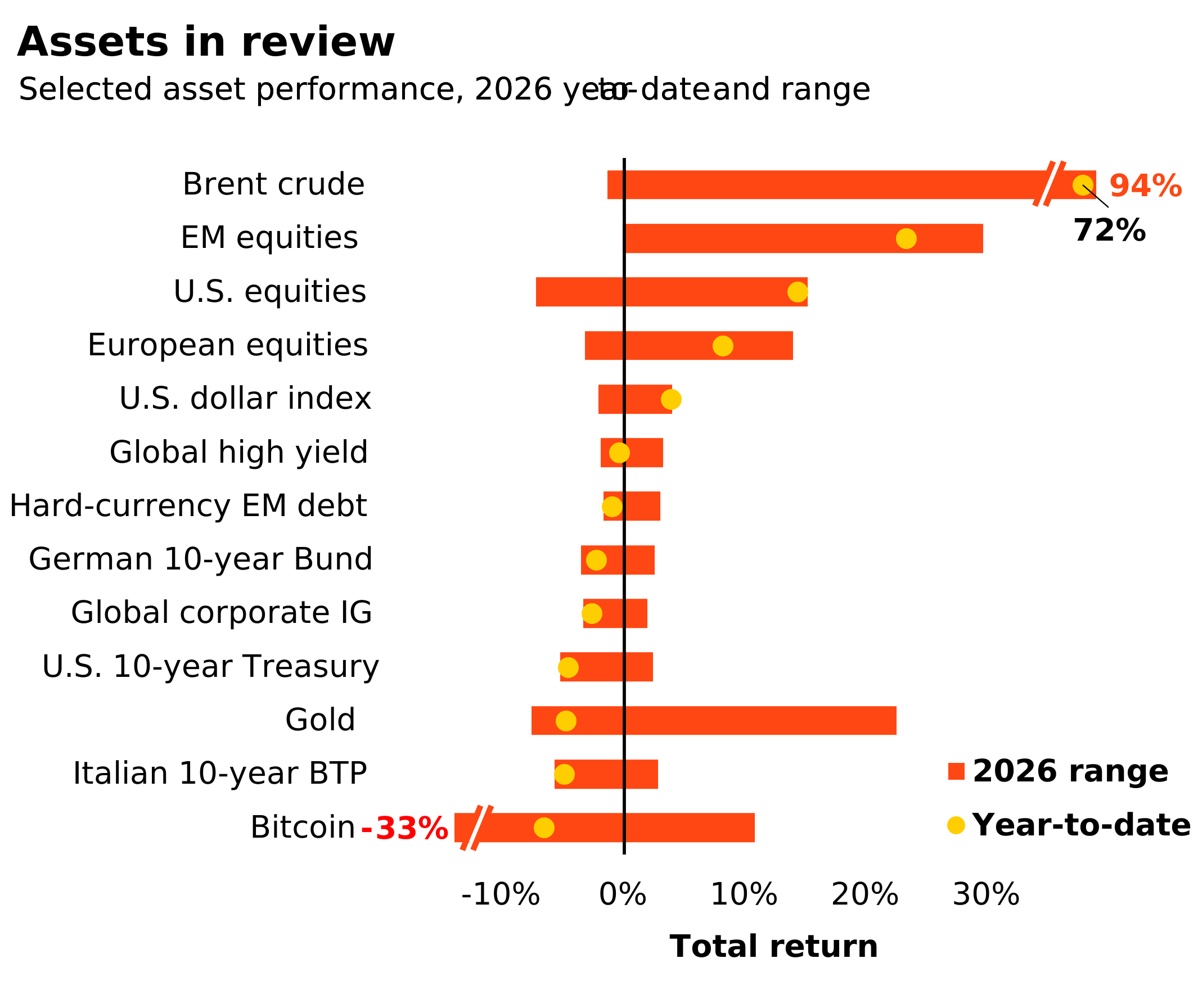
The S&P 500 fell on the week as the selloff of sectors seen as vulnerable to AI accelerated. U.S. 10-year Treasury yields hit a five-month low after U.S. January core CPI met expectations. This matched the picture from earlier in the week: an upside surprise of U.S. jobs data consistent with inflation settling closer to 3% than the Federal Reserve’s 2% target. That suggests monetary policy will remain restrictive, keeping markets highly sensitive to incoming inflation and growth data.
We’re watching U.S. core inflation this week for additional clues on the path of interest rates. Any changes would affect financial conditions for the ongoing AI buildout. We expect fourth-quarter GDP growth to moderate from the strong 4.4% annualized pace in the third quarter, while still reflecting strong underlying momentum.
Week ahead
Past performance is not a reliable indicator of current or future results. Indexes are unmanaged and do not account for fees. It is not possible to invest directly in an index. Sources: BlackRock Investment Institute, with data from LSEG Datastream as of February 12, 2026. Notes: The two ends of the bars show the lowest and highest returns at any point year to date, and the dots represent current year-to-date returns. Emerging market (EM), high yield and global corporate investment grade (IG) returns are denominated in U.S. dollars, and the rest in local currencies. Indexes or prices used are: spot Brent crude, ICE U.S. Dollar Index (DXY), spot gold, spot bitcoin, MSCI Emerging Markets Index, MSCI Europe Index, LSEG Datastream 10-year benchmark government bond index (U.S., Germany and Italy), Bloomberg Global High Yield Index, J.P. Morgan EMBI Index, Bloomberg Global Corporate Index and MSCI USA Index.
U.K. CPI, Japan trade balance
U.S. international trade & initial jobless claims
U.S. core PCE & Q4 2025 GDP advance, Japan CPI, and global PMI flash
Read our past weekly market commentaries here.
Big calls
Our highest conviction views on six- to 12-month (tactical) and over five-year (strategic) horizons, February 2026
| Reasons | ||
|---|---|---|
| Tactical | ||
| Still favor AI | We see the AI theme supported by strong earnings, resilient profit margins and healthy balance sheets at large listed tech companies. Continued Fed easing into 2026 and reduced policy uncertainty underpin our overweight to U.S. equities. | |
| Select international exposures | We like Japanese equities on strong nominal growth and corporate governance reforms. We stay selective in European equities, favoring financials, utilities and healthcare. In fixed income, we prefer EM due to improved economic resilience and disciplined fiscal and monetary policy. | |
| Evolving diversifiers | We suggest looking for a “plan B” portfolio hedge as long-dated U.S. Treasuries no longer provide portfolio ballast – and to mind potential sentiment shifts. We like gold as a tactical play with idiosyncratic drivers but don’t see it as a long-term portfolio hedge. | |
| Strategic | ||
| Portfolio construction | We favor a scenario-based approach as AI winners and losers emerge. We lean on private markets and hedge funds for idiosyncratic return and to anchor portfolios in mega forces. | |
| Infrastructure equity and private credit | We find infrastructure equity valuations attractive and mega forces underpinning structural demand. We still like private credit but see dispersion ahead – highlighting the importance of manager selection. | |
| Beyond market-cap benchmarks | We get granular in public markets. We favor DM government bonds outside the U.S. Within equities, we favor EM over DM yet get selective in both. In EM, we like India which sits at the intersection of mega forces. In DM, we like Japan as mild inflation and corporate reforms brighten the outlook. | |
Note: Views are from a U.S. dollar perspective, February 2026. This material represents an assessment of the market environment at a specific time and is not intended to be a forecast of future events or a guarantee of future results. This information should not be relied upon by the reader as research or investment advice regarding any particular funds, strategy or security.
Tactical granular views
Six- to 12-month tactical views on selected assets vs. broad global asset classes by level of conviction, February 2026

We have lengthened our tactical investment horizon back to six to 12 months. The table below reflects this and, importantly, leaves aside the opportunity for alpha, or the potential to generate above-benchmark returns – especially at a time of heightened volatility.
| Asset | Tactical view | Commentary | ||||
|---|---|---|---|---|---|---|
| Equities | ||||||
| United States | We are overweight. Strong corporate earnings, driven in part by the AI theme, are supported by a favorable macro backdrop: continued Federal Reserve easing, broad economic optimism and less policy uncertainty, particularly on the trade front. | |||||
| Europe | We are neutral. We would need to see more business-friendly policy and deeper capital markets for recent outperformance to continue and to justify a broad overweight. We stay selective, favoring financials, utilities and healthcare. | |||||
| UK | We are neutral. Valuations remain attractive relative to the U.S., but we see few near-term catalysts to trigger a shift. | |||||
| Japan | We are overweight. Strong nominal GDP, healthy corporate capex and governance reforms – such as the decline of cross-shareholdings – all support equities. | |||||
| Emerging markets (EM) | We are neutral. Economic resilience has improved, yet selectivity is key. We see opportunities across EM linked to AI and the energy transition and see the rewiring of supply chains benefiting countries like Mexico, Brazil and Vietnam. | |||||
| China | We are neutral. Trade relations with the U.S. have steadied, but property stress and an aging population still constrain the macro outlook. Relatively resilient activity limits near-term policy urgency. We like sectors like AI, automation and power generation. We still favor China tech within our neutral view. | |||||
| Fixed income | ||||||
| Short U.S. Treasuries | We are neutral. We see other assets offering more compelling returns as short-end yields have fallen alongside the U.S. policy rate. | |||||
| Long U.S. Treasuries | We are underweight. We see high debt servicing costs and price-sensitive domestic buyers pushing up on term premium. Yet we see risks to this view: lower inflation and better tax revenues could push down yields near term. | |||||
| Global inflation-linked bonds | We are neutral. We think inflation will settle above pre-pandemic levels, but markets may not price this in the near-term as growth cools. | |||||
| Euro area government bonds | We are neutral. We agree with market forecasts of ECB policy and think current prices largely reflect increased German bond issuance to finance its fiscal stimulus package. We prefer government bonds outside Germany. | |||||
| UK gilts | We are neutral. The recent budget aims to shore up market confidence through fiscal consolidation. But deferred borrowing cuts could bring back gilt market volatility. | |||||
| Japanese government bonds | We are underweight. Rate hikes, higher global term premium and heavy bond issuance will likely drive yields up further. | |||||
| China government bonds | We are neutral. China bonds offer stability and diversification but developed market yields are higher and investor sentiment shifting towards equities limits upside. | |||||
| U.S. agency MBS | We are overweight. Agency MBS offer higher income than Treasuries with similar risk, and may offer more diversification amid fiscal and inflationary pressures. | |||||
| Short-term IG credit | We are neutral. Corporate strength means spreads are low, but they could widen if issuance increases and investors rotate into U.S. Treasuries as the Fed cuts. | |||||
| Long-term IG credit | We are underweight. We prefer short-term bonds less exposed to interest rate risk over long-term bonds. | |||||
| Global high yield | We are neutral. High yield offers more attractive carry in an environment where growth is holding up – but we think dispersion between higher and weaker issuers will increase. | |||||
| Asia credit | We are neutral. Overall yields are attractive and fundamentals are solid, but spreads are tight. | |||||
| Emerging hard currency | We are overweight. A weaker U.S. dollar, lower U.S. rates and effective EM fiscal and monetary policy have improved economic resilience. We prefer high yield bonds. | |||||
| Emerging local currency | We are neutral. A weaker U.S. dollar has boosted local currency EM debt, but it’s unclear if this weakening will persist. | |||||
Past performance is not a reliable indicator of current or future results. It is not possible to invest directly in an index. Note: Views are from a U.S. dollar perspective. This material represents an assessment of the market environment at a specific time and is not intended to be a forecast or guarantee of future results. This information should not be relied upon as investment advice regarding any particular fund, strategy or security.
Euro-denominated tactical granular views
Six to 12-month tactical views on selected assets vs. broad global asset classes by level of conviction, February 2026

We have lengthened our tactical investment horizon back to six to 12 months. The table below reflects this and, importantly, leaves aside the opportunity for alpha, or the potential to generate above-benchmark returns – especially at a time of heightened volatility.
| Asset | Tactical view | Commentary | ||
|---|---|---|---|---|
| Equities | ||||
| Europe ex UK | We are neutral. We would need to see more business-friendly policy and deeper capital markets for recent outperformance to continue and to justify a broad overweight. We stay selective, favoring financials, utilities and healthcare. | |||
| Germany | We are neutral. Increased spending on defense and infrastructure could boost the corporate sector. But valuations rose significantly in 2025 and 2026 earnings revisions for other countries are outpacing Germany. | |||
| France | We are neutral. Political uncertainty could continue to drag corporate earnings behind peer markets. Yet some major French firms are shielded from domestic weakness, as foreign activity accounts for most of their revenues and operations. | |||
| Italy | We are neutral. Valuations are supportive relative to peers. Yet we think the growth and earnings outperformance that characterized 2022-2023 is unlikely to persist as fiscal consolidation continues and the impact of prior stimulus peters out. | |||
| Spain | We are overweight. Valuations and earnings growth are supportive relative to peers. Financials, utilities and infrastructure stocks stand to gain from a strong economic backdrop and advancements in AI. High exposure to fast-growing areas like emerging markets is also supportive. | |||
| Netherlands | We are neutral. Technology and semiconductors feature heavily in the Dutch stock market, but that’s offset by other sectors seeing less favorable valuations and a weaker earnings outlook than European peers. | |||
| Switzerland | We are neutral. Valuations have improved, but the earnings outlook is weaker than other European markets. If global risk appetite stays strong, the index’s tilt to stable, less volatile sectors may weigh on performance. | |||
| UK | We are neutral. Valuations remain attractive relative to the U.S., but we see few near-term catalysts to trigger a shift. | |||
| Fixed income | ||||
| Euro area government bonds | We are neutral. We agree with market forecasts of ECB policy and think current prices largely reflect increased German bond issuance to finance its fiscal stimulus package. We prefer government bonds outside Germany. | |||
| German bunds | We are neutral. Markets have largely priced in fiscal stimulus and bond issuance, and expectations for policy rates align with our view. | |||
| French OATs | We are neutral. Political uncertainty, high budget deficits and slow structural reforms could stoke volatility, but current spreads incorporate these risks and we don’t expect a worsening from here. | |||
| Italian BTPs | We are neutral. Demand from Italian households is strong at current yield levels. Spreads tightened in line with its sovereign credit upgrade, but a persistently high debt-to-GDP levels means they likely won’t tighten further. | |||
| UK gilts | We are neutral. The recent budget aims to shore up market confidence through fiscal consolidation. But deferred borrowing cuts could bring back gilt market volatility. | |||
| Swiss government bonds | We are neutral. We don’t think the Swiss National Bank will slash policy rates to below zero, as markets expect. | |||
| European inflation-protected securities | We are neutral. Our medium-term inflation expectations align with those implied in current market pricing. | |||
| European investment grade | We are neutral. We favor short- to medium-term debt and Europe over the U.S. An intense re-leveraging cycle to support the AI buildout could put upward pressure on U.S. spreads, making Europe relatively more attractive. | |||
| European high yield | We are overweight. Spreads hover near historic lows, but credit losses have been limited in this cycle and better economic growth in 2026 could reduce them further. | |||
Past performance is not a reliable indicator of current or future results. It is not possible to invest directly in an index. Note: Views are from a euro perspective, February 2026. This material represents an assessment of the market environment at a specific time and is not intended to be a forecast or guarantee of future results. This information should not be relied upon as investment advice regarding any particular fund, strategy or security.
On the go?